
Best Duty Drawback Software in 2026: 9 Platforms Compared

July 1, 2026
•
16
mins
Comparing the best duty drawback software for 2026: 1. Zollback, 2. Charter Brokerage, 3. Freehand, 4. Descartes, 5. Pax AI, 6. Comstock & Holt, 7. Apollo by Alliance Drawback, 8. J.M. Rodgers, and 9. Thomson Reuters ONESOURCE.
U.S. importers leave roughly $15 billion in duty refunds unclaimed every year, and about 80% of eligible companies never file. CBP refunds up to 99% of the duties, taxes, and fees you paid on goods you later export or destroy. Duty drawback software is how you actually claim that money instead of leaving it with customs.
This is a buyer's guide for trade compliance, customs, and finance leaders at importers and exporters.
If you import and then export or destroy goods, the comparison below helps you shortlist and book the right demos.
Below, we are going to see a detailed comparison of the best duty drawback software for 2026, one line per platform, before the full breakdown.
TL;DR: the best duty drawback software at a glance
- Zollback: AI refund-optimization engine that computes every import-to-export match to maximize recovery.
- Charter Brokerage: the largest US drawback filer by volume, with its Hamilton AI software.
- Freehand: AI-native duty drawback recovery inside a broader trade and compliance audit platform.
- Descartes: deep customs database and managed duty recovery through MSR Customs.
- Pax AI: algorithmic drawback optimization built by a team of former MIT and tech researchers.
- Comstock & Holt: one of the oldest US drawback specialists, with proprietary software.
- Apollo by Alliance Drawback: cloud drawback optimization built from decades of domain expertise.
- J.M. Rodgers: one of the largest US drawback filers, with customs-approved proprietary software.
- Thomson Reuters ONESOURCE: drawback inside an enterprise global trade suite.
Comparison table: top duty drawback software for 2026
What is duty drawback software?
Duty drawback software helps importers recover up to 99% of the duties, taxes, and fees they paid on goods that are later exported or destroyed. It automates the matching of import and export records, prepares and files claims with CBP, and tracks refunds, with AI approaches recovering 15 to 20% more than manual methods.
Technically, drawback is a combinatorial matching problem: reconciling millions of import lines against export lines across HTS codes, accounting methods, and regulatory limits to find the combination that maximizes the refund. Software automates inventory tracking, eligibility identification, claim preparation, and filing. The most advanced platforms compute every possible match, or audit broader duty and tariff overpayments alongside drawback.
For trade, customs, and finance leaders at importers, that means real cash recovered that usually goes unclaimed, about $15 billion a year industry-wide. You can see how this fits a wider program on Freehand's duty drawback explainer.
How we evaluated these platforms
We judged every platform on three things: independently verifiable evidence (recovered-dollar track record, named clients, reviews), AI and automation maturity, and fit to duty drawback for importers. Evidence came from vendor sites, industry comparisons, and trade press.
We weighted AI-native automation heavily, since algorithmic matching recovers more than manual filing, which is why the AI-native platforms rank high. Figures we could not independently confirm are labeled vendor-claimed.
Freehand publishes this guide and is included in it; we ranked it third on AI-native automation while stating openly that the dedicated specialists like Charter recover far more dollars today, and we invite you to score each vendor independently.
Best duty drawback software, ranked for 2026
Platforms are ordered by AI and automation maturity, then verifiable recovery evidence and fit. The AI-native engines lead on how much they recover and how fast. The established specialist filers lead on track record and dollar volume, noted in each section. Vendor figures we could not confirm are labeled vendor-claimed.
1. Zollback
Best for:
Importers that want maximum recovery and fast turnaround from an algorithm that tests every possible import-to-export match, not a manual reviewer.
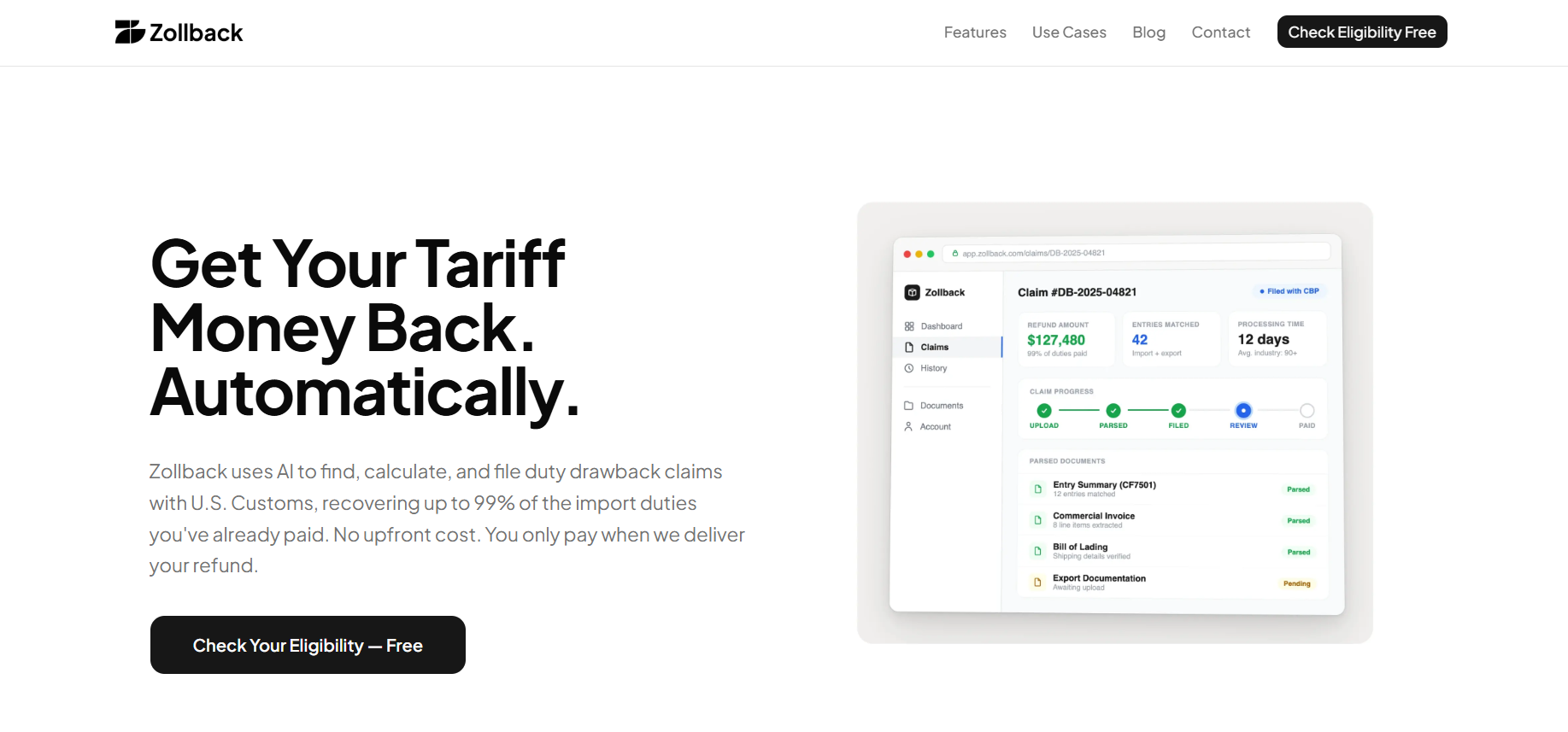
Zollback is an AI-native duty drawback platform built around a refund-optimization engine. It computes every possible import-export matching combination to maximize the refund and recovers cash in as little as 10 to 15 business days, faster than the traditional 9 to 12 month manual cycle.
Key features:
- Refund-optimization engine that tests every match combination
- Recovers 15 to 20% more than manual methods (vendor-claimed)
- Cash recovered in 10 to 15 business days (vendor-claimed)
- Automated import-to-export reconciliation
- Eligibility identification across HTS codes
- Claim preparation and CBP filing
- Works for companies of all sizes
- Transparent contingency pricing
Pricing:
Contingency-based, a percentage of refunds recovered, with no upfront fee. Confirm current terms directly.
Pros:
- Strongest algorithmic optimization in this comparison
- Fast recovery and no upfront cost
Cons:
- Younger than the established specialist filers
- Focused on drawback, not broader duty or tariff audit
Zollback reports recovering 15 to 20% more than manual methods through combinatorial matching. See Zollback. [UGC note: confirm a verbatim third-party quote.]
2. Charter Brokerage
Best for:
Large enterprises that want the biggest, most established drawback filer by dollar volume, with AI software behind the specialists.

Charter Brokerage is the largest duty drawback filer in the United States by dollar volume, having recovered over $4.1 billion in duties, taxes, and fees for clients since TFTEA implementation in 2018. Its Hamilton software pairs AI-powered technology with the expertise of dedicated drawback specialists.
Key features:
- Largest US drawback filer by dollar volume
- Hamilton AI-powered drawback software
- Dedicated duty-drawback specialists
- Manufacturing, unused, and rejected merchandise drawback
- Import and export data reconciliation
- Compliance and audit support
- Privilege and ruling application handling
- Tax recovery beyond drawback
Pricing:
Contingency-based, typically a percentage of recovered duties. Not published.
Pros:
- Unmatched recovered-dollar track record
- AI software backed by deep specialist expertise
Cons:
- Managed-service model rather than self-serve software
- Less of a fit for teams that want to run filing in-house
Charter reports recovering over $4.1 billion in duties, taxes, and fees since 2018. See Charter Brokerage. [UGC note: confirm a verbatim quote.]
3. Freehand
Best for:
Enterprise importers that want duty drawback recovery as part of a broader AI audit of duties, tariffs, and freight, rather than a standalone drawback filing house. A fit for trade, customs, and finance leaders.

Freehand is an AI-native platform whose Trade and Compliance Audit agents handle HS classification, duty calculation, FTA qualification, and duty drawback recovery. It identifies drawback-eligible matches and audits broader duty and tariff overpayments in the same system, so recovery is not siloed from the rest of your trade spend.
It ranks third here on AI-native automation. The dedicated specialists above recover far more drawback dollars today, since drawback is one module of Freehand's platform rather than its sole focus, a tradeoff we state openly.
Key features:
- AI agents identify drawback-eligible import and export matches across HTS codes
- Duty drawback recovery inside a broader trade compliance software audit
- HS classification and duty calculation to support claims
- FTA qualification alongside drawback
- Tariff monitoring that catches overpayments beyond drawback
- Automatic reconciliation of import and export records
- Connects duty recovery to freight audit and payment software in one platform
- Client-exclusive model trained on your data
- Real-time visibility into recoverable duty and tariff spend
- 12 to 14 week go-live using 11 to 20 hours of your team's time
Pricing:
Custom, tied to the broader audit platform rather than a standalone contingency fee. Quote after a scoping call.
Pros:
- Drawback plus broader duty and tariff audit in one AI platform
- No separate vendor for recovery, audit, and freight spend
Cons:
- Not a dedicated drawback filing house with a long claims track record
- Built for enterprise, not small importers wanting drawback only
Freehand handles duty drawback recovery within its broader AI trade and compliance audit. Independent drawback-specific reviews are still emerging. [UGC note: insert a verbatim G2 or Gartner quote once available; both block automated retrieval.]
4. Descartes
Best for:
Teams already on the Descartes customs and logistics platform that want duty recovery and drawback from the same vendor.
Descartes, through MSR Customs, helps companies recover duty overpayments from tariff classifications, concessionary codes, trade agreements, and valuation, and automates customs brokerage and drawback. It owns one of the deepest commercial tariff and customs databases in the market.
Key features:
- Customs duty recovery across classifications and trade agreements
- Duty drawback for importers and brokers
- Deep commercial tariff and customs database
- Automated broker interface for CBP filings
- HS classification support
- Compliance and documentation management
- Integration with the Descartes logistics platform
- Global customs coverage
Pricing:
Custom, combining software and recovery services. Not published.
Pros:
- Deep customs database and broad compliance coverage
- One vendor for customs, brokerage, and drawback
Cons:
- Best value comes when already on the Descartes platform
- Less AI-forward than the optimization-first entrants
Descartes reports recovering millions in customs duty overpayments through MSR Customs. See Descartes MSR Customs. [UGC note: confirm a verbatim quote.]
5. Pax AI
Best for:
Importers that want algorithmic drawback optimization from an AI-native team, with substitution-rule matching built into the engine.
Pax AI was built by former MIT and technology researchers and uses advanced algorithms to process and secure duty drawback refunds. It focuses on the matching math behind drawback, evaluating substitution and direct-identification pathways to maximize the legal refund.
Key features:
- Algorithmic import-to-export matching
- Substitution and direct-identification drawback support
- AI parsing of trade documents
- Eligibility identification across HTS codes
- Claim preparation and CBP filing
- Refund optimization
- Built by an AI-native research team
- Emerging platform in the drawback space
Pricing:
Custom, not published. Confirm the model directly, as newer entrants vary between contingency and subscription.
Pros:
- Strong algorithmic approach from an AI-native team
- Substitution-rule matching to maximize legal refunds
Cons:
- Emerging player with a limited public track record
- Fewer independent reviews than the established filers
Pax AI is described as an AI-native drawback platform built by former MIT and technology researchers. [UGC note: confirm a verbatim quote and source URL; treat capability claims as vendor-stated until verified.]
6. Comstock & Holt
Best for:
Complex drawback programs that want the deepest advisory and the most licensed customs brokers on staff.
Comstock & Holt, operating as DutyDrawback.com, is one of the oldest US drawback specialists, with roots dating back to 1856. It positions itself as a deep advisor on the drawback program, with more licensed customs brokers on staff than any dedicated US drawback specialist, and proprietary software tailored to each client.
Key features:
- Decades of drawback specialization
- Most licensed customs brokers among dedicated specialists
- Proprietary software configured per client
- Manufacturing, unused, and substitution drawback
- Privilege and ruling applications
- Compliance and audit defense
- Import-export reconciliation
- Program design advisory
Pricing:
Contingency-based, a percentage of recovered duties. Not published.
Pros:
- Deep program expertise and broker bench
- Strong fit for complex, high-stakes programs
Cons:
- Advisory-led, software is tailored rather than self-serve
- Less algorithmic automation than the AI-native engines
Comstock & Holt positions itself as one of the oldest US drawback specialists with the most licensed brokers on staff. See DutyDrawback.com.
7. Apollo by Alliance Drawback
Best for:
Importers that want a cloud drawback optimization and compliance platform backed by a specialist firm's hands-on expertise.
Apollo by Alliance Drawback is a cloud-based drawback optimization and compliance platform built from decades of hands-on, domain-specific expertise. It pairs software optimization with the program knowledge of a dedicated drawback specialist.
Key features:
- Cloud drawback optimization
- Compliance management
- Import-to-export matching
- Direct identification and substitution support
- Claim preparation and filing
- Audit-ready documentation
- Specialist advisory behind the software
- Deadline and regulatory tracking
Pricing:
Contingency-based, typical of drawback specialists. Not published.
Pros:
- Optimization software backed by deep domain expertise
- Cloud platform with compliance built in
Cons:
- Smaller public footprint than the largest filers
- Less independent review evidence available
Apollo is described as a cloud drawback optimization platform built from decades of domain expertise.
8. J.M. Rodgers
Best for:
Importers with complex, high-volume drawback programs that want a specialist filer with a long compliance record and customs-approved proprietary software behind the claims.
J.M. Rodgers Co., founded in 1952, is one of the largest US duty drawback filers by transaction volume, with customs-approved proprietary software and a team carrying more than 200 years of combined drawback experience. It runs drawback as a managed program rather than software you operate yourself.
Key features:
- Customs-approved proprietary drawback software
- Manufacturing, unused-merchandise, and rejected-merchandise drawback
- Substitution and direct-identification claims
- High-volume transaction filing capacity
- Decades-long CBP compliance record
- Import and export data reconciliation
- Recordkeeping and audit support for CBP reviews
- Dedicated drawback specialists per account
Pricing:
Contingency-based, so fees come out of the duties recovered. No upfront license, verify current terms with the vendor.
Pros:
- One of the longest, cleanest drawback compliance records in the US
- High-volume filing capacity backed by proprietary software
Cons:
- A managed-service filer, not self-serve software you run in-house
- Contingency fees reduce net recovery versus filing yourself
J.M. Rodgers is described as one of the largest US drawback filers by transaction volume, with customs-approved proprietary software. See J.M. Rodgers.
9. Thomson Reuters ONESOURCE
Best for:
Enterprises already standardized on ONESOURCE Global Trade that want drawback inside the same suite.
Thomson Reuters ONESOURCE is an enterprise global trade suite covering classification, screening, and customs management, with duty drawback among its modules. It suits Fortune 1000 importers that want drawback handled inside a platform they already run for broader trade compliance.
Key features:
- Drawback within an enterprise global trade suite
- HS and ECCN classification
- Denied-party screening across global lists
- Import and export management
- Customs filing and documentation
- ERP integration
- Regulatory content libraries
- Global compliance coverage
Pricing:
Custom enterprise pricing, not published.
Pros:
- Drawback inside a full trade compliance suite
- Strong fit for existing ONESOURCE customers
Cons:
- Heavy and costly outside the ONESOURCE ecosystem
- Drawback is one module, not the core focus
ONESOURCE is recognized as an enterprise global trade suite. See the global trade management reviews on Gartner Peer Insights.
Other duty drawback tools to know
These come up in evaluations but sit outside the core nine, either as broad suites or emerging players.
- MIC-CUST US Duty Drawback: a customs compliance and inventory management tool built specifically to facilitate US duty refund management.
- Oracle Global Trade Management: a broad supply chain ecosystem that automates drawback qualification, document collection, and CBP filing.
- Caspian: an emerging AI-driven entrant in the duty drawback space, worth watching as the category automates.
Best Charter Brokerage and Descartes alternatives for duty drawback
If you are weighing the established filers against a more automated approach, the AI-native alternatives are worth a direct look.
Freehand
Choose Freehand if you want drawback recovery tied into a broader AI audit of duties, tariffs, and freight, not a standalone filing engagement. For a trade or finance leader, the draw is one platform that recovers drawback and catches duty and tariff overpayments, with ERP integration and no separate vendor.
Zollback
Choose Zollback if drawback is your single focus and maximum recovery speed matters. Its optimization engine tests every match combination and recovers cash in days, a strong alternative to a months-long manual filing cycle.
How to choose the right duty drawback software
The decision comes down to whether drawback is a standalone need or part of a broader duty problem, and whether you want to file in-house or outsource.
- If drawback is your single focus, the AI-native engines recover the most and fastest: Zollback and Pax AI for algorithmic optimization, and Charter for the biggest specialist track record. Comstock and Apollo suit complex programs that want deep advisory behind the software.
- If you want a specialist filer with proprietary software and a decades-long compliance record, J.M. Rodgers is a strong pick.
- If you are already on a trade suite, Descartes and Thomson Reuters ONESOURCE keep drawback in the same system.
- If drawback is one piece of a wider duty and tariff problem, Freehand audits and recovers across all of it.
One number frames the urgency: about $15 billion in refunds go unclaimed yearly, so the cost of not acting is real money left with customs. Match the platform to your scope, then book the right demos.
Frequently asked questions
What is duty drawback software?
Software that helps importers recover up to 99% of duties paid on goods later exported or destroyed, by matching import and export records, filing claims, and tracking refunds.
How does duty drawback work?
You match imported goods to goods later exported or destroyed, then file a claim with CBP for a refund of up to 99% of the duties, taxes, and fees paid.
What is direct identification vs substitution drawback?
Direct identification matches the exact imported items to the exported ones. Substitution drawback matches commercially interchangeable goods, widening eligibility when exact units cannot be traced.
How much can I recover with duty drawback?
CBP refunds up to 99% of eligible duties. Industry-wide, about $15 billion goes unclaimed yearly, and AI matching recovers 15 to 20% more than manual methods.
What is the best duty drawback software?
It depends on scope. Zollback and Pax AI lead on AI optimization, Charter on filing volume, and Freehand for drawback tied into broader duty and tariff audit.
How much does duty drawback software cost?
Most providers use contingency pricing, a percentage of refunds recovered, with no upfront fee. Suite modules and in-house software use custom or subscription pricing.
Can AI do duty drawback automatically?
Yes. AI engines compute every import-to-export match to maximize the refund, generate CBP forms like CF-7551, and file claims, recovering more and faster than manual reconciliation.
The bottom line for 2026
If drawback is your focus, start with Zollback and Pax AI for AI optimization and Charter for the biggest track record. If drawback is part of a wider duty and tariff problem, Freehand recovers across all of it in one AI platform. If you are on a trade suite already, Descartes or ONESOURCE keep it in-house. Match the platform to your scope, then book the right demos.
Want to see duty drawback recovery inside one AI trade and compliance audit? Book a Freehand demo.
Conflict of interest disclosure:
This guide is published by Freehand, a platform included in this comparison.
We applied the same criteria to every platform, ranked Freehand third on AI-native automation while stating openly that the dedicated specialists like Charter Brokerage recover far more drawback dollars today, labeled vendor-claimed figures, and invite you to score each vendor independently.