FREEHAND FOR TRADE & COMPLIANCE

Duties. Tariffs. Brokerage. Government Fees. Validated before they cost you.

Freehand AI Teams validate every duty, tariff, brokerage charge, and government fee against the applicable tariff schedule, your contracted rates, and the actual goods crossing the border. Compliance gaps are closed before they become audit exposure.

Trusted by global leaders in Logistics, Manufacturing, and Retail

100%
Duty Overpayments Identified

20x
Increase in Eligible Duty Drawback recovered
SOC 2 & ISO 27001
Certifications

Trade spend is complex, opaque, and changing fast.

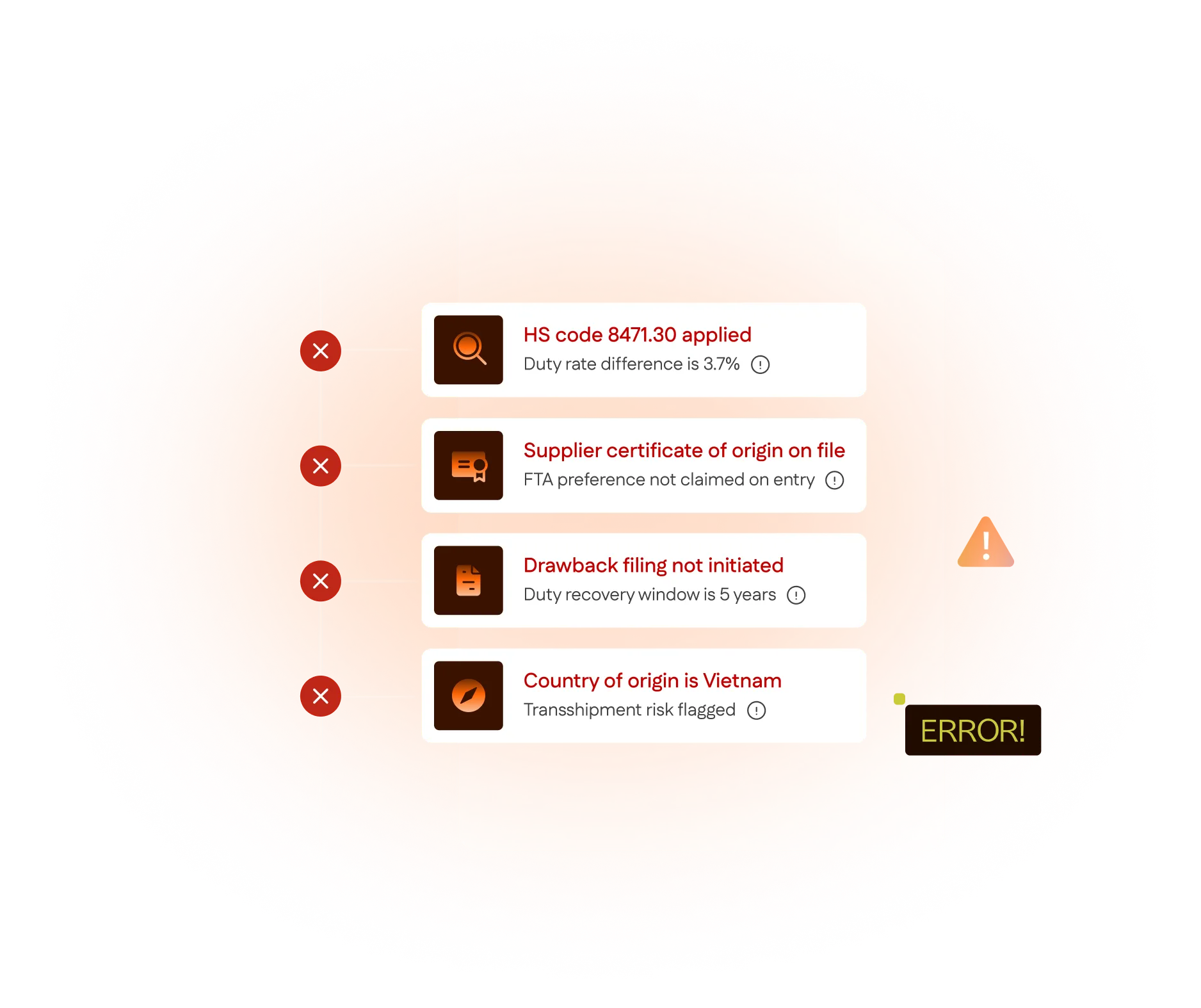
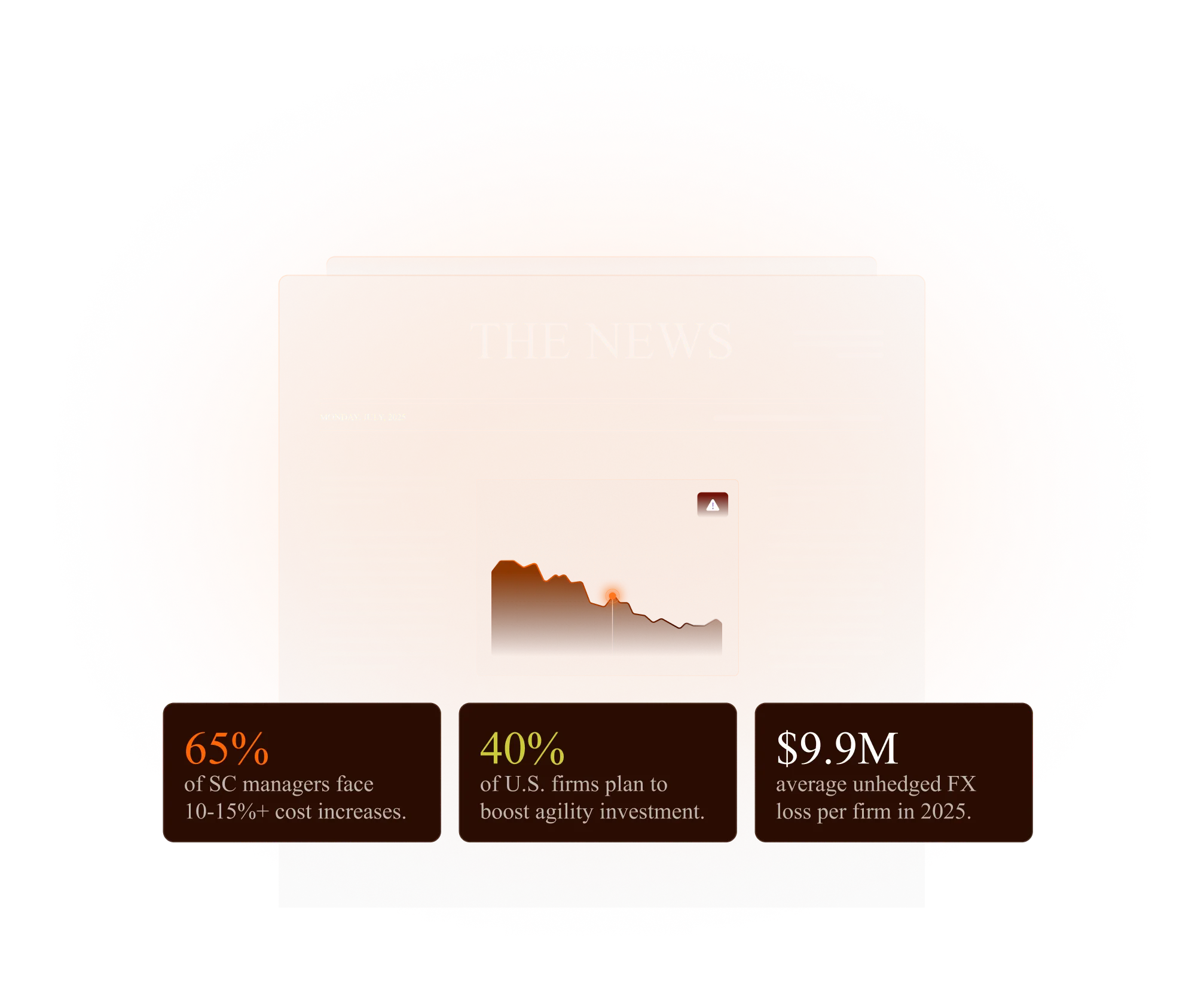
Duties, tariffs, customs fees, brokerage charges, and government levies are complex, jurisdiction-specific, and changing fast. Overpayments of 2 to 4% are common. And most enterprises have no systematic way to validate what they are being billed against what they actually owe.

Customs duty and tariff charges go unaudited

Calculating diverse tariffs and country-specific surcharges is incredibly complex, most enterprises simply pay what they are billed and hope the broker got it right.

HS code misclassifications are costing you money you do not know about.

Incorrect broker-assigned HS codes cause systematic, invisible errors that force you to unknowingly pay the wrong duty rates across thousands of transactions.

FTA entitlements go unclaimed.

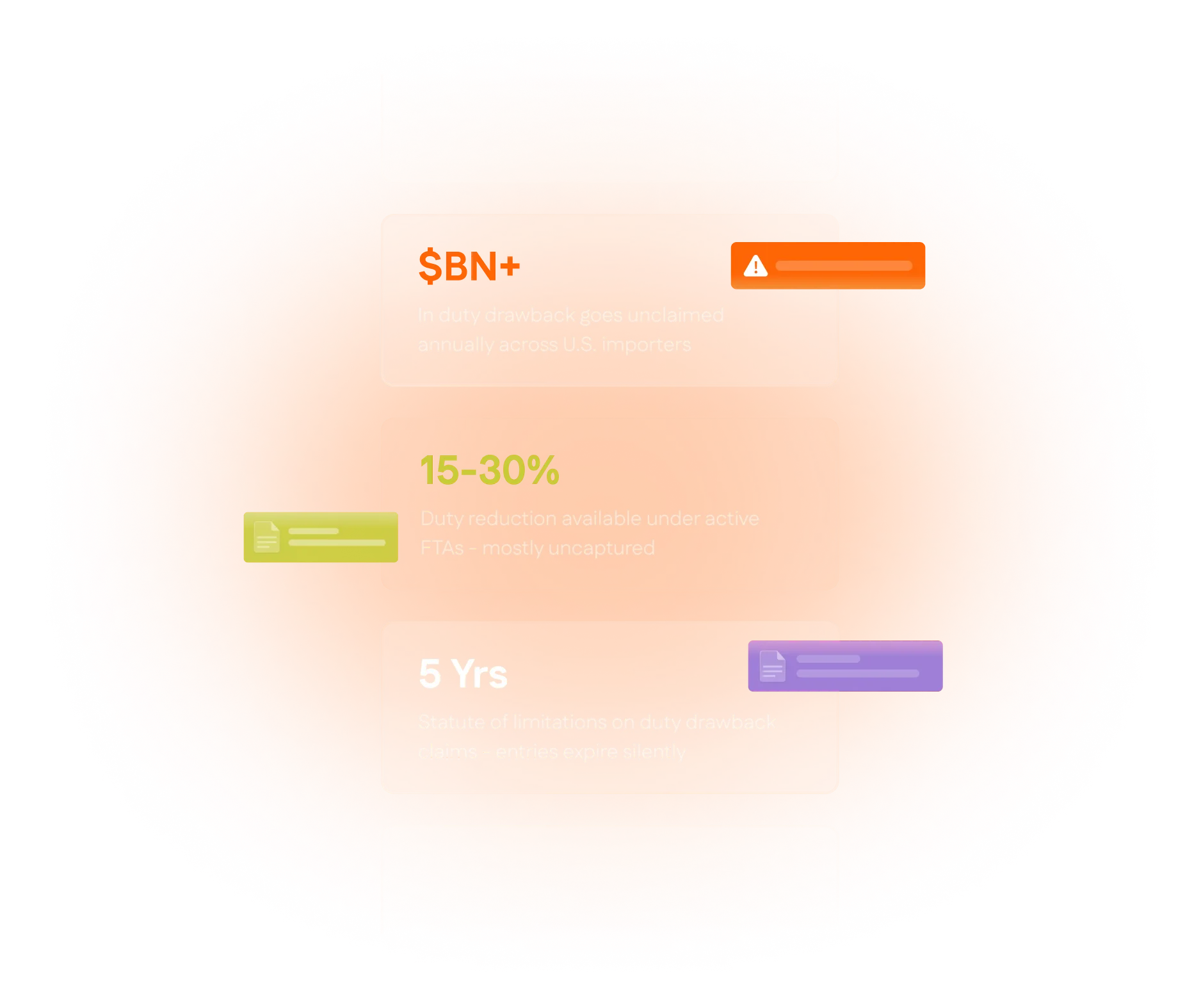
The complex documentation required for free trade agreements causes companies to leave 15% to 30% of eligible, recoverable duty spend on the table.

Tariff schedules change faster than teams can track.

Because global tariffs and trade agreements reshape duty costs quarterly, teams relying on static rate tables end up overpaying on current shipments.

how it works

AI Teams Validating Every Trade and Compliance Charge 24/7.

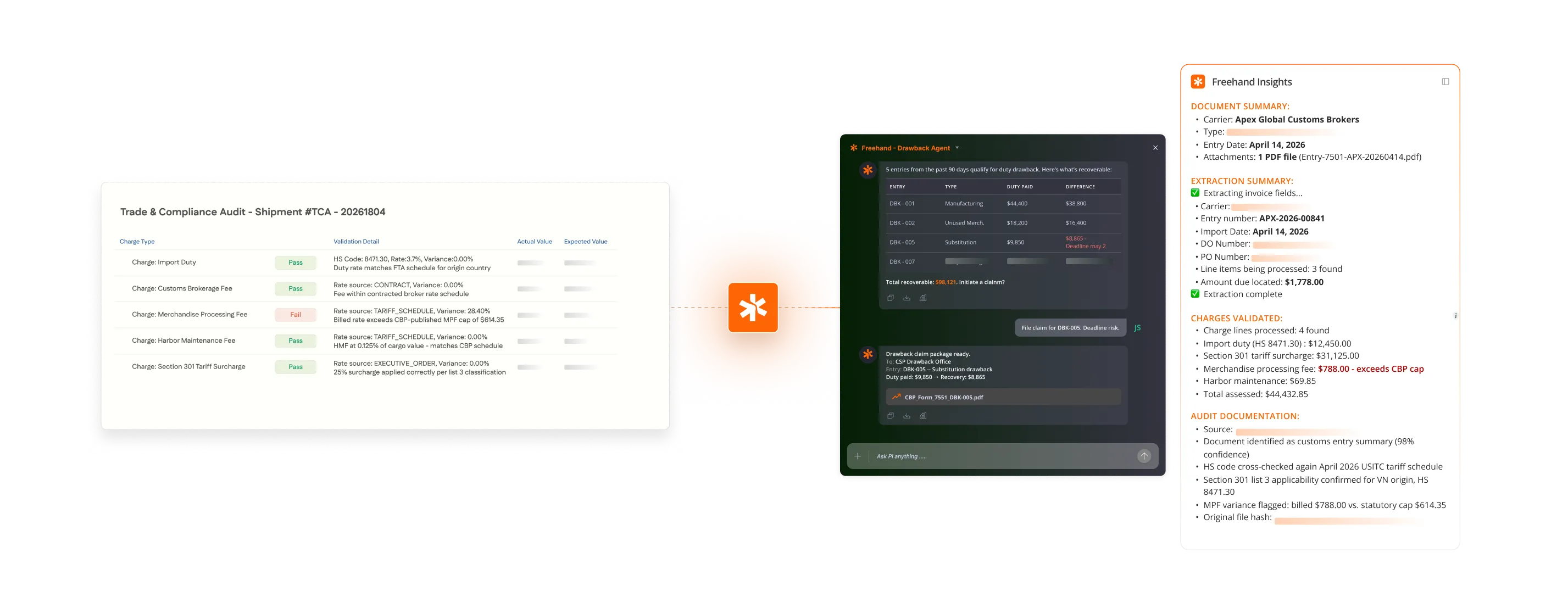
Freehand AI Teams validate HS code classifications, audit duty and tariff calculations, capture FTA entitlements, audit customs broker invoices, monitor tariff changes in real time, and screen every transaction against restricted party lists and export controls.

Trade & Compliance AI Agents

Seven specialized AI agents work across the full trade and compliance lifecycle. Every import, every export, every charge validated before payment.

HS Classification Agent
Duty Calculation Agent
FTA Qualification Agent
HS Classification Agent
Duty Calculation Agent
FTA Qualification Agent
Drawback Recovery Agent
Broker Audit Agent
Tariff Monitoring Agent
Compliance Screening Agent
Drawback Recovery Agent
Broker Audit Agent
Tariff Monitoring Agent
Compliance Screening Agent

Unlock cash flow from duties, tariffs, and compliance overcharges.

Import Duties & Tariffs

MFN, preferential, FTA, Section 301, anti-dumping, CVD

Customs Broker Fees

Disbursements, filing fees, examination fees, advancement charges

Export Compliance

EAR/ITAR classification, export license verification
Restricted Party Screening

OFAC, BIS, EU, UN sanctions lists

FTA Management

USMCA, EU agreements, CPTPP, bilateral agreements

Duty Drawback

Manufacturing, unused merchandise, rejected merchandise

Powered by the Freehand knowledge graph.

A proprietary semantic layer that unifies logistics contracts, operational activity data, invoice records, SLA terms, provider performance, and historical exceptions. Al agents reason across fragmented data, detect patterns, explain variances, and continuously improve.

01
Data Layer

Customs Entries | Broker Invoices | HS Tariff Schedules | FTA Certificates | Product Specifications | Origin Documentation | Sanctions Lists


02
Semantic Layer

Trade Ontology | Products > HS Codes > Tariff Rates | Origin > FTA Eligibility | Entries > Duties > Drawback | Broker > Fees > Contracts


03
AI Agents Layer

HS Classification | Duty Calculation | FTA Qualification | Drawback Recovery | Broker Audit | Tariff Monitoring | Compliance Screening

Enterprise-grade from day one.

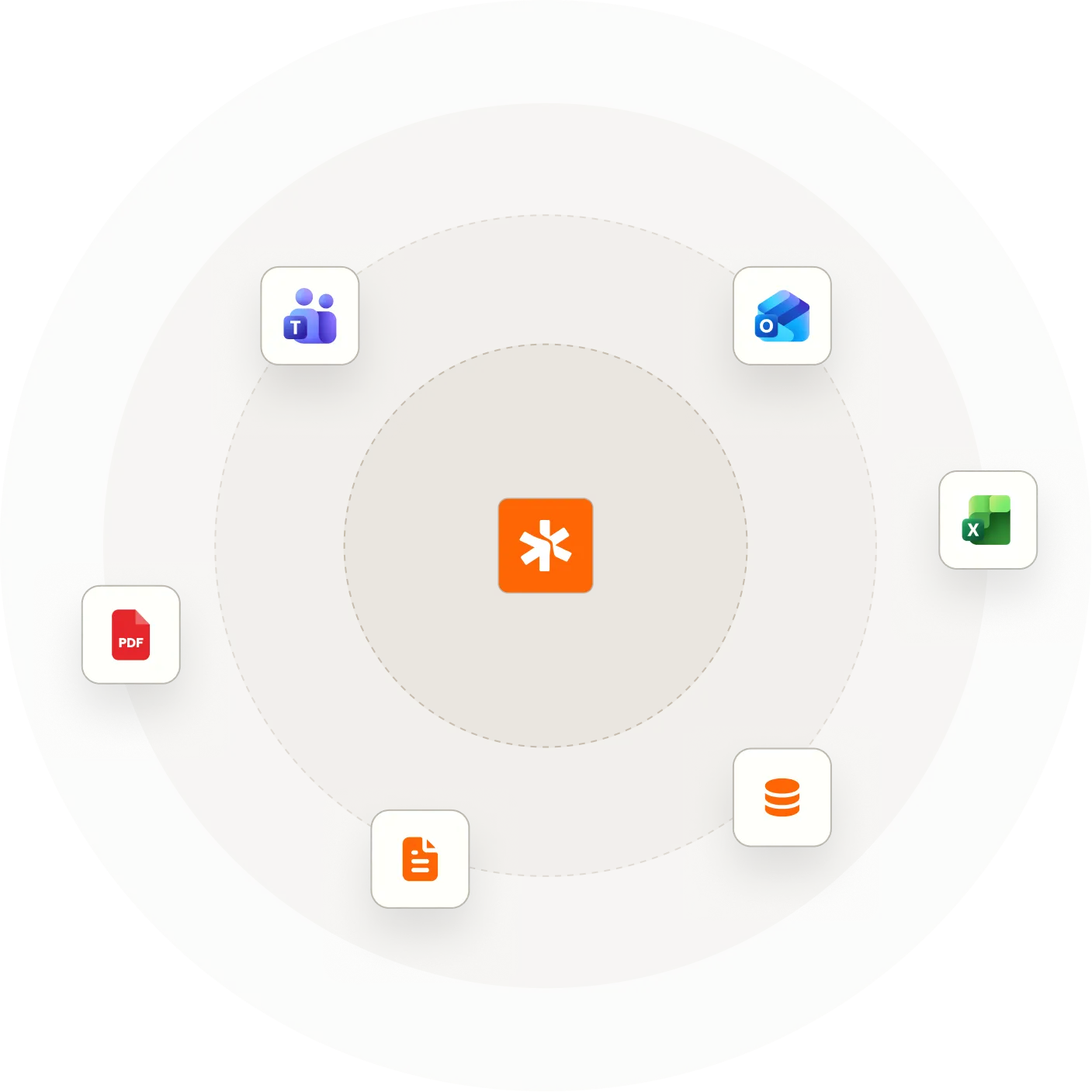
Freehand Agents execute in the tools your team already uses and post results to the systems you already trust.

Discover insights & best practices

Frequently Asked Questions

Have further questions and can’t find the answers?

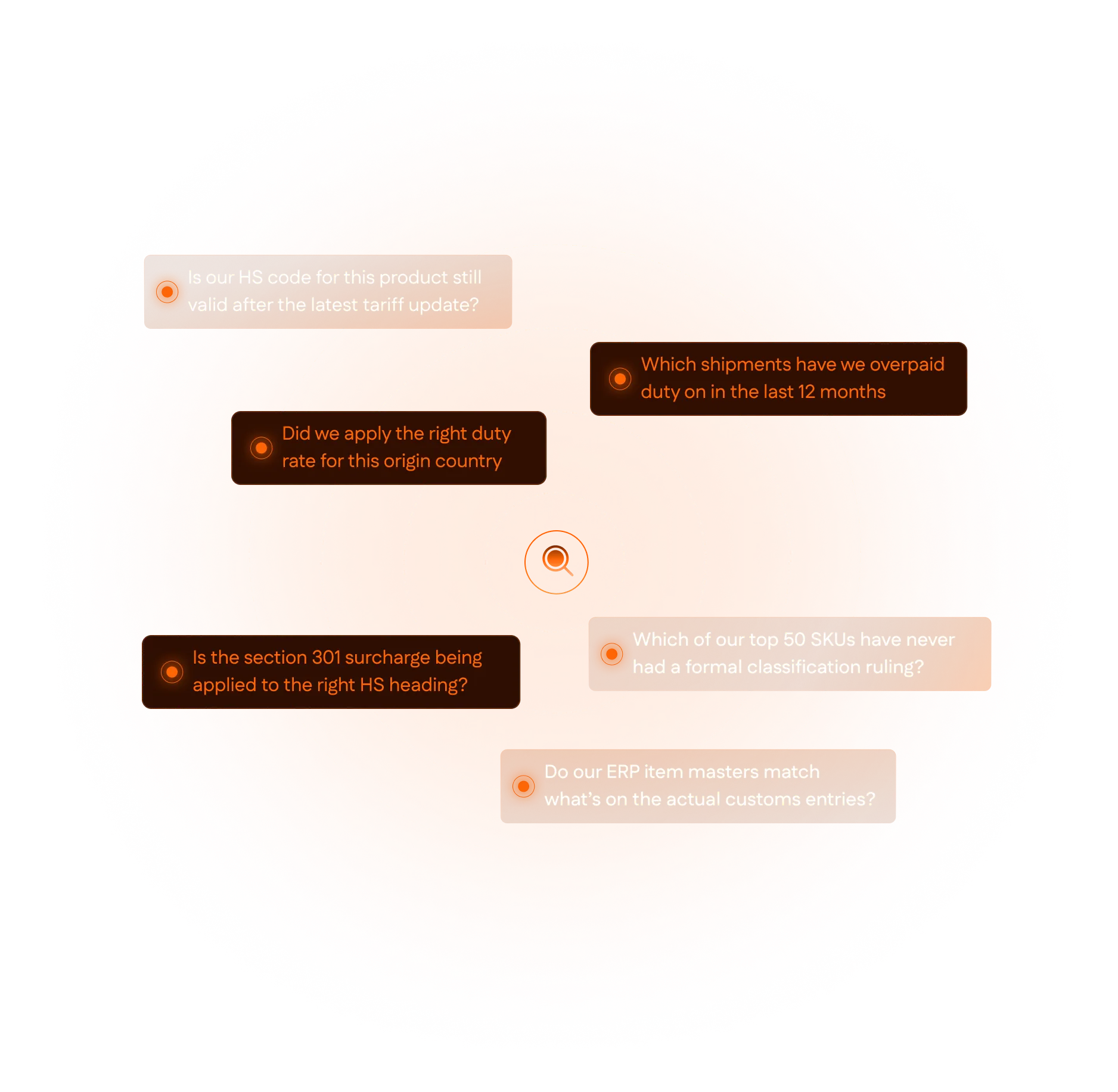
How does Freehand validate HS code classifications?

The HS Classification Agent compares broker-assigned codes against product specifications, historical classification patterns, and the current tariff schedule. Misclassifications are flagged before payment so you are paying the correct duty rate on every shipment.

What types of duty charges does Freehand audit?

Freehand validates MFN rates, preferential rates, FTA rates, Section 301 tariffs, anti-dumping duties, countervailing duties, and country-specific surcharges. Every duty charge is checked against the applicable rate for the specific HS code, country of origin, and import date.

How does Freehand recover FTA duty savings?

The FTA Qualification Agent identifies shipments eligible for preferential duty treatment under applicable trade agreements (USMCA, CPTPP, EU bilateral agreements, and others). It generates the documentation required to claim the benefit and flags drawback opportunities on duties already paid.

Can Freehand audit customs broker invoices?

Yes. The Broker Audit Agent validates every line of customs broker invoices against contracted fee schedules, actual service activities, and government-published rates. Disbursement charges, advancement fees, ISF filing fees, and examination fees are each verified independently.

How does Freehand handle tariff schedule changes?

The Tariff Monitoring Agent tracks tariff schedule changes in real time and updates the validation rate library automatically. Teams receive alerts when changes affect their commodity mix so they are never paying last quarter's rate on this quarter's shipments.

What is duty drawback and how does Freehand automate it?

Duty drawback is the refund of duties paid on imported goods that are subsequently exported, destroyed, or used in manufacturing for export. Freehand identifies eligible drawback claims across manufacturing, unused merchandise, and rejected merchandise categories, and automates the filing process to recover 15 to 30% of eligible duty spend.

Does Freehand screen against restricted party lists?

Yes. The Compliance Screening Agent screens transactions against OFAC, BIS, EU, and UN sanctions lists, as well as export control classifications and denied party databases. Every transaction gets an audit record demonstrating due diligence.

What is Section 301 tariff audit?

Section 301 tariffs are special duties imposed on specific products from designated countries. Freehand validates whether Section 301 tariffs have been correctly applied to the right HS codes and country of origin, and flags shipments where exclusions or exemptions may apply.

How does Freehand handle anti-dumping and countervailing duties?

The Duty Calculation Agent validates anti-dumping duty (ADD) and countervailing duty (CVD) charges against the applicable rates published by customs authorities for specific products and countries of origin. It flags when the wrong rate is applied or when an ADD/CVD determination has changed.

Can Freehand help with export compliance (EAR/ITAR)?

Yes. Freehand covers export control classifications under EAR (Export Administration Regulations) and ITAR (International Traffic in Arms Regulations), verifies export license requirements, and screens against denied party lists. This provides a documented compliance trail for every export transaction.

What is the difference between customs broker audit and freight audit?

Freight audit validates carrier charges for moving goods (fuel, accessorials, dimensional weight). Customs broker audit validates the charges and fees associated with clearing goods through customs: disbursements, filing fees, examination fees, advancement charges, and the duty and tariff calculations themselves. They are separate cost categories with different validation logic.

How does Freehand handle country of origin validation?

The Duty Calculation Agent and FTA Qualification Agent both validate country of origin against product documentation, supplier records, and origin certificates. Incorrect origin determination can result in paying the wrong duty rate or missing an FTA qualification entirely.

What trade agreements does Freehand support?

Freehand supports USMCA, CPTPP, EU bilateral agreements, and other active free trade agreements. The FTA Qualification Agent automatically identifies eligible shipments and generates the required documentation for each applicable agreement.

How does trade audit reduce compliance risk?

An unchallenged customs overbilling is not just a financial loss. It can indicate a classification gap, origin documentation weakness, or screening failure that creates regulatory exposure. By validating every charge, Freehand closes both the financial and compliance gaps simultaneously.

What is the Freehand Knowledge Graph for trade?

Freehand's proprietary Knowledge Graph connects customs entries, broker invoices, HS tariff schedules, FTA certificates, product specifications, origin documentation, and sanctions lists into a unified semantic layer. AI agents reason across this data to validate classifications, calculate duties, and identify recovery opportunities.

How does Freehand integrate with Global Trade Management platforms?

Freehand connects to GTM platforms, customs broker portals, and ABI/ACE direct systems alongside native ERP connectors for SAP, Oracle, Microsoft Dynamics, JDE, and NetSuite. Data exchange is supported via EDI, API, SFTP, and database sync.

What security certifications does Freehand have?

Freehand is SOC 2 Type II certified and ISO 27001 aligned. All data is encrypted with TLS 1.3 and AES-256. The platform is GDPR compliant and provides a full audit trail with role-based access controls (RBAC).

How does Freehand handle ISF filing fee validation?

ISF (Importer Security Filing) filing fees charged by customs brokers are validated against contracted fee schedules and the actual number of filings made. Overbilling on ISF fees, duplicate filings, and incorrect fee tiers are flagged before payment.

Can Freehand identify when Section 301 exclusions apply?

Yes. The Tariff Monitoring Agent and Duty Calculation Agent together track active Section 301 exclusions and exemptions. When a shipment qualifies for an exclusion, Freehand flags it so the correct (lower) rate is applied, preventing overpayment on excluded products.

How does Freehand provide a full audit trail for customs compliance?

Every validation decision, classification check, duty calculation, FTA qualification, and restricted party screen is logged with full supporting documentation. This audit trail satisfies internal audit requirements and provides the evidence needed in the event of a CBP post-entry audit.

What is customs broker disbursement audit?

Disbursements are costs that customs brokers pay on your behalf and then bill back to you: duties, taxes, examination fees, harbor maintenance fees, and merchandise processing fees. Freehand validates that each disbursement matches the government-published rate and the actual customs entry.

How does supply chain diversification affect trade compliance costs?

When companies shift sourcing to new countries, they encounter new tariff schedules, new FTA eligibility rules, and new compliance requirements. Each new origin country adds classification, duty calculation, and screening complexity. Freehand scales across all origin countries and trade agreements without manual rate table management.

Can Freehand audit trade charges retroactively?

Yes. Freehand can ingest historical customs entries and broker invoices to identify duty overpayments, missed FTA qualifications, and drawback opportunities from prior periods. Many enterprises recover significant amounts from the prior 3 to 5 years of trade transactions.

How does Freehand handle preferential duty rates?

The Duty Calculation Agent validates whether the preferential rate was correctly applied by checking the HS code, country of origin, FTA eligibility, and required documentation. If a shipment qualified for a preferential rate but was charged the MFN rate, Freehand flags the overpayment.

What is the ROI of automated trade compliance audit?

Enterprises typically identify 2 to 4% in duty overpayments and recover 15 to 30% of eligible duty drawback spend. Add 100% broker invoice audit coverage, real-time tariff monitoring, and a full compliance audit trail. For enterprises with $50M or more in annual duty spend, the financial recovery alone justifies the platform.

Recover margin. Enforce contracts. Close the loop.

See how Freehand recovers margin you're already losing

Map your commercial agreements to real-world execution - recovering 2-5% in lost margins and ensuring 100% audit coverage.

What to expect in the call

We identify exactly where you’re leaking margins

See how our AI Teams cross-check contracts, and resolve overcharges

Get a savings estimate based on your current spend and systems.

Trusted & Recognized by

KEARNEY
pwc
Gartner

See AI teams in action