
Hot Shipments Don’t Start in Audit, They Start 48 Hours Earlier

February 16, 2026
•
5
mins

Premium freight isn’t unavoidable. It’s unprevented. Most “emergency” shipments become emergencies because early warning signals get missed, ignored, or acted on too late…and then the only option left is expensive.
Friday afternoon. A transportation manager in a global auto corp approves expedited freight to get critical parts to the plant by Monday morning. Line being down is imminent. Customer is waiting. No choice.
The approval meeting is brief. Manufacturing needs it by Monday, or the line stops. Transportation confirms the closest option is a hot shipment. Finance approves because what’s the alternative? Lost production? Everyone agrees: unavoidable cost.
But rewind 48 hours.
Wednesday afternoon, the original carrier reported a potential delay: Potential weather issues, equipment constraints, and driver hours concerns. The shipment was flagged as “at risk” in the TMS. No escalation happened. No backup plan was triggered. Thursday, the risk solidified. Friday morning, risk became reality. Only option left: premium freight.
That expedited charge wasn’t unavoidable on Friday. It was unnoticed on Wednesday, when intervention options were still numerous and substantially cheaper. This is precisely how an avoidable issue metamorphosizes into a hot shipment.
The Problem: Early Signals Exist But Don’t Trigger Action
Most premium freight incidents have a predictable pattern. Early warning signals appear days before delivery. The signals sit in email inboxes or systems via carrier notifications, tracking data, weather alerts, or dock schedules. But no one is continuously monitoring these signals across all shipments, assessing risk, and triggering intervention while options are still affordable.
The cost curve is brutal. Days before delivery, intervention options are plentiful and cheap: switch carriers, adjust schedules, negotiate flexibility. At 24 hours out, options narrow and premiums rise. At 12 hours before delivery, options collapse to expensive emergency freight.
Organizations don’t lack data. They lack continuous monitoring that translates early signals into action before it’s too late. This isn’t a failure of people. It’s a structural problem. Continuous risk monitoring across hundreds of shipments requires pulling data from TMS, carrier portals, weather services, and dock schedules, then assessing each shipment’s risk, evaluating consequences, deciding whether to intervene, and acting. That needs to happen repeatedly, for every at-risk shipment, days before delivery.
Planners don’t have that bandwidth. They’re handling immediate problems. Early risk signals get deprioritized because they’re not urgent, until they become urgent, at which point intervention is no longer cheap.
Why Organizations Are Structurally Reactive
Even when someone spots early risk, action often doesn’t follow. Three gaps prevent early intervention:
- The monitoring gap: What gets watched are exception alerts after shipments are already late, customer complaints after impact occurs, and dock arrival scans when it’s too late to change plans. What doesn’t get watched are carrier-reported potential delays days ahead, shipment velocity trends vs available capacity, weather developing along routes, and dock scheduling constraints emerging before they’re critical.
- The authority gap: Planners who spot risk often need approval to switch carriers or expedite shipments. Customer service sees risk but can’t change transportation plans. Transportation sees risk but needs customer approval to adjust delivery times. By the time the decision chain resolves, intervention options have collapsed.
- The priority gap: Early risk signals compete with immediate fires. A shipment that might be late in 48 hours versus one that is late right now? The urgent always wins. Prevention gets deprioritized until it becomes a crisis.
Back to our automotive components example in the introduction: The Wednesday carrier notification sat in the TMS. The planner saw it, but had three shipments already late, requiring immediate attention. It didn’t trigger escalation because no one owned the decision to switch carriers without approval and getting that approval would take time the planner didn’t have while already managing active fires. By Friday, what could have been a proactive carrier switch became an emergency requiring premium freight.
When Prevention Failure Becomes Chronic
Individual premium freight incidents are expensive. But they’re symptoms of chronic prevention failure that compounds over time.
When the same pattern repeats, the same lane with recurring capacity issues, the same customer with recurring last-minute changes, the same carrier with recurring performance failures, the same dock with recurring scheduling conflicts, each incident gets treated as a unique emergency. But collectively, they reveal systemic issues that could be fixed.
Premium freight often gets absorbed into “freight variance” budget lines. Each quarter has overages with different explanations: Weather, capacity crunches, customer urgency, and seasonal surges. Each incident has a legitimate reason. The pattern is consistent: premium freight is treated as an unavoidable variance rather than a preventable cost.
When every hot shipment has a valid explanation for why it happened, no one asks the critical question: How many of these could have been seen earlier, prevented by a different means and at lower cost?
How an AI Freight Analyst Solves This
This is where a domain-specific AI Freight Analyst fundamentally changes premium freight management. Not by providing more dashboards or reports, but by continuously monitoring risk, identifying patterns, and enabling intervention while options are still affordable.
Continuous Risk Assessment
An AI Analyst monitors every shipment continuously, scoring late delivery risk based on carrier-reported delays, shipment tracking velocity compared to typical lane performance, weather along the route, dock capacity constraints, historical carrier performance in that lane, customer criticality, and delivery window tightness.
In our automotive components example, the AI Analyst would have flagged this shipment Wednesday afternoon when the carrier notification arrived. Not just as an alert in a queue, but with risk assessment: “High-priority shipment to critical manufacturing line. Carrier reports equipment delay. Current on-time probability: 60%. Risk trending negative. Recommend evaluation of intervention options.”
Early Escalation with Decision Support
When risk scores exceed thresholds days before delivery, the AI Analyst doesn’t just alert, it provides decision support. For the flagged automotive shipment, it would surface intervention options Wednesday when they were still plentiful: reassign to alternate carrier currently serving that lane with proven performance (minimal incremental cost, high reliability), expedite with current carrier (moderate cost increase, moderate reliability improvement), or monitor and prepare contingency (lowest immediate cost, high risk of expensive emergency freight later).
The human makes the decision, but the AI Analyst did the work of continuous monitoring, risk assessment, option evaluation, and cost-benefit analysis. What would have taken a planner 60–90 minutes to research across multiple systems happened automatically, surfaced earlier when intervention was still cheap.
Pattern Recognition and Root Cause Analysis
Beyond preventing individual incidents, the AI Analyst identifies structural issues creating chronic premium freight patterns.
After preventing or responding to several incidents, it surfaces patterns: “This carrier has elevated late delivery rates on automotive component lanes during Q3-Q4. Root cause analysis: capacity over-commitment during peak production periods. Recommendation: pre-qualify backup carriers for these critical lanes during identified periods.”
Or: “This production line requires emergency freight at elevated frequency. Pattern analysis: tight production schedules with minimal buffer. Recommendation: negotiate earlier order commitment from manufacturing or build inventory buffer for critical components.”
The shift is from treating each premium freight incident as unavoidable to identifying specific resolutions for why premium freight keeps happening.
Autonomous Execution Within Guardrails
For recurring scenarios, the AI Analyst can operate autonomously within defined parameters. When a high-priority shipment on a pre-approved lane shows elevated risk and an alternate carrier option exists within cost thresholds, the agent can execute the carrier switch automatically and notify the planner.
The human still controls the guardrails, which lanes are critical, what cost thresholds require approval, and which carriers are pre-approved for automatic reassignment. But within those guardrails, the AI Analyst handles the continuous monitoring, risk assessment, and intervention that humans don’t have bandwidth to execute at scale.
The Cost of Noticing Too Late
Every premium freight approval includes language like “unavoidable” or “necessary emergency”…but trace backwards, and most have a moment, days earlier, when intervention was possible at substantially lower cost.
“Unavoidable” often means “unnoticed until the only options left were expensive.”
Not every premium freight incident is preventable. Equipment genuinely breaks. The weather genuinely disrupts…but a substantial portion is predictable and preventable when someone (or something) is continuously watching for early signals and acting on them before intervention options collapse.
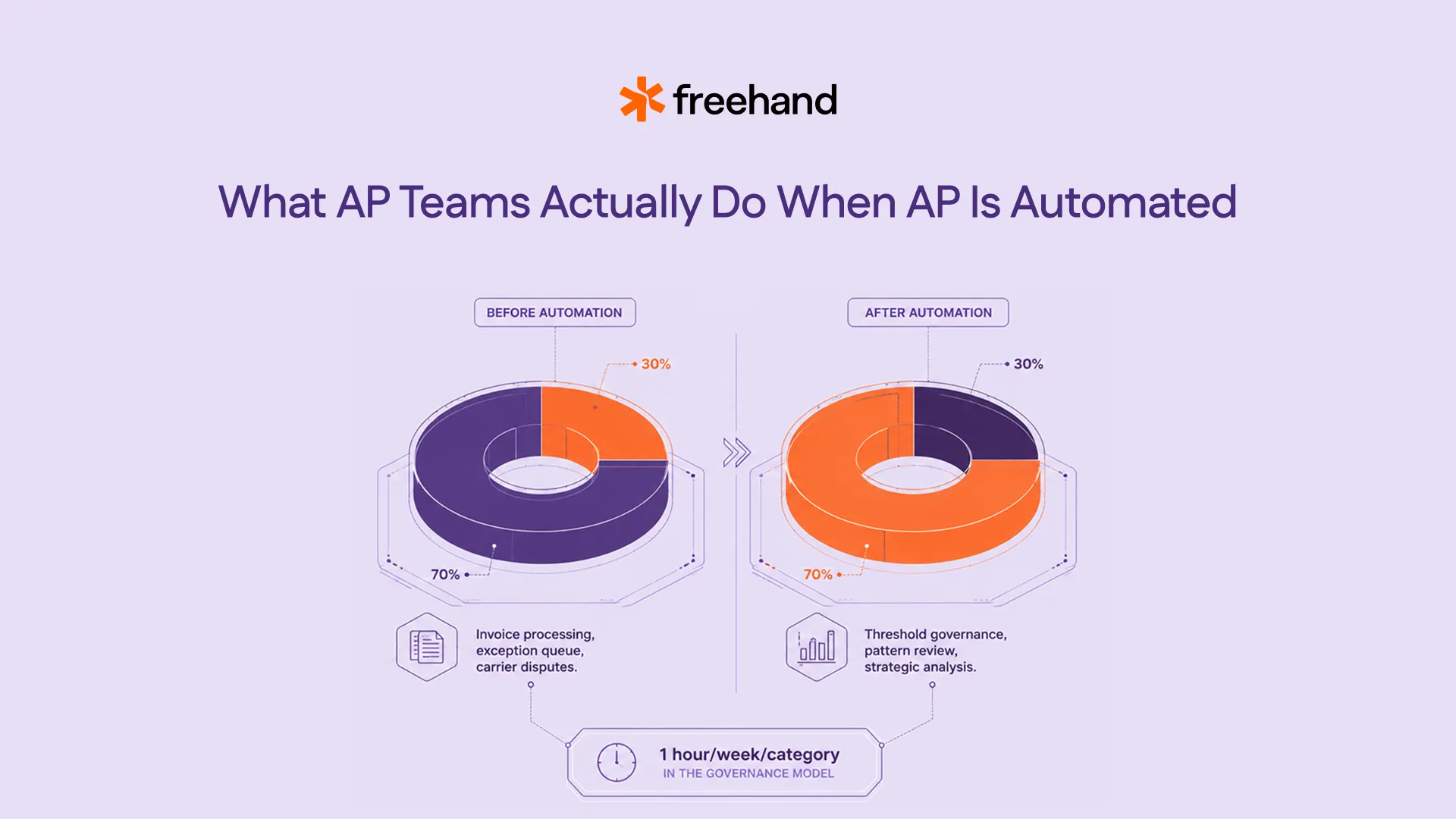
When planners aren’t firefighting emergencies, they focus on strategic improvements. When premium freight patterns get surfaced and addressed, chronic issues get fixed. The organizational cycle shifts from reactive to proactive.
This isn’t about more data or better dashboards. It’s about continuous intelligence reasoning across operational data to detect risk and enable intervention at the point where prevention is still possible and affordable.