
Why TONUs Are Paid by Default, and Why Audits Rarely Stop Them

February 5, 2026
•
5
mins

The problem isn’t that TONU charges are legitimate. It’s that disputing them costs more effort than the individual charge is worth, and by the time audit sees them, the evidence is scattered across four systems and two weeks old.
A finance operations manager of a global automobile organization stares at a spreadsheet full of Truck Ordered but Not Used (TONU) charges. Every single one was marked “approved” because the alternative, disputing them, would consume hours of staff time per charge, pulling data from multiple systems, reconstructing timelines, and building evidence files.
The uncomfortable reality: individual TONU charges typically fall into a range where the cost of investigation approaches or exceeds the potential recovery. Some TONU charges are valid and some may not be. Time to investigate one TONU can easily consume 30–60 minutes of audit staff time. The effort required to dispute makes approval the path of least resistance.
Here’s the question that doesn’t get asked: What if a significant portion of these charges are disputable? In freight operations managing similar challenges, auto manufacturers discover they fail to recover a significant amount annually, not because the charges weren’t recoverable, but because the investigation process was too complex to execute consistently. TONUs follow the same pattern: scattered evidence, tight timelines, and economics that favor approval over dispute.
What Actually Causes TONUs (And Why Fault Matters)
Not all TONUs are created equal. Some are legitimate, customer cancels after carrier dispatch, production delays push freight staging past pickup window, or genuine operational failure. Pay it and move on.
The gray-area TONU is where disputes live. One common instance is when the carrier arrives early, before the appointment window. Dock miscommunication where the shipper confirms 2 PM, but the carrier shows up at 10 AM. Appointment changed by the carrier without the shipper’s acknowledgment. Freight was ready, but the carrier didn’t follow check-in procedures. Force majeure or weather, where contracts have specific carve-outs.
In these cases, fault is shared, disputed, or on the carrier side. The charge should be challenged. But it rarely is.
Why? Most carrier contracts include language like “TONU applies when shipper fails to provide freight as scheduled,” “Carrier must arrive within appointment window,” and “Shipper has the right to dispute with supporting documentation within 30 days.” That “supporting documentation” requires reconstructing a timeline from multiple systems. By the time audit flags the charge, that reconstruction is ancient history.
The Reasons TONUs Get Paid by Default
If TONUs were simply invalid charges, audit would have eliminated them years ago. The reason they persist is not policy failure, but structural reality. Disputing a TONU requires timely context, cross-system evidence, and economic justification. By the time audit engages, all three are compromised. The default outcome is therefore not a decision, but a consequence.
- The evidence is scattered. To validate or dispute a TONU, you need appointment confirmation from the TMS or email, dock readiness logs from the WMS, carrier arrival time from carrier portals or phone logs, freight staging timestamps from the WMS, and contract terms from CLM. These live in four or five different systems.
- The economics don’t favor disputes. Investigation time can run 30–60 minutes per charge. Even with evidence, dispute success rates are historically low as carriers push back aggressively. Recoveries often result in partial credits rather than full reversals. Staff time invested frequently approaches or exceeds the expected recovery value. For audit teams under resource pressure, it’s a losing trade.
- Carriers know the pattern. Carriers understand that most shippers auto-approve small TONU charges because disputes are costly, turning TONUs into “optimistic billing.” Some procurement teams already address this in parcel services by pre-negotiating acceptable failure rates and reviewing them quarterly. A similar tolerance band for TONUs could reduce admin effort, while an agentic approach investigates exceptions beyond the threshold to assign responsibility and prevent recurrence.
- Audit sees the charge too late. The TONU incident happens on Day 1. Invoice arrives on Day 12. Audit reviews on Day 15. By then, no one remembers the details. Warehouse staff focus has moved on, warehouse logs may be archived, email threads are buried, the carrier’s driver is unreachable, and no one remembers if freight was actually staged. To dispute effectively, you need fresh evidence. Audit is seeing stale evidence. The window for challenging has narrowed if not closed.
The Real Cost: Patterns That Never Get Fixed
TONU charges represent significant freight cost leakage. Individual charges may seem manageable, but they accumulate rapidly. When a substantial portion of potentially disputable charges goes unchallenged due to investigation complexity, that leakage compounds month after month. One gets “nicked & dimed” to death…
More importantly, TONUs reveal patterns: same carrier, same lane, recurring issues; same warehouse, same dock, recurring staging problems; same customer, recurring cancellations. Audit sees individual charges, with no ability to see patterns. So, root causes never get fixed.
Why Traditional Systems Can’t Solve This
Most freight operations have the systems: TMS tracks appointments, WMS logs dock schedules, email contains carrier communications & booking slot appointment details, and contract management stores TONU terms. What’s missing isn’t data, it’s continuous and contextual reasoning across that data, with an almost forensic mindset — an ability to connect the data and build a story, for every TONU.
A dashboard shows yesterday’s TONUs. A report flags patterns monthly. But neither can detect a TONU about to happen, instantly reconstruct what happened when one occurs, understand contract nuances to determine disputability, or learn from patterns to prevent future incidents. This requires domain-specific intelligence operating continuously, not on-demand.
Freight AI Data Analysts to the Rescue
Think of a freight AI data analyst as an agent who never sleeps, continuously monitors every shipment, knows every contract clause, and has instant access to every system, operating autonomously within guardrails you set…and has been trained to find the patterns.
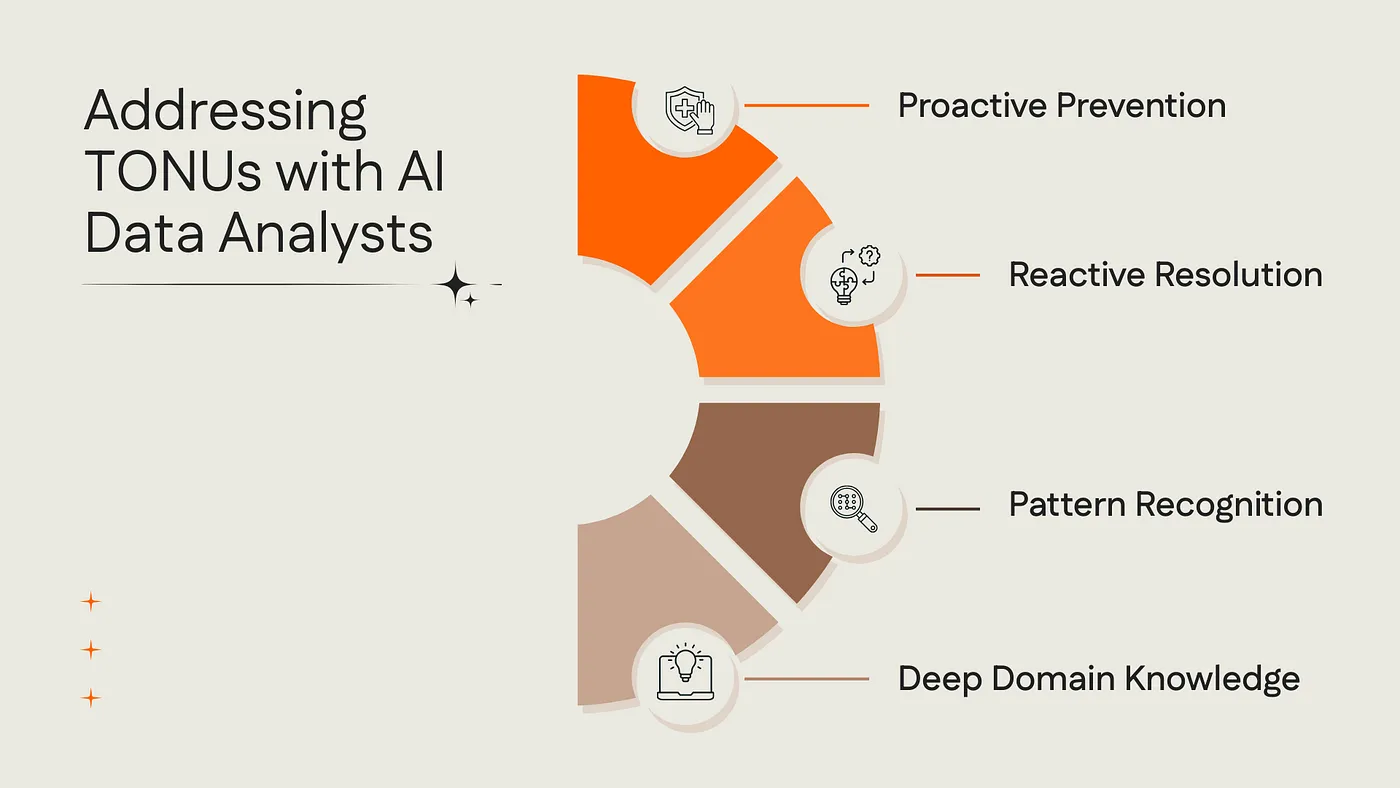
- Preventive mode: The agent monitors shipments approaching pickup. Hours before the scheduled pickup, it checks if the freight is staged, the dock schedule is aligned, and the carrier has confirmed arrival. If there’s misalignment, it alerts the planner. The planner acts. Appointment shifts. TONU prevented. What makes this different from a regular bot? The agent reasons across three data sources (TMS, WMS, carrier communication), understands the implications under contract terms, and surfaces intervention with context and recommendation, in real time, before the truck rolls.
- Reactive mode: When a carrier logs a TONU, the agent immediately queries the TMS for appointment records, pulls WMS dock readiness logs, retrieves carrier arrival logs, checks contract terms, and analyzes fault. Was the TONU valid? If not, then it generates a dispute readiness file with a complete timeline, supporting evidence, and recommended action with draft dispute language referencing specific contract sections. Timeline: near-instantaneous. When the invoice arrives days later, ideally the carrier has already removed the TONU charge. Audit doesn’t need to re-investigate. They review the pre-built case and decides on approval or rejection of the dispute, or negotiating a partial credit. The evidence gathering already happened while the incident was fresh. Dispute success rate improves significantly because evidence is timely, complete, and directly tied to contract terms.
- Pattern recognition: Over time, the agent detects patterns humans can’t see across thousands of shipments. “Carrier X has recurring TONUs on Lane Y, consistently arriving before appointment windows…and we need to discuss with the carrier” “Dock 3 has staging delays causing disproportionate TONUs…and we need to discuss with the 3PL” The agent surfaces these with specificity and recommended actions like revise appointment protocols, or escalate to the carrier account manager, or consider alternate carriers. It tells you which patterns to fix first based on cost impact.
- Domain-specific AI: A generic workflow tool can’t understand that “carrier arrived early” is different from “freight wasn’t ready,” know contract applicability conditions, reason about disputability based on multi-system evidence, learn carrier patterns, or draft dispute language referencing the right clauses. Freight domain expertise is encoded in the agent, what TONUs are, how carriers behave, what contract terms typically say, what evidence matters, and what patterns indicate systemic issues.
Improve Cost Recovery with Proactive Action
The shift from reactive management to proactive prevention changes the economics fundamentally. Traditional approach: audit reviews charges after the fact, low dispute rate due to complexity, moderate success on disputes filed, resulting in substantial leakage from charges never challenged. AI agent approach: preventative alerts stop TONUs before they occur, remaining charges come with pre-built dispute files, higher dispute rate becomes feasible, improved success rate due to timely evidence, and staff time shifts from investigation to strategic decisions.
TONUs are only one example that would benefit from this approach. The value compounds beyond direct cost recovery. Pattern recognition surfaces systemic issues that weren’t visible when looking at individual charges. Root cause fixes prevent future incidents entirely.
When audit teams aren’t spending hours reconstructing context for each exception, that capacity redirects to strategic cost analysis, contract compliance validation, and procurement support. The work doesn’t disappear. It gets elevated.
Changing that design requires continuous reasoning across fragmented data, instant evidence assembly when incidents occur, and pattern recognition that surfaces fixable root causes. That’s not a reporting problem or a workflow problem. It’s a reasoning problem. And reasoning problems require intelligence that operates at the speed and scale of freight execution, not at the speed of monthly reports or manual investigations.