
Audit Isn’t Broken — It’s Just Too Late for TONUs, T-Codes, and Hot Shipments

February 1, 2026
•
5
mins
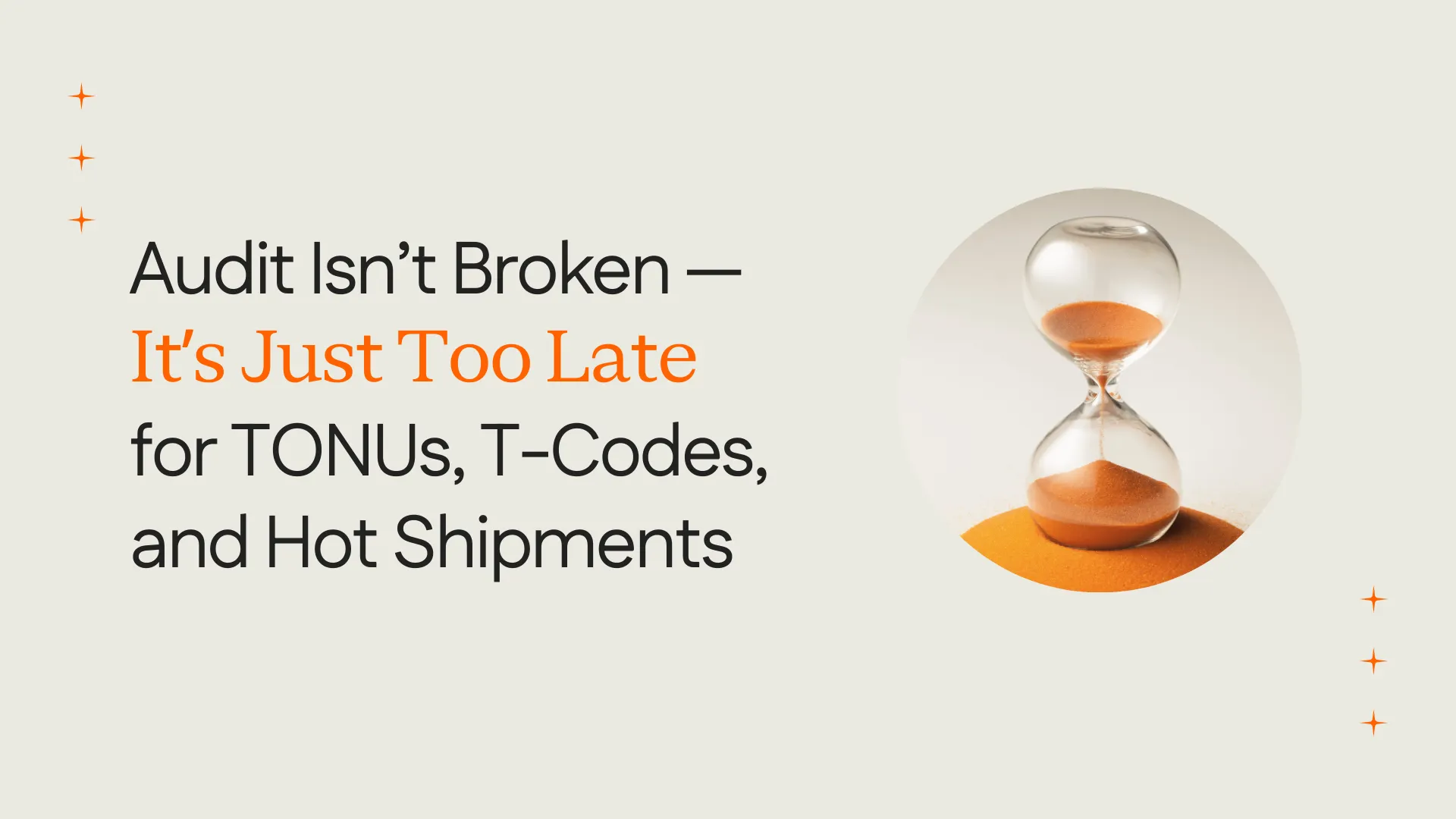
A hard truth about freight cost control in the auto supply chain: By the time audit sees the problem, the money is already spent.
Three decades of logistics operations in automobile manufacturing reveal a pattern that’s both consistent and frustrating: the post-mortem. Finance asks why freight costs exceed the budget. Audit delivers a detailed report — TONUs (Truck Ordered Not Used) from unneeded pickups, secondary carrier premiums, and hot shipment charges (for example, a critical delivery delayed by more than a specified amount of time, like 48 hours). Everyone nods in agreement. The costs were real. The audit was done properly. And yet, nothing changes.
Here’s the uncomfortable truth that doesn’t get said in those meetings: The audit team didn’t fail. They found every discrepancy. They just found it after the moment when anyone could have done something about it.
Let’s be direct about something the industry has been politely avoiding. Audit is structurally positioned to operate downstream from where the freight cost decision originates. That’s not a criticism of audit professionals. It’s a statement about where audit sits in the freight lifecycle. And it’s the reason freight cost overruns keep happening despite increasingly sophisticated audit processes.
The Uncomfortable Truth About Freight Cost Overruns
Every quarter, the same conversation happens in conference rooms across manufacturing operations. Finance wants to know why freight costs are “X%” over budget. Audit produces a detailed report. Transportation explains what happened: Tight capacity, last-minute changes, production was over/under forecast, carrier no-shows, etc. Procurement points to the contracts and says, “We negotiated good rates.” Everyone agrees the costs were unavoidable. The meeting ends. The overrun gets absorbed. And six weeks later, it happens again.
But here’s the question no one asks
What if these costs weren’t unavoidable? What if they were just invisible, until it was too late to avoid them?
The freight cost lifecycle doesn’t start with an invoice. It starts days or weeks earlier, in moments that have nothing to do with the audit. A logistics plan without enough flex. A tight dock schedule. A missed appointment window. For example, a primary carrier rejection triggers a secondary carrier at a very high premium. A shipment flagged as “at risk” 48 hours before delivery, with no backup plan, that escalates to hot-shot freight.
By the time the invoice arrives, and audit validates the charges, the operational moment that created the cost is many days in the past. The carrier has been paid or is about to be. The opportunity to dispute, recover, or intervene is gone.
This is the audit paradox: The system is designed to catch everything, after the moment when catching it would have mattered.
Four Scenarios Where “Too Late” Costs Real Money
Anyone who’s managed freight operations in the automobile sector knows these hypothetical (yet not so hypothetical) scenarios. They’re not edge cases. They’re Tuesday.

TONUs paid by default
A carrier shows up for pickup. The dock isn’t ready. The carrier leaves. Ten days later, a $350 TONU charge appears. Audit sees a valid charge per carrier terms. What audit doesn’t see: Was the dock actually unavailable? Who changed the appointment and when? Is this disputable under the contract? To answer those questions requires pulling dock schedules from the WMS, appointment logs from the TMS, and email threads with the carrier. That investigation takes 90 minutes. The charge is $350. The path of least resistance? Pay it. Now compound it to 100s or 1000s of TONU charges every year.
T-code cost leakage
A primary carrier rejects a load. The system assigns a secondary carrier at 40% premium. Both invoices get approved during audit. But according to the contract, that cost delta should have been recovered from the primary carrier as a rejection penalty. No one filed the debit because the audit process sees two separate, valid invoices. The T-code is buried in the TMS. The contract language about recovery lives in SharePoint. The connection never gets made. Procurement’s negotiated savings evaporate, one rejected load at a time.
Hot shipments that start upstream
A shipment gets flagged as “at risk” 48 hours before delivery. No backup plan is triggered. Twelve hours before delivery, the only option left is premium freight. Audit sees a $1,200 hot shipment charge, approved as expedited service. What audit doesn’t see: This was predictable two days earlier, when intervention would have cost $200 instead of $1,200. “Unavoidable” really means “unnoticed until it was too late.”
Fragmented context
The information needed to prevent freight cost overruns doesn’t live in one place. Shipment data is in the TMS. Invoices are in AP. Contract terms are in procurement portals or CLM tools. Dock schedules are in the WMS. Carrier communications come through email. Audit gets the invoice, and only the invoice. To validate a TONU dispute requires accessing four other systems and reconstructing a timeline. Most of the time, it’s easier to just pay.
This isn’t a people problem. It’s an architecture problem. The data exists. It’s just not connected. And by the time audit tries to connect it, the moment for action has passed.
Why This Happens: It’s Structural, Not Personal
Audit operates at the end of the freight lifecycle. It receives data after execution is complete, carriers have performed, and costs have been incurred. Audit’s job is to verify that what was invoiced matches what was delivered. It often does that job well.
But traditional audit doesn’t have access to the upstream signals that predict cost risk. It doesn’t see carrier rejection patterns that should trigger recovery debits, shipment risk indicators that predict premium freight escalation, or appointment misalignments that will lead to TONU charges. And audit doesn’t have the decision authority to intervene. Even if it spots a pattern, it can flag but can’t fix.
Here’s the hard truth: Audit is designed to catch what happened. It’s not designed to stop what’s about to happen, to inform upstream planning & execution business processes to stop the trend. And in freight cost control, that gap between “about to happen” and “here’s the invoice” is where the budget bleeds.
The Shift: From Reactive to Preventive
What if freight cost control worked differently? What if the goal wasn’t to audit faster, but to detect earlier while decisions were still reversible?
Consider what becomes possible when you can reason across the full automobile freight lifecycle in real time. Before the TONU happens, the system checks if the dock is ready and flags conflicts before the truck rolls. When the primary carrier rejects, recovery terms are automatically checked, and debit documentation is generated immediately…not six weeks later during reconciliation. As shipments become at-risk, alternatives are surfaced 48 hours out, nearby carriers with capacity, adjusted dock windows, enabling intervention before the only option is a hot shot.
When the invoice finally arrives, the audit still happens. But now it’s validating decisions that were already informed by full context. TONU charges come pre-flagged with dispute rationale. T-code recoveries are already in process. Hot shipments are minimized and have documented escalation justifications. Audit becomes a checkpoint, not the last line of defence.
This isn’t about replacing audit. It’s sensing and finding situations early, about repositioning cost control to operate upstream, where risk forms, not downstream, where it gets documented.
What This Requires
The shift from reactive audit to proactive cost control requires three things most freight operations don’t have today.

- Continuous data integration across fragmented systems. Shipment execution, invoice processing, and contract management can’t remain separate workflows. Connecting procurement, TMS, WMS, carrier communications, and AP…not in batch, not weekly, but continuously. It creates the foundation for seeing cost-impacting events as they happen
- Real-time reasoning to surface risk before it crystallizes. Data integration alone isn’t enough. Systems need to reason across that data to detect patterns: “This carrier has rejected three loads this week on this lane, should we pre-assign backups?” or “This shipment is at risk of missing delivery, here are four options, ranked by cost.” That reasoning can’t happen in a monthly report. It has to happen in the moment when decisions are still reversible.
- Proactive alerts and decision support where action matters. Detecting risk is only valuable if it reaches the people who can do something about it, while they can still do something about it….worked into the business process. That means alerting procurement when carriers reject loads that should trigger debits, notifying transportation when shipments trend toward premium freight, and flagging TONU disputes with pre-built evidence before invoices are paid.
The Value of Getting Ahead of the Invoice
Early detection means TONUs get prevented, not disputed after the fact. The system flags appointment conflicts before dispatch. The planner adjusts. The TONU never happens.
T-code recovery becomes automated. When a primary carrier rejects a load, the system immediately logs the rejection, checks the contract for recovery terms, calculates the cost delta, generates a debit memo with documentation, and routes it for approval. The recovery doesn’t wait for month-end reconciliation.
At-risk shipments get intervention options. A shipment 48 hours from delivery with a delayed carrier gets flagged with alternatives. The transportation team makes an informed decision, not a crisis reaction.
Context-rich exception management means invoices with detention charges arrive with auto-populated dispute files: dock logs, GPS timestamps, BOL signatures, and recommended actions. Audit reviews, approvals, and disputes are filed with the carrier, with evidence, all within minutes/hours.
In every scenario, the audit still happens. It’s just no longer the first time anyone is looking at solving the problem.
When freight cost control operates upstream, three things happen: Preventable costs stop happening, TONUs paid by default get resolved before dispatch, and at-risk shipments get intervention before they escalate. Recoverable costs get recovered, T-code debits get filed automatically, and disputes succeed at higher rates with timely evidence. The audit capacity gets redirected from reconstructing context to strategic cost analysis and procurement support.
Looking Forward
There’s a version of freight operations where cost overruns still happen, but they’re genuinely unavoidable, not just unnoticed. Where audit’s quarterly report says: “We found three exceptions this period. All three were valid, documented, and justified at the time of execution.” Where finance stops asking “How did we miss this?” and starts asking “What did we learn?”
That version requires giving people the context, time, and tools to do what they’re already trying to do to control costs…but before they crystallize.
The freight audit function isn’t broken. But the freight cost control model is incomplete. And the gap between the “this is about to become a problem” and “here’s the invoice” is where budgets bleed. Closing that gap doesn’t mean auditing faster. It means reasoning earlier and creating the feedback loop into upstream business processes.