
Best Logistics BPO Services vs. Software: Which Is Right for Your Team? (2026)

June 30, 2026
•
12
mins
Comparing the best logistics BPO services and software alternatives for 2026: 1. Freehand, 2. Loop, 3. Cass Information Systems, 4. OpenEnvoy, 5. Genpact, 6. Accenture Operations, 7. WNS, 8. ARDEM, 9. Invensis, and 10. Rely Services.
Outsourcing freight back-office work to a BPO trades a hiring problem for a cost that grows with every shipment, because each new invoice is another unit of human labor. Sample-based BPO audits also leave overcharges uncaught in the unchecked remainder, where billing errors run 3 to 7% of freight spend. This page compares both models so you can decide which one your spend justifies.
This is a buyer's guide for supply chain teams weighing outsourcing against automation. If you sit in supply chain, finance, procurement, or IT leadership and you are deciding whether to hire a logistics BPO or deploy software, the comparison below helps you choose the model and shortlist the right vendor.
Below, we are going to see a detailed comparison of the best logistics BPO services and their software alternatives for 2026, one line per provider, before the full breakdown.
TL;DR: the best logistics BPO services and software at a glance
- Freehand: AI Teams that replace the BPO entirely, 100% audit coverage and resolution without added headcount.
- Loop: AI-native logistics data platform with the strongest independently verified recovery evidence here.
- Cass Information Systems: the largest established freight payment processor, software plus managed service.
- OpenEnvoy: no-template freight invoice automation, drop in invoices and the system handles exceptions and payment.
- Genpact: enterprise procurement and supply chain BPO with deep process expertise and RPA.
- Accenture Operations: global SCM outsourcing at transformation scale, with AI and cloud capability.
- WNS: large-scale logistics BPO blending analytics, cloud, and automation.
- ARDEM: two decades of freight bill processing, outsourced labor layered with OCR and RPA.
- Invensis: back-office depth in billing reconciliation, claims, and freight documentation.
- Rely Services: freight payment BPO and invoice processing for mid-market administration.
Comparison table: logistics BPO services vs software for 2026
What is logistics BPO services?
Logistics BPO services delegate non-core supply chain and transportation tasks to a specialized third-party provider: freight bill auditing, shipment tracking and coordination, data entry and documentation, customer support, and fleet management. Teams use it to cut operational costs, improve delivery efficiency, scale through peak seasons without hiring, and free internal staff for carrier negotiations and strategic growth.
Technically, a BPO staffs offshore or nearshore teams, often layered with OCR and robotic process automation, to read and key documents like bills of lading, airway bills, and customs forms against your rules, then push the data back into your TMS and ERP. Shipment tracking, dispatch, and route optimization may run the same way.
The modern software alternative removes the staffing dependency: AI agents read unstructured documents, reason across contracts and policies, and execute decisions directly in your systems, so accuracy and coverage no longer scale with headcount.
- For a CFO, the difference is recovered spend and a cost that stays flat as volume grows instead of one that rises with it. For a CIO, software means clean data and fewer manual queues without a custom build.
- For a CSCO, CPO, or VP of supply chain, it decides whether back-office capacity is a hiring decision or a deployment.
You can see the automation model on Freehand's logistics BPO services page.
How we evaluated these providers
We judged every provider on three things: independently verifiable evidence (named customers, third-party reviews, public data), automation maturity, and fit to logistics back-office work for enterprise and mid-market shippers. Evidence came from vendor sites, G2, Gartner Peer Insights, industry coverage, and analyst benchmarks on automation cost and accuracy.
Figures we could not independently confirm are labeled vendor-claimed. Freehand publishes this guide and is included in it. We applied the same criteria to ourselves, ranked traditional BPO providers fairly on the strengths outsourcing genuinely offers, and invite you to score each provider independently.
Best logistics BPO services and software, ranked for 2026
The AI software platforms lead on autonomous coverage and flat cost; the established BPO providers follow on scale, flexibility, and human judgment for non-standard work.
1. Freehand
Best for:
Enterprises that want to replace the logistics BPO entirely, not just supervise it, eliminating the headcount that scales with volume, and where SAP or Oracle integration without custom EDI build is non-negotiable. A strong fit for CFO, CIO, CSCO, and CPO buyers above $250M in freight spend.

Freehand is an agentic AI platform for supply chain and spend management that came out of stealth at Manifest 2026. Its Autonomous AI Teams read unstructured documents, emails, and chats, reason across contracts and policies, make decisions, and execute them directly inside procurement, ERP, and finance systems. It is built by the team behind Pi, recognized as a TIME Best Invention of 2025 and a Gartner Visionary, and its customers include Meta, General Electric, Johnson & Johnson, Pfizer, and Unilever.
Key features:
- AI Teams execute decisions directly in your ERP, replacing the BPO queue rather than supervising it
- 100% audit coverage across all modes instead of BPO sample-based review
- Multi-way matching across invoice, rate, shipment, and purchase order
- Autonomous dispute management and resolution without analyst review
- Real-time GL coding posted automatically after audit
- Freight audit and payment software and procure-to-pay software on one platform
- Built-in spend analytics software by mode, carrier, lane, and cost center
- Native connectors for SAP, Oracle, NetSuite, and Dynamics with no custom build
- Client-exclusive model in a dedicated environment, no pooled data
- An auditable trace finance can review for every decision
Pricing:
Custom, volume-based. No percentage-of-savings fees and no per-headcount charges, so a fixed cost replaces a BPO bill that grows with volume.
Pros:
- Removes the BPO headcount entirely, with autonomous resolution at full coverage
- One platform spanning audit, payment, procure-to-pay, and spend analytics
- Native ERP integration without EDI workarounds
Cons:
- Launched in early 2026, so long-run independent recovery benchmarks are still limited
- Built for enterprise complexity, not single-carrier or SMB shippers
"Freehand's AI Teams read unstructured inputs, reason across contracts and policies, and execute decisions directly in enterprise systems. Early deployments have cut reconciliation and AP cycle times by 80 to 90%." Supply Chain 24/7, February 2026.
2. Loop
Best for: Large enterprises that want the strongest documented recovery evidence to build the business case for replacing a BPO, and that run freight and parcel across multiple modes on messy, fragmented data.
[Screenshot: Loop.com homepage]
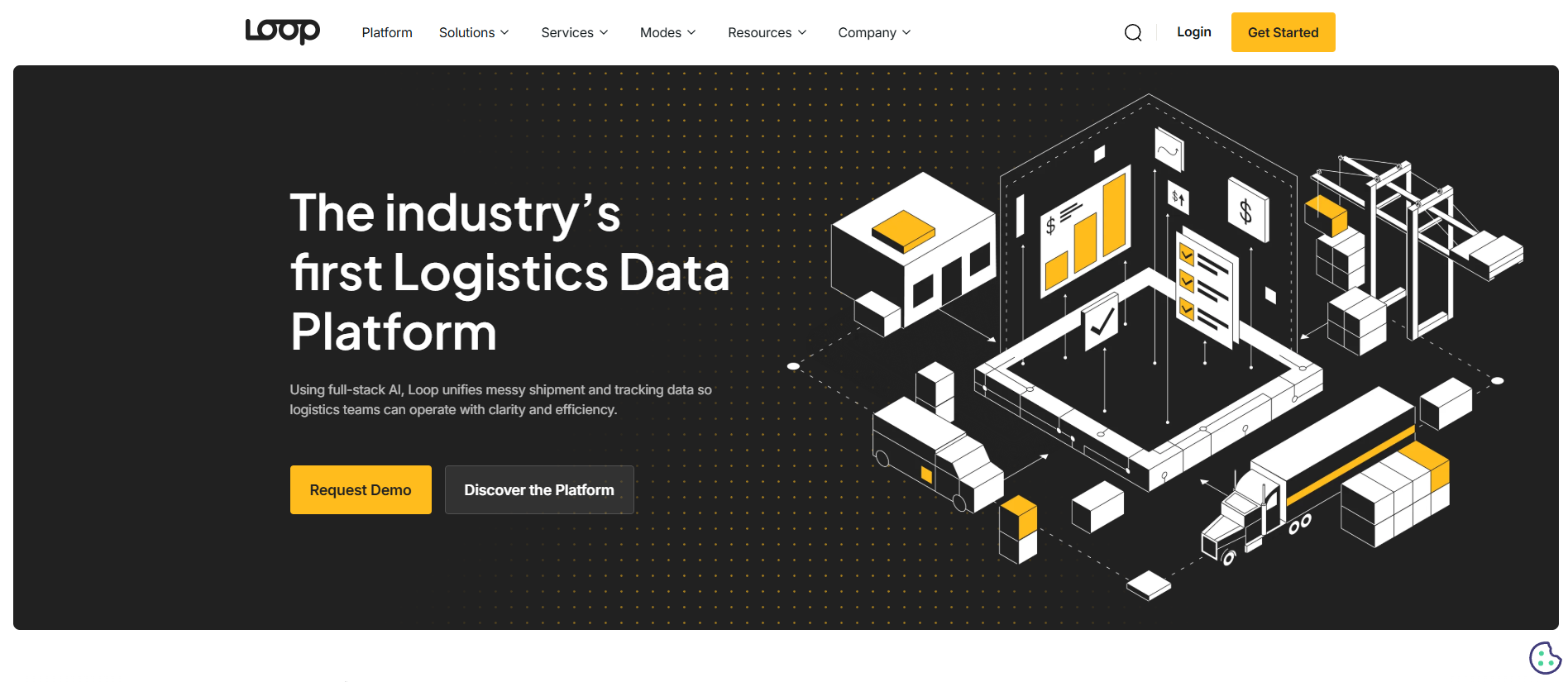
Loop is an AI-native logistics data platform founded in 2021 by former Uber Freight leaders. Its model reads unstructured documents and turns them into clean, unified data before the audit runs, automating freight and parcel audit at the line-item level. It is the closest software alternative to a managed BPO for shippers whose core problem is data quality.
Key features:
- Document normalization across PDFs, EDIs, emails, spreadsheets, and POs
- Line-item invoice auditing with a high automation rate
- Freight and parcel audit across ocean, air, LTL, and TL
- Autonomous dispute initiation and resolution
- Carrier payment alongside audit
- Spend analytics built on normalized data
- API-first ERP, TMS, and accounting integration
- Backing from Founders Fund, J.P. Morgan Asset Management, and Index Ventures
Pricing:
Custom enterprise pricing, not published. Quotes depend on freight volume and modules, so expect a sales conversation.
Pros:
- Strongest independently sourced recovery proof among the software options
- Solves the data normalization problem most BPOs handle with manual labor
Cons:
- No published standard go-live timeline or public pricing floor
- Parcel capability is newer than its freight core
"Loop is a trusted partner with their deep knowledge of transportation that delivers accuracy, transparency and speed to our process." Reviewer on Gartner Peer Insights, 2026.
3. Cass Information Systems
Best for:
Large shippers that want an established, financially secure freight payment processor with decades of scale, and that are comfortable with a hybrid software-plus-managed-service model rather than full autonomy.
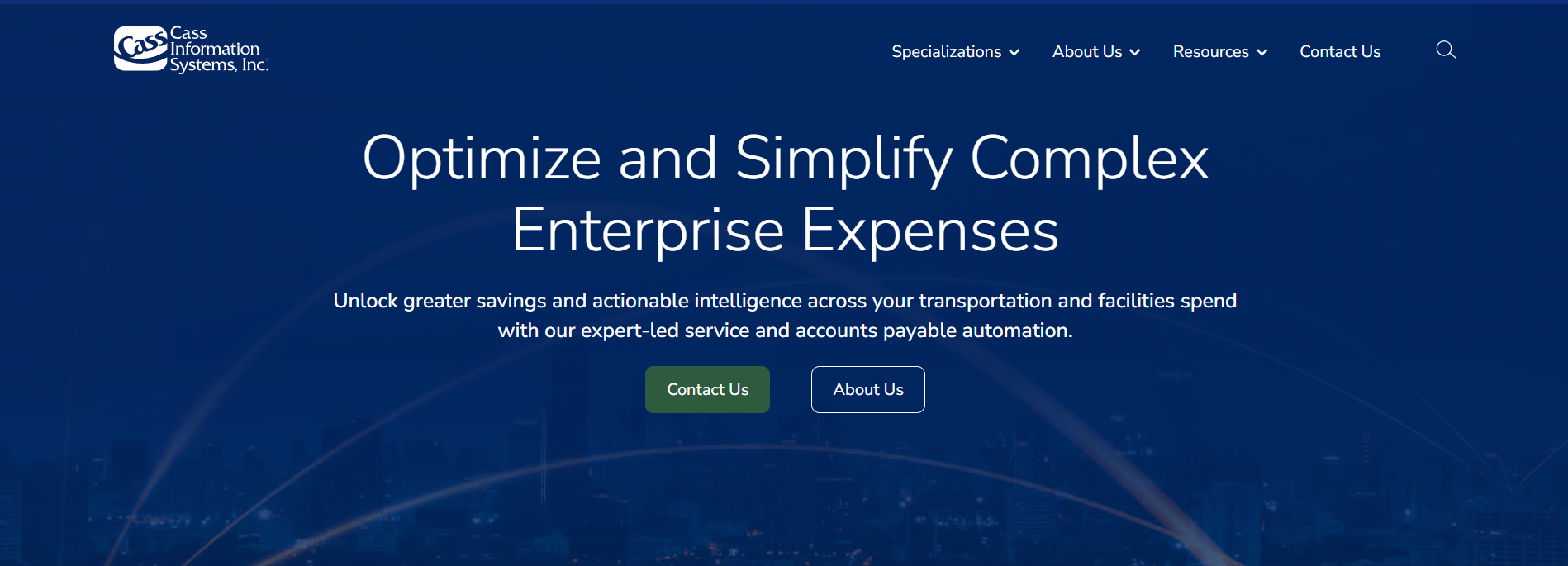
Cass Information Systems is one of the oldest and largest freight audit and payment processors, pairing software with a managed service backed by its own bank. It processes a very high volume of freight transactions annually and is a default incumbent for enterprises that prioritize payment reliability and financial stability over the newest automation.
Key features:
- Freight audit and payment at large enterprise scale
- Bank-backed payment processing and financial security
- Spend data and analytics across modes
- Carrier payment execution and reconciliation
- GL coding and cost allocation
- Established compliance and controls
- Integration with major ERP and TMS systems
- Global payment capability across currencies
Pricing:
Per-transaction fees plus payment float economics. Not published, and quotes scale with transaction volume.
Pros:
- Deep scale and financial security from a bank-backed processor
- Reliable payment execution trusted by large enterprises for decades
Cons:
- Hybrid managed model, not autonomous resolution
- Legacy architecture and slower innovation than AI-native platforms
Cass holds a long-standing position as a large-scale freight payment processor. See reviews on Gartner Peer Insights, 2026.
4. OpenEnvoy
Best for:
Teams that want fast, template-free freight invoice automation without standing up rules or portals, replacing the data-entry layer a BPO would otherwise staff.
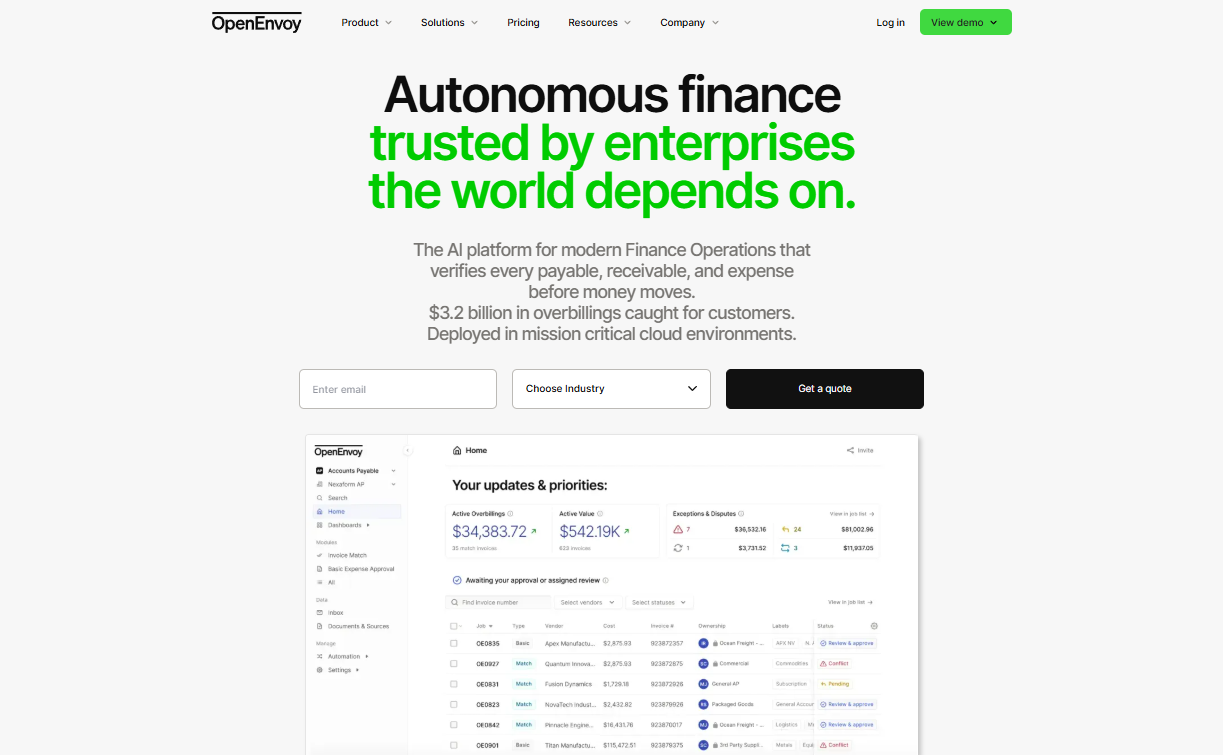
OpenEnvoy is a real-time invoice automation platform that requires no templates, portals, or rules. You drop in carrier invoices and the system handles freight invoice approval, exceptions, and payments in one automated flow. It is a software-first alternative to outsourcing the manual matching and validation a BPO performs.
Key features:
- No-template, no-rules invoice ingestion
- Automated freight invoice matching and validation
- Real-time exception detection and routing
- Integrated approval and payment workflow
- Duplicate and overcharge detection
- ERP and accounting integrations
- Fast implementation relative to managed services
- Spend visibility across processed invoices
Pricing:
Subscription software pricing. Not fully published, so verify current tiers and volume terms directly.
Pros:
- Very fast to deploy with no template or rule setup
- Replaces manual data entry and matching labor with software
Cons:
- Narrower scope than full source-to-pay or audit suites
- Less independent enterprise review data than incumbents
OpenEnvoy positions template-free, real-time invoice automation as a BPO alternative. Vendor overview via OpenEnvoy, 2026.
5. Genpact
Best for:
Enterprises that want a global outsourcing partner for procurement and supply chain back office, combining deep process expertise with RPA across multiple functions, not just freight.

Genpact is a frontrunner in procurement and supply chain BPO with a strong footprint across logistics, CPG, and aviation. It combines deep process expertise with digital technologies like robotic process automation to streamline procurement, freight, and warehouse processes. It is a managed-service model run by people, with automation layered on top.
Key features:
- Enterprise procurement and supply chain BPO at global scale
- RPA layered onto outsourced process teams
- Freight bill processing, procurement, and warehouse support
- Analytics and reporting across managed processes
- Domain expertise across logistics and CPG verticals
- Flexible staffing and managed delivery centers
- ERP integration for processed data
- Transformation consulting alongside operations
Pricing:
Per-FTE or managed-contract pricing. Not published, and quotes scale with scope and headcount.
Pros:
- Deep process expertise across many back-office functions
- Global delivery scale and flexible staffing
Cons:
- Cost scales with headcount as volume grows
- Automation assists humans rather than replacing them
Genpact is recognized as a leader in procurement and supply chain BPO. See coverage via Verified Market Research, 2026.
6. Accenture Operations
Best for:
Large enterprises pursuing a broad supply chain transformation where outsourced operations sit alongside consulting, AI, and cloud platform work under one global partner.
Accenture is a global leader in supply chain management BPO, offering solutions spanning procurement, logistics, and supply chain analytics. It pairs managed operations with industry-leading technology capability, including AI and cloud platforms, for enterprises that want strategy and execution from a single provider.
Key features:
- Global SCM BPO across procurement and logistics
- AI and cloud platform capability alongside operations
- Supply chain analytics and reporting
- Transformation consulting integrated with delivery
- Large global delivery network
- Industry-specific process expertise
- ERP and platform integration at scale
- Managed services across multiple functions
Pricing:
Per-FTE or managed-contract pricing, often inside a larger transformation engagement. Not published.
Pros:
- Transformation scale and breadth few providers match
- Strong AI and cloud capability behind the operations
Cons:
- Premium pricing and complexity overshoot focused freight needs
- Outcomes depend on engagement scope and staffing
Accenture is cited as a global leader in supply chain BPO and operations. See industry coverage via Verified Market Research, 2026.
7. WNS
Best for:
Enterprises that want a large-scale logistics BPO with strong analytics and outcome-based delivery, blending managed teams with automation and cloud.

WNS is a large global BPO provider that uses digital technologies, cloud platforms, analytics, and automation across logistics and supply chain operations. It runs managed operations for shipping, freight, and back-office functions, with analytics positioned as a differentiator over pure staffing shops.
Key features:
- Large-scale managed logistics and supply chain operations
- Analytics and reporting embedded in delivery
- Automation and cloud platforms layered on teams
- Freight, finance, and back-office process coverage
- Outcome-based commercial models available
- Global delivery centers and flexible staffing
- Domain expertise across transportation
- Integration with client ERP and TMS systems
Pricing:
Per-FTE or outcome-based managed pricing. Not published, and quotes scale with scope.
Pros:
- Strong analytics layer over managed operations
- Flexible commercial models including outcome-based
Cons:
- Still a headcount-led model at its core
- Automation supplements rather than replaces staff
WNS is recognized among leading supply chain BPO providers. See coverage via Verified Market Research, 2026.
8. ARDEM
Best for:
Freight forwarders, trucking companies, and 3PLs that want a specialized BPO for freight bill processing and documentation, with cloud platforms layered on outsourced labor.
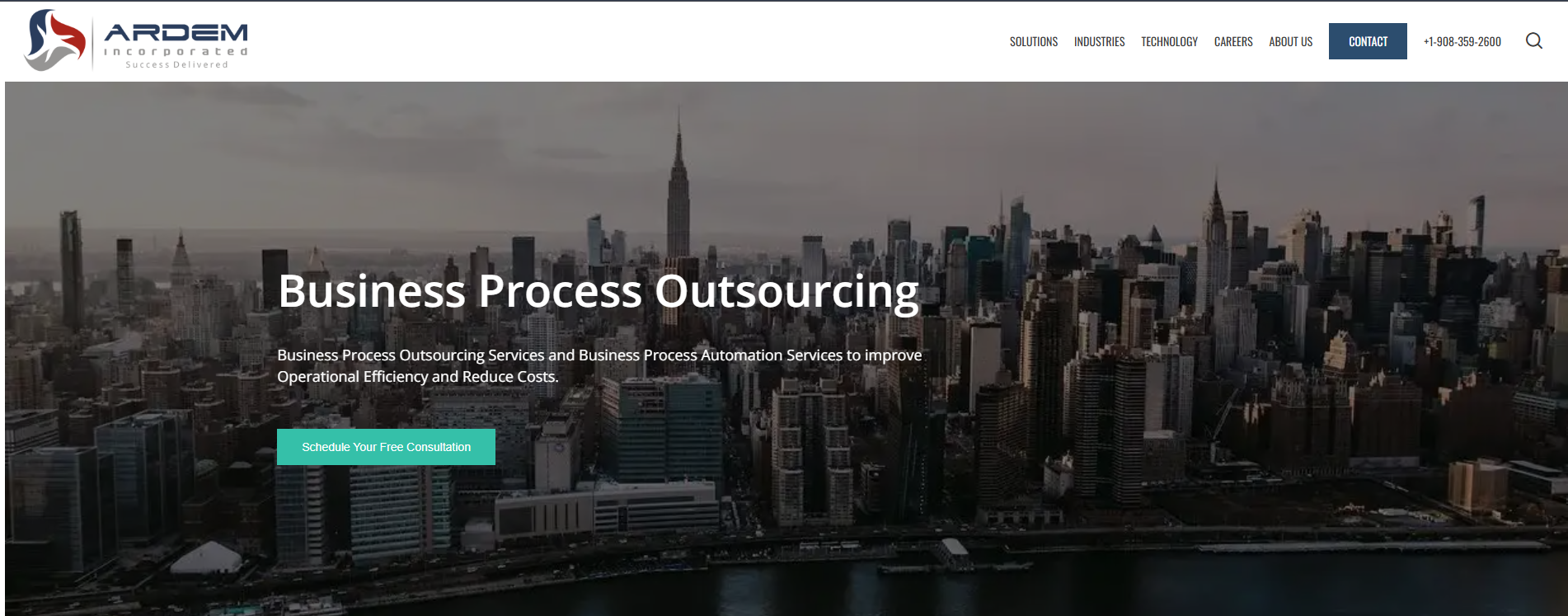
ARDEM is a logistics BPO with over two decades of experience in freight bill processing, freight invoice management, data capture, and rate validation. It centers on the documentation-heavy tasks that support freight transportation and forwarding, and increasingly markets automation alongside its outsourced teams.
Key features:
- Freight bill processing and invoice management
- Data capture from freight bills and shipping documents
- Rate validation services
- Cloud-based platforms layered on processing teams
- Compliance and documentation workflows
- Shipment tracking support
- Accounting and ERP data integration
- Flexible volume handling
Pricing:
Per-document or per-transaction pricing. Not published, and quotes scale with document volume.
Pros:
- Deep specialization in freight documentation and billing
- Automation-leaning model relative to pure staffing shops
Cons:
- Throughput and cost still tied to processing labor
- Less autonomous than software-first platforms
ARDEM markets freight bill automation layered onto its logistics BPO services. Vendor overview via ARDEM, 2026.
9. Invensis
Best for:
Logistics and delivery companies that want broad back-office outsourcing across billing reconciliation, claims, freight documentation, and data entry from one global partner.
Invensis is a global outsourcing partner known for comprehensive BPO across contact center, back office, and logistics operations. Its logistics back-office services include billing reconciliation, claims processing, shipment data entry, freight documentation, and inventory data maintenance for transportation companies.
Key features:
- Billing reconciliation and claims processing
- Shipment data entry and freight documentation
- Inventory data maintenance
- Contact center and customer support
- Back-office process coverage across functions
- Global delivery and flexible staffing
- Accounting and ERP data support
- Documentation and compliance workflows
Pricing:
Per-FTE or per-process pricing. Not published, and quotes scale with scope.
Pros:
- Broad back-office coverage from one provider
- Established global delivery capability
Cons:
- Manual processing model with limited automation depth
- Cost and accuracy tied to staffing
Invensis provides billing reconciliation, claims, and freight documentation outsourcing. Vendor overview via Invensis, 2026.
10. Rely Services
Best for:
Mid-market shippers that want an affordable BPO for freight payment, invoice workflows, and document-related processes without enterprise complexity.
Rely Services provides logistics BPO support for companies that need help managing freight administration, logistics data, invoice workflows, and document processes. It focuses on routine but important operational tasks, including freight bill audits and invoice processing, positioned for cost-conscious mid-market teams.
Key features:
- Freight payment and invoice processing
- Freight bill audits
- Logistics data management
- Document and back-office workflows
- Freight administration support
- Accounting data integration
- Flexible mid-market staffing
- Reporting on processed work
Pricing:
Per-transaction or per-FTE pricing aimed at mid-market budgets. Not published, so contact the provider directly.
Pros:
- Affordable entry point for mid-market freight admin
- Focused on routine freight payment and invoice tasks
Cons:
- Manual model with limited automation
- Less scale and analytics than enterprise providers
Rely Services streamlines freight payments and back-office logistics operations. Vendor overview via Rely Services, 2026.
Best Genpact and Accenture alternatives: freight audit BPO software
If you are replacing a managed BPO or an analyst-dependent service, the modern alternatives are the AI-native software platforms that remove the headcount instead of managing it. Here is how to route the decision by what your ICP evaluates.
Freehand
Choose Freehand if your pain is the BPO headcount and cost that scales with volume. For a CFO, the draw is recovered spend with real-time accruals and a fixed cost that does not rise with shipment count. For a CIO, it is normalization across ERPs without a custom build and a client-exclusive model. For a CSCO or CPO, it is one platform connecting audit to procure-to-pay and spend analytics. It is the only option here that resolves and posts autonomously rather than routing to people.
Loop
Choose Loop if your primary problem is fragmented, messy logistics data and you want the strongest documented recovery evidence to defend the switch. It is the closest software alternative to a managed service for data quality. The difference is resolution depth: Loop unifies and surfaces, Freehand resolves and posts.
Logistics outsourcing vs automation: how to choose
The decision comes down to three things: how standard your work is, how fast your volume is growing, and what your team can evaluate.
- Choose a BPO if your work is highly variable, judgment-heavy, or spread across many one-off processes that no software covers cleanly, or if you need to stand up capacity in weeks without an IT project.
- Genpact, Accenture, and WNS bring transformation scale;
- ARDEM, Invensis, and Rely Services bring focused freight document processing;
- customer-support-heavy operations are where shops like Helpware CX concentrate.
Outsourcing can cut administrative expense by up to 40% and transportation cost by up to 15% through optimized routing (provider-claimed), but those savings ride on a cost that rises with every shipment.
- Choose software if your volume is growing and you do not want cost to grow with it, if accuracy matters more than flexibility, and if your team can evaluate on architecture.
- Freehand and Loop are the AI-native leaders,
- OpenEnvoy is the fast no-template option,
- and Cass is the established hybrid for payment scale.
The hybrid reality is that most modern BPOs now automate routine tasks and reserve people for exceptions. The question is who owns the automation. With a BPO, you rent it and keep paying per head. With software, you own the workflow and the cost stays flat.
One number to settle first: at a 5% recovery rate on $500M in freight spend, the gap between sample-based BPO auditing and 100% software coverage is real money left in the unchecked remainder every cycle. Treat coverage as a financial variable, not a service-level footnote.
Frequently asked questions
What is logistics BPO services?
Logistics BPO services delegate operational supply chain tasks like freight bill processing, invoice audit, documentation, and data entry to a third-party provider that runs the work against agreed service levels.
What services do logistics BPO companies provide?
Freight bill auditing, shipment tracking and coordination, data entry and documentation (BOL and customs forms via OCR), 24/7 customer support, and fleet management like route optimization and dispatch.
Is BPO or automation software better for freight processing?
Software wins when volume is growing and work is standard, since cost stays flat and coverage is complete. BPO fits variable, judgment-heavy work that needs fast human capacity.
How much do logistics BPO services cost?
Most BPOs charge per FTE, per transaction, or per document, so cost rises with volume. Software typically charges a fixed or volume-based fee that does not scale with headcount.
Can AI replace logistics BPO?
For standard, high-volume back-office work, yes. AI agents read documents, reason across contracts, and execute decisions in your systems, removing the headcount that BPO models depend on.
What is freight audit BPO?
Freight audit BPO is outsourcing invoice auditing to a provider whose staff check carrier bills for errors. Most audit a sample, which leaves overcharges in the unchecked remainder.
How do I choose a logistics BPO provider?
Match the model to your work: standard and high-volume favors software, variable and judgment-heavy favors a BPO. Then compare automation level, coverage, integration, and cost model.
What is the difference between BPO and freight automation software?
A BPO uses people to do the work and bills by headcount or transaction. Software uses automation you own, with coverage and cost that stay flat as volume grows.
The bottom line for 2026
If you want to remove the back-office headcount entirely, start with Freehand and Loop. If you need an established payment processor at scale, Cass is credible. If your work is variable and judgment-heavy, Genpact, Accenture, and WNS bring outsourcing depth, while ARDEM, Invensis, and Rely Services handle focused freight processing. Map the shortlist to your volume, your stack, and the team you do not want to keep growing, then book the right demos.
Want to see autonomous logistics operations replace your BPO queue? Book a Freehand demo.
Conflict of interest disclosure:
This guide is published by Freehand, a supply chain automation vendor that competes with logistics BPO services and is included in this comparison.
We applied the same criteria to ourselves as to every other provider, treated traditional BPO strengths fairly in pros and cons, labeled vendor-claimed figures, and tied Freehand's numbers to its own case studies and press coverage. Run the same criteria in your own RFP and score each provider independently, including us.