
Best Trade Compliance Software in 2026: 6 Tools Compared
.webp)
July 8, 2026
•
8
mins
Comparing the top trade compliance software options for 2026: 1. Freehand, 2. SAP Global Trade Services, 3. Thomson Reuters ONESOURCE Global Trade, 4. Descartes, 5. E2open, 6. Oracle Global Trade Management.
A misclassified HS code, a missed denied-party match, or a drawback claim that expired in the filing window all cost the same thing: money and regulatory exposure.
The stakes vary by sector, which is why we map global trade compliance obligations to the industries carrying the most exposure.
The right platform decides how much of that risk your team catches before goods move, and how much clears without a second look. Here is how the six leading options compare for enterprise importers.
Comparison table: Top trade compliance software for 2026
| Tool | Best For | Classification & Screening Coverage | AI Autonomy | Implementation Time | ERP Fit | Overall (/5) |
|---|---|---|---|---|---|---|
| Freehand | Importers wanting agentic execution across classification, duty, and screening | 100% of shipments and counterparties | Agentic (acts on findings) | 12 to 14 weeks | SAP, Oracle, NetSuite (agnostic) | 4.7 |
| SAP Global Trade Services | SAP-standardized enterprises needing native ERP compliance | High, rules-configured | Assistive (flags for review) | Several months to a year | SAP-native | 4.4 |
| Thomson Reuters ONESOURCE | Fortune 1000 importers on a Thomson Reuters tax stack | High, content-driven | Assistive (flags for review) | Multi-month | SAP S/4HANA | 4.2 |
| Descartes | Customs teams wanting the deepest tariff content library | High, content-driven | Assistive (flags for review) | Multi-month | Agnostic, integrates SAP GTS | 3.9 |
| E2open | Multinationals running trade across 10+ jurisdictions | Broad, FTA-focused | Assistive (flags for review) | Long, multi-phase | Multi-ERP | 3.6 |
| Oracle Global Trade Management | Oracle-standardized enterprises inside OTM | Moderate to high | Assistive (flags for review) | Multi-month | Oracle-native | 3.3 |
TL;DR
- Freehand: Agentic trade compliance that classifies, calculates duty, screens counterparties, and files drawback claims autonomously, with 100% shipment coverage.
- SAP Global Trade Services: The default for SAP-native shops that want compliance controls inside the ERP, if you can absorb a long implementation.
- Thomson Reuters ONESOURCE Global Trade: Deep trade content and classification, strongest for Fortune 1000 importers already on the Thomson Reuters tax stack.
- Descartes: The deepest commercial tariff database across 175+ countries, best when customs content quality is the priority.
- E2open: Strong free trade agreement logic for multinationals running complex multi-country supply chains.
- Oracle Global Trade Management: A clean, capable GTM layer for Oracle-standardized enterprises, priced at the top of the market.
What is trade compliance software?
Trade compliance software helps importers and exporters follow the regulatory requirements of cross-border trade, applying continuously updated global rules so goods move correctly, without penalties or delays. It centralizes the decisions behind every international shipment:
- HS classification to the correct code in each country's tariff schedule
- Duty and tax calculation with landed-cost estimates
- Free trade agreement eligibility and certificates of origin
- Denied and restricted party screening against government lists
- License determination for controlled goods
- Documentation and audit evidence for customs authorities
Traditional platforms flag these decisions for a compliance analyst; agentic systems execute and file them. For a VP of Trade Compliance or CFO, start with the trade compliance software capabilities that map to your highest-risk flows.
How We Evaluated Trade Compliance Software
We scored each platform against the nine criteria that decide a real enterprise trade compliance program, weighted toward the outcomes that carry financial and regulatory risk. Every tool was assessed on the same basis using public documentation, G2 and Gartner reviews, and vendor materials. Coverage and AI autonomy carry the most weight, because they determine how much of your trade risk is actually caught versus sampled.
- Classification & Screening Coverage (20%): What share of shipments get classified and counterparties get screened: every transaction or a sample.
- AI Autonomy (20%): Does the system act on findings (classify, calculate, file, block) or surface recommendations for a human to execute.
- Duty Recovery Depth (12%): Drawback recovery, customs broker audit, and post-entry protest to recover overpaid duty.
- Tariff Change Monitoring (10%): Proactive tracking of tariff and rule changes with landed-cost impact modeling.
- Implementation Speed (10%): Time from contract to live and screening.
- ERP & Trade-Content Integration (10%): Native connectors to SAP, Oracle, and NetSuite plus current tariff and sanctions content.
- Data Ownership & Portability (8%): Who controls the trade data and how easily you can export it.
- Scalability Without Headcount (6%): Handling volume and new jurisdictions without adding analysts.
- Pricing Transparency (4%): How clearly pricing is disclosed and structured.
Best trade compliance software, reviewed
Here is each platform in detail, in ranked order, with what it is best for, its features, pricing, and pros and cons.
{{blue-cta}}
Freehand
Best for:
Enterprise importers who want trade compliance decisions executed, not just flagged. If your team spends its week classifying products, chasing duty variances, and manually clearing screening hits, Freehand runs those tasks end to end.

Freehand is an AI-native platform that deploys specialized AI Teams across the trade compliance lifecycle. Where legacy tools surface a recommendation for an analyst to approve, Freehand's agents classify the product, calculate the duty, screen the counterparty, and file the claim. The platform runs on a proprietary Context Graph and a domain model trained on tariff schedule structures and customs audit workflows, which keeps its decisions grounded in your actual product and shipment data rather than pattern-matched guesses.
Key Features
- Autonomous HS classification that assigns codes from verified product specifications and re-evaluates the moment tariff schedules shift, covering 100% of shipments.
- Duty calculation per shipment using the correct HS code, country of origin, and applicable trade agreement, with pre-departure landed-cost estimates.
- FTA qualification that checks rules of origin, regional value content, and tariff-shift thresholds, then generates and files certificates of origin.
- Continuous restricted and denied party screening against OFAC, BIS, EU, and UN lists at the point of every transaction, not just at vendor onboarding, with automatic holds on a match.
- Tariff monitoring that tracks schedule and rule changes against your active product mix and models the landed-cost impact before effective dates.
- Customs broker invoice audit that validates entries against your own shipment and duty records within the legal protest window.
- Automated duty drawback recovery that matches import duty lines to export events and files claims before the window closes.
- Native connectors to SAP GTS, Oracle GTM, Oracle Cloud ERP, JD Edwards, and NetSuite, with no-code document ingestion for unstructured filings.
- Full audit trail with role-based access and immutable decision logs for SOX-grade defensibility.
Pricing
Volume-based pricing quoted per engagement, aligned to trade volume rather than per-seat licenses. No percentage-of-savings or opaque tiers.
Pros
- Acts on compliance decisions autonomously, removing analyst review from routine classification, screening, and filing.
- 100% shipment and counterparty coverage instead of sampling or threshold-based checks.
- Recovers overpaid duty through drawback, customs broker audit, and post-entry protest.
- Goes live in 12 to 14 weeks, fast for the category, with data you own and can export.
Cons
- A newer entrant to trade compliance compared with incumbents carrying two to four decades of customs-content pedigree.
- Scope centers on trade compliance tied to freight and logistics operations rather than a standalone 175-country brokerage content library.
What Users Say
- Love: Recognized by analysts and the market before the review sites caught up. Freehand was named in the 2026 Gartner Market Guide for Freight Audit and Payment Providers and featured in TIME Best Inventions 2025 (source).
- Complain: No independent trade compliance review profile yet. As a newer entrant, Freehand has no G2 or Gartner Global Trade Management review presence, so buyers validate it through reference calls rather than aggregated ratings (source).
SAP Global Trade Services
Best for:
Large enterprises already standardized on SAP that want compliance controls living natively inside the ERP, and that have the time and partner budget for a long deployment.
SAP Global Trade Services is the trade compliance module built into the SAP stack.
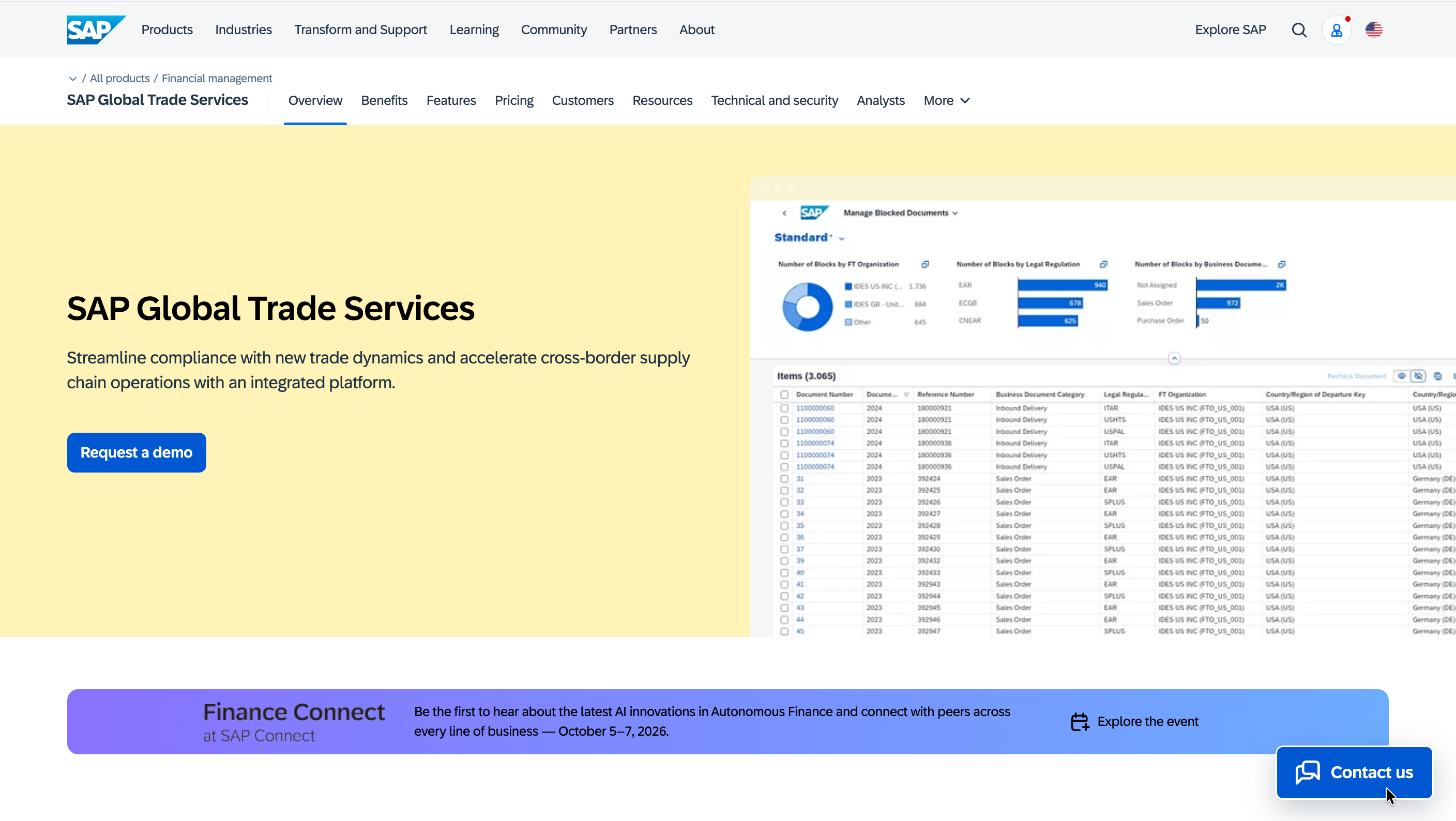
It automates sanctioned party list screening, export and import controls, classification, and customs management, pulling documents and master data directly from core SAP processes. For a shop running SAP S/4HANA, that native integration is the whole argument.
Key Features
- Sanctioned and denied party list screening on every new customer and business partner before shipment.
- Import and export license determination and control.
- Customs declaration management and electronic filing.
- HS and commodity classification against tariff schedules.
- Preference and free trade agreement management.
- Deep integration with SAP logistics and finance modules.
- Global trade reporting for senior management visibility.
Pricing
Enterprise licensing, quoted through SAP or a partner. Not publicly disclosed and typically bundled into broader SAP agreements.
Pros
- Native SAP integration pulls compliance data straight from the ERP with no separate data layer.
- Strong, dependable screening that reviewers trust for regulatory confidence.
- Mature customs and export control coverage for complex, high-volume operations.
Cons
- Long, resource-heavy implementation with a shortage of qualified partners.
- Flags exceptions for human review rather than resolving them, so analyst headcount scales with volume.
- Compliance screening can generate false positives that require manual clearing.
What Users Say
- Love: Screening that builds regulatory confidence. A verified reviewer writes that "the screening feature works very well, giving us confidence that we are not violating trade regulations," and that export declarations are easier because the system pulls documents from the ERP (source).
- Complain: Setup runs long. The same reviewer notes "the initial setup of SAP Global Trade Services can be complex and slow, sometimes taking several months to a year," compounded by "a lack of qualified implementation partners" (source). SAP GTS holds a 4.3/5 across 58 G2 reviews.
Thomson Reuters ONESOURCE Global Trade
Best for:
Fortune 1000 importers and exporters that already run a Thomson Reuters tax and content stack and want classification, duty determination, and screening on the same platform.
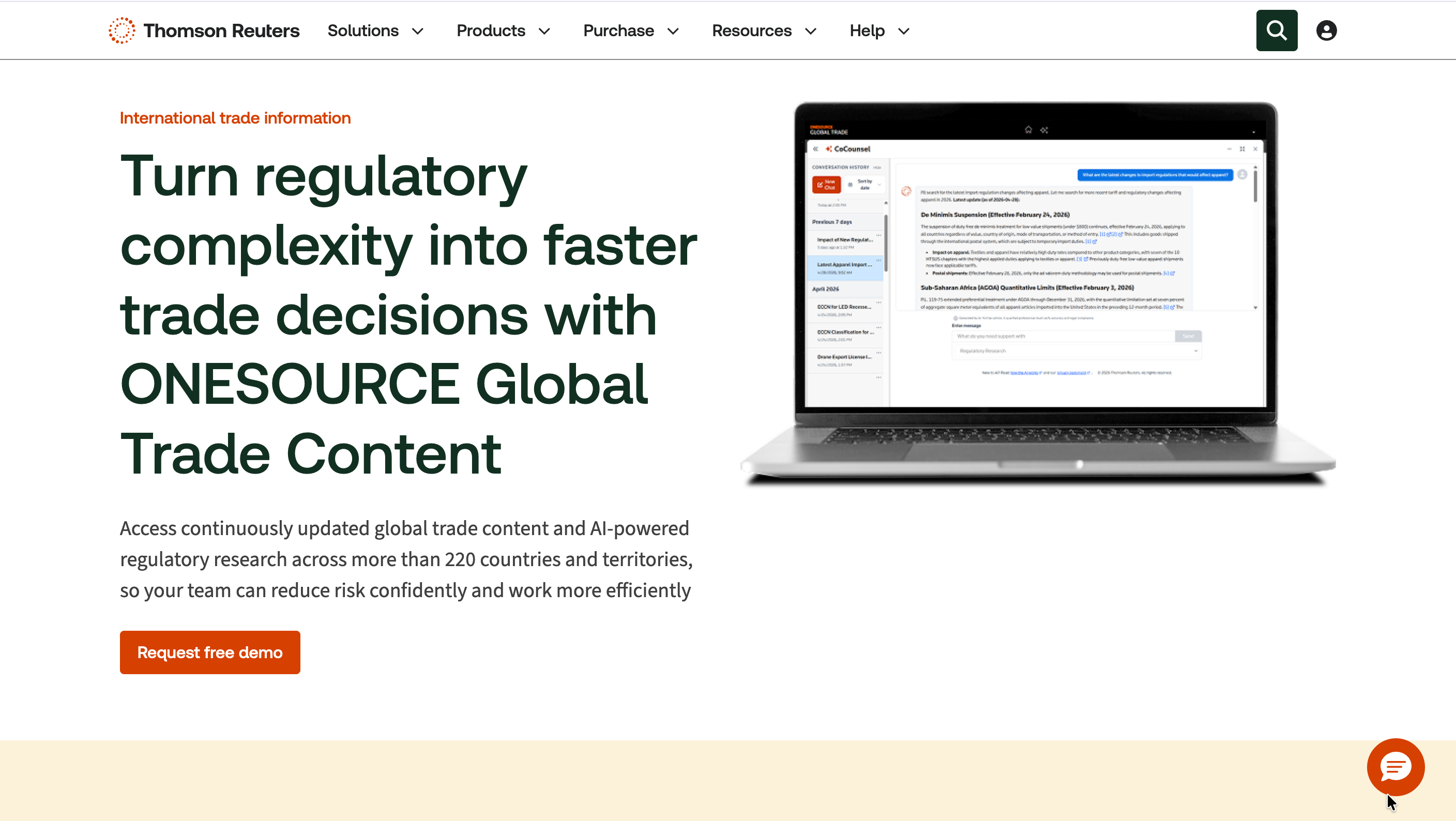
ONESOURCE Global Trade is Thomson Reuters' trade automation suite, offering a single interface for classification, duty determination, restricted party screening, FTA management, and reconciliation. Its differentiator is content: Thomson Reuters maintains one of the deepest trade content libraries in the market, and the suite integrates natively with SAP S/4HANA. For enterprises where classification accuracy and regulatory content depth matter most, it is a recognized leader.
Key Features
- HS classification backed by extensive proprietary trade content.
- Duty and landed-cost determination across jurisdictions.
- Restricted and denied party screening.
- Free trade agreement and preference management.
- Import and export declaration and reconciliation.
- Native SAP S/4HANA integration.
- Global trade reporting and audit support.
Pricing
Enterprise licensing, quoted, typically tied to the broader Thomson Reuters content and tax stack. Not publicly disclosed.
Pros
- Deep, well-maintained trade content for accurate classification and duty determination.
- Strong fit for organizations already invested in Thomson Reuters tax products.
- Recognized Global Trade Management leader with mature FTA and reconciliation coverage.
Cons
- Assistive by design, so classification and screening decisions still route to analysts.
- Pricing sits at the enterprise tier and is tied to the wider Thomson Reuters stack.
- Continuous tariff monitoring and proactive landed-cost modeling are lighter than the content and classification depth.
What Users Say
- Love: Content depth that anchors accurate classification. ONESOURCE is widely recognized as an end-to-end, ERP-integrated trade compliance platform whose classification and duty content is trusted by Fortune 1000 importers (source).
- Complain: Thin independent review signal. ONESOURCE Global Trade carries no G2 review volume, so day-to-day usability is hard to validate outside analyst positioning and vendor references (source).
Descartes
Best for:
Customs and compliance teams that treat tariff content quality as the deciding factor, and want customs functions connected to a wider logistics portfolio.
Descartes Customs & Compliance Suite is a cross-border compliance solution built around what many consider the deepest commercial tariff database, covering 175+ countries. It handles customs entries, classification validation, and compliance workflows in a single ecosystem, and it integrates well with SAP GTS through its CustomsInfo content. Reviewers consistently praise its reliability and real-time regulation updates.
Key Features
- The deepest commercial tariff and trade content database, spanning 175+ countries.
- Customs entry management and electronic filing.
- Restricted and denied party restricted party screening against global lists.
- Real-time tariff and regulation validation updates.
- Classification validation and duty determination.
- Document archive and statement processing.
- Integration with the broader Descartes logistics and transportation portfolio.
Pricing
Modular, quoted by function. You license the components you need, which suits teams scoping a specific customs workflow.
Pros
- Best-in-class tariff content and real-time regulatory updates reduce manual research.
- All-in-one customs ecosystem cuts platform switching for entry teams.
- Reliable at high entry volume with responsive support.
Cons
- Interface feels dated, and experienced users hit workflow friction.
- Lacks a REST API for some third-party integrations, per user reviews.
- Assistive rather than agentic, so classification and screening still need human sign-off.
What Users Say
- Love: A dependable, consolidated customs workflow. A verified logistics reviewer calls it a "Reliable, All-in-One Platform for Efficient Customs & Compliance Workflows" that "combines multiple customs and compliance functions within a single ecosystem, reducing the need to switch between different platforms" (source).
- Complain: The experience shows its age. The same reviewer notes "some parts of the user experience feel dated compared to modern software solutions," with "occasional workflow inefficiencies, extra clicks, and small usability issues that can slow down experienced users" (source). Descartes Customs & Compliance holds 4.4/5 across 93 G2 reviews.
E2open
Best for:
Multinationals running trade across 10 or more jurisdictions that need strong free trade agreement qualification logic across complex supply chains.
E2open's Global Trade Application Suite, which absorbed Amber Road, automates compliance, import and export operations, and duty management inside a broader supply chain platform. Its strength is FTA qualification across multi-country supply chains, making it a fit for large manufacturers optimizing preferential duty rates across many trade lanes.
Key Features
- Strong FTA qualification and rules-of-origin logic across multiple jurisdictions.
- Import and export compliance management.
- Restricted party screening.
- Duty management and landed-cost calculation.
- HS classification.
- Integration with the wider E2open supply chain suite.
- Global trade documentation and reporting.
Pricing
Enterprise licensing, quoted. Not publicly disclosed, and buyer's guides note deployments can reach seven figures.
Pros
- Strong FTA and rules-of-origin logic for complex multi-country supply chains.
- Part of a broader supply chain platform, useful for shippers consolidating trade and logistics.
- Broad jurisdictional coverage for global manufacturers.
Cons
- Multi-million-dollar implementations with long, multi-phase timelines, per buyer's guides.
- Thin independent review volume makes usability hard to validate.
- Assistive workflow, so compliance decisions still route to analysts.
What Users Say
- Love: FTA logic built for global complexity. Buyer's guides highlight E2open's "strong FTA qualification logic across complex multi-country supply chains," best suited to multinationals running trade across 10+ jurisdictions, and it carries a 4.6/5 on G2 (source).
- Complain: Limited public validation and heavy deployments. The suite has only five G2 reviews, the most recent more than two months old, so independent signal is thin, and buyer's guides flag "multi-million-dollar implementations; long timelines" (source).
Oracle Global Trade Management
Best for:
Enterprises standardized on Oracle that want a GTM layer inside Oracle Transportation Management, and can absorb top-of-market pricing.
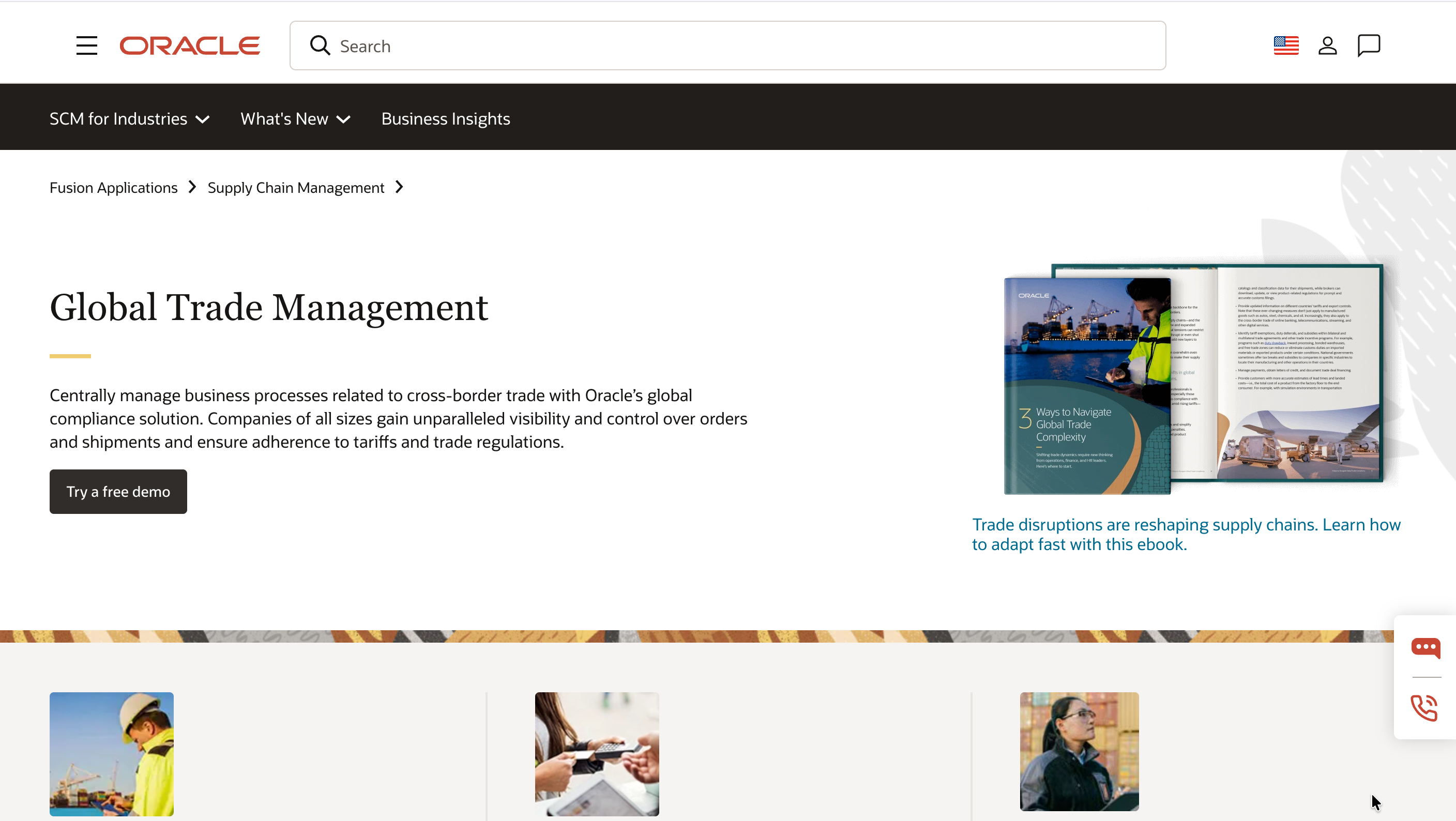
Oracle Global Trade Management Cloud is Oracle's trade compliance offering, delivered within OTM. It automates tariff classification, denied party screening, licensing, and trade execution, and integrates cleanly with the Oracle stack. Reviewers like its clean interface and reporting, though cost is a recurring theme.
Key Features
- Tariff and commodity classification.
- Denied and restricted party screening.
- License determination and management.
- Duty calculation and landed-cost analysis.
- Trade execution and documentation.
- Native integration with Oracle Transportation Management and Oracle Cloud ERP.
- Reporting and analytics with configurable views.
Pricing
Enterprise licensing, quoted through Oracle. Reviewers repeatedly describe it as more expensive than competing platforms.
Pros
- Clean, easy-to-use interface that shortens training time for new users.
- Strong reporting and analytics for trend and compliance visibility.
- Native fit for Oracle-standardized enterprises inside OTM.
Cons
- Priced above competing platforms, a consistent reviewer complaint.
- Occasional slow dashboard load times on larger data sets.
- Assistive rather than agentic, and buyer's guides note a lighter feature roadmap in recent years.
What Users Say
- Love: Clean and quick to learn. A mid-market reviewer describes it as a "Clean and easy to use portal" where "even with new users, the training time is reduced due to the entire portal's easy functionality" (source).
- Complain: Priced at the top of the market. The same reviewer notes "cost of the software is higher than the competitors" and wishes for "a more cost effective version" (source). Oracle GTM Cloud holds 4.2/5 across 16 G2 reviews.
{{brown-cta}}
How to choose the right trade compliance software
Match the platform to how much of the compliance workload you want it to carry, then weigh that against your ERP stack and implementation timeline.
- Full coverage and autonomous execution: Freehand classifies, screens, calculates duty, and files claims without routing decisions to an analyst, covering every shipment instead of a sample.
- Native ERP standardization: SAP Global Trade Services fits enterprises already running SAP end to end, while Oracle Global Trade Management suits teams standardized on Oracle Transportation Management.
- Trade content depth: Thomson Reuters ONESOURCE and Descartes lead on classification and tariff content, useful when content accuracy outweighs autonomous execution.
Pick based on how much manual review your team is willing to keep in the loop, not on feature count.
Software is only part of the answer; the compliance obligations behind it keep shifting with tariffs and screening rules. For the fuller picture of what you are accountable for, see our overview of global trade compliance.
Our recommendation
Freehand leads this list for enterprises that want classification, duty, and screening decisions executed rather than flagged, with 100% shipment coverage and a 12 to 14 week go live.
SAP Global Trade Services is the stronger pick if you are standardized on SAP and can absorb a long implementation for native ERP controls.
Thomson Reuters ONESOURCE and Descartes remain the deepest options on trade content, worth shortlisting when classification accuracy matters more than execution speed, while Oracle Global Trade Management and E2open round out the list for Oracle-native shops and multinationals with heavy FTA needs.
The decision comes down to autonomy versus content depth: how much compliance work you want the platform to execute versus how much analyst review you are willing to keep.
Best Trade Compliance Software Alternatives: SAP Global Trade Services
If SAP GTS fits your ERP but not your timeline or your appetite for manual review, these alternatives address the gap differently.
Freehand
For teams that want compliance decisions executed rather than flagged, Freehand's agents classify, screen, calculate duty, and file autonomously, and go live in 12 to 14 weeks instead of the months-to-a-year SAP deployment.
Thomson Reuters ONESOURCE Global Trade
A content-first alternative that still integrates with SAP S/4HANA, strongest when classification accuracy and trade content depth outweigh native-ERP screening.
Oracle Global Trade Management
The natural counterpart for enterprises weighing an ERP-native GTM layer, if the standardization is on Oracle rather than SAP.
Best Trade Compliance Software Alternatives: Thomson Reuters ONESOURCE Global Trade
When ONESOURCE's content depth is attractive but its assistive workflow or enterprise pricing is not, these platforms are worth a look.
Freehand
Pairs autonomous execution with continuous screening and duty recovery, closing the loop that content-only platforms leave to analysts.
Descartes
A direct content rival with the deepest commercial tariff database across 175+ countries, better when customs entry management is the core job.
E2open
Stronger FTA qualification across many jurisdictions for multinationals optimizing preferential duty at scale.
FAQ
What is trade compliance software?
It is a system that helps importers and exporters meet cross-border regulations, automating HS classification, duty calculation, denied party screening, licensing, and documentation on continuously updated global rules.
How much does trade compliance software cost?
Enterprise platforms use quoted licensing rather than public pricing. Lightweight classification tools start near $1,400 per year; full enterprise suites run into six or seven figures by volume.
What is the difference between trade compliance software and global trade management software?
Trade compliance software ensures shipments meet regulations. Global trade management is broader, adding logistics coordination, trade finance, and execution. Most enterprise GTM suites include compliance as a core module.
Does trade compliance software classify HS codes automatically?
Yes. It analyzes product attributes and matches them to the correct code in each country's tariff schedule. Agentic tools like Freehand assign and stamp the code without manual review.
What is denied party screening?
It checks every customer, supplier, carrier, and consignee against government restricted and sanctioned party lists, such as OFAC, BIS, EU, and UN, before a transaction proceeds, blocking matches automatically.
How long does trade compliance software take to implement?
It varies widely. ERP-native suites can take several months to over a year, while agentic platforms such as Freehand go live in roughly 12 to 14 weeks.
Can trade compliance software recover overpaid duty?
Yes. Platforms with drawback recovery, customs broker audit, and post-entry protest reclaim duty on exported goods and correct broker errors within legal filing windows, often recovering millions annually.
Which trade compliance software is best for enterprise importers?
It depends on your stack and goals. SAP and Oracle suit ERP-native shops, Thomson Reuters and Descartes lead on content, and Freehand leads on autonomous execution and full coverage.
Compliance Handled Separately From the Freight Bill, Both Covered.
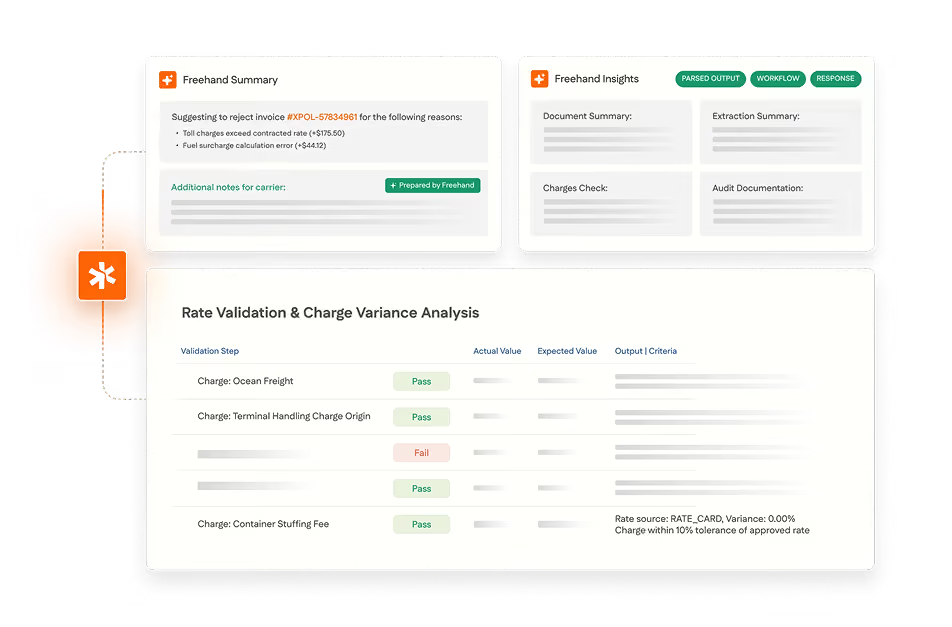
Freehand audits every freight invoice against contract terms, a distinct workstream from trade compliance that still needs its own coverage.
Trade Compliance Software Keeps You Out of Trouble. It Doesn't Keep You From Overpaying.
Classification, screening, and documentation reduce regulatory risk. None of it checks whether the freight invoice matches the contract.
Every warehouse. Every provider. Every mile.
Gartner's 2026 outlook on logistics outsourcing, and how AI Teams hold every contract to the terms you agreed.
- Where outsourced logistics quietly loses margin
- Why billed charges drift from the contract
- How AI Teams close the gap