
Best AI Supply Chain Software for Finance Teams in 2026
.webp)
July 9, 2026
•
9
mins
The best AI supply chain software for finance teams in 2026, by function: Finance: 1. Freehand, 2. HighRadius. Planning: 3. o9 Solutions, 4. Kinaxis, 5. Blue Yonder. Visibility: 6. project44, 7. FourKites, 8. e2open. Execution: 9. Manhattan Associates, 10. SAP.
For a finance team, the supply chain software that matters most is the layer that turns freight and supply chain activity into controlled cost: audit, AP, and payment.
This guide leads with that finance layer, then maps the planning, visibility, and execution tools it connects to, so you can see where your spend runs and what feeds it.
Gartner projects supply chain software with agentic AI will reach $53 billion in spend by 2030, and finance is where that autonomy shows up as recovered margin.
TL;DR
- Freehand (Finance). AI Teams that run freight AP, audit, and payment autonomously at 100% coverage, the standout for logistics finance.
- HighRadius (Finance). A deep agentic finance suite across order-to-cash, close, and AP for enterprise finance teams.
- o9 Solutions (Planning). AI-native integrated planning on an Enterprise Knowledge Graph, a Gartner-recognized leader for complex enterprises.
- Kinaxis (Planning). Concurrent planning with Maestro Agents, explainable AI co-workers embedded in live planning.
- Blue Yonder (Planning). Luminate cognitive AI for demand, inventory, and transportation, strong in retail and dense networks.
- project44 (Visibility). Real-time transportation visibility with predictive ETAs across a large carrier network.
- FourKites (Visibility). Multimodal shipment visibility with predictive ML, broad across ocean, rail, and road.
- e2open (Visibility). Connected-network platform for collaboration and supply risk beyond a single company's walls.
- Manhattan Associates (Execution). Unified WMS, OMS, and TMS with ML order orchestration across the fulfillment network.
- SAP (Execution and suite). The ERP backbone under a large share of global supply chain and finance data, with Joule agents.
What is AI supply chain software?
AI supply chain software applies machine learning and agentic AI to plan, execute, and finance the flow of goods, moving from reporting toward autonomous action. It typically spans four functions:
- Planning: demand, supply, and inventory optimization
- Visibility: real-time tracking, ETAs, and risk
- Execution: warehouse, order, and transportation management
- Finance: freight audit, AP, and payment
- Orchestration: agents that act across these layers within guardrails
Because the functions are distinct, most enterprises assemble a stack rather than buy one platform. For the finance function, see Freehand's freight audit and payment software page.
How We Evaluated AI Supply Chain Software
We identified the leading platform in each function, then judged candidates on the same cross-cutting criteria using vendor documentation, Gartner Peer Insights, and G2. Autonomy and function depth carry the most weight, because a tool that only reports leaves the decision on your desk.
- AI autonomy and agentic action (25%). Does the system act on decisions or only surface them.
- Function depth (20%). Best-in-class capability in its category, not thin breadth.
- Explainability and adoption (15%). Whether teams trust and use the AI, the most common failure point.
- Integration and data model (15%). ERP, TMS, and network connectivity.
- Real-time data and accuracy (15%). Quality and timeliness of the underlying data.
- ROI and time-to-value (10%). How quickly the platform pays back.
This is an independent editorial comparison referencing Gartner and G2 alongside vendor documentation; it is not a certified third-party ranking.
AI supply chain software, by function
No single platform wins every function, so the standouts below are grouped by what you are buying for, starting with the finance layer.
AI supply chain software compared by function
| Tool | Function | Best For | AI Capability | Implementation | Pricing Model | Overall (/5) |
|---|---|---|---|---|---|---|
| Freehand | Finance | Autonomous freight AP, audit, and payment | Agentic AI Teams, 100% audit | 12 to 14 weeks | Custom, volume-based | 4.5 |
| HighRadius | Finance | Agentic order-to-cash, close, and AP | 180+ finance agents | 3 to 6 months | Custom | 4.0 |
| o9 Solutions | Planning | Integrated demand and supply planning | Enterprise Knowledge Graph, AI-native | 6 to 12 months | Custom | 4.6 |
| Kinaxis | Planning | Concurrent planning and orchestration | Maestro Agents, explainable | 6 to 12 months | Custom | 4.5 |
| Blue Yonder | Planning | Demand, inventory, and transportation | Luminate cognitive AI | 6 to 12 months | Custom | 4.2 |
| project44 | Visibility | Real-time transportation visibility | Movement, predictive ETAs | 2 to 4 months | Subscription | 4.1 |
| FourKites | Visibility | Multimodal shipment visibility | Predictive ML on network data | 2 to 4 months | Subscription | 4.0 |
| e2open | Visibility | Network collaboration and risk | Connected-network AI | 3 to 6 months | Subscription | 3.9 |
| Manhattan Associates | Execution | Unified WMS, OMS, and TMS | ML order orchestration | 4 to 9 months | Custom | 4.1 |
| SAP | Execution and suite | ERP backbone for supply chain and finance | Joule agents | 6 to 18 months | Custom | 3.9 |
Overall is our weighted editorial score on the criteria below, not a third-party rating.
Here is a detailed comparison of the best AI supply chain software grouped by function.
AI Supply Chain Finance Software
Finance tools audit, process, and pay freight and vendor invoices, the function that turns supply chain activity into cost. This is where Freehand leads.
{{blue-cta}}
Freehand
Best for
Logistics finance teams that want freight AP, audit, and payment run autonomously, not sampled and routed to analysts.

Freehand is an AI-native platform whose AI Teams audit 100% of freight invoices, resolve exceptions, file disputes, and execute payment, posting to the ERP without a queue. It is the finance layer of the supply chain stack, delivering completed AP work as software rather than seats, so it replaces the labor line instead of assisting it.
Key Features
- AI Teams that run freight AP, audit, and payment end to end
- Agentic exception resolution, see autonomous exception management
- 100% invoice audit coverage, not a sample
- Multi-way matching across invoice, rate, shipment, and PO
- Autonomous carrier dispute and recovery
- Real-time GL coding and cost allocation
- Native SAP, Oracle, and NetSuite connectors, TMS-agnostic
- 30+ freight billing error types caught, adaptive
- Client-exclusive model trained on your data
Pricing
Custom, volume-based, with no percentage-of-savings fee. Quote after a scoping call.
Pros
- Fully agentic, resolves exceptions rather than flagging them
- 100% coverage that scales without added headcount
Cons
- Covers the finance function only, not planning or visibility
- A newer entrant than the established supply chain suites
What Users Say
- Love: Autonomy that runs freight finance. Freehand audits 100% of invoices and resolves exceptions autonomously, and is named in the 2026 Gartner Market Guide for Freight Audit and Payment Providers. (source)
- Complain: No independent review profile yet. As a newer entrant, Freehand has no Gartner Peer Insights or G2 presence, so buyers validate it through reference calls rather than aggregated ratings.
HighRadius
Best for
Enterprise finance teams that want a deep agentic suite across order-to-cash, close, and AP.
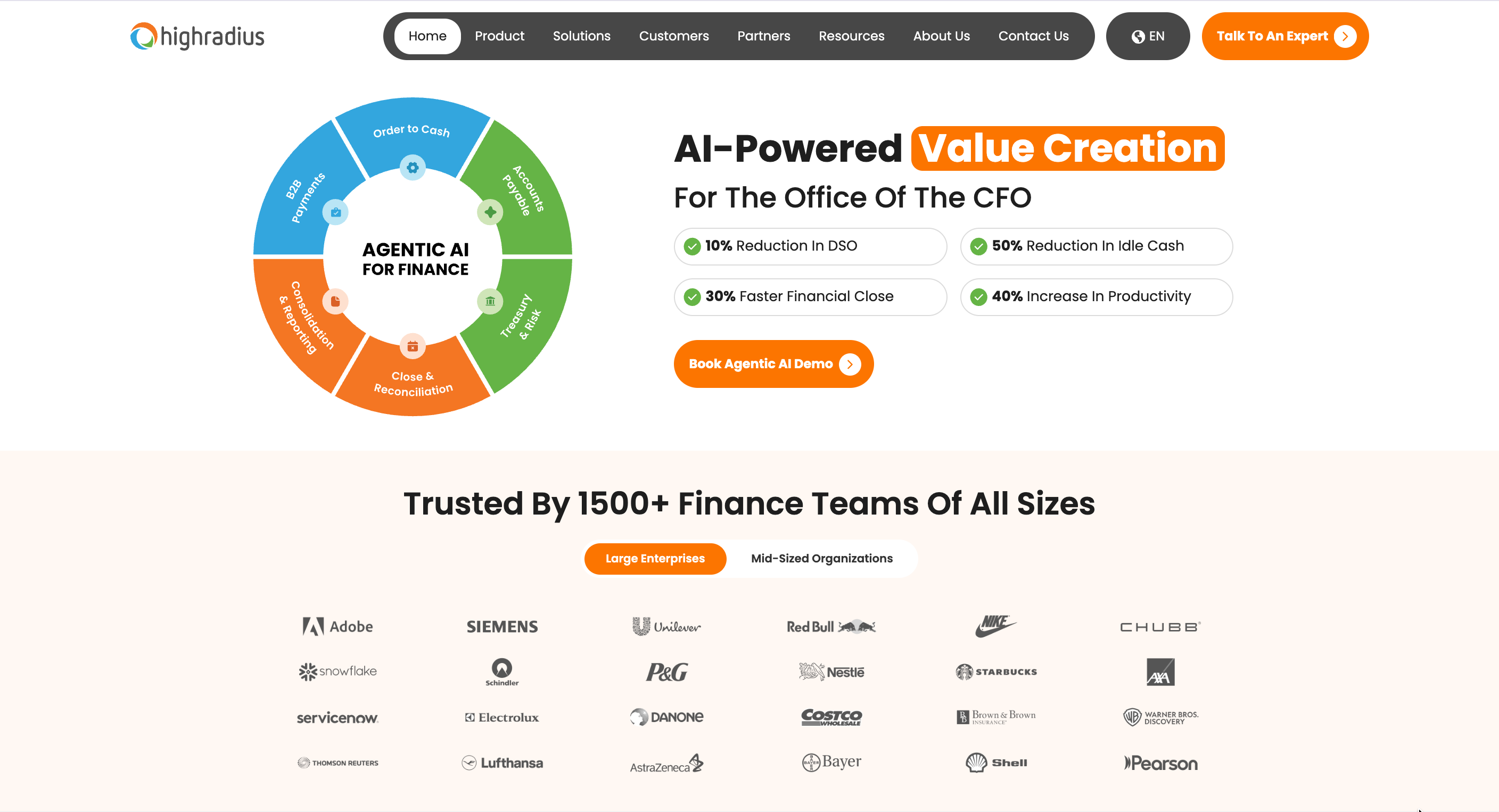
HighRadius runs 180+ agents across O2C, close and reconciliation, AP, and treasury, with a three-way matching agent that auto-codes freight and tax. It is built for finance broadly rather than logistics specifically.
Key Features
- 180+ agents across O2C, close, AP, and treasury
- Three-way matching agent that auto-codes freight and tax
- Autonomous exception handling
- Cash-flow forecasting
- Fraud and duplicate detection
- Live PO and GRN balances
- SAP and Oracle integrations
- Enterprise governance
Pricing
Custom, enterprise. Not published.
Pros
- Deep agentic finance automation at scale
- Freight-aware invoice coding within a broad suite
Cons
- Best known for receivables, not logistics finance
- Long enterprise implementation
What Users Say
- Love: Agentic finance at scale. HighRadius is recognized for a deep agentic suite that cuts invoice exceptions and manual touchpoints across O2C, close, and AP. (source)
- Complain: Broad finance focus. Freight audit sits inside a large O2C suite rather than carrier-native logic. (source)
AI Supply Chain Planning Software
Planning tools forecast demand, balance inventory, and align supply, and this is where AI-native depth matters most.
o9 Solutions
Best for
Large enterprises that want AI-native integrated planning on a single knowledge graph.

o9 built its Enterprise Knowledge Graph to model demand, supply, and financial signals together, so plans reflect the whole network. It is a Gartner-recognized leader for complex, high-variability planning.
Key Features
- Enterprise Knowledge Graph data model
- Integrated demand and supply planning
- Scenario modeling and simulation
- Revenue and margin planning
- Machine-learning forecasting
- Collaborative planning workflows
- ERP integrations
- Real-time analytics
Pricing
Custom, enterprise. Not published.
Pros
- Deep, AI-native planning for complex enterprises
- Unified data model across supply and finance signals
Cons
- Long implementation and change management
- Planning scope, not execution or freight finance
What Users Say
- Love: Recognized planning leader. o9 was named a Leader in the 2026 Gartner Magic Quadrant for Supply Chain Planning, with marquee enterprise customers. (source)
- Complain: Heavy to deploy. Reviewers note the platform's depth requires significant implementation and data effort. (source)
Kinaxis
Best for
Enterprises that want concurrent planning where any change propagates across the network instantly.
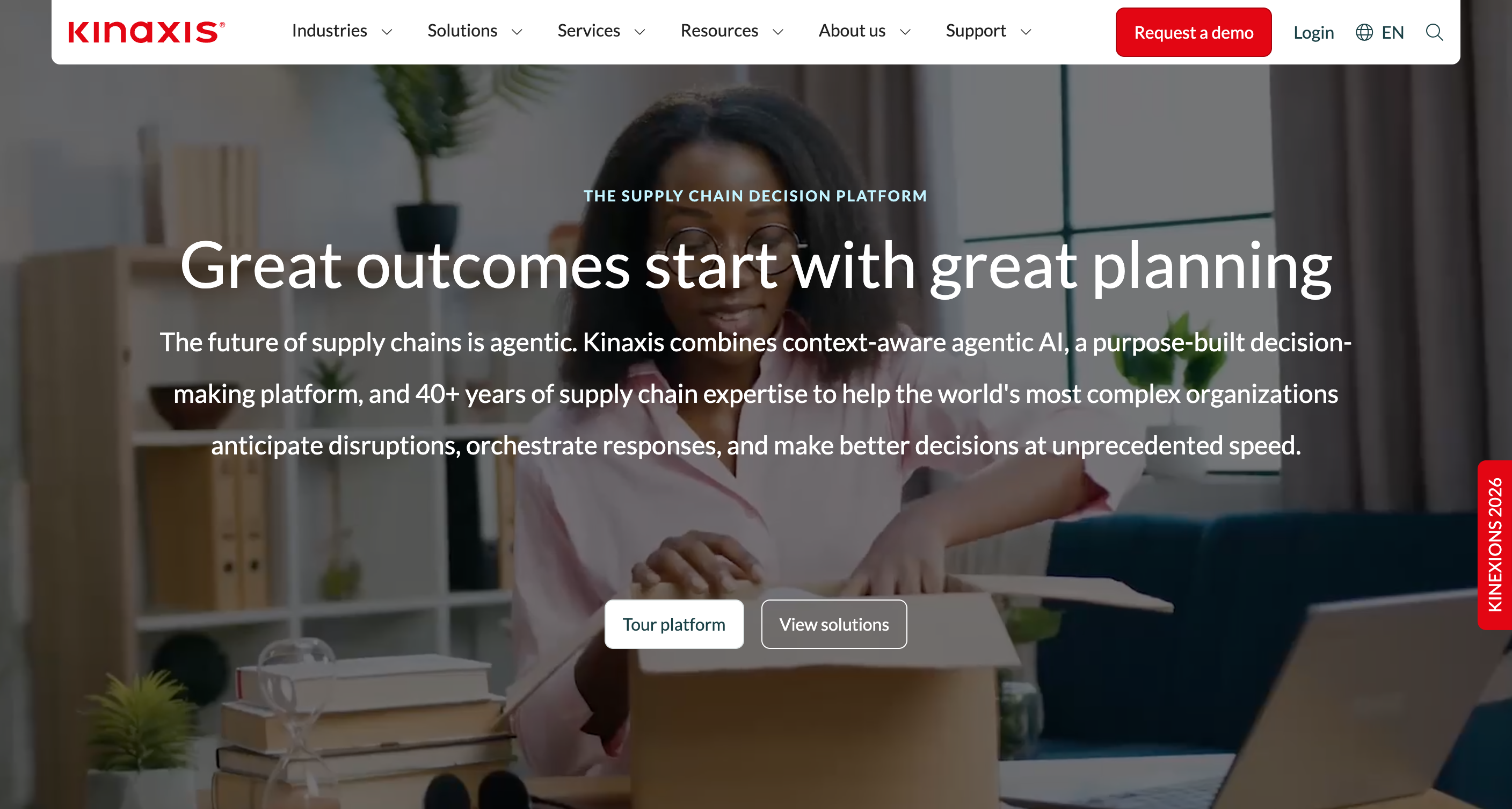
Kinaxis Maestro runs a concurrent planning engine so a supplier delay or demand spike updates the whole model at once, now with Maestro Agents that act as explainable AI co-workers inside live planning.
Key Features
- Concurrent planning engine
- Maestro Agents, explainable AI
- Demand and supply planning
- Scenario and what-if analysis
- Inventory optimization
- S&OP support
- ERP integrations
- Real-time replanning
Pricing
Custom, enterprise. Not published.
Pros
- Fast, network-wide replanning
- Explainable AI aids planner adoption
Cons
- Enterprise cost and complexity
- Planning focus, not finance execution
What Users Say
- Love: Concurrent planning with explainable agents. Kinaxis is valued for propagating changes across the network instantly, with Maestro Agents embedded in planning. (source)
- Complain: Steep learning curve. Reviewers cite complexity and the effort to configure the model to their network. (source)
Blue Yonder
Best for
Retailers and logistics providers managing volatile demand and dense distribution networks.

Blue Yonder's Luminate platform applies cognitive learning to forecast demand, balance inventory, and adjust transportation in real time, with broad reach across planning and execution.
Key Features
- Luminate cognitive AI
- Demand and fulfillment planning
- Inventory optimization
- Transportation planning
- Real-time adjustments
- Retail-focused capabilities
- ERP and network integrations
- Scenario planning
Pricing
Custom, enterprise. Not published.
Pros
- Broad planning and execution coverage
- Strong in retail and dense networks
Cons
- Large, multi-module deployments
- Not a freight finance or AP tool
What Users Say
- Love: Broad planning across demand and transport. Blue Yonder is recognized for cognitive demand, inventory, and transportation planning at scale. (source)
- Complain: Implementation scope. Reviewers point to the breadth of modules meaning longer, more involved rollouts. (source)
AI Supply Chain Visibility Software
Visibility tools track shipments, predict ETAs, and flag risk, solving problems planning tools alone cannot.
project44
Best for
Shippers and logistics teams that want real-time transportation visibility with accurate predictive ETAs.
project44's Movement platform tracks shipments across modes and carriers, using predictive models to sharpen ETAs and surface exceptions early across a large connected network.
Key Features
- Real-time multimodal tracking
- Predictive ETAs
- Exception alerts
- Large carrier network
- Ocean and over-the-road visibility
- API-first integrations
- Performance analytics
- Customer delivery experience tools
Pricing
Subscription, by volume. Contact for a quote.
Pros
- Accurate predictive ETAs
- Broad carrier connectivity
Cons
- Visibility layer, not planning or finance
- Value depends on carrier data quality
What Users Say
- Love: Strong predictive ETAs. project44 is credited for accurate, real-time transportation visibility across a wide carrier network. (source)
- Complain: Onboarding carriers takes effort. Reviewers note visibility quality depends on connecting and normalizing carrier data. (source)
FourKites
Best for
Enterprises that want multimodal shipment visibility with predictive machine learning across a large data network.
FourKites provides real-time visibility across ocean, rail, and road, applying predictive ML to a broad shipment data network to anticipate delays and disruptions.
Key Features
- Multimodal real-time visibility
- Predictive delay detection
- Large shipment data network
- Yard and facility visibility
- Exception management
- Analytics and reporting
- ERP and TMS integrations
- Sustainability tracking
Pricing
Subscription, by volume. Contact for a quote.
Pros
- Broad multimodal coverage
- Predictive ML on a large network
Cons
- Visibility only, no execution or finance
- Data completeness varies by lane
What Users Say
- Love: Broad multimodal visibility. FourKites is valued for tracking across ocean, rail, and road with predictive delay alerts. (source)
- Complain: Coverage gaps on some lanes. Reviewers cite variable data completeness depending on carriers and regions. (source)
e2open
Best for
Enterprises that need network-wide collaboration and supply risk management beyond their own systems.
e2open connects trading partners on a shared network, applying AI to collaboration, supply risk, and logistics across the extended supply chain rather than a single company.
Key Features
- Connected supply network
- Partner collaboration
- Supply and demand sensing
- Logistics and global trade management
- Risk monitoring
- Channel and inventory visibility
- ERP integrations
- Analytics
Pricing
Subscription, enterprise. Not published.
Pros
- Strong multi-party network collaboration
- Broad global trade and logistics coverage
Cons
- Complex, broad platform
- Not a freight finance or AP solution
What Users Say
- Love: Network-wide collaboration. e2open is recognized for connecting trading partners and managing supply risk across the extended network. (source)
- Complain: Breadth adds complexity. Reviewers note the wide module set can be complex to adopt fully. (source)
AI Supply Chain Execution Software
Execution and suite platforms run the warehouse, orders, and the underlying ERP data model.
Manhattan Associates
Best for
Enterprises that want unified warehouse, order, and transportation management in one cloud architecture.
Manhattan Active unifies WMS, order management, and TMS in a single cloud-native platform, applying machine learning to orchestrate orders across distribution centers, stores, and drop-ship partners.
Key Features
- Unified WMS, OMS, and TMS
- ML order orchestration
- Warehouse automation support
- Transportation management
- Store and drop-ship fulfillment
- Cloud-native architecture
- Real-time inventory
- Labor management
Pricing
Custom, enterprise. Not published.
Pros
- Unified execution across fulfillment
- Strong ML order orchestration
Cons
- Execution focus, not planning or finance
- Enterprise implementation timeline
What Users Say
- Love: Unified fulfillment execution. Manhattan is credited for bringing WMS, OMS, and TMS together with ML-driven order orchestration. (source)
- Complain: Implementation effort. Reviewers note unifying execution across a network is a significant project. (source)
SAP
Best for
Enterprises standardizing supply chain and finance on a single ERP backbone with embedded agents.

SAP's S/4HANA core sits under a large share of the world's production and logistics data, and its strategy makes that data the substrate for agentic execution through Joule and its expanding agent library.
Key Features
- S/4HANA ERP backbone
- Joule agents across finance and supply chain
- Integrated business planning
- Extended warehouse management
- Digital supply chain management
- Broad module ecosystem
- Global compliance and finance
- Enterprise integrations
Pricing
Custom, enterprise. Not published.
Pros
- Single data model across supply chain and finance
- Deep, embedded agentic roadmap
Cons
- Large, long, and costly deployments
- Freight audit depth is generic, not carrier-specialized
What Users Say
- Love: The enterprise data backbone. SAP is recognized as the ERP substrate under much of global supply chain and finance, now adding Joule agents. (source)
- Complain: Complexity and cost. Reviewers cite long implementations and the need for specialists to realize value. (source)
{{brown-cta}}
How to choose the right AI supply chain software
Match the software to the function that is costing you money today, not to the vendor with the longest feature list.
- Planning: if forecast accuracy and inventory balance are the problem, look at o9 Solutions, Kinaxis, or Blue Yonder.
- Visibility: if you need to see and predict shipment delays across carriers, look at project44, FourKites, or e2open.
- Execution and finance: if fulfillment or freight cost is the gap, Manhattan Associates and SAP run execution, while Freehand and HighRadius run the finance layer.
Buy for the function you are solving first, then add the next layer once that gap is closed.
Best AI Supply Chain Software Alternatives: Planning Platforms
If a planning platform anchors your stack, these cover the functions it does not.
Freehand
The finance-layer complement that audits and pays freight invoices autonomously, closing the loop between the plan and the actual freight cost.
project44
A visibility complement that adds real-time transportation tracking and predictive ETAs alongside planning.
Best AI Supply Chain Software Alternatives: SAP
When SAP is your backbone but freight audit depth is thin, pair it with a specialist.
Freehand
Native SAP connectors with carrier-specific freight audit at 100% coverage and autonomous dispute, deeper than generic ERP matching.
Manhattan Associates
An execution specialist for warehouse, order, and transportation management on top of the SAP data core.
Other AI supply chain tools supply chain teams consider
These names come up in supply chain software searches but sit outside the four functions this guide ranks.
- Relex: a retail and grocery-focused planning platform for demand forecasting and replenishment.
- Aera Technology: a decision-intelligence platform that layers recommendations across planning and operations data.
- Interos: a supply chain risk and mapping platform focused on supplier network exposure.
Our recommendation
For a finance team, Freehand is the pick for the layer you own: freight audit, exception resolution, and payment at 100% coverage without a manual queue. o9 and Kinaxis lead planning, project44 and FourKites lead visibility, and Manhattan and SAP run execution and the ERP core, the adjacent layers your finance data flows from.
Shortlist the finance layer first, then align on the planning, visibility, and execution tools your supply chain peers run.
FAQs
What is AI supply chain software?
Software that applies machine learning and agentic AI to plan, track, execute, and finance the flow of goods, increasingly acting on decisions rather than only reporting them.
What are the categories of AI supply chain software?
The main functions are planning, visibility, execution, and finance, plus orchestration agents that act across them. Most enterprises combine specialists rather than buy one platform.
What is the best AI supply chain software?
It depends on function: o9 and Kinaxis lead planning, project44 and FourKites lead visibility, Manhattan leads execution, and Freehand leads logistics finance.
Does AI supply chain software include finance and AP?
Yes. The finance function covers freight audit, AP, and payment. Freehand runs it autonomously at 100% coverage, turning supply chain activity into controlled cost.
How is agentic AI changing supply chain software?
Agentic AI shifts software from reporting to action, rerouting shipments, adjusting plans, resolving invoice exceptions, and paying carriers within guardrails you define.
Does AI supply chain software integrate with SAP and Oracle?
Yes. Leading tools connect to major ERPs; SAP embeds agents in its own core, while Freehand offers native SAP, Oracle, and NetSuite connectors for freight finance.
The AI Layer That Actually Checks the Invoice.
Freehand's AI Teams audit every freight invoice against contract terms, the piece of supply chain AI most platforms leave out.
Supply Chain AI Covers Planning and Visibility. Someone Still Audits the Freight Bill by Hand.
Forecasting demand and tracking shipments are valuable. Neither one checks whether the carrier invoice matches what was negotiated.
Every warehouse. Every provider. Every mile.
Gartner's 2026 outlook on logistics outsourcing, and how AI Teams hold every contract to the terms you agreed.
- Where outsourced logistics quietly loses margin
- Why billed charges drift from the contract
- How AI Teams close the gap