
Why Autonomous Exception Management Is Not Automated Exception Routing

April 1, 2026
•
6
mins
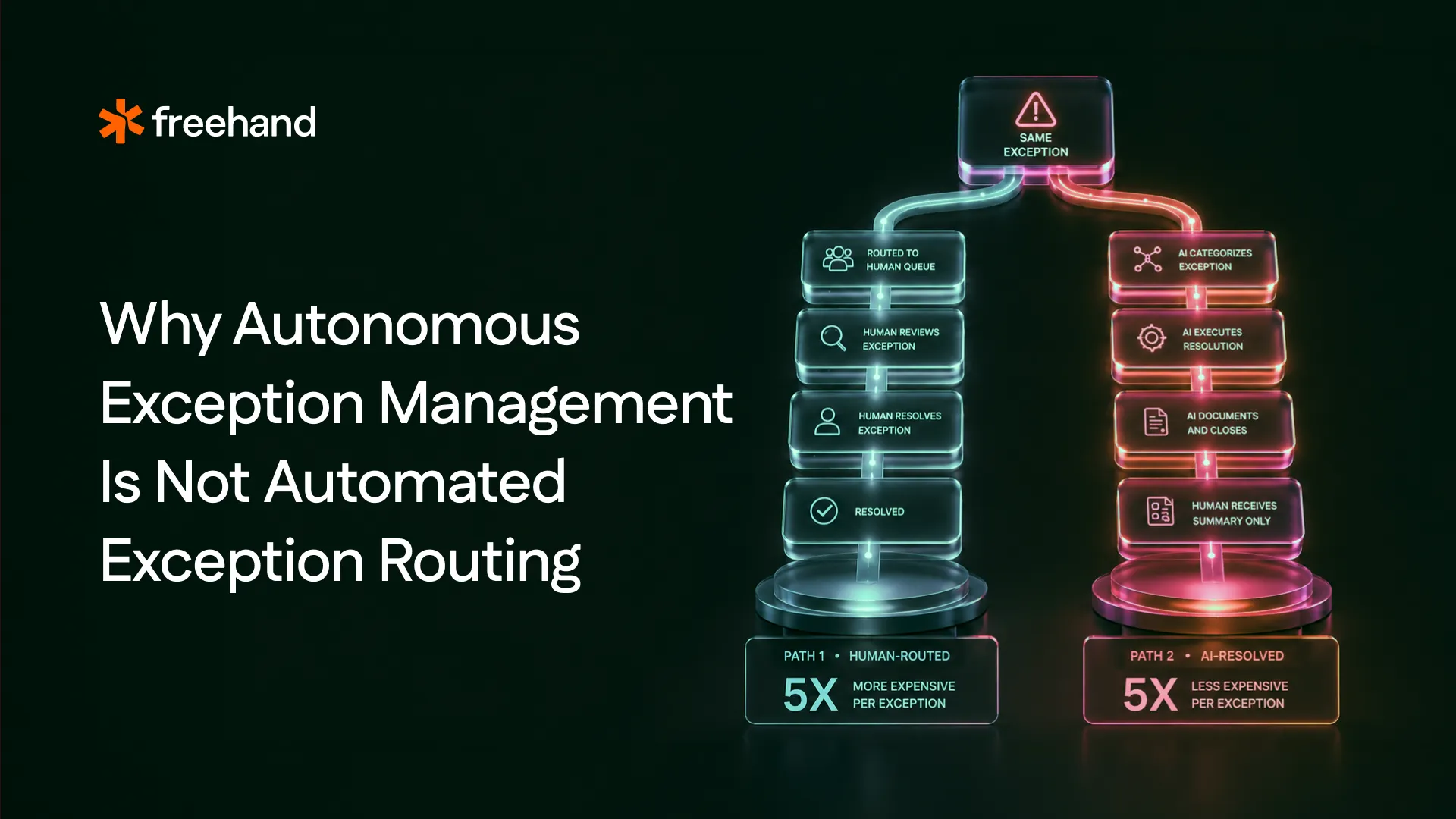
Routing sends an exception to a human. Autonomous management resolves it. The distinction is the entire value proposition.
Automated exception routing is a real capability and a genuine improvement over manual triage. When a billing discrepancy is detected, a system that automatically routes it to the correct review queue — by exception type, by carrier, by dollar threshold, by region — is faster and more consistent than a team sorting through an exception list manually. This is workflow automation, and most mature freight audit platforms offer some version of it.
Autonomous exception management is different in a specific and important way. Routing sends the exception to a human who then resolves it. Autonomous management categorizes the exception, determines the resolution path, executes the resolution, documents it, and closes it — without the human in the middle. The exception reaches a human desk only if it genuinely requires human judgment. That distinction is the difference between a system that reduces triage time and a system that eliminates it.
What categorization actually requires
Autonomous categorization of freight exceptions is computationally harder than it appears from the outside. An exception is not just a billing discrepancy. It is a billing discrepancy with a specific root cause that determines the appropriate resolution path. A fuel surcharge overage on a TL shipment where the carrier applied the wrong index requires a different response than a detention charge on an LTL shipment where the shipper's own facility data shows the driver was released within the free-time window. Both are exceptions. One is a billing correction. The other is a data dispute that requires shipment event verification.
Categorization at this level of precision requires three things: knowledge of the carrier-specific billing rules that govern what was billed, access to the shipment execution data that provides the ground truth for what actually happened, and historical pattern context about how this type of exception has been resolved in the past on this carrier on this lane. Without all three, categorization defaults to generic exception types that require human judgment to sort into resolution paths.

L1 versus L2: where the line sits
In a mature autonomous exception management system, exceptions are classified as L1 or L2 based on whether resolution requires human judgment. L1 exceptions — which typically represent 70 to 80 percent of exception volume after the system has been trained on the organization's exception patterns — can be resolved with information the system already has: carrier billing rules, shipment event data, contracted rates, and historical resolution patterns. The system generates the dispute packet, contacts the carrier, tracks the response, applies the credit, and closes the exception.
L2 exceptions are the ones that genuinely require a human: novel billing structures the system has not seen before, exceptions involving carrier relationship decisions that should have human accountability, disputes where the evidence is ambiguous and the resolution depends on commercial judgment rather than contractual logic. These are the exceptions that belong on a human desk. The L1 exceptions that currently fill most exception queues do not.
“A system that routes 60% of exceptions to humans has automated triage. A system that routes 5% to humans has automated resolution. The operational cost difference is not incremental. It is transformative.”
The recurring exception suppression curve
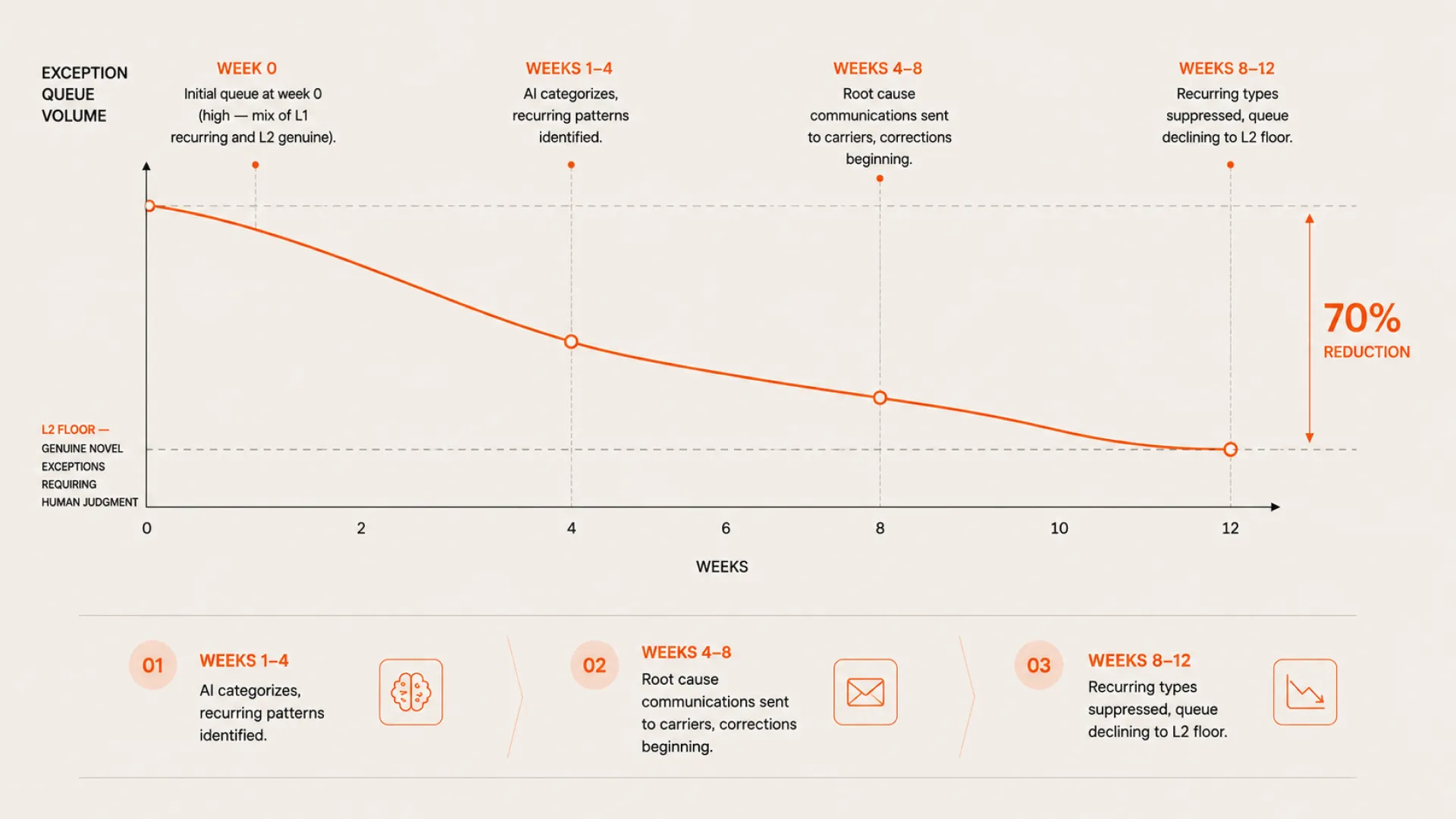
The most significant operational output of autonomous exception management is not how fast individual exceptions are resolved. It is how quickly recurring exception types are suppressed. When an L1 exception is resolved autonomously and the root cause is identified — a misconfigured DIM weight divisor in the carrier's billing system, a fuel surcharge table that was never updated to reflect the current contract — the system can communicate the root cause back to the carrier and track whether it is corrected. When the carrier corrects the underlying configuration, that exception type stops appearing. The queue permanently shrinks.
The 70% reduction in recurring exceptions that organizations see within 90 days of deploying autonomous exception management reflects this suppression effect. It is not that 70% fewer billing discrepancies occur in the carrier base. It is that 70% of the exceptions that were recurring every cycle are now resolved at the root cause rather than addressed individually each time they appear.