
Freehand Named a Representative Vendor in the 2026 Gartner® Market Guide for Freight Audit and Payment Providers
Gartner has published its 2026 Market Guide for Freight Audit and Payment Providers, and Freehand is named among the representative vendors in the market. For a company that has spent the last several years building agentic AI for the hardest category in enterprise spend, the recognition is a marker of where the freight audit and payment market is heading.

February 11, 2026
•
5
mins

Freehand Named a Representative Vendor in the 2026 Gartner® Market Guide for Freight Audit and Payment Providers
Recognized for automating spend management across sourcing, negotiation, contracting, and invoicing through payment processing.
Gartner has published its 2026 Market Guide for Freight Audit and Payment Providers, and Freehand is named among the representative vendors in the market. For a company that has spent the last several years building agentic AI for the hardest category in enterprise spend, the recognition is a marker of where the freight audit and payment market is heading.
The guide describes Freehand as offering services beyond freight audit and payment, spanning freight procurement, transport and freight insights, and supply chain orchestration. It identifies Freehand Studio as the platform that manages and executes source-to-pay operations. In Gartner's words, Freehand was recognized for its ability to automate spend management from sourcing, negotiation, contracting, and invoicing through payment processing.
“Freehand was recognized for its ability to automate spend management from sourcing, negotiation, contracting, and invoicing through payment processing.”
Gartner, Market Guide for Freight Audit and Payment Providers, February 2026
Why this market is changing
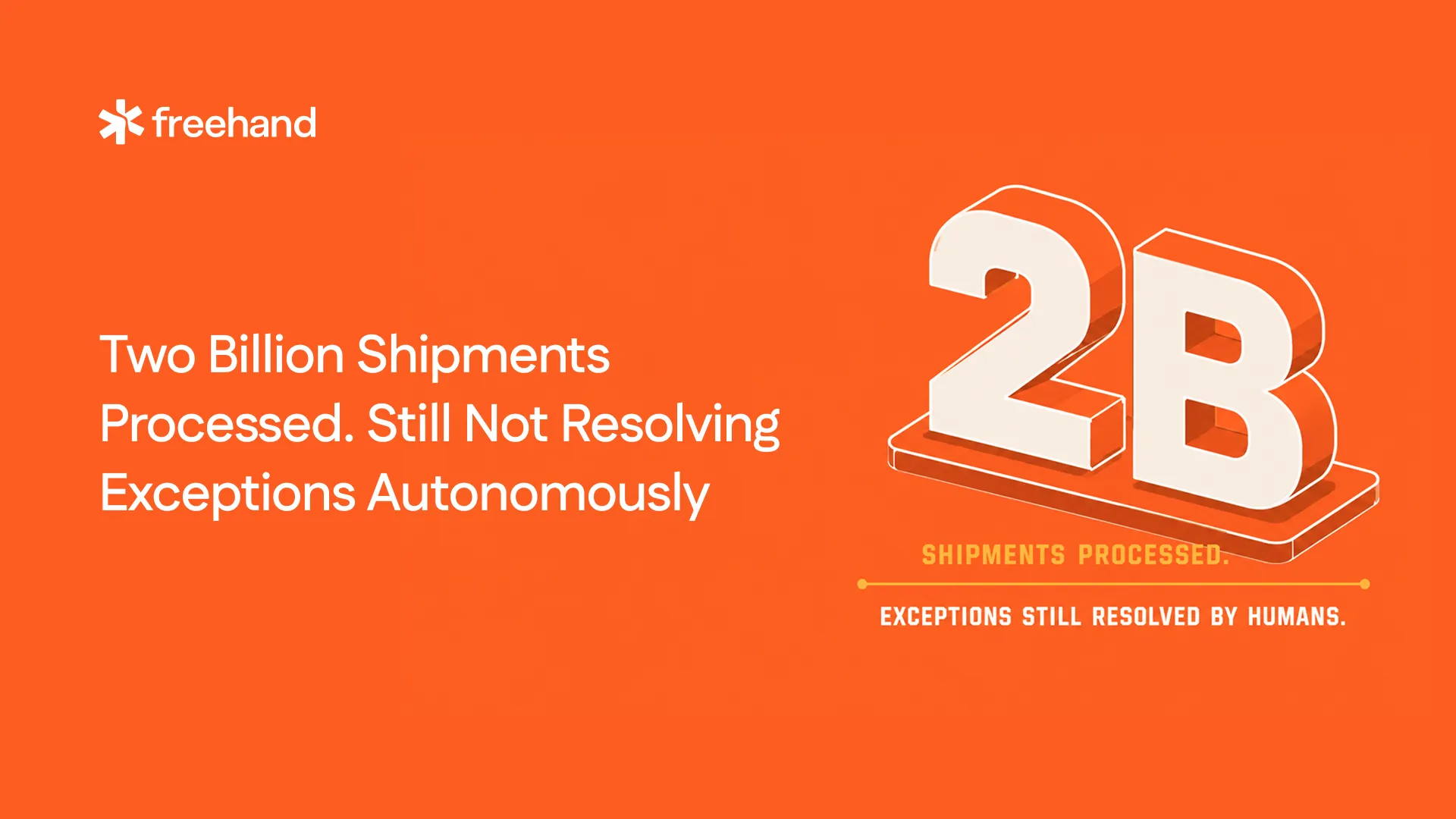
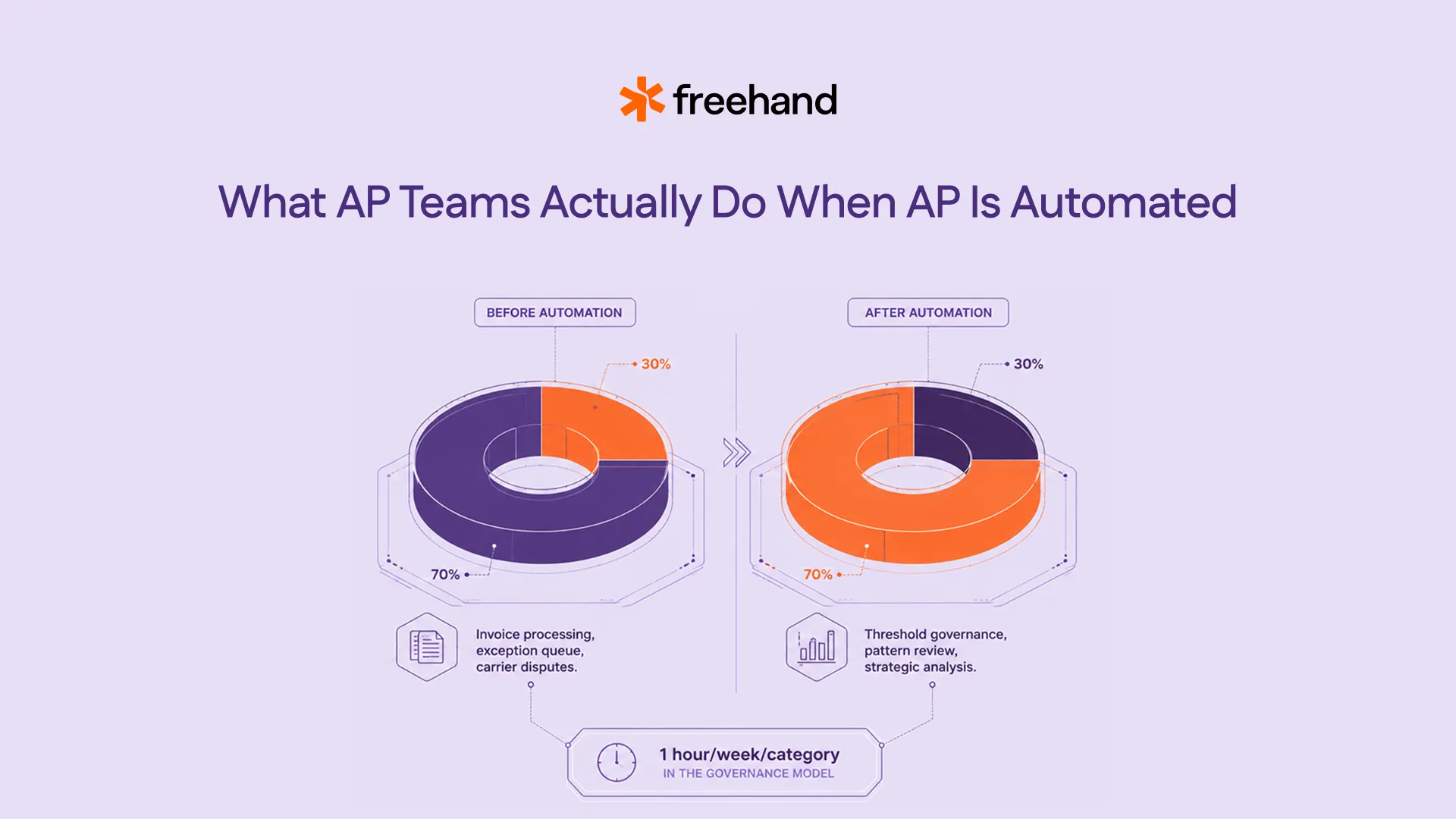
The guide is direct about the force reshaping this market. It observes that AI has significantly differentiated some vendors, particularly in autonomously processing large volumes of invoices, detecting discrepancies, and maintaining data integrity at scale. It notes that for vendors that have deployed AI at scale, human experts have shifted toward managing complex exceptions and adding business context, rather than performing the transactional work directly.
This is the distinction we have built the company around. A freight audit and payment operation is not primarily a software problem. It is a labor problem. The invoices arrive in every format. The contracts live in email. The accessorial rules are inconsistent across carriers and regions. Most of the cost of running freight AP is the human effort required to bridge those gaps. The market is now recognizing that agentic AI does not just accelerate that human effort. It replaces the layer of work entirely, and leaves people to do the judgment-heavy exception handling that actually requires a person.
The guide also documents a split in the market between managed service models, where the vendor runs the audit and payment process on the shipper's behalf, and self-service platforms, where the shipper manages the process using autonomous tooling. It notes that hybrid models are emerging as AI matures. Our position on this is that the operating-model question becomes far less important once the work itself is autonomous. When the AI completes the work, the shipper gets the control of a platform and the hands-off experience of a managed service at the same time. The tradeoff that used to define the choice is one that agentic AI removes.
What the recognition reflects
The guide records that Freehand processes more than $4.6 billion in global freight payments annually, at roughly 20,000 transactions per day, with processing and payment support in more than 20 languages and currencies, across a network of 40,000 preonboarded carriers. It notes that Freehand was recently named to the Deloitte Technology Fast 500 for its use of agentic AI to automate tasks across logistics and supply chain operations.
Those numbers describe scale. What they do not fully capture is the architecture underneath. The reason Freehand can automate the full path from sourcing to payment is that the agents operate on a shared context layer: carrier contracts, rate cards, shipment execution data, and the historical record of how every exception was resolved. The audit does not run on a static rule base that ages out of alignment with how carriers actually bill. It runs on a model that learns each carrier's billing behavior and updates with every cycle. That is what makes the difference between detecting an exception and resolving it without a person in the loop.
Where this goes next
The guide observes that freight audit and payment is expanding beyond cost control into a strategic data source that informs procurement, planning, and financial reporting. This is the direction we have been building toward. The same context layer that validates a freight invoice tells the procurement team whether a carrier is performing to contract. The same audit data that catches an overcharge feeds the accrual that finance closes the month on. Freight AP was never meant to be an isolated function. It is the closest thing most organizations have to a real-time view of supplier performance, and it becomes far more valuable once the data is captured completely and analyzed continuously.
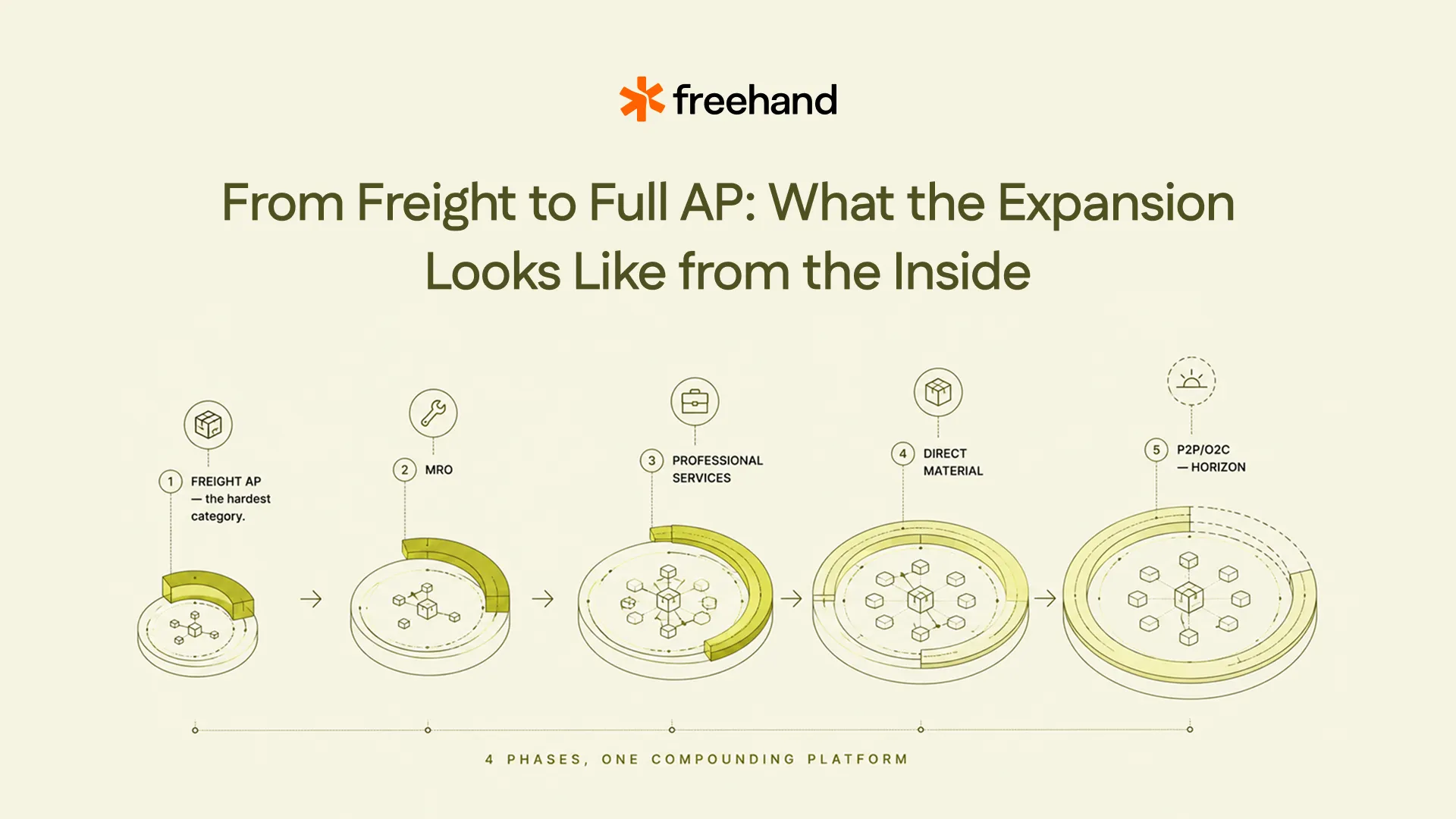
We are grateful to be recognized in this market, and clearer than ever about the work ahead. Freight is the hardest category in enterprise spend. It is where we started, by choice, because proving the model there makes everything that follows more credible. The recognition in this guide is a signal that the market sees the same shift we do.
────────────────────────────────────────
Gartner, Market Guide for Freight Audit and Payment Providers, Brian Day, Brian Whitlock, Matthew Beckett, 10 February 2026.
GARTNER is a registered trademark and service mark of Gartner, Inc. and/or its affiliates in the U.S. and internationally and is used herein with permission. All rights reserved. Gartner does not endorse any vendor, product or service depicted in its research publications, and does not advise technology users to select only those vendors with the highest ratings or other designation. Gartner research publications consist of the opinions of Gartner's research organization and should not be construed as statements of fact. Gartner disclaims all warranties, expressed or implied, with respect to this research, including any warranties of merchantability or fitness for a particular purpose.
────────────────────────────────────────
Read next
→ 33% Audit Coverage Is Not a Resource Constraint. It's a Design Choice.: Why sampling-based audit produces systematic gaps, and what full coverage requires.
→ The BPO Model Is Profitable Enough to Survive. Not Profitable Enough to Invest.: The economics behind the AI shift the Market Guide describes.
→ What Enterprise AI Gets Wrong Before It Gets Anything Right: The context and governance architecture that makes autonomous freight AP possible.