
The 30% That Contains 90% of the Leakage. What Horizontal AP Automation Misses Every Time.
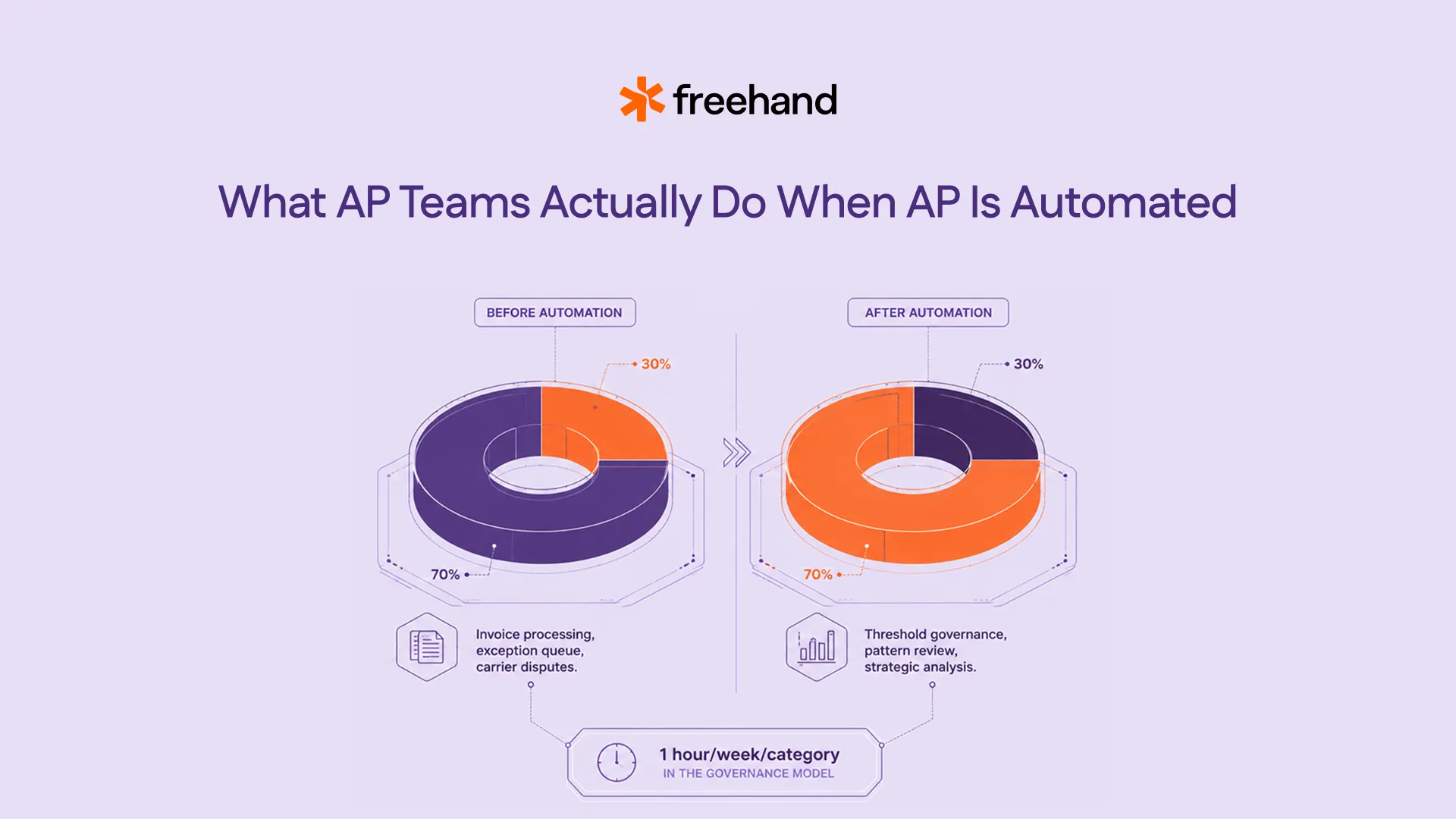
Generic tools handle the 70% of invoices that follow standard patterns. The 30% that require category expertise contain most of the financial exposure.

August 3, 2026
•
4
mins
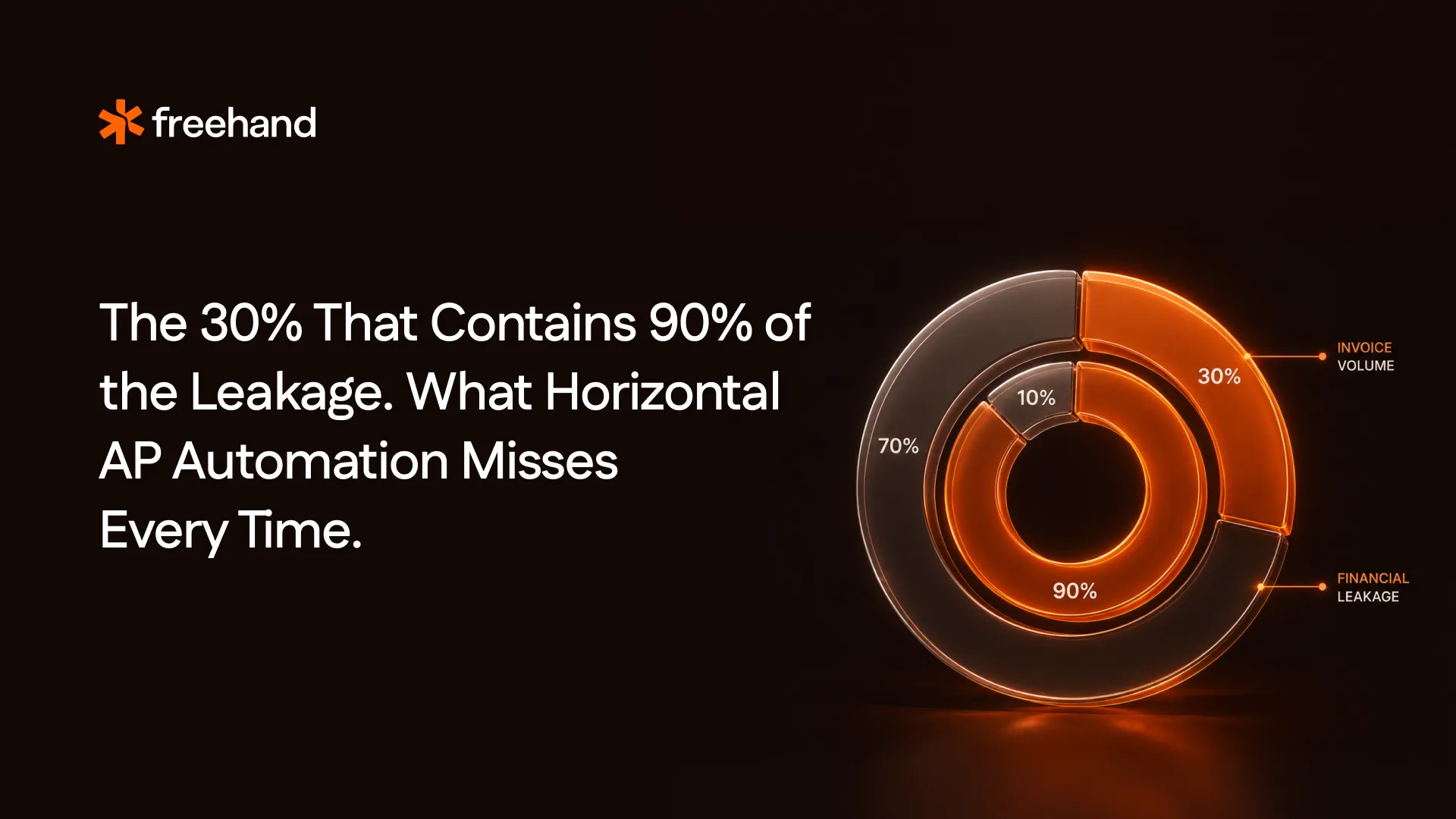
Generic tools handle the 70% of invoices that follow standard patterns. The 30% that require category expertise contain most of the financial exposure.
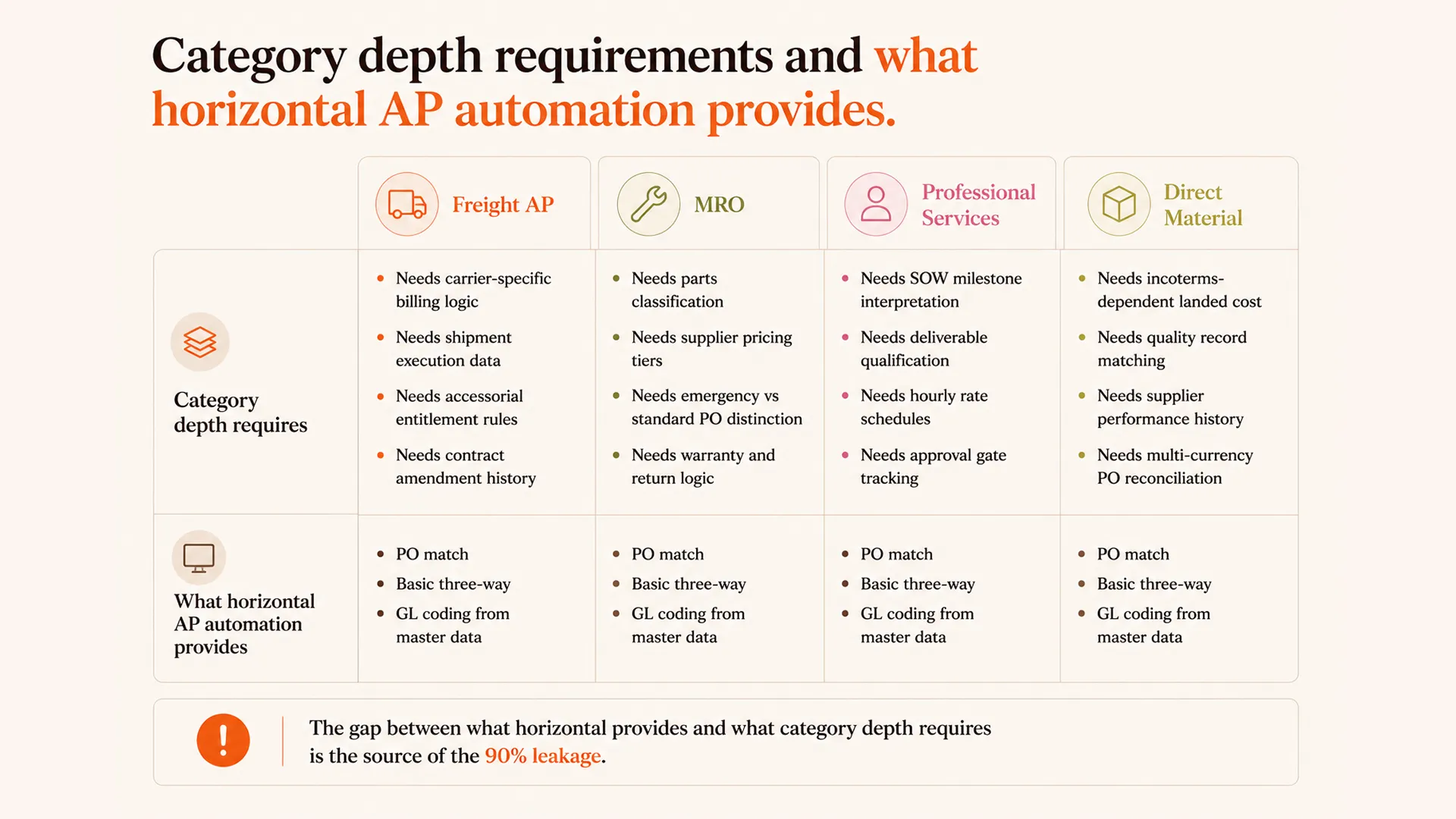
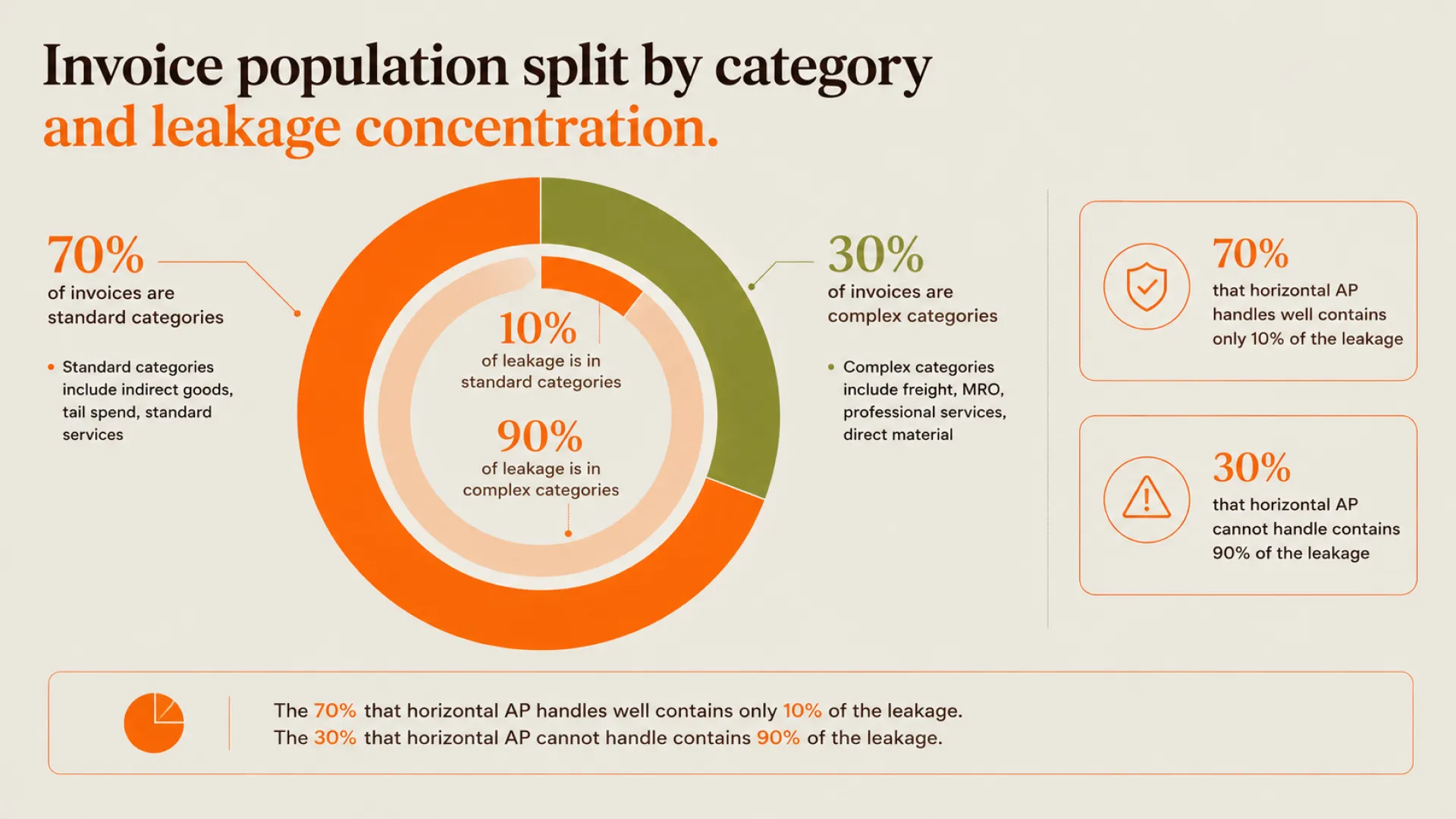
Horizontal AP automation platforms process invoices. They handle PO matching, basic three-way validation, GL coding from master data, and payment scheduling. For the category of invoices that follow standard procurement patterns, clearly documented terms, clean goods receipt, matching PO and invoice, they do this competently. At most Fortune 500 companies, roughly 70% of AP volume falls into this category. Horizontal platforms handle that 70% well.
The remaining 30% of invoice volume does not follow standard procurement patterns. It involves freight accessorial charges with contract-specific calculation rules. Professional services invoices with SOW interpretation. MRO invoices with complex part-number to cost-center mappings. Direct material invoices with incoterms-dependent landed cost calculations. Each of these categories has its own exception structure, its own domain-specific contract logic, and its own patterns of billing error. Horizontal platforms were not designed for any of them. That 30% contains approximately 90% of the leakage.
Why category depth determines where the value is
The 90/30 ratio is not a coincidence. It reflects the relationship between invoice complexity and billing error density. Standard procurement invoices, indirect goods, tail spend, standard services, are the product of mature procurement processes with well-documented terms. The error rate is low. The per-invoice recovery when errors do occur is modest. Horizontal automation handles these efficiently and the operational value is real but bounded.
Complex category invoices, freight, MRO, professional services, direct material, have higher error rates because their billing logic is more complex. Freight invoices have accessorial charges triggered by shipment conditions that the billing system may not have accurately recorded. MRO invoices have pricing that depends on contract terms that vary by part category, supplier relationship, and order size. Professional services invoices require matching against SOW milestones, approval gates, and hourly rate schedules that are often partially documented in email rather than fully expressed in the procurement system. The error rate in these categories is meaningfully higher than in standard procurement, and the per-invoice recovery when errors are found is substantially larger.
What category expertise requires technically
Category expertise in freight AP means the AI system understands carrier-specific billing logic at a depth that a general-purpose matching engine cannot provide. It knows that carrier A calculates detention from gate arrival rather than dock arrival. It knows that this shipper's contract with carrier B includes a fuel cap clause that was verbally agreed during a capacity crunch two years ago and has never been formally amended. It knows that the accessorial structure for parcel differs from the accessorial structure for LTL even when both are billed by the same carrier under the same master agreement.
Category expertise in professional services AP means the system understands SOW interpretation, when a delivered milestone qualifies for payment, what constitutes an acceptable deliverable under the contract terms, how to classify a disputed deliverable for escalation versus autonomous resolution. Category expertise in MRO means the system understands parts classification, supplier pricing tiers, and the difference between a planned purchase order and an emergency requisition that bypassed the standard procurement process.
The expansion sequence and why it matters
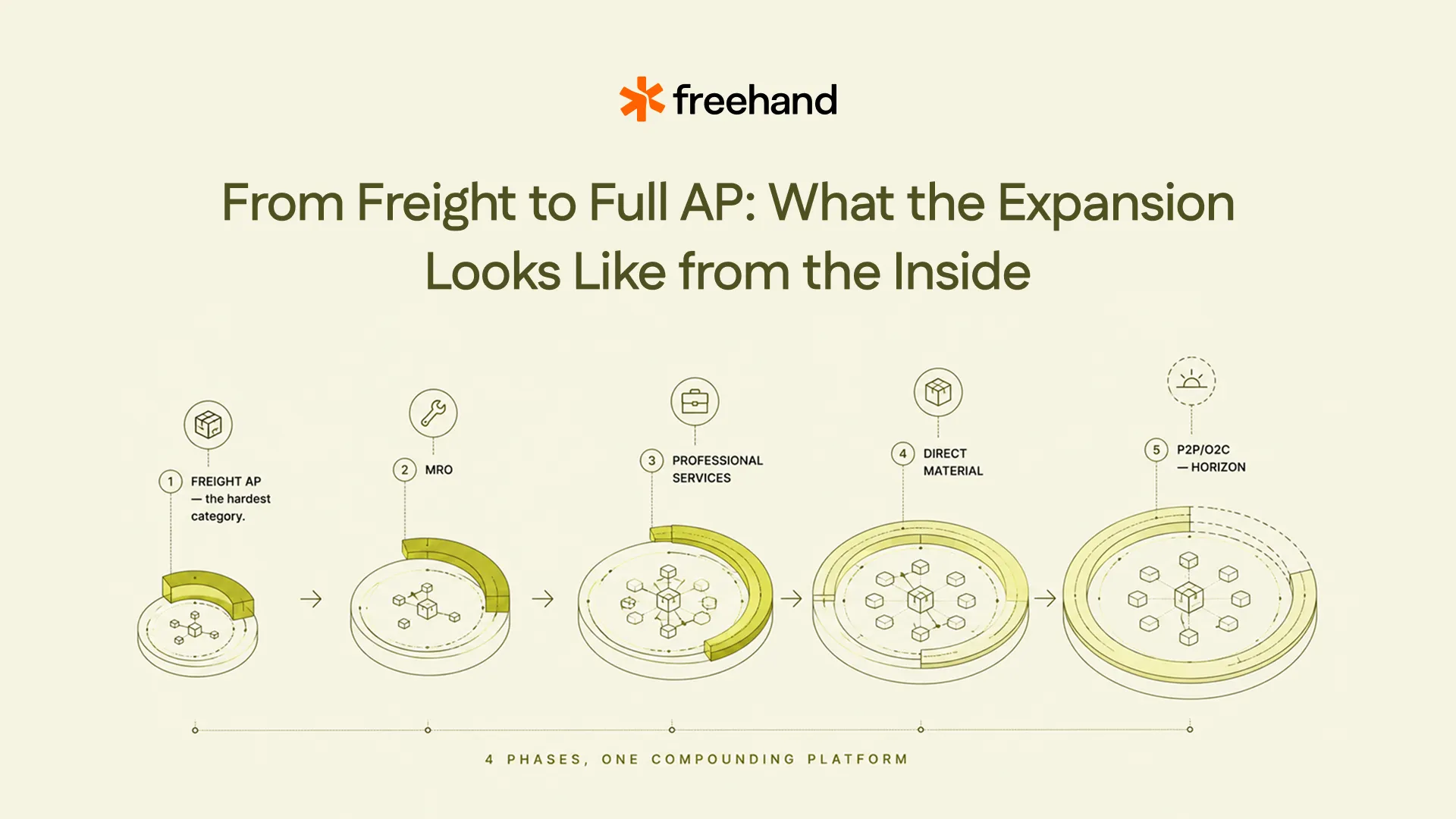
The argument for starting with the highest-complexity, highest-leakage category rather than the easiest category is the same argument a finance team makes when prioritizing audit projects: go where the money is. Freight AP produces the clearest ROI because the billing complexity is the highest and the leakage per invoice is the largest. The category expertise proven in freight compounds to MRO, professional services, and direct material as the AOP is extended.
A deployment that starts with the easy 70% and plans to address the complex 30% later will find that the complex 30% is significantly harder to automate after the fact than it would have been to address at the outset. The category-specific context graph that makes freight AP automation accurate, the carrier billing patterns, the contract amendment history, the exception resolutions, is the same data layer that will be needed for MRO and professional services AP. Building it once and extending it is more efficient than building it separately for each category after a horizontal platform has already been deployed.