
What AP Teams Actually Do When AP Is Automated

August 17, 2026
•
4
mins
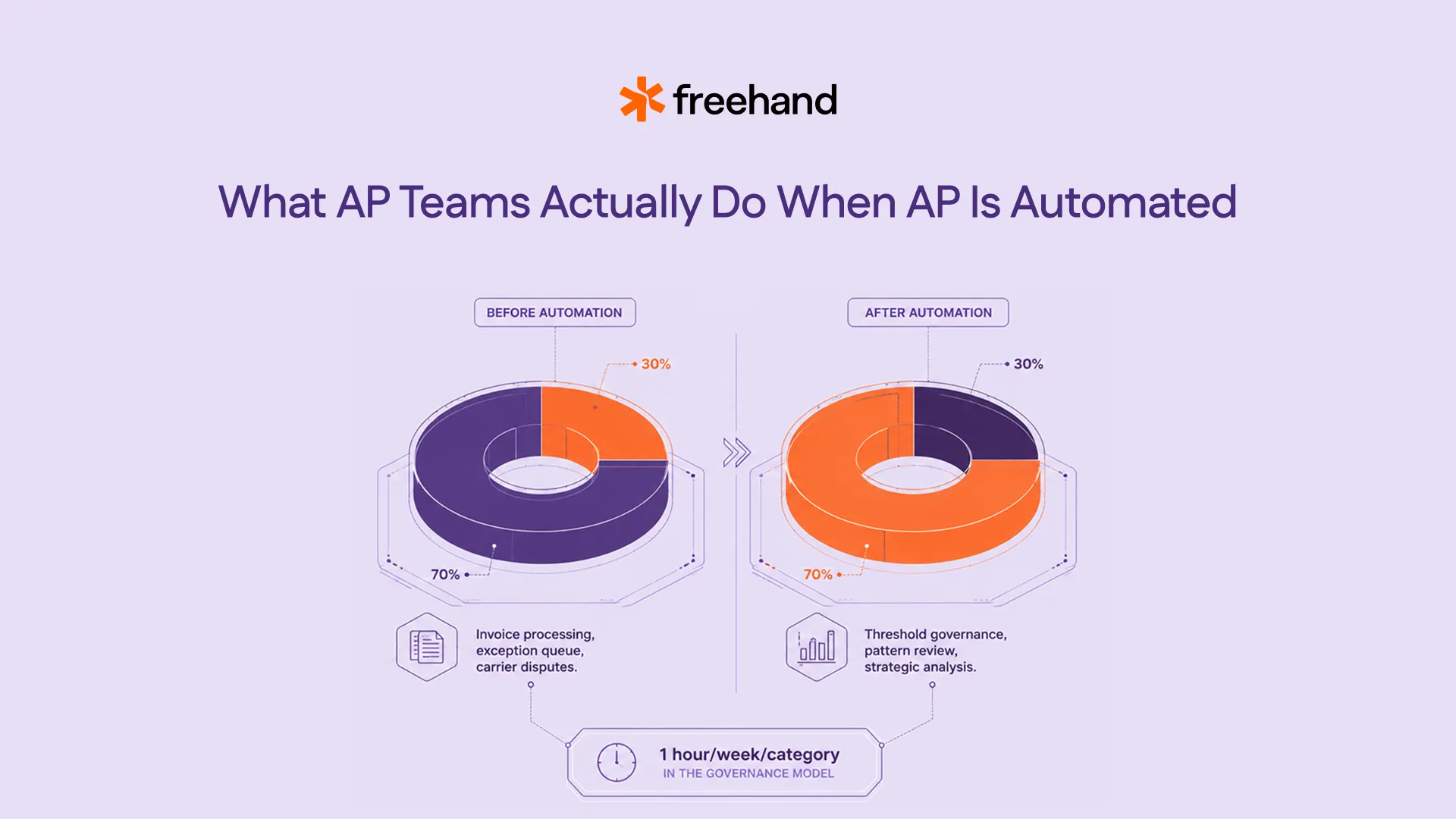
The workflow stops being the job. The governance of the workflow becomes the job. That is a different and more valuable use of the same people.
The first question that comes up in every AP automation conversation is the organizational question: what happens to the people? It is the right question to ask. It is also the question that most organizations answer too quickly, substituting reassurance for operational clarity. The honest answer is that the job changes substantially, not that it disappears, and not that it stays the same with fewer people.
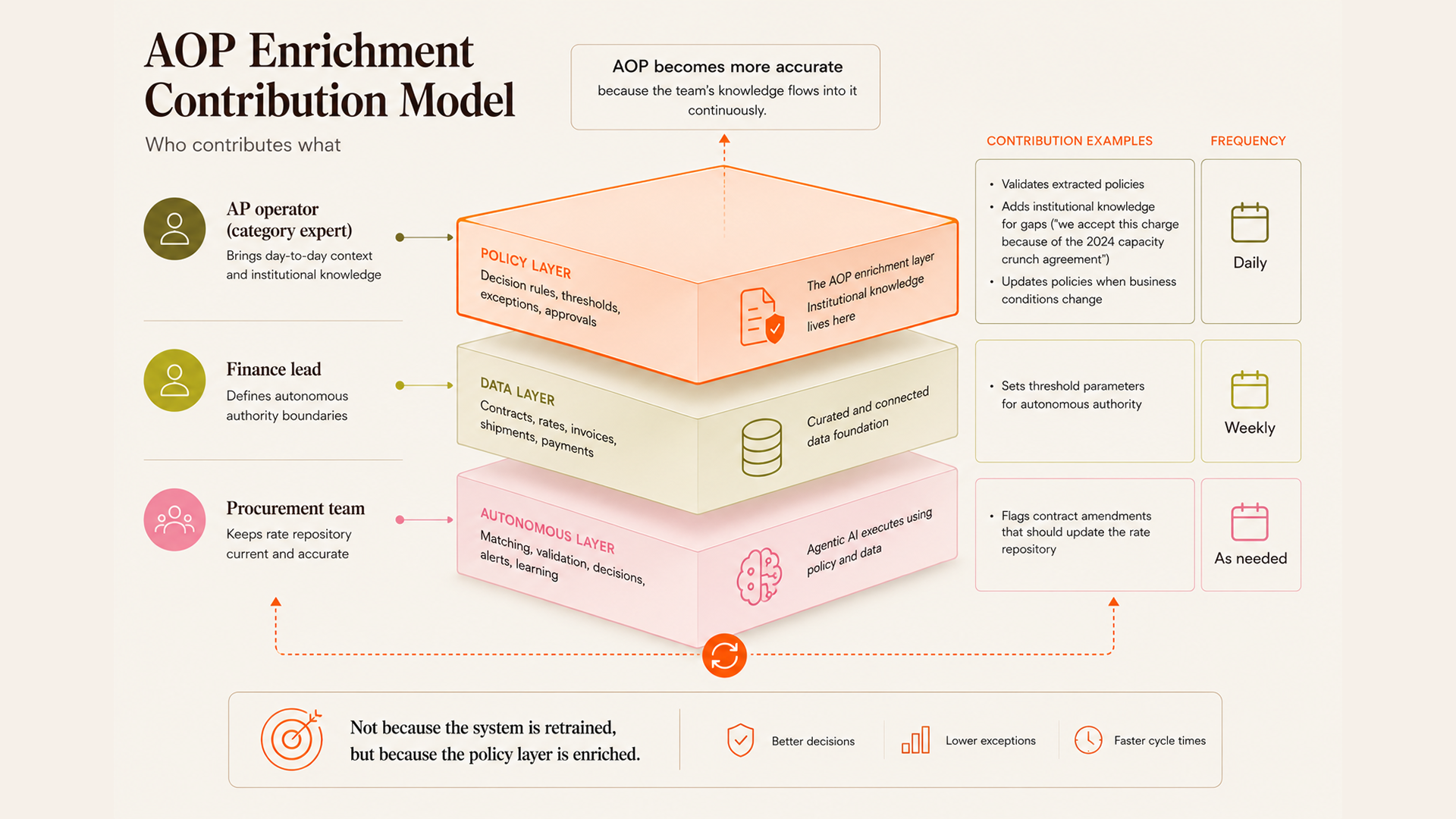
At the organizations where Freehand AI Teams are fully deployed at production scale, the AP team's operational reality has shifted from workflow execution to workflow governance. They are no longer the people who validate invoices, resolve exceptions, coordinate with carriers, and manage the payment queue. The AI Teams handle all of that. The AP team members who remain are the people who set the thresholds, review the patterns, manage the edge cases that exceed the system's autonomous authority, and translate organizational knowledge into AOP policies that improve the agents' decision quality over time.
What governance actually looks like day to day
The governance role in an autonomous AP operation has three primary activities. The first is threshold management: setting and adjusting the parameters that determine which decisions the system handles autonomously and which require human review. If an exception exceeds $50,000, it goes to a human. If an exception involves a carrier relationship that is currently under renegotiation, it goes to a human. These thresholds reflect organizational risk tolerance and change as the system's track record develops and confidence in its judgment grows.
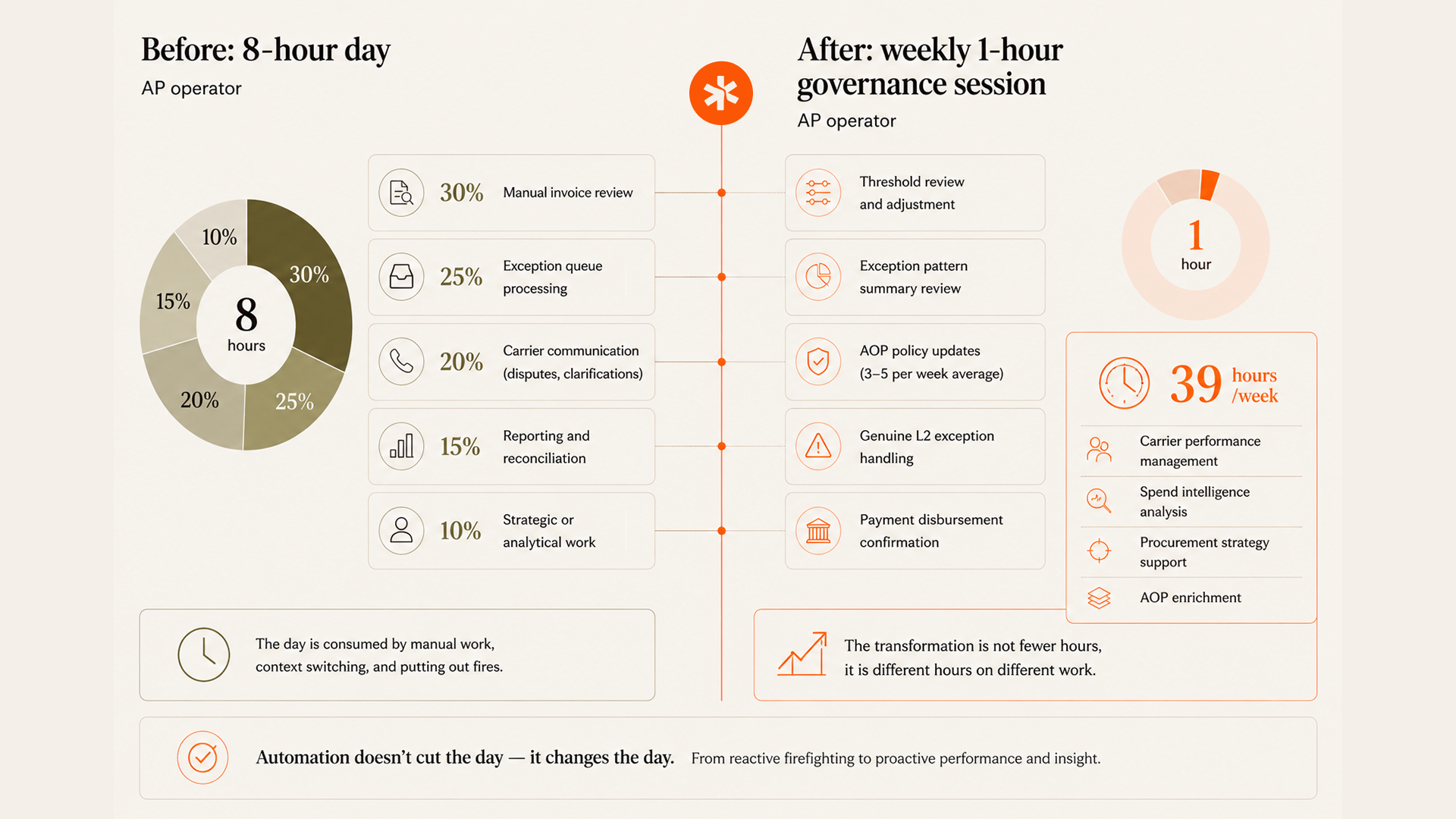
The second activity is pattern review. Once per week or twice per month, the AP lead reviews the aggregate exception patterns from the previous period: which exception types appeared most frequently, which carriers generated the most disputes, which categories produced the highest rate of variance between contracted and billed amounts. This review is the input for AOP policy updates and for the procurement team's carrier management agenda. The intelligence that the AP function now generates from 100% invoice coverage, rather than the partial picture that sampling-based audit produced, is the most valuable output of the transformation.
The one-person-one-hour model
The operational model that Freehand's delivery team targets for a mature deployment is one hour per week per category under management for the AP operator responsible for that category. The operator reviews the exception summary, approves or adjusts any policy updates recommended by the pattern analysis, handles the genuine L2 exceptions that required human judgment during the week, and confirms that the payment disbursements for the period are complete. One hour per week per category, when the category is running autonomously.
At the transition from a legacy BPO or in-house team model, the path to this state takes 60 to 90 days per category. The first 30 days are high-involvement: the operator is reviewing many exceptions, enriching the AOP with the institutional knowledge that the system extracted from history but needs human validation to confirm. By day 60, the exception rate has fallen substantially as the recurring patterns are resolved and the AOP is more complete. By day 90, the operator is in the governance model, reviewing patterns, handling genuine edge cases, and managing the policy layer that ensures the system continues making decisions that reflect how the organization wants to operate.
The redirection of expertise
The people who were most skilled at exception resolution, the analysts who knew which carriers had problematic billing patterns, which contract terms were frequently disputed, and which accessorial charges were most often incorrectly applied, are the people whose knowledge is most valuable to the AOP enrichment process. Their expertise does not become obsolete. It becomes the content that the system learns from. The analyst who previously spent three days per week reviewing and disputing exceptions now spends one hour per week confirming that the system is applying the institutional knowledge she spent years accumulating.
The surplus capacity goes to higher-value work: carrier performance management, strategic procurement analysis, financial planning support, and the oversight of spend intelligence outputs that the autonomous AP function generates. These are the activities that AP teams have always said they wanted to do more of and could never prioritize because the transactional workload consumed most of their time. Automation does not eliminate the AP function. It redirects it to the work that justifies having a finance professional in the role rather than a transaction processor.