
From Freight to Full AP: What the Expansion Looks Like from the Inside

August 20, 2026
•
4
mins
Freight was not where we started because it was easy. It was where we started because it was hardest. That distinction matters for what comes next.
Freehand started in freight AP. That choice was deliberate and it was not because freight was the easiest entry point. It was the hardest. Freight invoices involve more data sources than any other AP category, rate cards, shipment execution records, carrier-specific accessorial schedules, contract amendments that live in email, TMS data that does not synchronize with ERP data, and accessorial charges triggered by conditions that nobody documented systematically. If an AI agent could handle freight AP at production scale and Fortune 500 accuracy, it could handle anything.
The argument proved out. Eight years into the deployment and the organizations where Freehand has been running at production scale, Apple, Meta, J&J, Cardinal Health, Unilever, Greif, and others, are running freight AP autonomously across freight networks of extraordinary complexity. The model is proven. The question now is what expanding it to the full AP function looks like in practice, and why the expansion sequence matters.
Why the expansion sequence is not arbitrary
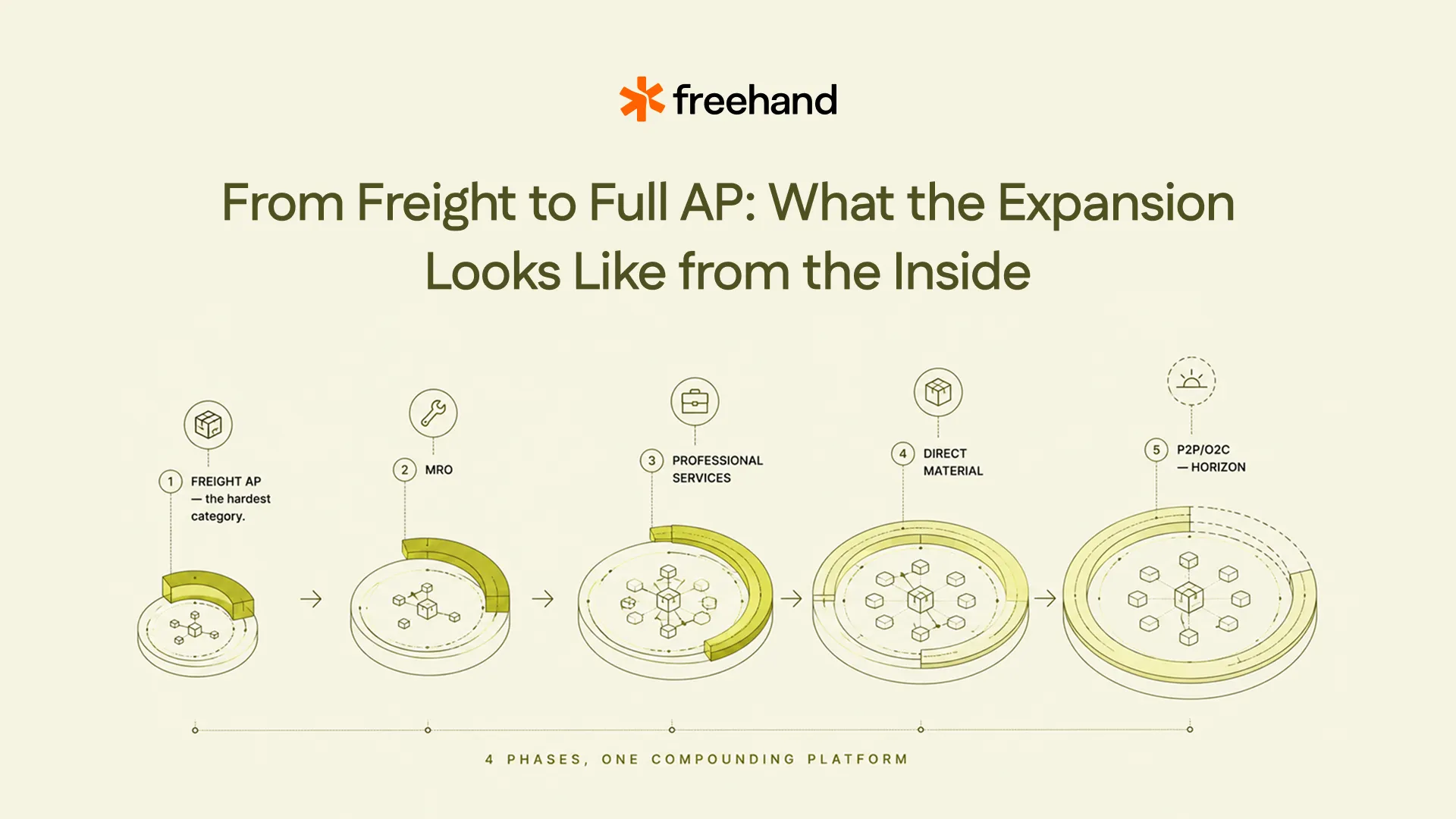
The categories that expand from freight AP are not chosen randomly. They are chosen based on structural similarity to freight in three dimensions: the exception density per invoice, the degree to which billing logic requires category-specific domain knowledge rather than standard PO-match rules, and the availability of historical data from which the AOP can be built. MRO procurement scores high on all three dimensions. Professional services AP scores high on exception density and domain-specific knowledge but lower on historical data availability because most organizations have never systematically captured professional services billing patterns. Direct material is structurally similar to freight in the multi-way matching requirement but differs in the supplier relationship dynamics.
The expansion follows the context graph. The freight context graph, built from rate cards, carrier relationships, shipment records, and exception history, contains data that is adjacent to what MRO and professional services require. Carrier relationships inform supplier relationship management patterns. Freight exception history informs the initial policy set for MRO exception handling. The cost center and GL coding infrastructure built for freight extends naturally to MRO and professional services because the organizational units that procure and consume these categories overlap significantly with the ones that manage freight operations.
What the expansion looks like at months 6 through 18
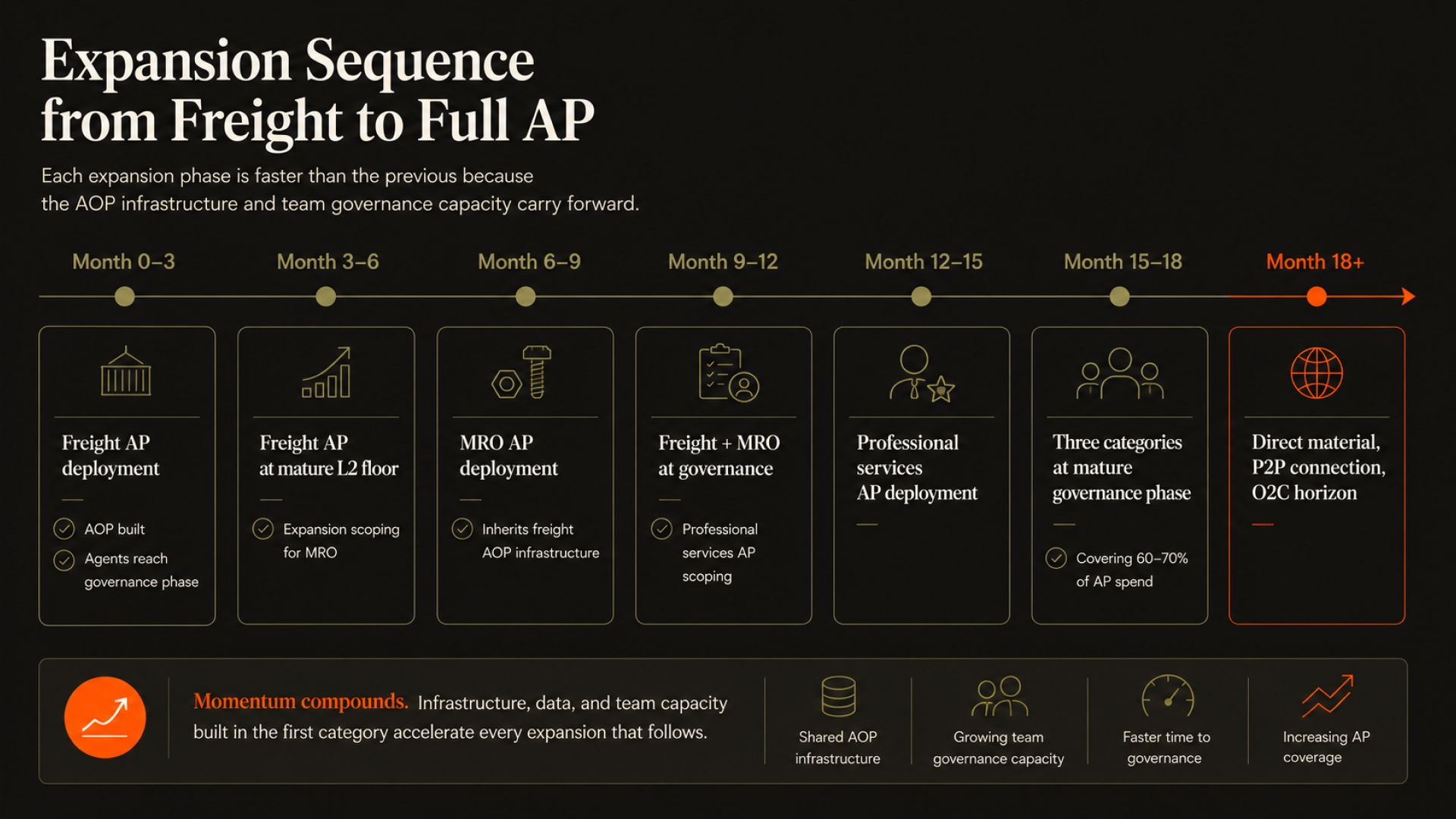
The expansion from freight to MRO typically takes 60 to 90 days per category once the freight AP deployment is at the mature governance phase. The AOP for MRO begins where the freight AOP ended: with the institutional knowledge the team has already codified in plain language, the policy enrichment process they already understand, and the exception review cadence they have already established. The new domain requires new category knowledge, parts classification logic, pricing tier structures, supplier-specific billing behavior, but the governance model is the same.
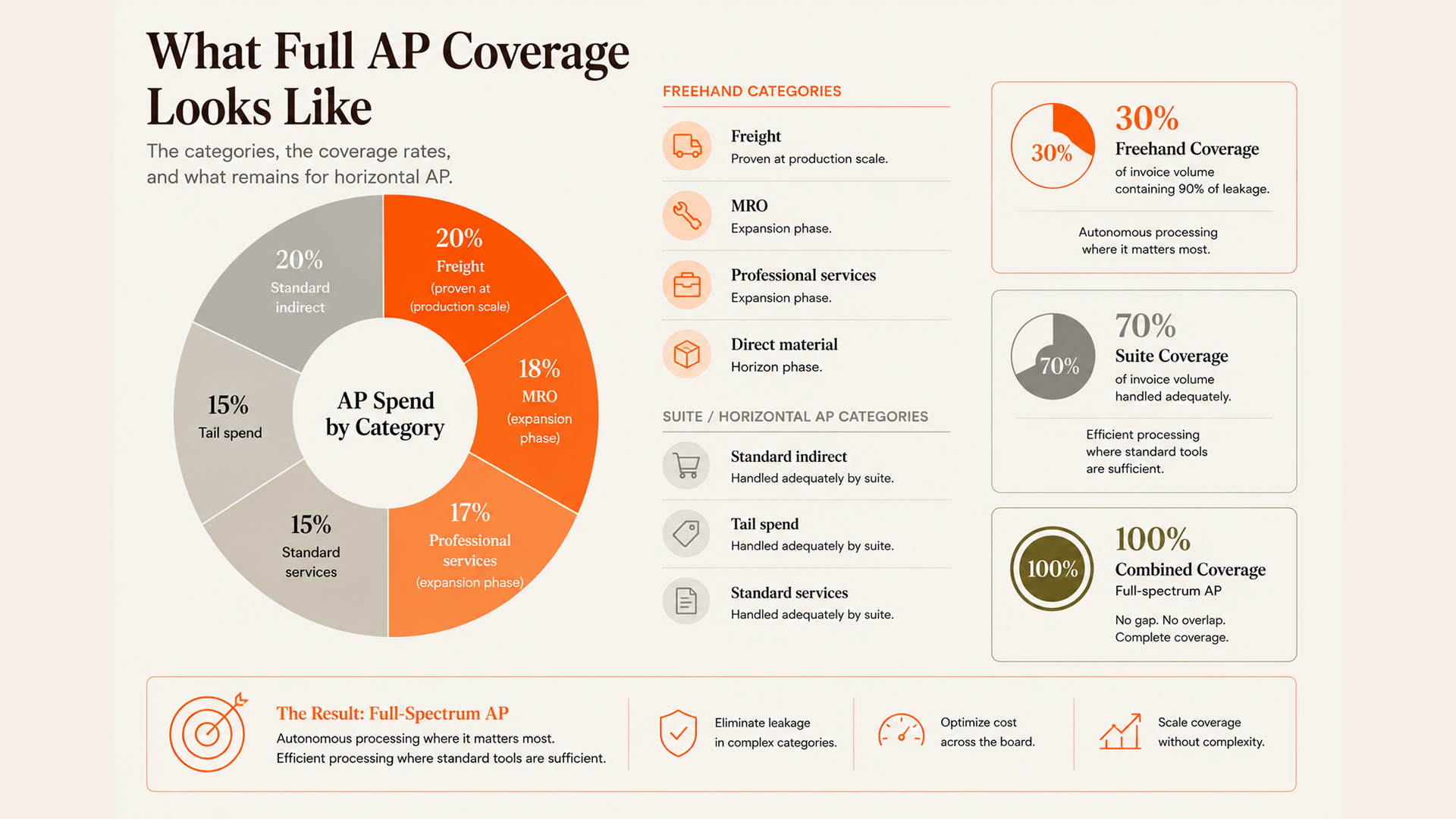
By month 18 of a deployment that began with freight AP, an organization running Freehand across freight, MRO, and professional services is covering approximately 60 to 70% of its total AP spend under autonomous processing. The 30 to 40% that remains, standard indirect, tail spend, and the categories that the suite's horizontal AP module handles competently, is not Freehand's target. The goal is the 30% of invoice volume that contains 90% of the leakage, not the 70% where horizontal AP automation is already adequate.
The P2P and O2C horizon
Phase 4 of the Freehand roadmap connects the AP context graph to the upstream procurement function, where agents trigger sourcing events when rate drift is detected, negotiate with suppliers within defined guardrails, and manage supplier onboarding as a byproduct of the invoice validation relationship. This is not a feature addition to the AP function. It is a different architectural relationship between finance and procurement: one where the intelligence generated in AP, carrier performance patterns, rate drift alerts, exception root causes, flows upstream to inform sourcing strategy rather than being contained in a reporting dashboard that procurement may or may not review.
The organizations that are already at production scale in freight AP are beginning to see this connection take shape. The same data layer that tells the AP team whether a carrier billed correctly tells the procurement team whether the carrier is performing to the terms of their contract. The same context graph that enables autonomous invoice validation enables the analysis of whether the contract should be renegotiated. The AP function was always the closest thing the organization had to a real-time view of supplier performance. It just could not be read that way until the data was systematically captured, the patterns were continuously analyzed, and the insights were connected to the teams that could act on them.