
MRO Procurement Has the Same Exception Problem as Freight. It Just Has No Audit Culture.
The structural complexity is identical. The systematic measurement of what it costs is absent.

August 6, 2026
•
4
mins
The structural complexity is identical. The systematic measurement of what it costs is absent.
Maintenance, repair, and operations procurement is one of the most complex AP categories in any manufacturing organization. MRO invoices can span thousands of part numbers, each with its own contracted pricing tier, from dozens of suppliers, each with its own invoice format, billing logic, and exception rate. The complexity of the matching problem, confirming that the part received matches the part ordered, at the price contracted for that specific part category from that specific supplier under the current contract vintage, rivals freight AP in every structural dimension.
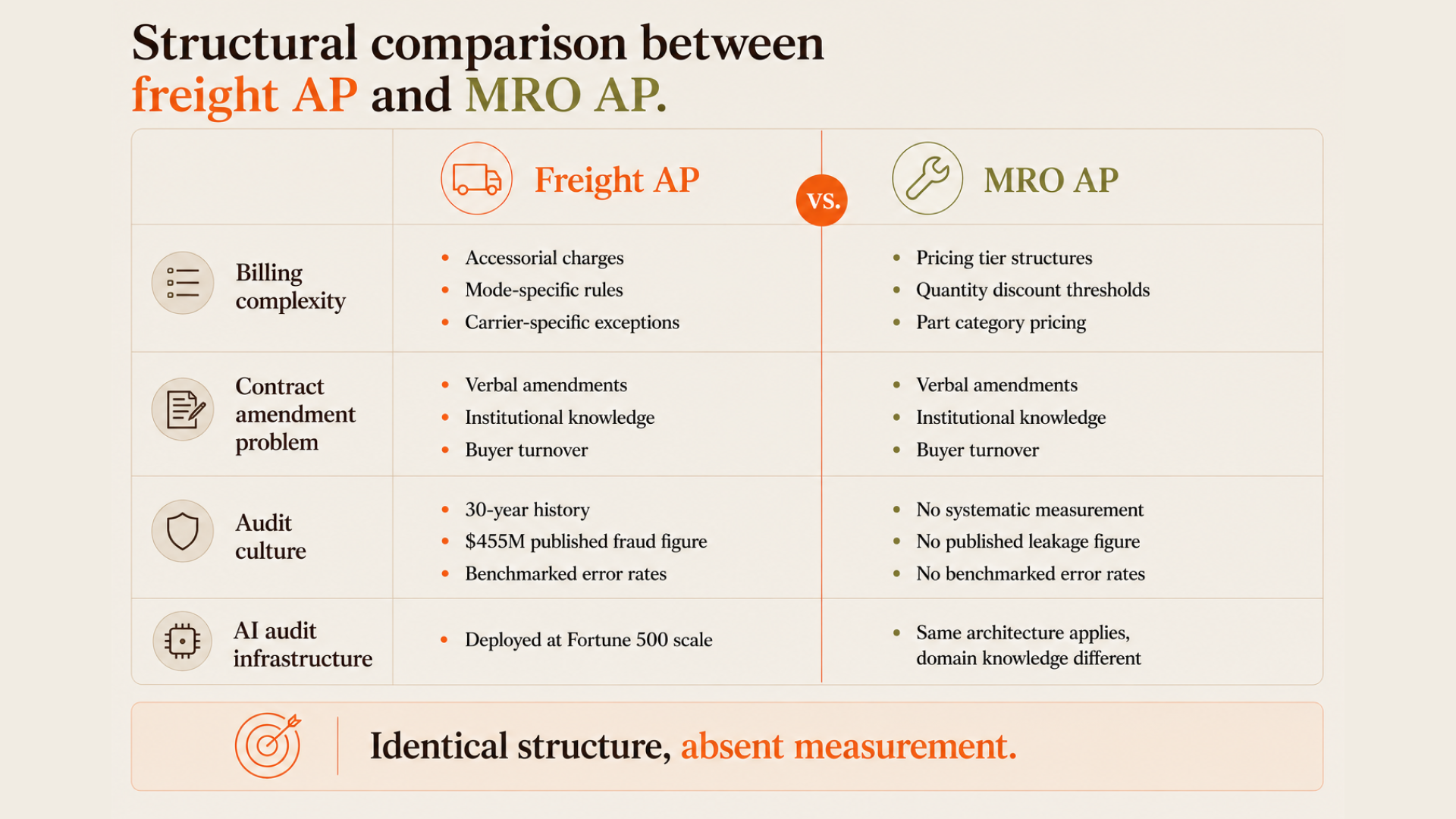
The difference is audit culture. Freight AP has a 30-year history of systematic overcharge measurement, contingency recovery programs, and investment in audit tools. The $455 million freight fraud number gets reported. The freight billing error rate gets benchmarked. Conference presentations get built around it. MRO AP has almost none of this. The overcharge rate is not systematically measured. The leakage is not published. Most MRO AP teams do not know what percentage of their invoices contain billing errors because nobody has built the infrastructure to measure it.
Why MRO billing is complex in the same structural way
The complexity in MRO billing does not come from accessorial charges, it comes from pricing tier structures, quantity discount thresholds, and contract amendments. An MRO supplier may offer five pricing tiers based on annual volume, with different prices for the same part at different order quantities. The correct invoice price for a specific part depends on which tier the organization has reached year-to-date, which may require real-time knowledge of cumulative purchase volume across all orders from that supplier in the current contract year. A billing error that invoices at the wrong tier affects every invoice for that part category until the error is caught.
Contract amendments in MRO procurement have the same institutional knowledge problem as contract amendments in freight. A verbal agreement with a supplier to extend a pricing tier benefit in exchange for a commitment to consolidate purchases is rarely formally documented. It exists in email, in a meeting note, or in the memory of the buyer who negotiated it. When that buyer leaves, the amendment leaves with them. The supplier continues billing at the agreed price. Finance continues approving the invoice, not knowing the amendment existed, and then the supplier's billing system updates and the price reverts to the standard tier. The change produces an exception. Nobody can explain it because nobody documented the original amendment.
What Freehand's freight deployment proves for MRO
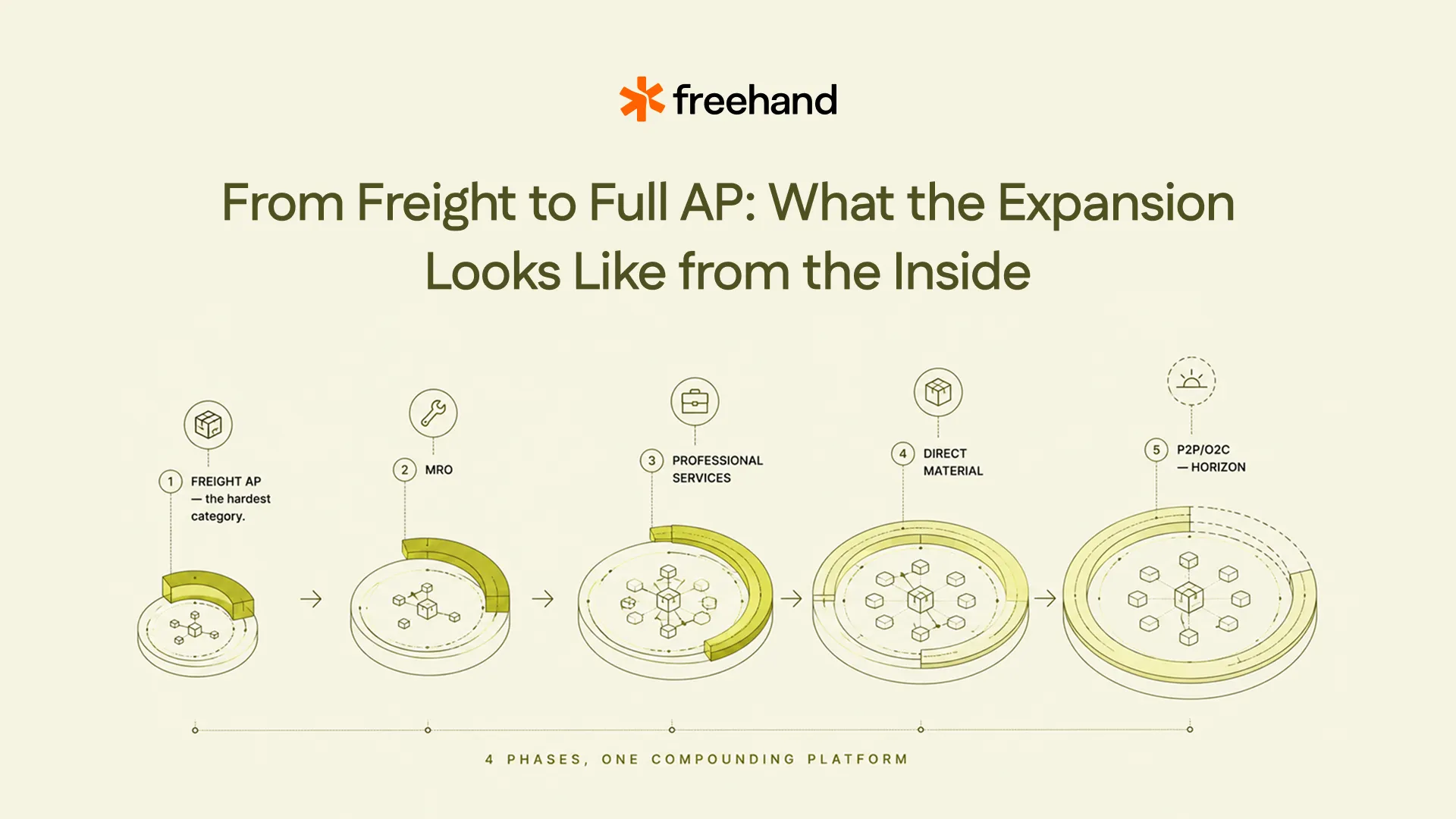
The freight AP deployment that proved the model at Fortune 500 scale, autonomous invoice processing, exception resolution, rate management, and spend intelligence, was built on the same category-specialist architecture that MRO requires. The difference is domain: the freight-specific knowledge encoded in the context graph (carrier billing logic, accessorial rules, mode-specific exception patterns) would be replaced with MRO-specific knowledge (supplier pricing tier structures, part category classification logic, warranty and return processing rules). The AOP that governs agent decisions would be built from MRO exception history rather than freight exception history. The architecture is the same.
The organizations that are moving Freehand from freight AP to MRO AP are finding that the transition is faster than the original freight deployment because the context graph infrastructure, the decision trace architecture, and the team's ability to enrich the AOP in plain language are already in place. The domain knowledge is different. The deployment model is proven. The remaining question is what the MRO leakage number turns out to be, which, for most organizations, will be the first time they have ever measured it.
The leakage measurement case
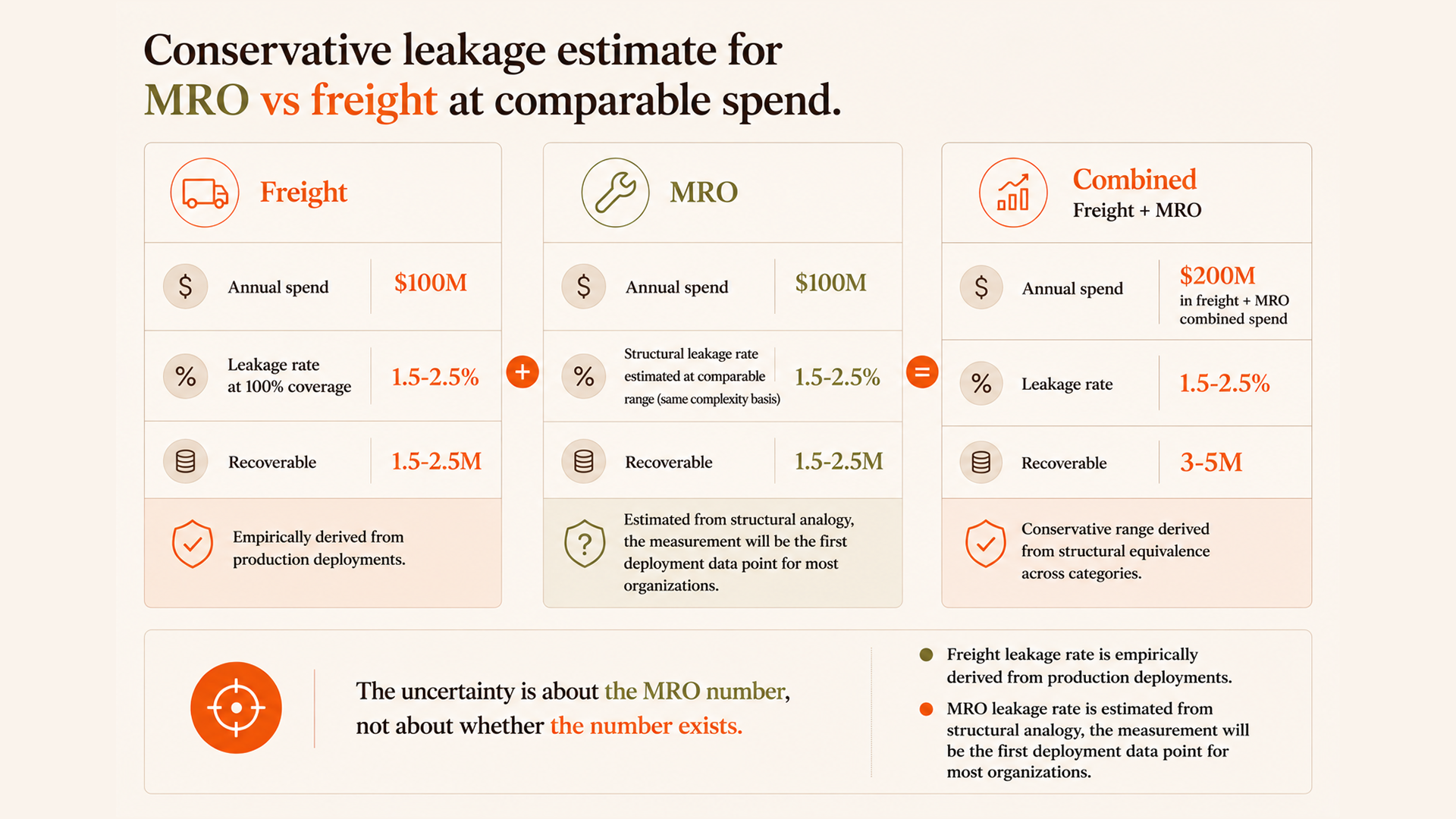
The business case for MRO AP automation does not need to be built from a known leakage rate because no organization has measured it. The business case can be built from the structural argument: if a category has the same billing complexity, the same contract amendment problem, and the same institutional knowledge fragility as freight, and freight is consistently found to have a 1.5 to 2.5% leakage rate when audited at 100% coverage, then MRO at similar coverage should produce a comparable leakage rate. At a company with $200 million in annual MRO spend, the conservative estimate of recoverable leakage from a full-coverage audit is $3 to $5 million annually. That is a number worth testing.