
Why Your Freight Audit Should Not Be Trained on 2,500 Other Clients' Patterns
A shared model reflects the average billing behavior of every client in the network. Your contracts are not average.

August 4, 2026
•
4
mins
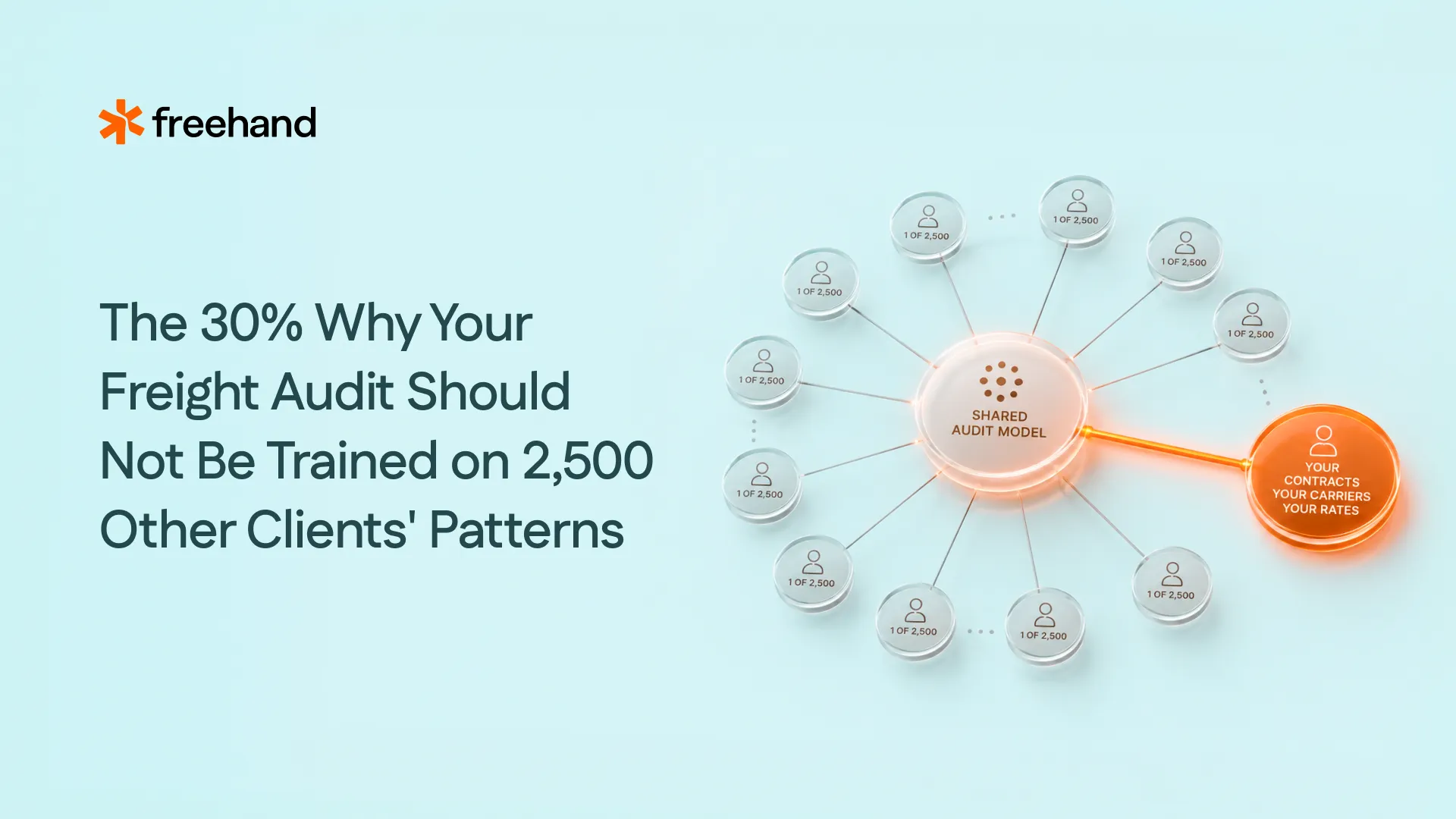
A shared model reflects the average billing behavior of every client in the network. Your contracts are not average.
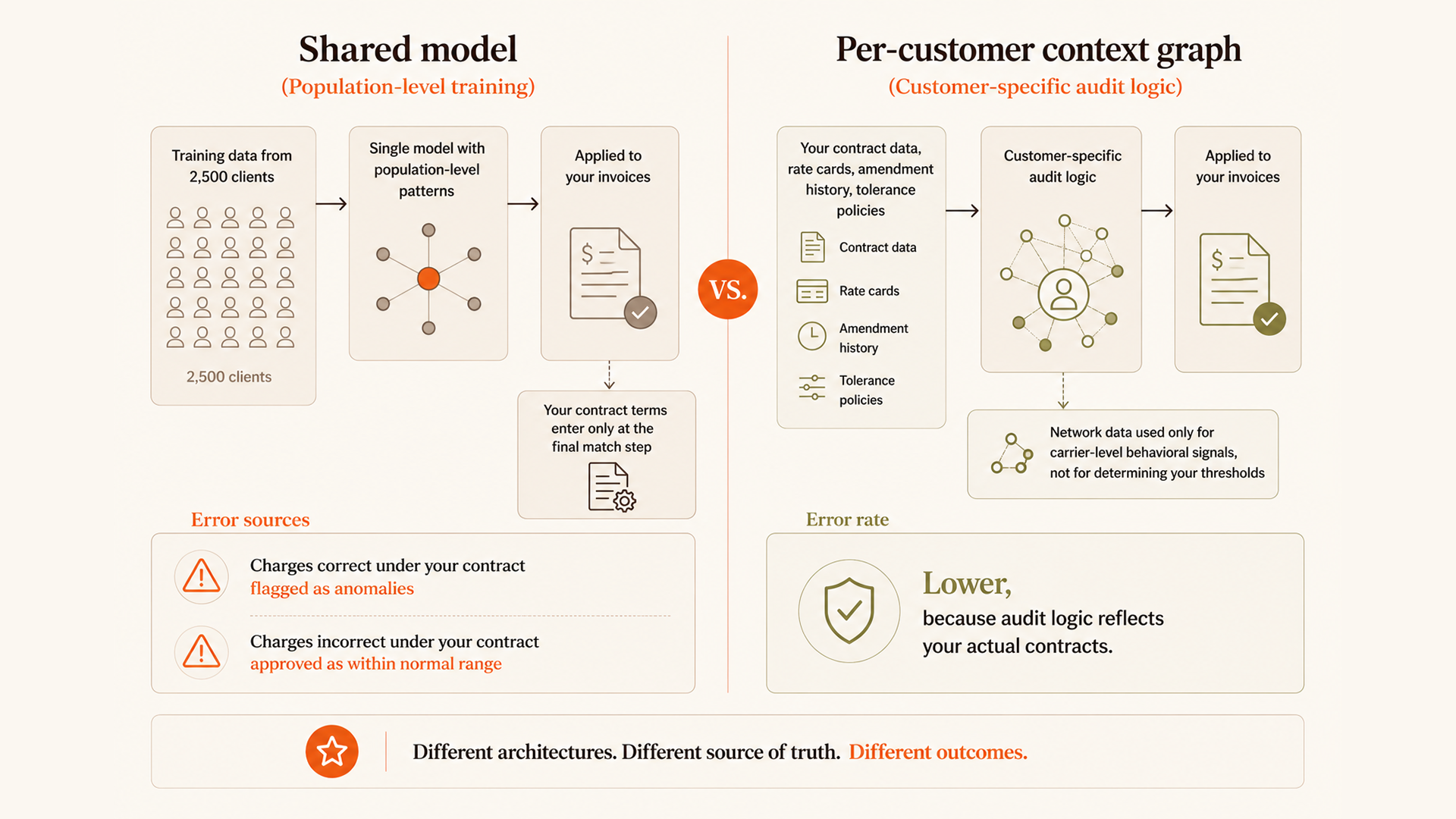
Some freight audit AI systems are trained on pooled data from every client in the vendor's network. The model sees invoices from 2,500 shippers across every mode, every lane, and every carrier relationship in the vendor's portfolio. The training data is large, the pattern recognition is sophisticated, and the anomaly detection is more accurate than what rules-based systems produce. The model also reflects the average billing behavior across all 2,500 clients, not the specific contract terms that govern your carrier relationships.
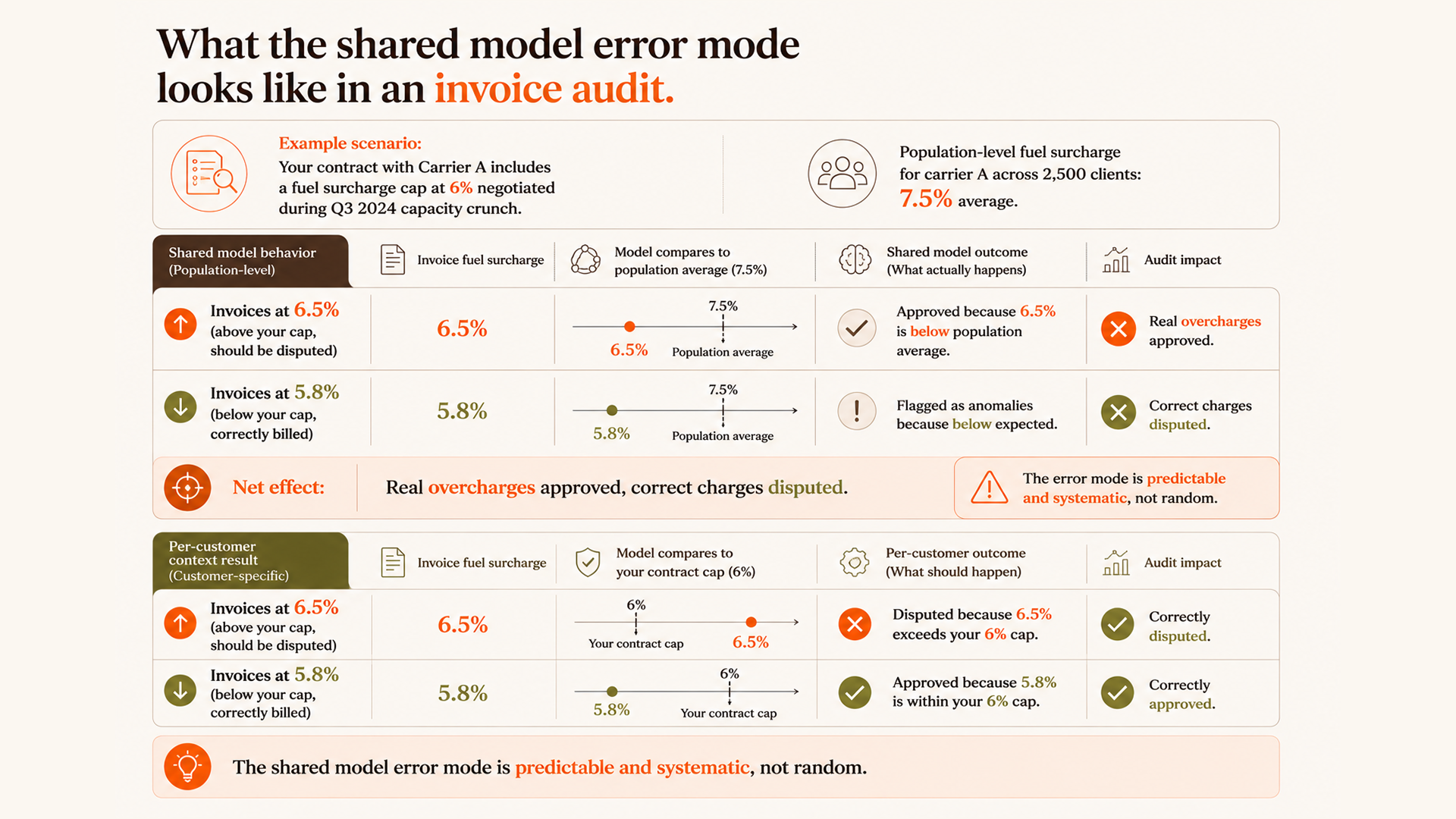
Your freight contracts are not average. Your fuel surcharge tolerance is different from the industry average because you negotiated a cap during a capacity crunch two years ago. Your accessorial schedule for detention reflects your specific DC operations, not the standard industry calculation. Your carrier A has a billing behavior on Southeast LTL lanes that deviates from the general pattern in ways that are correct under your contract but anomalous relative to what carrier A bills every other shipper. A model trained on 2,500 clients' data will apply the population-level pattern to your specific situation. The result is audit logic that reflects every shipper's experience, not yours.
How shared model training produces systematic errors
The error mode in a shared training model is not random. It is systematic, which makes it more difficult to detect and correct. When the model applies a population-level fuel surcharge expectation to your invoices, because that expectation is grounded in the observed billing behavior of thousands of other shippers, it will generate false exceptions on charges that are correct under your specific contract and approve charges that are incorrect under your specific contract. Both errors are predictable from the training data, not random.
The false exception problem is visible: your audit team receives disputes that the carrier correctly rejects, carrier relationships accumulate friction, and the exception queue grows with noise. The approval error problem is invisible: invoices that contain charges that deviate from your specific contracted terms are approved because they fall within the population-level normal range. The carrier continues billing incorrectly. The amount accumulates quietly across months of billing cycles.
What per-customer context requires technically
Per-customer audit logic requires a context graph that is specific to your organization: your carrier contracts, your rate cards and their amendments, your accessorial schedules, your tolerance policies, your historical exception resolutions. The context graph is not shared with other clients. The audit logic derived from it is not the average of what every other shipper does. It is the specific encoding of how your organization has contracted with its carriers and managed its freight billing over time.
The technical challenge is building this graph from the data that actually exists in your organization, rate cards in Excel files, contract amendments in email threads, tolerance policies in finance documentation that was never formally encoded anywhere. This is the data normalization and context ingestion work that a deployment addresses in the first phase of implementation. It is also the work that continues throughout the deployment as new contracts are executed, new carriers are onboarded, and new exception patterns are identified and encoded into the AOP.
The network data question
The legitimate value in a vendor's multi-client dataset is carrier-level pattern recognition that benefits from scale: understanding how carrier A typically bills across a broad population of shippers can identify when carrier A has changed its billing logic in a way that deviates from its established behavior. This network-level signal is real and useful, and cannot be generated from a single client's invoice history alone.
The distinction is between using network data to understand carrier behavior and using network data to determine your audit thresholds. The first is legitimate and valuable. The second substitutes population-level averages for your specific contract terms. A well-designed per-customer audit architecture uses network signals to identify carrier-level anomalies and customer-specific context to determine whether those anomalies represent billing errors under your particular contracts. The two data layers serve different functions and should not be conflated.