
What Enterprise AI Gets Wrong Before It Gets Anything Right

May 6, 2026
•
7
mins
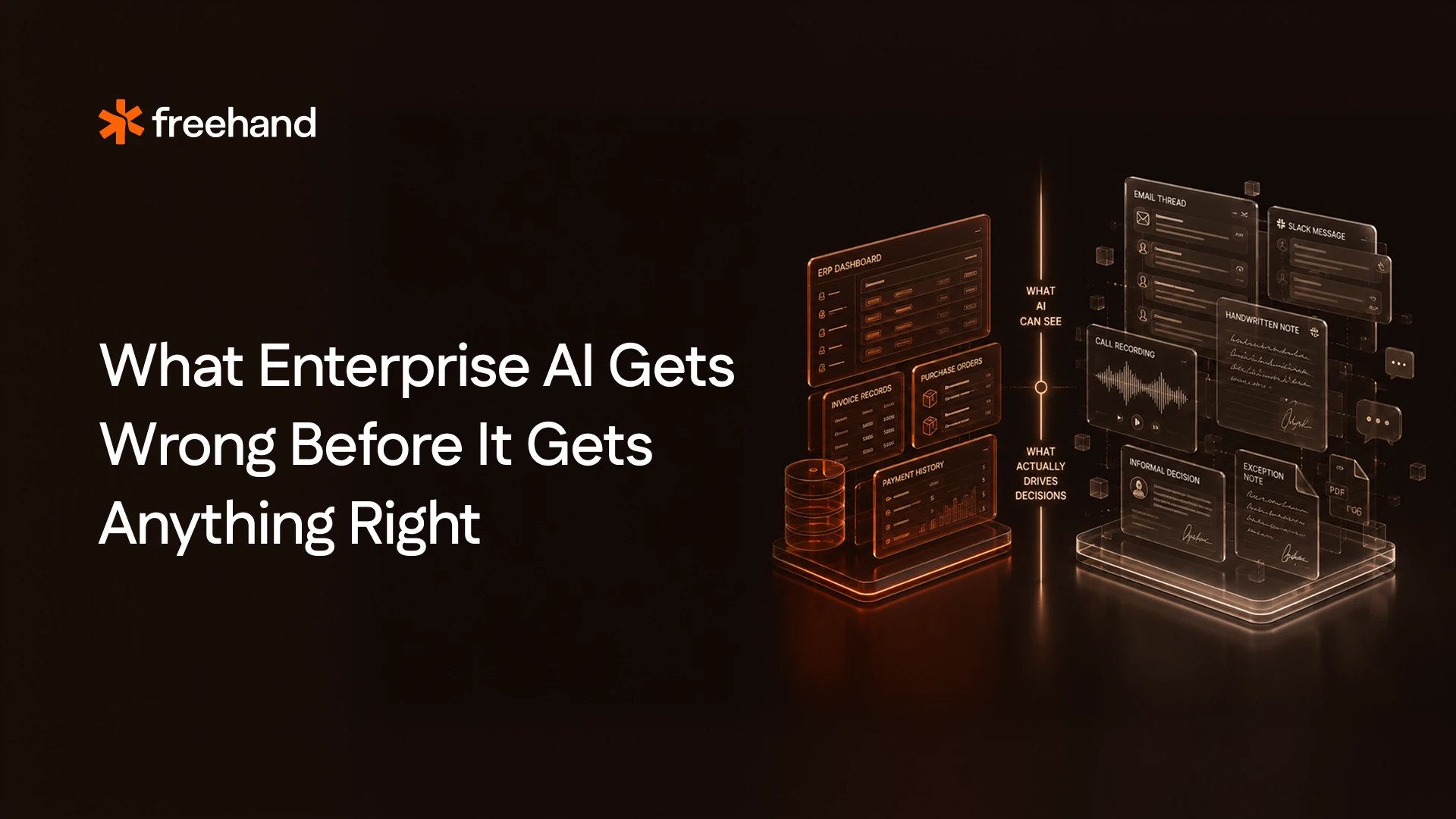
The failure mode is not the model. It is the context the model was never given.
There is a version of enterprise AI that works in the controlled setting and fails in production. Most organizations have encountered it. The model performs in the proof of concept. The pilot looks promising. The business case gets approved. Then it goes live and the accuracy degrades, the exception queue grows, and the team that was supposed to be freed up spends its time reviewing what the AI got wrong.
The failure mode is almost never the model. The models available today are genuinely capable. They reason well. They understand complex instructions. They produce outputs that look right. The failure is in what the model was given to reason with — which is to say, it is an infrastructure problem, not an intelligence problem.
Records move through systems. Reasoning doesn't.
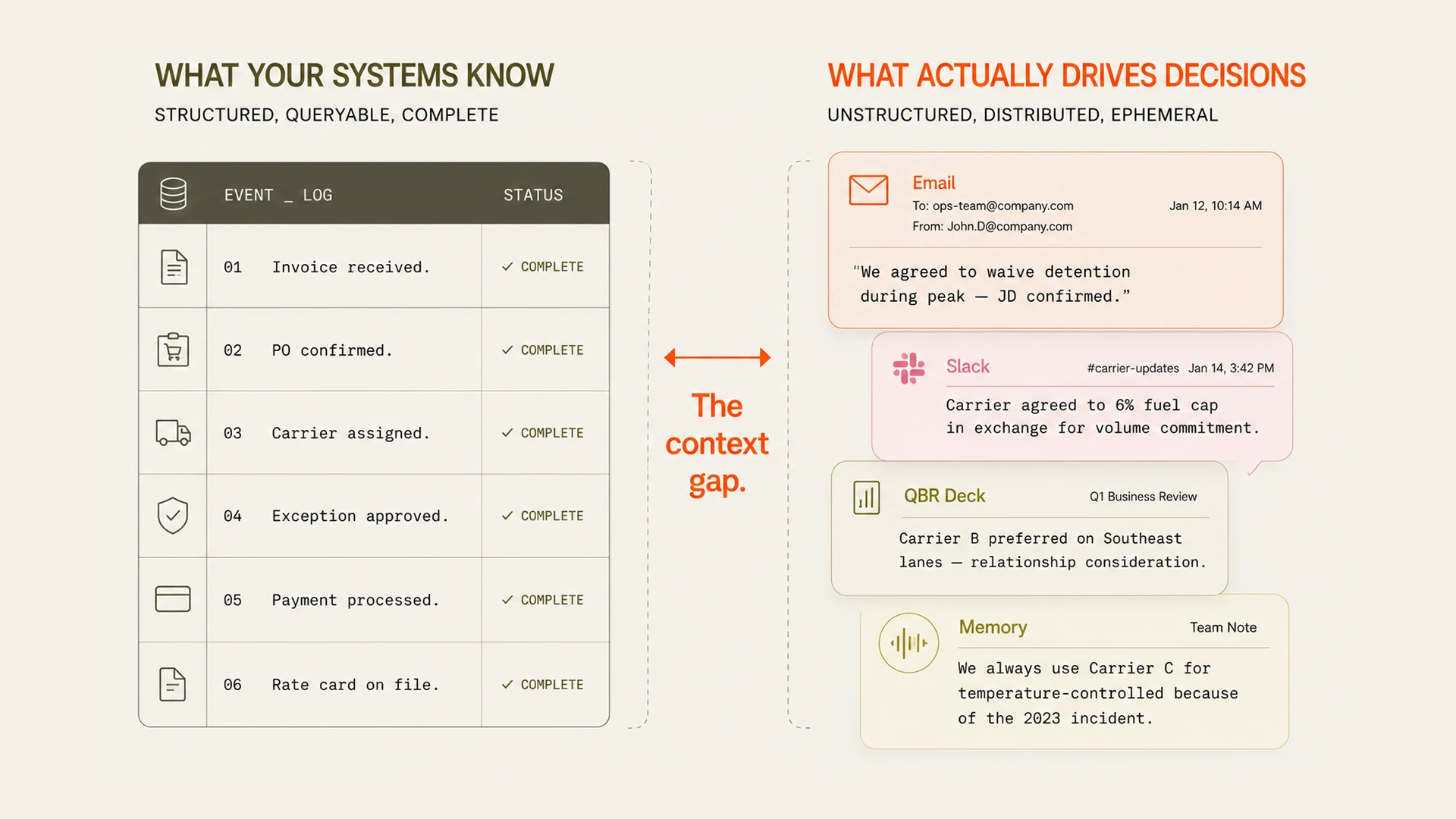
Your enterprise systems record what happened. Invoice received. PO confirmed. Shipment dispatched. Payment processed. These records are clean, structured, and queryable. They are also insufficient for AI to make decisions on, because they record the what but not the why.
When AP flags an exception, it doesn't know why procurement approved a premium rate last quarter for this carrier on this lane. When sourcing builds an RFQ, it cannot access the decision trace that explains why the organization dual-sourced this component. When tariffs change overnight, no system connects the policy rationale to the specific contracts and categories affected. The reasoning behind every significant supply chain decision — the context that a human expert would reach for instantly — is not in any system. It exists in email threads, call transcripts, QBR decks, and the memory of people who may no longer be in the role.
Why this specific failure mode repeats
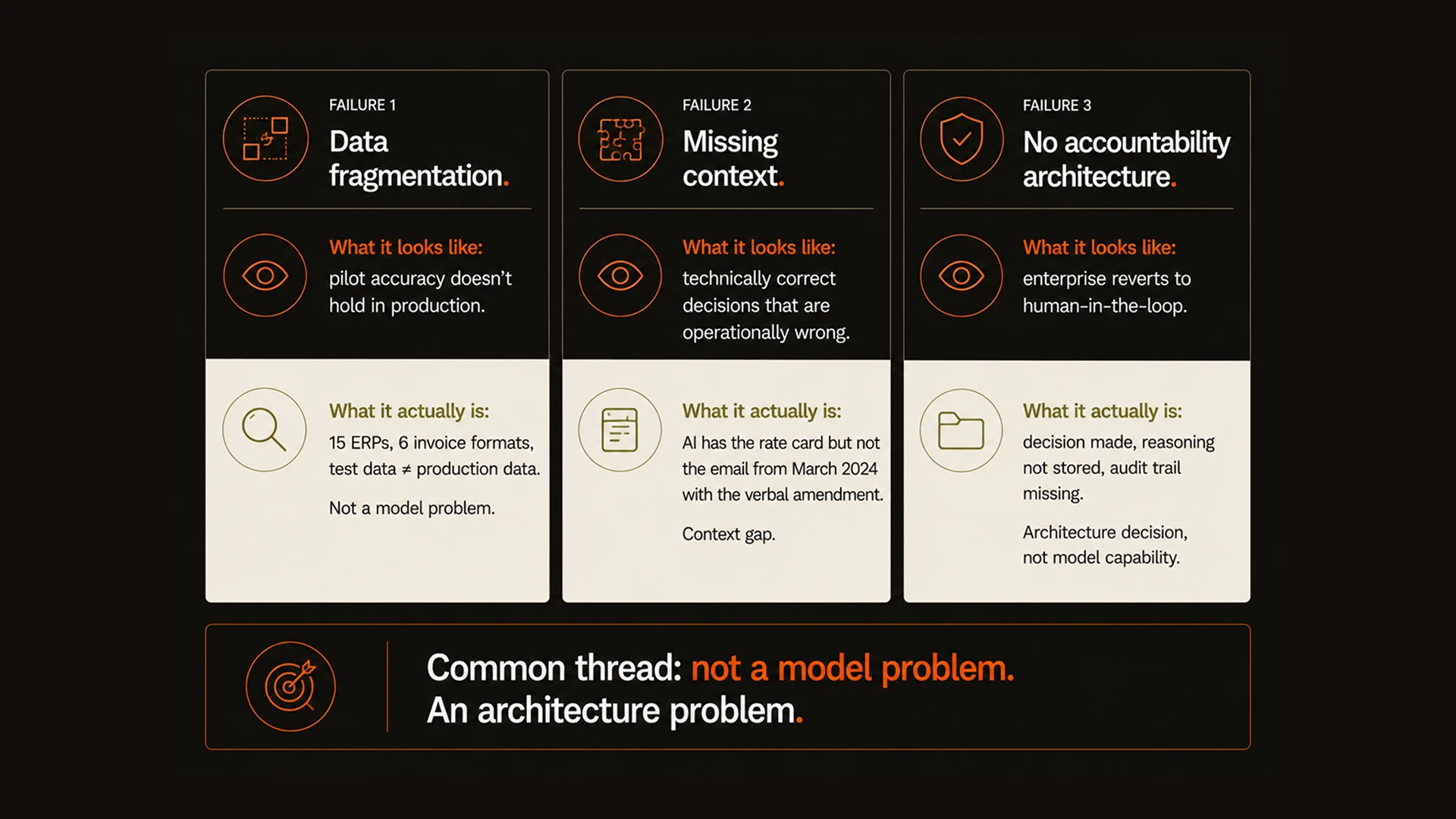
The enterprise AI deployment that fails at scale almost always fails for one of three reasons, and they are all context problems. The first is data fragmentation: the AI was trained on clean, normalized test data and deployed against fifteen ERP instances with inconsistent field names, invoice formats that range from EDI to handwritten PDFs, and carrier relationships documented in three different systems none of which talk to each other.
The second is missing institutional context: the AI has the rate card but not the amendment that was verbally agreed during last year's capacity crunch, the vendor that was flagged as high-risk in a QBR that nobody logged into the procurement system, the exception tolerance that finance approved for a key supplier relationship three years ago. Without this context, the AI produces decisions that are technically consistent with the available data and practically wrong.
The third is no accountability architecture. When an AI agent takes a decision that costs real money — approves an invoice incorrectly, disputes a charge that was legitimately owed, misroutes an exception — the enterprise needs to understand why. If the reasoning is not stored, the decision cannot be audited, challenged, or corrected in a way that prevents recurrence. The organization reverts to human oversight not because the AI is inaccurate but because it is inexplicable.
“The enterprise AI failure mode isn't a bad model. It is a good model with no context. The fix isn't a better algorithm. It is the infrastructure to make the context available.”
What getting the infrastructure right requires
Closing the context gap requires connecting the AI to the data that actually drives supply chain decisions — not just the ERP and TMS records, but the email threads, call transcripts, and documents where the institutional reasoning lives. It requires a category-specific context graph that understands not just supply chain operations in the abstract but your supply chain: your carrier relationships, your exception patterns, your rate tolerances, your institutional history. And it requires decision traces — stored records of why each decision was made, traceable to the specific facts and context that produced it.
The companies where AI is working at production scale have all built this infrastructure, whether they call it a context graph or something else. The companies where AI pilots are stalling have good models sitting on top of inadequate context. The fix is not to switch models. It is to build the layer that makes the models useful.