
Customs Compliance: What It Covers, and Where the Billing Risk Hides
Customs compliance covers classification, valuation, and origin, but few programs audit the billing behind it. See what's covered, and what most miss.
.webp)
August 24, 2026
•
9
mins
.png)
Customs compliance is the set of rules an importer has to follow to move goods across a border legally: correct product classification, accurate valuation, verified country of origin, and proper documentation. Most compliance programs are built to get a shipment through customs cleanly. Fewer are built to check whether the resulting bills, broker fees, duty charges, and disbursements, are actually correct.
Key Takeaways
- Customs compliance is the set of classification, valuation, origin, and documentation requirements an importer must meet to legally move goods across a border.
- The four pillars most programs are built around: HS/HTS classification, customs valuation, country-of-origin determination, and recordkeeping for post-entry audits.
- Getting a shipment through customs and getting billed correctly for it are two different problems, most compliance programs solve the first and leave the second to whoever reviews the broker invoice, if anyone does.
- Duty drawback, the recovery of duties already paid on goods that are re-exported or destroyed, goes unclaimed at most enterprises simply because nobody is tracking eligibility continuously.
- Freehand's trade compliance agents work both sides: classification and screening on the way in, and billing accuracy (broker invoices, duty calculations, drawback eligibility) on the way out.
What is customs compliance?
Customs compliance is the practice of meeting a government's legal requirements for importing or exporting goods: correctly classifying products, declaring accurate value, verifying country of origin, and maintaining the documentation customs authorities can audit after the fact. It exists because import duties, trade agreements, and restricted-goods rules all depend on getting these four things right, and getting any of them wrong carries financial and legal exposure that surfaces well after the shipment has already cleared.
The compliance obligation doesn't end when a shipment clears the border. U.S. Customs and Border Protection, and equivalent authorities elsewhere, can audit an entry years after the fact, which is why recordkeeping is as much a compliance requirement as the declaration itself.
What are the core pillars of a customs compliance program?
Four areas account for most of what a customs compliance program has to manage: classification, valuation, origin, and recordkeeping.
| Pillar | What it requires | What goes wrong |
|---|---|---|
| Classification (HS/HTS codes) | Assigning the correct tariff code to every product shipped | A single-digit code error can shift the duty rate significantly, and the error repeats on every shipment until caught |
| Valuation | Declaring the correct customs value, not just the invoice price | Freight, insurance, and assist costs are often left out or included incorrectly, both directions create exposure |
| Country of origin | Verifying and documenting where goods actually originated | Origin determines duty rate and FTA eligibility; getting it wrong risks both overpayment and non-compliance |
| Recordkeeping | Maintaining entry documentation for a minimum of five years from the date of entry, the standard post-entry audit window | Missing or incomplete records turn a routine audit into a much larger liability |
For the mechanics of one specific compliance action, filing for duty already paid on re-exported goods, see our guide to duty drawback.
{{blue-cta}}
Why does classification carry so much of the risk?
Classification sits upstream of almost everything else in customs compliance, since the HS code assigned to a product determines its duty rate, its FTA eligibility, and whether it's subject to any additional tariff actions. A classification error doesn't just affect one shipment. It repeats on every entry until someone catches it, which means a single wrong code can compound into years of misclassification exposure before a customs audit or an internal review surfaces it.
Freehand's HS Classification Agent validates product classifications against current tariff schedules and ruling databases at 95%+ accuracy, checking the classification continuously rather than once at initial setup.
Where does customs compliance stop, and billing risk start?
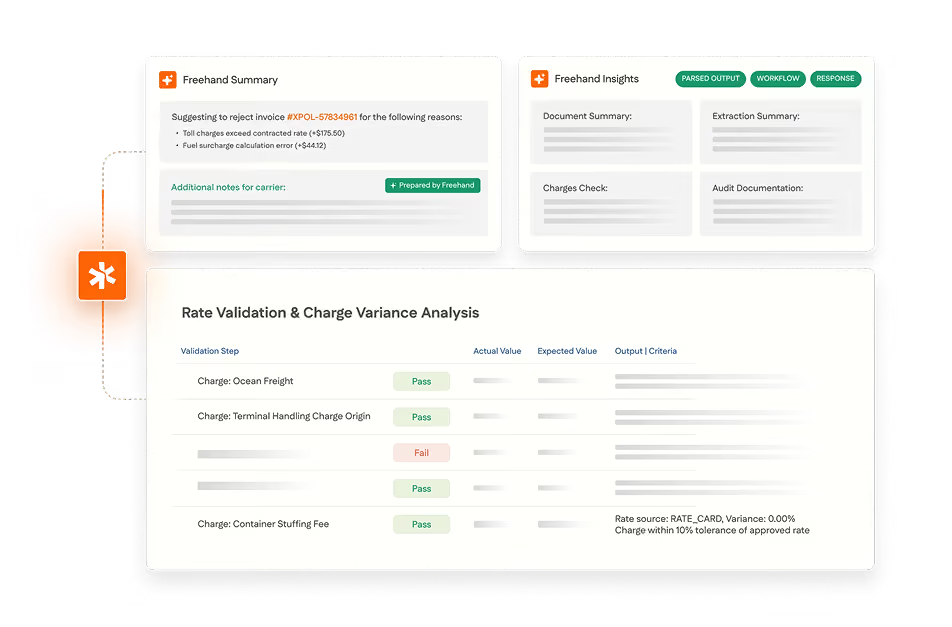
A customs compliance program built around classification, valuation, and origin protects against legal and regulatory exposure. It doesn't automatically protect against being overbilled for the customs work itself. A customs broker handles entry filing, duty payment, and disbursements on the importer's behalf, and bills for that work separately from the duty itself, brokerage fees, disbursement fees, and ancillary charges that most compliance programs never audit line by line.
That's a different function from compliance, but it sits right next to it, and the two get treated as one problem when they're actually two. A company can be fully compliant and still be paying broker fees that don't match the contracted schedule, or letting recoverable duty drawback go unclaimed because nobody owns that specific recovery.
How much duty goes unclaimed because nobody's tracking eligibility?
Enterprises with significant re-export or destroyed-goods volume typically leave 15% to 30% of eligible duty drawback unclaimed, not because the drawback program doesn't apply to them, but because nobody is tracking eligibility continuously enough to file. Drawback is a real recovery mechanism, duty already paid on goods that are later re-exported or destroyed can be reclaimed, but it requires matching import records to export or destruction records, a data-matching problem most trade compliance teams don't have the bandwidth to run continuously.
Freehand's drawback recovery agent identifies and files eligible duty drawback claims automatically, turning a recovery that most companies treat as occasional into one that runs on every eligible shipment.
Put a number on it: an importer with $2 million in eligible annual drawback leaving 15% to 30% unclaimed is $300,000 to $600,000 a year in duty that was legally recoverable and simply expired. Across the five-year filing window, that's $1.5 million to $3 million forfeited from one uncaptured mechanism.
How does compliance risk extend to who you're allowed to ship to?
Customs compliance also includes screening counterparties, customers, suppliers, carriers, against denied and restricted party lists, since shipping to a sanctioned entity is a compliance failure regardless of how correctly the goods were classified. This is a related but distinct obligation from classification and valuation: it's checked at the counterparty level, not the product level, and it has to run continuously, not just at onboarding.
For how denied party screening works and which lists apply, see our guide to denied party screening.
What should an enterprise customs compliance program check regularly?
- Are HS classifications reviewed against current tariff schedules, or set once and left unchanged? Tariff schedules and rulings change; a classification that was correct last year isn't guaranteed to be correct now.
- Is the customs broker's invoice itself being audited, line by line, against the contracted fee schedule? Compliance and billing accuracy are separate checks, and most programs only run the first one.
- Is duty drawback eligibility tracked continuously, or reviewed occasionally? Occasional review is how eligible recovery goes unclaimed.
- Does denied party screening run on every transaction, or only at vendor onboarding? A counterparty can move onto a restricted list after the relationship starts.
- Is Section 301 or 232 exposure monitored by HTS code, or checked once when the tariff first took effect? Tariff actions change, and exposure that was accurate at filing can be stale within months.
- Does the program rely on a licensed customs broker for entry filing, and is that broker's own work being checked, not just trusted? A licensed broker is a compliance best practice; auditing their invoice is a separate, often-skipped step.
- Is staff trained on current trade rules, or working from what was true when they were onboarded? Classification and tariff rules change often enough that training has a shelf life.
Customs compliance done well gets a shipment through the border cleanly. It doesn't automatically mean the broker invoice, the duty calculation, or the drawback opportunity behind that shipment ever gets checked. Freehand's trade compliance agents work both sides, classification and screening on the way in, billing accuracy and recovery on the way out, so compliance and cost control stop being two separate programs.
{{brown-cta}}
Frequently Asked Questions
What is customs compliance?
Customs compliance is meeting a government's legal requirements for importing or exporting goods, correct product classification, accurate valuation, verified country of origin, and documentation customs authorities can audit after the fact.
What are the four pillars of customs compliance?
Classification (HS/HTS codes), valuation, country of origin, and recordkeeping. Most compliance programs are structured around getting these four right at the point of entry.
Is customs compliance the same as being audited correctly for billing?
No. Customs compliance protects against legal and regulatory exposure. It doesn't automatically mean broker invoices, duty charges, and disbursement fees are being checked for billing accuracy, that's a separate audit function.
How much duty drawback goes unclaimed at most companies?
Enterprises with significant re-export or destroyed-goods volume typically leave 15% to 30% of eligible duty drawback unclaimed, usually because nobody is tracking eligibility continuously enough to file.
Does customs compliance include screening who you ship to?
Yes. Denied and restricted party screening is a customs compliance obligation, checked at the counterparty level rather than the product level, and it needs to run continuously, not just at vendor onboarding.
Know Your Exposure Before the Next Tariff Change Hits.
Freehand's AI Teams track every HTS code you ship against Section 301 and 232 actions, and quantify the dollar impact before it lands on an invoice.
One Misclassified HTS Code Changes Your Whole Duty Rate.
The gap between 0% and 25% tariff exposure can be a single digit in your HTS code. Most teams find out after the bill arrives.
Every warehouse. Every provider. Every mile.
Gartner's 2026 outlook on logistics outsourcing, and how AI Teams hold every contract to the terms you agreed.
- Where outsourced logistics quietly loses margin
- Why billed charges drift from the contract
- How AI Teams close the gap