
How to Perform Denied Party Screening: A Step-by-Step Guide
.webp)
August 12, 2026
•
8
mins
To perform denied party screening, check every counterparty, customer, supplier, carrier, and consignee, against OFAC, BIS, EU, and UN sanctions lists. Use fuzzy and phonetic matching, not just exact names. Investigate any match scoring above roughly 65% similarity before the transaction proceeds. Screening only at onboarding misses the ownership changes and list updates that happen afterward.
Key Takeaways
- Denied party screening, also called restricted party screening (the terms mean the same thing), is the process of checking a counterparty against government sanctions and denied-party lists before you transact with them.
- OFAC's 50 percent rule blocks an entity owned 50% or more in the aggregate by one or more blocked persons, even if that entity isn't separately named on any list.
- Most screening programs check a name at onboarding and stop. The exposure sits in what happens after: ownership changes, a list updates, or a new party joins an order mid-transaction.
- Matches typically get flagged for review around 65% similarity and above. Automatically clearing everything below that threshold, or automatically rejecting everything above it, both create real risk.
- Freehand's compliance screening agent screens every counterparty continuously at the point of transaction and places an automatic hold the moment it intercepts a match.
- The process in six steps: identify who needs screening, screen against the relevant lists, score and review matches, check ownership under the 50 percent rule, resolve the match, rescreen continuously.
What lists do you need to screen against?
You need to screen against OFAC's Specially Designated Nationals list, the BIS Entity List, and the relevant EU, UN, and country-specific sanctions lists. No single list covers every restriction that could apply to a given counterparty or transaction.
How do you perform denied party screening step by step?
You perform it by identifying who needs screening, checking them against the relevant lists, scoring and resolving matches, and rescreening continuously as ownership and lists change. Skipping the rescreening step is how a name cleared once stays cleared long after it should have been flagged.
Step 1: Identify who needs to be screened
Screen every party in the transaction, not just the customer of record. That includes suppliers, carriers, freight forwarders, and consignees. Also screen any party added mid-transaction, like a change in delivery destination or an added intermediary.
Step 2: Screen against the relevant sanctions and denied-party lists
Check the counterparty's name, and known aliases, against OFAC, BIS, EU, UN, and any country-specific lists that apply to the transaction.
Step 3: Score and review the matches
Use fuzzy, phonetic, and semantic matching to catch misspellings and aliases, not just exact name matches. Route anything scoring around 65% similarity and above to a reviewer instead of auto-clearing it.
Step 4: Check ownership under the 50 percent rule
Confirm the counterparty isn't 50% or more owned, in the aggregate, by one or more already-blocked persons. That still applies even if the counterparty itself isn't separately listed by name.
Step 5: Resolve the match
Clear a false positive with documentation of why it doesn't match. Escalate and hold the transaction on a true match, and keep a record of that decision for audit purposes.
Step 6: Rescreen continuously, not just at onboarding
Rerun screening at the point of each transaction, not only when a counterparty is first added. Ownership changes, list updates, and new parties joining an order all create exposure. Onboarding-only screening never catches any of it.
{{blue-cta}}
What mistakes weaken a denied party screening program?
Most weak screening programs check once at onboarding and treat a clean initial result as permanent.
- Screening only at onboarding. A counterparty that cleared a year ago may not clear today. Ownership changes and list updates both happen without any signal on your end unless you rescreen.
- Skipping fuzzy and phonetic matching. An exact-match-only check misses aliases, transliterations, and simple misspellings, the most common ways a real match gets through undetected.
- Ignoring the 50 percent rule. A counterparty can be blocked through aggregate ownership without appearing on any list by its own name. Checking the name alone isn't enough.
- Treating a flag as a resolution. A flagged match still needs investigation. Routing it to a queue and moving on is not the same as clearing or escalating it.
How do you catch a sanctioned party before it costs you a headline?
You catch it by screening every counterparty continuously, at the point of every transaction, instead of once at onboarding. Freehand's compliance screening agent checks customers, suppliers, carriers, freight forwarders, and consignees against OFAC, BIS, EU, UN, and country-specific lists. It places an automatic system hold the moment it intercepts a match, without waiting for a reviewer to get to the queue.
In one deployment, a global life sciences firm screened 3,400 active counterparties continuously. Within 90 days, the agent caught 7 critical near-matches and enforced 2 transaction blocks that averted regulatory exposure.
{{brown-cta}}
Frequently Asked Questions
What's the difference between denied party screening and restricted party screening?
None. The two terms describe the same process: checking a counterparty against government sanctions and denied-party lists before transacting with them.
What is the OFAC 50 percent rule?
It blocks an entity that's owned 50% or more in the aggregate by one or more blocked persons. That applies even if the entity isn't separately named on any sanctions list. Ownership from multiple blocked persons is added together to reach that threshold.
How do you reduce false positives without missing real matches?
Use fuzzy, phonetic, and semantic matching alongside additional data points like date of birth or location, rather than exact name matching alone. More data per record narrows down genuine matches without lowering the match threshold.
Do you need to screen your own employees, or just external parties?
Primarily external parties: customers, suppliers, carriers, freight forwarders, and consignees. Some programs extend screening to employees or agents who handle restricted transactions directly. The core requirement, though, is screening who you transact with.
What happens if you find a true match after a transaction has already started?
Hold the transaction immediately and document the decision. Continuing a transaction with a confirmed match, even one already in progress, creates real sanctions exposure. It also creates personal liability for the compliance officer who signed off.
How often should screening run?
Continuously, at the point of every transaction, not just at onboarding. Best practice treats every shipment, order, or added party as its own screening event, since ownership and lists both change after the initial check.
Can denied party screening be fully automated?
Yes, for the screening and holding steps. Automated systems can screen every counterparty continuously and place a hold the moment they intercept a match. That's faster than waiting for a reviewer to reach a queued flag. Investigating a genuine match still benefits from human judgment.
Every Counterparty. Every Transaction. Screened.
Freehand screens every customer, supplier, and carrier continuously, not just at onboarding, and holds the transaction automatically the moment it finds a match.
A Name Cleared Once Isn't Cleared Forever.
Ownership changes. Lists update. A counterparty screened at onboarding can become a sanctioned party by the time of your next shipment.
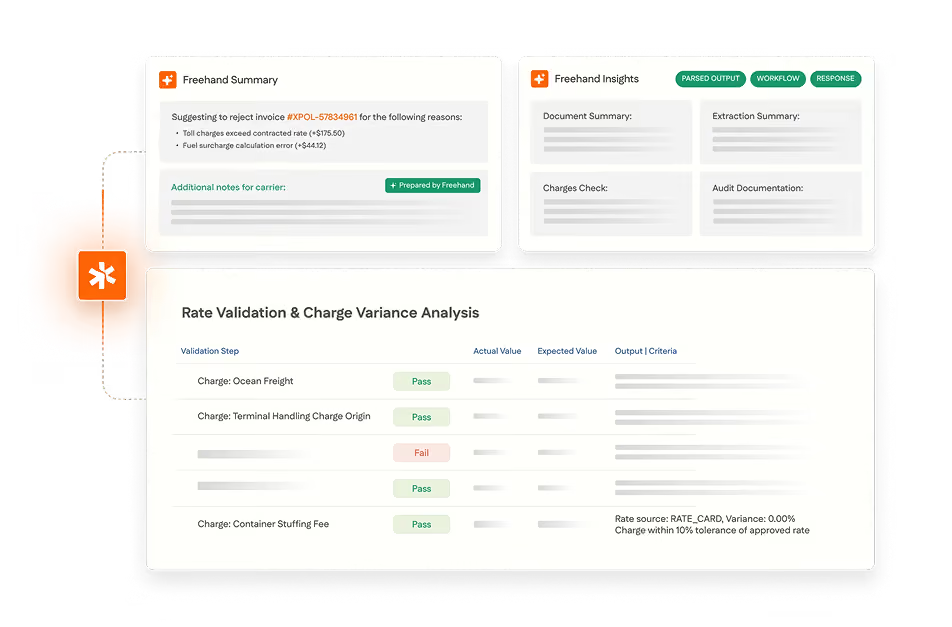
Every warehouse. Every provider. Every mile.
Gartner's 2026 outlook on logistics outsourcing, and how AI Teams hold every contract to the terms you agreed.
- Where outsourced logistics quietly loses margin
- Why billed charges drift from the contract
- How AI Teams close the gap