

Closed-Loop Spend Management: Why Point Tools Can't Do It
Closed-loop spend management only works if insight feeds back automatically. See why dashboards and eSourcing tools leave that step to your team.
.webp)
September 22, 2026
•
11
mins
Closed-loop spend management is a framework where spend data, sourcing, and contract execution continuously feed back into each other instead of sitting in separate systems. The loop closes when a finding from one stage (an audit catch, a negotiated rate) automatically changes the next stage. Most enterprises have the data. Almost none have the loop.
Key Takeaways
- Closed-loop spend management is the continuous feedback of spend insight back into sourcing, contracting, and execution, not a one-time dashboard review.
- Enterprises typically overpay 2 to 5% of freight spend, recoverable margin that a real feedback loop would catch and correct, not just report on.
- Spend-analytics and eSourcing tools show you where the leakage is. They rarely act on it, that step still lands on a person, on a schedule, if it happens at all.
- The loop breaks most often between audit and sourcing: an invoice discrepancy gets flagged and paid, but the pattern behind it never reaches the team renegotiating that lane.
- Freehand's Context Graph closes the loop automatically: what the audit finds changes what the negotiation agent proposes next cycle, without anyone exporting a report.
What is closed-loop spend management?
Closed-loop spend management is the practice of feeding spend insight back into sourcing and contracting decisions automatically, rather than treating visibility and action as separate steps.
In the textbook sense, it is a management framework that connects four functions, spend analytics, strategic sourcing, contract management, and supplier performance, so that output from one becomes input to the next.
In practice at a $1B+ enterprise, it means a discrepancy your audit team caught in March shows up as a renegotiated clause by the time that contract is up for renewal, without a person manually carrying that finding from one team to the other.
The term shows up most often in indirect-spend and procurement contexts (Accenture and Infosys have both published frameworks under this name), but the mechanism applies identically to freight and logistics spend, arguably more urgently, because freight rates, accessorials, and fuel surcharges drift off contract far faster than most indirect categories do.
"Closed loop" itself is borrowed from control engineering, where a sensor measures an actual value, a controller compares it to a target, and an actuator corrects the difference, closing the loop back to the sensor.
Spend management works the same way: audit is the sensor, the contracted rate is the target, and sourcing or contract correction is the actuator. An open loop has the sensor (audit) without a controller wired to an actuator, someone reads the finding and has to act on it by hand, if they act on it at all.
Why does the loop keep breaking?
The loop breaks at the handoff between systems, not inside any single one of them.
Three points fail most often:
- Incomplete or siloed data: Spend data lives in a TMS, an ERP, and a stack of carrier invoices, three different records of the same shipment, none of which automatically reconciles with the others.
- Manual translation between stages: A spend-analytics dashboard can show that a lane is overpaying by 4%. Getting that finding into the next sourcing event still requires someone to notice it, pull it into a deck, and bring it to the table.
- Point tools stop at insight: eSourcing software runs the RFP. Spend-analytics software shows the trend. Neither one changes what the other does on its own, the person in between is the actual mechanism closing the loop, and people are inconsistent, busy, and eventually move teams.
{{blue-cta}}
What does the loop look like when it's actually closed?
A closed loop runs through four stages where each stage's output becomes the next stage's input without a manual handoff.
Spend analytics identifies where money is going and where it's leaking. Strategic sourcing acts on that pattern at the next RFP or renegotiation. Contract management locks the negotiated terms in a form the next stage can check against. Execution and audit verify every transaction against those terms, then feed whatever they find back into spend analytics, starting the cycle again.
Worked example: A CSCO's team negotiates a 6% reduction on a lane's base rate. Six months later, the audit function catches that a carrier has been applying an old fuel-surcharge schedule, adding back roughly 3 of those 6 points on every shipment on that lane. In an open loop, that finding sits in an exceptions report. In a closed loop, it automatically flags the contract clause for correction and adjusts the baseline the next sourcing event negotiates against, so the same drift can't quietly erode the next round of savings too.
The stage that most often gets left out of this picture entirely is procure-to-pay integration, the connection between a contracted rate and the actual payment that goes out the door.
A negotiated term that lives in a contract but isn't checked against the invoice at payment time isn't really contracted, it's aspirational. Closing the loop means the P2P step enforces the contract stage's terms automatically, instead of contract management and payment execution running as two systems that happen to reference the same rate.
What's the difference between spend visibility and a closed loop?
Spend visibility tells you what happened. A closed loop changes what happens next.
A spend-analytics dashboard is the visibility layer, it aggregates and reports. Closing the loop means that report's findings automatically reshape the next sourcing cycle, the next contract term, or the next audit rule, without a person carrying that translation by hand. Most enterprises running mature spend-analytics programs still have an open loop: excellent visibility, and a fully manual, inconsistent path from that visibility to action.
What does an open loop actually cost?
An open loop costs whatever the gap is between what your negotiated rate should recover and what your invoices actually show.
Enterprises typically overpay 2 to 5% of freight spend, which on a $2B freight book is $40 to $100 million in recoverable leakage. That number persists year over year specifically because the loop is open: audit catches the overcharge, the invoice gets corrected or disputed, and the underlying pattern, the reason the overcharge kept happening, never reaches the team that could prevent it at the source.
This is also where "tail spend" (the long tail of low-volume, high-friction vendors and lanes) does the most damage. Tail spend rarely gets the sourcing attention high-volume lanes do, and in an open loop it never will, because nobody is systematically feeding its audit findings back into a sourcing decision. A closed loop treats tail spend the same way it treats a top lane: whatever the audit finds changes the next negotiation, regardless of volume.
An open loop also has a compliance cost that never shows up on the same line item as an overcharge: maverick spend, purchases routed around the negotiated contract entirely.
Without a system checking every transaction against contract terms, buying off-contract is easy to miss and easier to repeat. A closed loop makes it structurally harder: the same mechanism enforcing the negotiated rate at payment time also flags the transaction that skipped the contract altogether, without anyone policing it manually.
How does Freehand actually close the loop?
Freehand's Context Graph links audit findings, contract terms, and sourcing history so each one automatically informs the others, without a person moving data between systems.
Point tools give a CSCO a dashboard and an eSourcing platform for the next RFP; closing the gap between them is still the team's job. Freehand's invoice audit function checks 100% of invoices, not a sample, against the contracted rate, and every discrepancy it finds becomes part of the Context Graph that informs the next negotiation and the next contract's terms. Coupa or a similar tool surfaces the data. Freehand acts on it.
This is the structural difference between a company that has spend visibility and one that has a closed loop: visibility is a report someone has to read and act on manually; a closed loop is a system where the acting already happened by the time anyone opens the report.
Freehand was named a Representative Vendor in Gartner's Market Guide for freight audit and payment providers specifically for this full-lifecycle mechanism, not just the audit step in isolation.
How do you actually start closing the loop?
Start with the stage where insight most often dies before it reaches action, usually the audit-to-sourcing handoff, and fix that connection first.
Trying to close every stage of the loop at once is the most common reason these programs stall.
- Map where handoffs are currently manual: Identify every point where a person exports a report, builds a deck, or emails a finding to another team, that's where the loop is open.
- Prioritize the highest-leakage handoff, not the easiest one: For most freight programs, that's audit findings failing to reach sourcing and renegotiation.
- Connect systems before adding new dashboards: Another visibility tool doesn't close a loop that's already visible and still not acted on.
- Measure the loop by action taken, not reports generated: Track how many audit findings actually changed a contract term or sourcing decision within the next cycle, not how many were flagged.
A framework that stops at the first bullet is still an open loop with better documentation.
If your spend-analytics dashboard shows the leakage but nothing downstream actually changes because of it, the gap isn't visibility. It's the missing mechanism that turns a finding into an action, on the next invoice, the next negotiation, and the next contract, without anyone carrying that translation by hand.
{{brown-cta}}
Frequently Asked Questions
Is closed-loop spend management the same as spend visibility?
No. Spend visibility reports what happened. A closed loop uses that report to automatically change the next sourcing, contracting, or audit decision, without a manual handoff.
Does closed-loop spend management apply to freight, or only indirect spend?
It applies to any spend category with recurring transactions and contracted terms. Freight is arguably the strongest fit, since rates and accessorials drift off contract faster than most indirect categories.
What's the biggest reason closed-loop spend management programs stall?
Trying to connect every stage at once. Programs that succeed start with the single highest-leakage handoff, usually audit findings failing to reach the next sourcing cycle, and fix that first.
Can spend-analytics software close the loop on its own?
No. Spend-analytics software builds the visibility layer. Closing the loop requires that visibility to automatically reshape sourcing, contracting, or audit rules, a separate mechanism most point tools don't include.
One Spend Cube. Every Dollar Accounted For.
Freehand consolidates freight spend from every system into one continuously updated view, then feeds it straight into audit, negotiation, and sourcing decisions.
You Can't Manage What You Can't See in One Place.
Freight spend sits in a TMS, an ERP, and a stack of carrier invoices. That's three different stories about the same dollar.
Every warehouse. Every provider. Every mile.
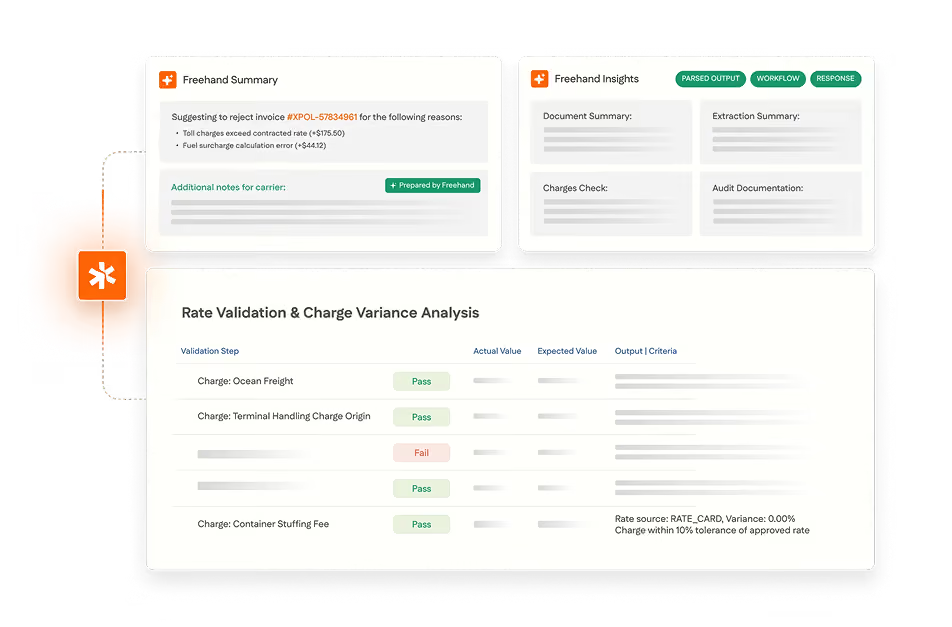
Gartner's 2026 outlook on logistics outsourcing, and how AI Teams hold every contract to the terms you agreed.
- Where outsourced logistics quietly loses margin
- Why billed charges drift from the contract
- How AI Teams close the gap