
Procure to Pay: The 7-Step Process for Freight
Procure to pay is the process from purchase requisition to supplier payment. Learn the 7 steps, KPIs, software category, and freight-specific best practices.
.webp)
June 17, 2026
•
18
mins
Procure to pay is the process that runs from a purchase requisition through supplier payment: request, approve, order, receive, invoice, audit, and pay. It exists so what a business ordered, received, and pays for are all the same thing. In freight, that chain breaks most often between the invoice and the payment.
Key Takeaways
- Procure to pay (P2P) is the end-to-end workflow connecting purchasing activity to financial settlement: requisition, approval, purchase order, receipt, invoice, audit, and payment.
- P2P is a subset of source to pay (S2P). P2P starts from an approved requisition; S2P starts further upstream, at supplier sourcing, RFP, and contract negotiation.
- Manual P2P processes typically run a 30-plus-day invoice-to-payment cycle. Automated P2P compresses that to under 3 days, and mature programs close in under 5 days end to end.
- Most P2P breakdowns trace back to two places: invoice exception volume that outpaces the team handling it, and contract rates that go stale in the AP validation layer.
- Freehand is recognized in the 2026 Gartner Market Guide for Freight Audit and Payment Providers for closing that exact gap in freight-specific P2P.
What is procure to pay?
Procure to pay connects the moment a business identifies a need to the moment it pays for it. The point is simple: a purchase order, a delivery, and an invoice should all describe the same transaction, and payment should only happen once all three agree.
For a freight-heavy enterprise, P2P covers freight the same way it covers any other purchase. A lane gets tendered. A shipment moves. A carrier invoices for it. Someone has to confirm the invoice matches what was contracted before payment goes out. The hard part is that a freight invoice carries more variable charges, fuel surcharges, accessorials, reclassifications, than a typical PO line item ever does, and that's where general-purpose P2P tools tend to fall short.
What is the difference between procure to pay and source to pay?
Procure to pay and source to pay cover different parts of the same supplier relationship. P2P is the narrower of the two. The table below shows where each one starts and ends.
| Aspect | Procure to pay (P2P) | Source to pay (S2P) |
|---|---|---|
| Starts at | An identified need and an approved requisition | Supplier sourcing, RFP, and contract negotiation |
| Scope | Purchase requisition through supplier payment | Supplier identification through supplier payment |
| Typical owner | AP and procurement operations | Strategic sourcing and procurement |
P2P is a subset of S2P. An enterprise that has already established supplier relationships and contracted rates uses P2P to manage the day-to-day operational cycle. S2P extends upstream to include carrier RFPs, bid normalization, and contract award, the work that produces the rates P2P then has to enforce.
{{blue-cta}}What is the difference between procure to pay and accounts payable?
Accounts payable is one stage inside procure to pay, not a separate process running alongside it. AP specifically covers invoice receipt, verification, and payment disbursement, the back half of the P2P cycle. Procure to pay includes everything upstream of that too: the requisition, the approval, and the purchase order that AP later has to match an invoice against.
The distinction matters operationally. An AP team can run a tight invoice-matching process and still inherit problems that started upstream, like a purchase order that never got issued correctly or a requisition approved against the wrong cost center. Fixing that requires visibility into the full P2P cycle, not just the AP stage of it.
What are the 7 steps of the P2P cycle?
The P2P cycle runs in seven sequential steps, from purchase requisition through payment disbursement, and each step produces something the next step depends on. Invoice lifecycle management sits inside steps 5 through 7 specifically: receipt, verification, and payment, the part of P2P where most freight AP teams actually spend their time.
Step 1: Purchase requisition
A need gets written down: what's needed, how much, and why. This is where everything else starts, and a vague requisition creates confusion that comes back later at invoice matching.
Step 2: Purchase approval
Someone reviews the requisition against budget and policy, then approves or rejects it. Delays pile up here when the approver has no context on urgency or past spend.
Step 3: Purchase order issuance
An approved requisition turns into a formal purchase order sent to the supplier or carrier, with the price, terms, and delivery expectations spelled out. That PO is the reference point every later invoice gets checked against.
Step 4: Goods or services receipt
The shipment moves, or the service gets delivered, and receipt gets confirmed against what the PO specified. For freight, this is where a bill of lading or proof of delivery enters the record.
Step 5: Invoice receipt and processing
The carrier or supplier submits an invoice, in whatever format they use, EDI, PDF, or a portal upload. That invoice has to enter your system before it can be checked against anything.
Step 6: Invoice verification and audit
The invoice gets checked against the PO and the delivery record, the standard three-way match, then against the contracted rate on top of that. This is the step general P2P tools handle least well for freight, since it requires validating fuel surcharges, accessorials, and reclassifications that a standard invoice-matching rule set was never built to catch.
Step 7: Payment approval and disbursement
A verified invoice gets approved and paid, on terms, with the right GL coding applied. An invoice that clears audit but sits waiting for approval still delays the cycle, even though the hard part is already done.
What role do catalogs and supplier onboarding play in P2P?
Catalogs and supplier onboarding sit at the edges of the P2P cycle. They feed it, rather than sitting inside the seven steps directly. A punchout catalog lets a requester pick from pre-negotiated items or services right at the requisition stage, so purchasing stays inside contracted terms instead of triggering a new negotiation every time.
Supplier and carrier onboarding is a separate, ongoing job: getting a new carrier's rate cards, remittance details, and compliance paperwork into your systems before the first PO ever goes out. Skip or rush that step, and it shows up later as friction. A carrier with incomplete or outdated data looks like an audit failure at the invoice stage, when the real problem started back at onboarding.
What are the biggest challenges in the P2P cycle?
The biggest P2P challenges concentrate in a handful of recurring spots, and most of them show up as a slow invoice cycle rather than announcing themselves directly.
- Data fragmentation across ERP, TMS, and AP systems: the same shipment tells a different story in each system, and nobody owns reconciling them.
- Supplier and carrier onboarding friction: incomplete rate cards or compliance data at onboarding surfaces later as invoice mismatches that look like audit failures.
- Invoice exception volume exceeding team capacity: more exceptions than a team can review by hand means some clear without real review, and some sit for weeks.
- Payment approval delays straining carrier relationships: an approval sitting in an inbox for over a week is not unusual, and it shows up as strained terms on the next negotiation.
- Contract rates not staying current in the AP validation layer: a rate that changed at the negotiation table has to be updated everywhere invoices get checked, or the audit checks against a number that's already wrong.
- Spend data too fragmented to inform the next procurement cycle: if P2P data never rolls up cleanly, the next sourcing cycle negotiates from instinct instead of verified history.
What are the benefits of an optimized P2P process?
An optimized P2P process turns a source of manual work and cash leakage into a fast, predictable cycle finance can plan around. Invoice-to-payment time drops from 30-plus days to under 3, freeing 60 to 70% of the back-office capacity that manual exception handling used to consume. Freight-specific audit coverage on top of that typically recovers 1.5 to 2.5% of freight spend that a general-purpose P2P tool would have paid out as billed.
Two other benefits matter just as much, even without a dollar figure attached. A requisition-to-PO process with real approval controls stops maverick spending before it happens, instead of catching it after the fact in an audit. And a carrier that gets paid on time, on the terms it agreed to, is a carrier more willing to hold its rates and prioritize your freight the next time capacity gets tight.
What KPIs matter most for a P2P process?
The KPIs that matter most for P2P are the ones that show whether the process itself is working, not just whether spend went up or down.
- Invoice cycle time: time from invoice receipt to payment disbursement. Best-in-class sits under 3.5 days; industry average runs 14 or more.
- First-pass match rate: share of invoices that clear automatically on the first check, without manual intervention. Target 90% or higher.
- Touchless (straight-through) processing rate: share of invoices processed with zero human touch, start to finish. This is increasingly the headline automation metric; best-in-class programs run 70% or higher.
- PO-to-invoice match rate: how often an invoice matches its purchase order cleanly, a narrower measure than first-pass match rate, which also accounts for contract and receipt data.
- Exception resolution rate: share of flagged exceptions resolved within a defined window. Target 85% or higher.
- Discount capture rate: share of available early-payment or dynamic discounts actually captured, not left on the table because an invoice cleared too slowly.
- Spend under management: share of total spend running through a managed, audited P2P process rather than off-process purchasing. Top performers run 80% or higher; on-contract spend specifically benchmarks near 79.6% for leading programs.
What P2P software category should you know about?
Most enterprise P2P software, platforms like Coupa, SAP Ariba, JAGGAER, GEP SMART, Oracle Procurement Cloud, Ivalua, and Basware, handles purchase orders, catalog and punchout management, supplier onboarding, and general invoice-matching rules across every category of spend a business buys.
That breadth is also the limit for freight specifically. General P2P platforms check an invoice against a PO and a rate, which works fine for a standard purchase with one line item. A freight invoice carries fuel surcharges, accessorials, and reclassifications that shift after tender, and a generic matching rule was never built to catch any of that. That is the gap a freight-specific audit layer closes on top of whatever P2P platform is already in place.
What causes the P2P cycle to run slowly?
The P2P cycle runs slowly when exception volume outpaces the team handling it, and when contract rates in the AP system have gone stale next to what was actually negotiated. A single approver sitting on invoices without full audit context adds days on its own. Nobody wants to approve payment on an invoice they can't confirm has cleared review.
A global FMCG shipper ran into this at scale. Half its invoices needed manual exception handling, and accessorial rules broke down across 139 separate carrier relationships, each with its own quirks the system hadn't been built to handle. A multi-site manufacturer saw the same pattern from a different angle: average approval cycles of 7.4 days, just from payments sitting without the context needed to clear them.
What are the current trends in P2P?
Four trends are reshaping how enterprises run P2P right now.
- Agentic AI replacing rules-based automation: static rules flag an exception and hand it back to a person. Agentic systems resolve the exception itself, and only escalate what genuinely needs a human call.
- Real-time spend visibility replacing month-end reporting: waiting for a monthly close to see what freight actually cost is giving way to continuous, always-current spend data.
- Source-to-pay integration closing the loop: P2P and S2P data increasingly feed each other directly, so audited invoice data informs the next sourcing cycle instead of sitting in a separate system.
- Four-way matching replacing three-way matching: the standard three-way match checks an invoice against the PO and the receipt, but still misses what actually shipped. Four-way matching adds the shipment record on top, which is what freight needs to catch a reclassification or a rate that drifted mid-transit.
What are the best practices for P2P in freight and logistics?
The best P2P practices for freight and logistics center on keeping the audit layer complete and current, not just fast.
- Audit 100% of invoice volume, not a sample.
- Keep rate cards current in the AP validation layer the moment a contract changes.
- Separate invoice validation from payment approval, so a slow approver doesn't also slow down the audit.
- Track the total cost of a carrier relationship, not just the contracted rate on paper.
- Feed validated P2P data back into the next sourcing cycle instead of starting that negotiation from scratch.
A global pharma company applied this directly, consolidating freight spend across 14 countries, 6 modes, and 3 cold-chain service providers into a single visibility layer. It reached a first single-view freight spend report within 45 days of implementation, replacing what had been a fragmented, per-region view with no consistent source of truth.
How does Freehand close the P2P gap in freight?
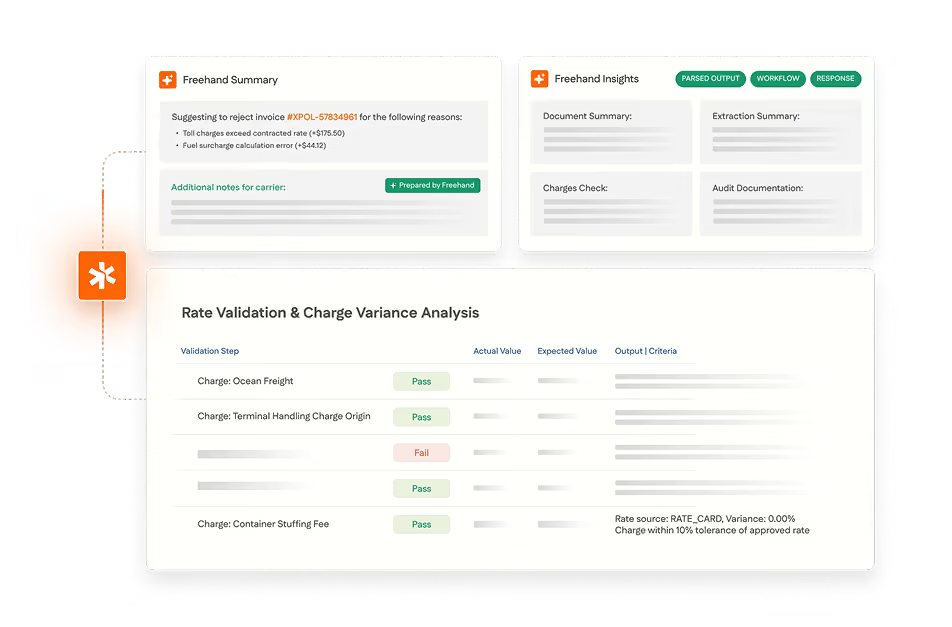
Freehand closes the P2P gap in freight by running the invoice verification and audit step at 100% coverage, on every invoice, instead of the sampled or rules-based checking most general P2P platforms apply to freight the same way they apply it to any other purchase category. That coverage sits underneath Freehand's own procure-to-pay software, so the audit layer and the P2P workflow run on the same data instead of two disconnected systems.
Freehand's freight audit and payment software checks every freight invoice against the contracted rate, the shipment record, and the accessorial rules that generic matching engines miss. Where P2P connects to source to pay, Freehand's source-to-pay software carries that same audited data upstream into the next RFP and negotiation cycle. That coverage is the direction Gartner itself points to for this category.
{{brown-cta}}
Frequently Asked Questions
What is procure to pay?
Procure to pay is the process that connects a purchase requisition to supplier payment. It runs through requisition, approval, purchase order, receipt, invoice, audit, and payment.
What is the difference between procure to pay and accounts payable?
Accounts payable is one stage inside procure to pay: invoice receipt, verification, and payment. Procure to pay includes everything upstream too, the requisition, approval, and purchase order an invoice later gets matched against.
What is the difference between P2P and S2P?
P2P is a subset of S2P. P2P starts from an approved requisition and runs through payment. S2P starts further upstream, at supplier sourcing, RFP, and contract negotiation, then extends through the same payment stage P2P covers.
What causes P2P cycles to run slowly?
Two things, mainly. Invoice exception volume outpaces the team handling it, and contract rates in the AP system go stale compared to what was actually negotiated. Both force manual correction on invoices that should have cleared on their own.
How does automation improve the P2P process?
Automation matches invoices against POs, contracts, and delivery records without manual review. It resolves routine exceptions instead of just flagging them, and keeps contract rates current so audit checks run against the right data.
What ROI can enterprises expect from P2P automation?
Invoice cycle time typically drops from 30-plus days to under 3. Automation also frees 60 to 70% of back-office capacity from manual exception handling, and recovers 1.5 to 2.5% of freight spend that a sampled process would have missed.
Why does freight P2P require a different approach than general P2P?
Freight invoices carry fuel surcharges, accessorials, and reclassifications that shift after a shipment moves, none of which a generic invoice-matching rule set was built to catch. Freight-specific audit logic is what closes that gap on top of a standard P2P platform.
What is the difference between a requisition and an invoice?
A requisition is an internal request to buy something, submitted before any purchase order exists. An invoice is the supplier's bill for goods or services already delivered, submitted after the fact. In P2P terms, the requisition opens the cycle (Step 1) and the invoice arrives near its end (Step 5), and matching one against the other is what invoice verification checks.
Freehand Closes the P2P Gap Freight Invoices Fall Into.
Freehand's AI Teams keep contract rates current and validate every freight invoice against them, so the handoff between procurement and payment doesn't leak.
A Contract Rate Expired Months Ago. Nobody Updated the AP System.
The gap between procurement and AP is where a stale rate table quietly becomes an overpayment.
Every warehouse. Every provider. Every mile.
Gartner's 2026 outlook on logistics outsourcing, and how AI Teams hold every contract to the terms you agreed.
- Where outsourced logistics quietly loses margin
- Why billed charges drift from the contract
- How AI Teams close the gap