
Best Freight Claims Management Software for 2026: 7 Tools Compared
.webp)
July 21, 2026
•
15
mins
.webp)
Comparing the top freight claims management software options for 2026: 1. Freehand, 2. iNymbus, 3. TranSolutions, 4. Cass Information Systems, 5. nVision Global, 6. Descartes 3G TMS, 7. CargoWise.
This comparison is written for enterprise shippers, the $1B-plus companies filing hundreds of cargo loss, damage, and shortage claims a year. Freight claims leak value quietly: OS&D goes unnoticed at delivery, the paperwork sits until the filing window closes, and recoverable money is written off as the cost of doing business.
The platforms below manage the claim from the damaged pallet to the carrier settlement. They differ on how much of that work the software does on its own, and the table scores them on that.
TL;DR
- Freehand: AI Teams that run cargo loss and damage claims end to end, detecting OS&D, assembling evidence, filing with the carrier, and tracking to settlement autonomously.
- iNymbus: RPA robots that file and dispute claims across 50-plus carrier and retailer portals, strong on high-volume, repetitive claims.
- TranSolutions: The deepest dedicated claims software (MyEZClaim), the category pioneer, though the workflow is human-run.
- Cass Information Systems: Combines freight overcharge recovery with managed loss and damage claims under one established provider.
- nVision Global: Region-tailored managed claims for global shippers, delivered as a service.
- Descartes 3G TMS: Freight claims tracking and filing built inside a full transportation management system.
- CargoWise: Claims handled within a global forwarding ERP, best when you already run WiseTech.
What is freight claims management software?
Freight claims management software digitizes and automates the filing, tracking, and settlement of lost, damaged, or delayed cargo, to recover the shipment's value from the carrier.
Core functions the software performs:
- Detects OS&D (over, short, and damage) from delivery, POD, and shipment data.
- Assembles the evidence packet: bill of lading, proof of delivery, photos, and invoice.
- Calculates the claim value net of freight charges, salvage, and prior payments.
- Files the claim with the carrier and tracks acknowledgment, review, and settlement.
- Sends deadline reminders so claims never lapse past the filing window.
It automates the process of filing and managing freight claims, which reduces risk, strengthens documentation, and improves outcomes on every claim. Claims sit next to freight audit as the other half of carrier recovery, which is why an agentic accounts receivable automation software layer that files and settles on its own separates from a claims desk that waits for a human.
How we evaluated freight claims management software
We scored each vendor on the decision an enterprise team makes when cargo arrives damaged or short: which platform recovers the most value with the least manual effort, and how far it carries the claim toward settlement. All seven were assessed on the same weighted criteria, using vendor documentation, Gartner Peer Insights, and G2 review data. Weights reflect what drives recovery for a high-volume claims program.
- AI autonomy and agentic filing (25%): Does the platform run the claim on its own, or hand a queue to a human or a service team?
- Claims coverage and OS&D detection (20%): How well it detects loss, damage, and shortage and assembles the evidence packet.
- Recovery rate and settlement tracking (18%): How much it recovers and how it tracks claims to closure.
- Carrier and portal integration and documentation (15%): Direct filing into carrier portals with the right documents attached.
- ERP and TMS integration and data ownership (12%): Pre-built connectors and who controls the claims data.
- Time-to-value and pricing transparency (10%): Speed to go live and whether pricing is disclosed.
This is an independent editorial comparison referencing Gartner and G2 alongside vendor documentation; it is not a certified third-party ranking.
Freight Claims Management Software Comparison
Here is a detailed comparison of the best freight claims management software: 1. Freehand, 2. iNymbus, 3. TranSolutions, 4. Cass Information Systems, 5. nVision Global, 6. Descartes 3G TMS, 7. CargoWise.
{{blue-cta}}
Freehand: Best AI-Native Freight Claims Management Software
Best for: Enterprises that want cargo loss and damage claims detected, filed, and recovered without a claims desk to staff. Built for logistics and finance leaders tired of writing off recoverable value because the paperwork never got done in time.

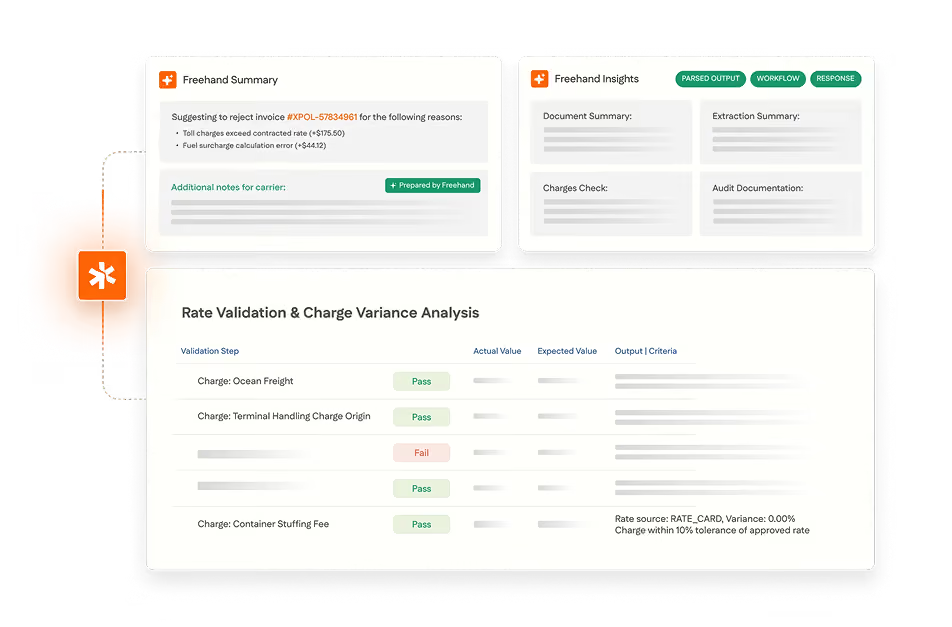
Freehand's Claims and Recovery Agent runs the claim end to end. It reads delivery exceptions and damage events straight from your TMS and WMS and flags claims from complaint emails and carrier notifications, so 100% of carrier filing windows are met instead of the usual scramble to beat the deadline. It assembles the evidence packet, files touchlessly into carrier portals, tracks to resolution, and posts the recovery to your ERP ledger.
Where the incumbents give you a claims desk a person operates or a service team that files for you, Freehand runs the claim autonomously and reports lifting recovery rates 20 to 30 percentage points over manually managed claims.
Key Features
- OS&D detection from TMS and WMS exceptions, plus complaint emails and carrier notifications, so 100% of filing windows are met.
- Evidence packets assembled from POD and digital signatures, carrier and damage-report emails with photos, and applicable insurance policy rules.
- Touchless filing into carrier portals or by email, tracked to resolution.
- Escalation alerts via Microsoft Teams or Slack when a claim stalls or a carrier breaches its response SLA.
- Automatic receivables updates in your ERP ledger (SAP, Oracle, NetSuite) on resolution.
- Carrier Evaluation feedback: claim frequency and carrier performance flow into the next RFQ and contract negotiation.
- Context Graph that surfaces recurring damage patterns by lane, carrier, and product.
- System-agnostic integration with SAP, Oracle, NetSuite, Infor, and Manhattan, with full data ownership.
- Pairs with enterprise freight audit and payment software so overcharge and claims recovery run together.
- Managed accounts payable automation software workflows delivered as completed work rather than seats to staff.
Pricing
Performance-based pricing scales with claim and freight volume rather than per-seat licensing. Typically lower than a managed claims service, with no headcount added as volume grows.
Pros
- Captures 100% of eligible OS&D events; manual processes miss 30% to 40%.
- Runs claims autonomously end to end and reports a 20 to 30 point recovery-rate lift.
- Recovery and carrier data feed the next RFQ, so claims history shapes sourcing.
Cons
- A newer name than the decades-old claims incumbents.
- Deepest fit is enterprise volume rather than a small claims desk.
What Users Say
Love: Recovery rates that climb fast. A high-volume DTC retailer filing 300 to 400 cargo claims a month lifted its recovery rate from 52% to 81% within two quarters on Freehand, capturing over 600 eligible claims its manual process had missed. (source)
Complain: Younger name in an established category. As a newer entrant, Freehand has a shorter public track record than claims pioneers like TranSolutions, and its strongest fit is high enterprise claim volume. (source)
iNymbus: Best Freight Claims Automation Software
Best for: Shippers and retailers filing high volumes of repetitive claims and deductions across many carrier and retailer portals.
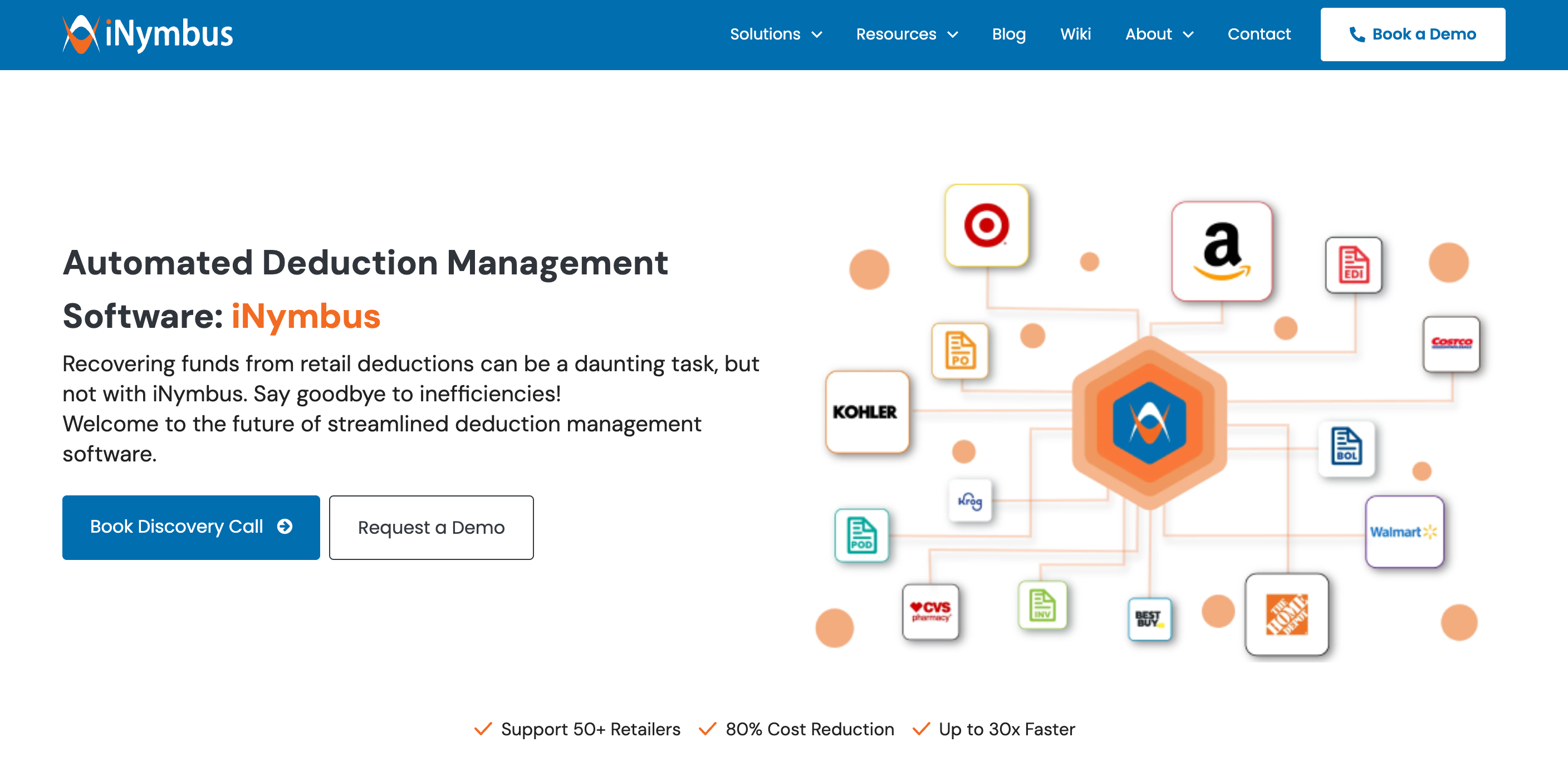
iNymbus uses robotic process automation to file and dispute freight claims and chargebacks across 50-plus portals, including UPS, FedEx, Walmart, Amazon, and major ocean lines. Its robots populate claim forms from standard operating procedures, attach the right documents, and submit directly through each portal. It reports accelerating the claims process substantially and cutting cost per claim sharply. Its automation is script-based rather than reasoning, so it is strongest on high-volume, repeatable claims.
Key Features
- RPA robots that file and dispute claims across 50-plus carrier and retailer portals.
- Automated claim package creation from standard operating procedures.
- Freight claims and retailer deduction handling in one tool.
- Direct portal submission with documents attached.
- Settlement and status tracking.
- Reported large reductions in cost per claim.
- Pay-as-you-go per-claim pricing.
- Coverage that pairs with 3PL and 4PL audit software needs.
Pricing
Per-claim, pay-as-you-go pricing, reported around $0.40 to $0.70 per claim, with a pilot and a free deductions audit before commitment.
Pros
- Strong automation for high-volume, repetitive claims.
- Broad carrier and retailer portal coverage.
Cons
- RPA is script-based rather than reasoning, so it adapts less to edge cases.
- Reviewers note pricing higher than some alternatives.
- Portal-bound rather than a full detection-to-settlement agent.
What Users Say
Love: High-volume claims on autopilot. Reviewers say iNymbus saves significant time and manpower resolving carrier and retailer deductions, with robots filing across dozens of portals. (source)
Complain: Priced above some options. Some reviewers note that iNymbus price points run a little higher than other options in the category. (source)
TranSolutions: Best Dedicated Freight Claims Software
Best for: Teams that want the deepest purpose-built claims software, with carrier-accepted forms and extensive claims reporting.

TranSolutions introduced MyEZClaim in 1996 as the first dedicated freight claim software, and it remains the category's deepest claims desk for shippers, brokers, and 3PLs. It generates claim forms accepted by all carriers, calculates payment due net of freight charges, salvage, and prior payments, and offers 80-plus reports with 150 variables. Reminder letters generate automatically at 30-day intervals. Its depth is real; its model is a claims desk a person operates rather than an autonomous agent.
Key Features
- Carrier-accepted claim form generation across modes.
- Payment-due calculation net of salvage and prior payments.
- Item-level merchandise tracking across transport modes.
- 80-plus automated reports with 150 variables.
- Automatic reminder letters at 30-day intervals.
- API and web-services integration with supply chain and financial systems.
- Claims for shippers, brokers, and 3PLs.
- Coverage that complements parcel audit software.
Pricing
License pricing by custom quote; not publicly disclosed. Structured around users and claim volume.
Pros
- The deepest dedicated claims functionality and reporting.
- Category pioneer with carrier-accepted forms.
Cons
- Human-run claims desk rather than autonomous filing.
- Thin independent review footprint to triangulate.
- Reporting depth requires configuration.
What Users Say
Love: Deep, intuitive claims desk. Reviewers describe MyEZClaim as intuitive and easy to navigate, letting teams manage claims efficiently without extensive training. (source)
Complain: Thin independent review signal. MyEZClaim has limited third-party review volume, and G2 listings surface a different product, so buyers have fewer outside data points. (source)
Cass Information Systems: Best Freight Claims and Overcharge Recovery
Best for: Shippers that want loss and damage claims handled alongside freight overcharge recovery under one established provider.
Cass is one of the most established freight audit and payment providers, and it runs loss and damage claims as a full-service offering where its team handles filing, follow-up, and carrier correspondence. That pairing of overcharge recovery with claims under one roof is its draw. As with its audit, the model is managed-service and human-led rather than autonomous.
Key Features
- Managed loss and damage claims filing and follow-up.
- Freight overcharge recovery in the same relationship.
- Carrier correspondence handled by the Cass team.
- Multi-modal claims coverage.
- Large-scale payment and recovery operations.
- Business-intelligence reporting.
- ERP integration via established feeds.
- Compatible with enterprise freight payment software workflows.
Pricing
Bank-first model with custom quotes; not publicly disclosed. Claims typically bundled with audit and payment services.
Pros
- Claims and overcharge recovery under one established provider.
- Deep scale and carrier relationships.
Cons
- Managed-service model rather than autonomous software.
- Human-led filing keeps headcount in the loop.
- Pricing bundled and not transparent.
What Users Say
Love: Trusted recovery at scale. A Senior Director of Transportation calls Cass "a benchmark amongst it's peer group," citing ease of transition and business intelligence. (source)
Complain: Very thin, dated review signal. Cass shows a single Gartner rating from 2023, so there is little current peer feedback to validate. (source)
nVision Global: Best Global Managed Freight Claims
Best for: Multinational shippers that want region-tailored loss and damage claims managed across countries.
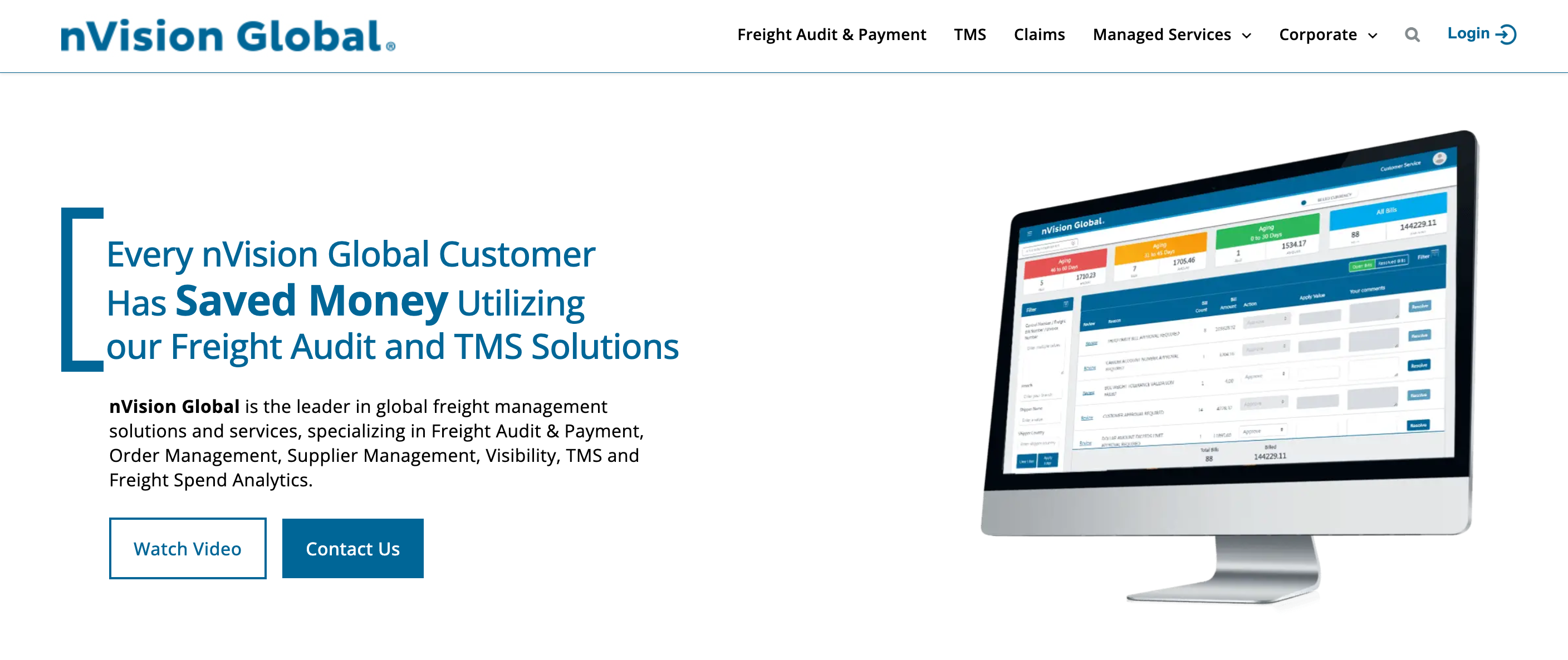
nVision Global runs freight claims as part of its global freight audit and payment service, with processing centers worldwide and region-specific handling. It manages claims filing, follow-up, and multi-currency recovery for multinational programs. Reviewers describe it as a reliable global partner. As a managed service, its claims are service-led rather than autonomous, and its independent software-review footprint is thin.
Key Features
- Managed freight claims filing across regions.
- Global freight audit and payment integration.
- Multi-currency and multi-language claims handling.
- Processing centers across 190-plus countries.
- Claims reporting and analytics.
- Carrier correspondence handled by nVision.
- ERP and TMS data integration.
- Coverage that extends toward source-to-pay software processes.
Pricing
Managed-service pricing by custom quote; not publicly disclosed. Structured around volume and regional scope.
Pros
- Region-tailored global claims handling.
- Reliable managed-service delivery.
Cons
- Managed-service model rather than autonomous software.
- Thin independent software-review footprint.
- Human-led exception handling at scale.
What Users Say
Love: Region-by-region customization. A Supply Chain Manager at a $10B-plus manufacturer notes solutions tailored to each region that adjust year over year, calling them a reliable partner. (source)
Complain: Thin independent software reviews. nVision runs as a managed service; its G2 product profile shows zero reviews, limiting software-level diligence. (source)
Descartes 3G TMS: Best Freight Claims Inside a TMS
Best for: Shippers and 3PLs that want claims tracking and filing built into the same TMS that plans and executes freight.
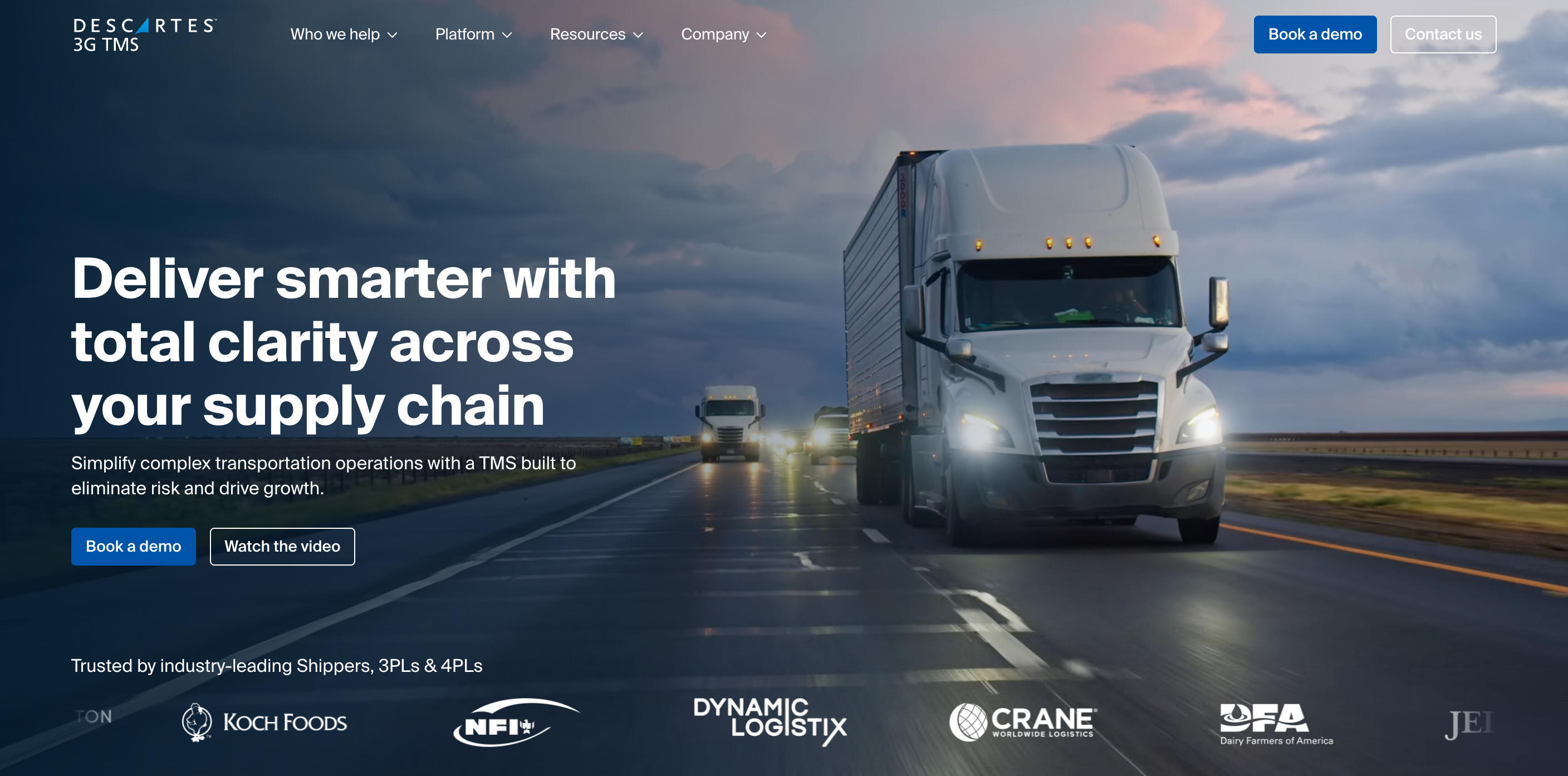
Descartes 3G TMS, formerly 3Gtms, is a cloud transportation management system that captures damage reports and freight claims alongside execution data and business intelligence. Claims live next to the load records that created them, so filing and tracking draw on shipment context directly. It suits teams that want claims inside their TMS rather than a separate tool, with the tradeoff that claims are one module within a broad platform.
Key Features
- Freight claims tracking tied to load records.
- Damage reporting within the TMS.
- Business intelligence on on-time, damage, and claims filed.
- Multi-modal transportation execution.
- Carrier communication and documentation.
- Rate and settlement data in one place.
- API integration across the supply chain stack.
- Analytics that complement spend analytics software.
Pricing
License and quote-only pricing; not publicly disclosed. Best fit for teams already on the TMS.
Pros
- Claims tied directly to shipment and load context.
- One system for execution and claims.
Cons
- Claims are a module within a broad TMS, not a specialist.
- Assistive workflow rather than autonomous filing.
- Quote-only pricing.
What Users Say
Love: Claims in shipment context. Reviewers value a unified TMS that captures damage reports and freight claims alongside on-time performance and execution data. (source)
Complain: Claims are one module. As claims sit within a full TMS rather than a dedicated tool, depth on claims-specific workflows is lighter than a specialist. (source)
CargoWise: Best Freight Claims for Global Forwarders
Best for: Global freight forwarders and large logistics operators that want claims handled inside a single logistics ERP.
CargoWise, by WiseTech Global, is a logistics ERP that unifies forwarding, customs, warehousing, and transport across 216-plus modules. Claims are handled within its forwarding and accounting operations rather than as a standalone product, which suits organizations already standardized on CargoWise. Its strength is breadth and global coverage; its tradeoff is that claims are one function inside a large, complex platform rather than a dedicated claims engine.
Key Features
- Claims handled within forwarding and accounting operations.
- Global freight forwarding automation across modes.
- Customs and compliance in the same platform.
- Enterprise accrual-based accounting.
- Near real-time cargo visibility.
- Carrier and partner connectivity.
- Modular value-pack architecture.
- Coverage that spans toward trade compliance software needs.
Pricing
Value-pack license pricing; not publicly disclosed. Total cost scales with modules and users.
Pros
- Claims within a single global logistics ERP.
- Deep forwarding, customs, and accounting breadth.
Cons
- Claims are a function within a broad ERP, not a specialist tool.
- Complex and costly to implement.
- Best only if already on CargoWise.
What Users Say
Love: One platform for global logistics. Reviewers value unifying forwarding, customs, warehousing, and accounting on a single enterprise platform with near real-time visibility. (source)
Complain: Complexity and cost. Reviewers note CargoWise is complex and costly to implement, with a steep learning curve across its many modules. (source)
How to choose freight claims management software
Match the tool to how many claims you file and how much of the work you want off your team. Run each shortlist vendor against these questions:
- Does it detect OS&D on its own, or wait for someone to report the damage?
- Does it file and dispute the claim autonomously, or hand a queue to a person or a service team?
- Does it recover value fast enough to beat the filing window, and track claims to settlement?
- Does it file directly into carrier portals with the right evidence attached?
- Does it feed claim outcomes back into audit and billing so repeat losses drop?
Weight autonomy and recovery highest. A deep claims desk still leaves the filing to people, and value written off past the deadline never comes back.
{{brown-cta}}
Freight claims software by company type and data source
The right tool depends on who you are and where your claim data already lives.
- Shippers filing their own OS&D claims want detection straight from the TMS and WMS and autonomous filing: Freehand, or TranSolutions for a dedicated claims desk.
- 3PLs managing claims on behalf of customers need multi-account handling and broad portal coverage: Freehand, iNymbus, or Descartes 3G TMS when claims should live in the TMS.
- Carriers processing and defending incoming claims lean toward TMS-native or ERP-based handling: Descartes 3G TMS or CargoWise.
- Where your data lives decides the fit: claim data already in a TMS points to a TMS-native tool; damage events spread across WMS, ERP, and email favor an agentic platform like Freehand; high volumes across carrier and retailer portals suit iNymbus.
Frequently Asked Questions
What is freight claims management software?
Software that identifies, documents, and resolves claims when goods are lost, damaged, or short, filing with the carrier to recover the shipment's value and tracking each claim to settlement.
How does the freight claim process work?
You document the damage at delivery, gather the bill of lading and proof of delivery, file a formal claim with the carrier, and the carrier approves or denies it.
How long do you have to file a freight claim?
Under the Carmack Amendment, shippers generally have nine months to file a cargo claim, and carriers have 30 days to acknowledge and 120 days to resolve it.
Can freight claims be automated?
Yes. Modern tools detect OS&D from delivery data, assemble evidence, and file into carrier portals. Agentic platforms run the whole claim autonomously; RPA tools script the repetitive steps.
What documents do you need for a freight claim?
The core evidence is the bill of lading, proof of delivery noting the damage, the commercial invoice showing value, and photos. Missing documents are the top reason claims get denied.
How much can claims software recover?
It varies by damage rate and filing discipline, but automating detection and filing recovers value that manual desks write off by missing deadlines, and cuts cost per claim sharply.
Who needs freight claims management software?
Enterprises filing high volumes of cargo loss, damage, and shortage claims, typically logistics and finance teams that lose recoverable value when claims lapse past the filing window.
Which freight claims software is best for a 3PL, carrier, or shipper?
Shippers favor TMS/WMS-integrated tools like Freehand; 3PLs need multi-account portal coverage (Freehand, iNymbus); carriers lean TMS-native (Descartes 3G TMS). Match it to where your data lives.
Every Claim Detected, Filed, and Tracked to Settlement.
Freehand's AI Teams catch OS&D the moment it happens and file before the deadline, so recoverable value stops depending on who remembered to check.
A Damaged Pallet Doesn't File Its Own Claim.
OS&D goes unnoticed at delivery, the paperwork sits, and the filing window closes before anyone gets to it.
Every warehouse. Every provider. Every mile.
Gartner's 2026 outlook on logistics outsourcing, and how AI Teams hold every contract to the terms you agreed.
- Where outsourced logistics quietly loses margin
- Why billed charges drift from the contract
- How AI Teams close the gap