
What Is Agentic AI for Logistics? A Practical Definition
Agentic AI resolves logistics exceptions instead of flagging them for a person. See how it works in freight audit and how it differs from RPA and generative AI.
.webp)
September 22, 2026
•
11
mins
Agentic AI for logistics is AI that resolves a freight exception on its own, rather than flagging it for a person to handle. Most "AI in logistics" tools today do the flagging part well and stop there. Agentic AI is defined by what happens after: a decision and an action, without a person picking up the queue.
Key Takeaways
- Agentic AI is AI that completes a task end to end, including the judgment calls, instead of surfacing a recommendation for a human to act on.
- Most logistics AI today automates data extraction and flags anomalies. Fewer than half of enterprises have moved past that stage into actual autonomous resolution.
- In freight audit specifically, the gap between "flags an overcharge" and "resolves an overcharge" is the gap between a 33% BPO sampling model and Freehand's 100% invoice coverage.
- Agentic AI needs grounding to act safely. Without a verified record of your contracts and shipment history, an autonomous agent is guessing, not deciding.
- Freehand's agents don't just detect a billing discrepancy. They classify it, resolve it against the contracted rate, and post the correction, the same three-step judgment a trained auditor would make.
What does "agentic" actually mean, as opposed to just "AI"?
"Agentic" describes an AI system that pursues a goal through a sequence of decisions and actions, rather than answering a single prompt or flagging a single anomaly.
In the mechanism sense, an agentic system perceives a state (a new invoice arrives), reasons about what it means relative to a goal (does this match the contracted rate), acts (approves, disputes, or corrects it), and learns from the outcome, feeding the resolution back in so the next similar case is judged faster and against a wider set of precedent. In the textbook sense, this is what AI researchers call an "agent": a system with a goal, a set of available actions, and the autonomy to choose among them based on what it observes.
In business terms, at a $1B+ enterprise, the difference shows up as headcount. A flagging tool still needs an AP analyst to review every exception it surfaces. Autonomous AI in logistics closes most of those exceptions itself and only escalates the ones that genuinely need a human judgment call, a contract ambiguity, a disputed accessorial, a carrier relationship decision.
How is this different from RPA or a standard AI model?
RPA follows a fixed script; a standard AI model answers a question; agentic AI decides what to do and then does it.
RPA (robotic process automation) is deterministic: it does exactly what it was scripted to do, and it breaks the moment an invoice doesn't match the expected format. A generative AI model can read a document and summarize what it finds, but it stops at the answer, someone still has to act on it. Agentic AI carries that answer forward into a decision and an action, then verifies the outcome.
RPA automated roughly half of a given process and queued the rest for a person. Agentic AI is built specifically to close that remaining half, the exceptions, not just the routine matches.
How does agentic AI actually work in a logistics context?
An agentic system in logistics runs a continuous loop of ingesting a transaction, checking it against a verified source of truth, deciding on an action, and executing it.
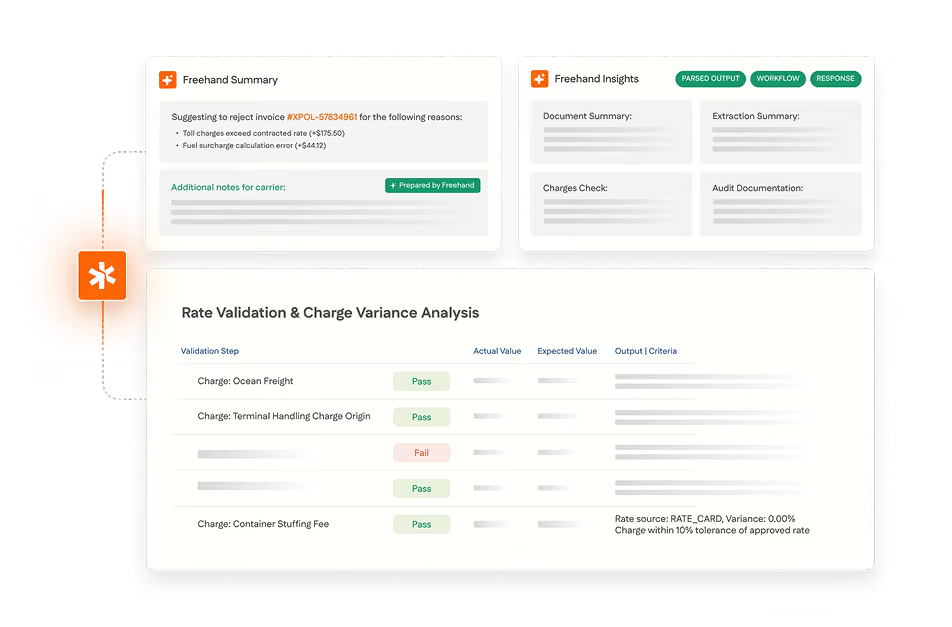
Take a freight invoice: the agent ingests the carrier's bill, checks the billed rate against the contracted rate and the shipment's actual weight and mode, decides whether the charge is valid, and either approves the payment, corrects the GL code, or opens a dispute with the carrier, all without a person opening the invoice first.
{{blue-cta}}
Worked example: A carrier bills a $2,400 accessorial charge for detention on a shipment. An RPA script would only catch this if detention charges were explicitly in its rule set at that exact dollar threshold; anything slightly different breaks it. A flagging AI tool would surface the charge as "unusually high" and route it to an analyst's queue, where it sits until reviewed. An agentic system checks the shipment's actual dwell time against the carrier's contracted free-time allowance, determines the charge should have been $1,650, corrects the invoice line, and files the $750 dispute with supporting documentation attached, before the invoice would have otherwise been paid in full.
What does an agent need in order to act safely and autonomously?
An agentic system needs a verified, current record of your contracts, rates, and shipment history to ground its decisions in, or it's autonomous in name only.
An agent that decides without that grounding is guessing with more confidence than a person would allow, not resolving anything. This is why Freehand's Context Graph exists: it links contract terms, shipment data, and prior exception resolutions into one verified record, so every agent decision traces back to a fact, not an inference, and each new resolution becomes precedent the next agent decision can learn from. An AI that can't show its work isn't ready to act on a freight invoice unsupervised.
Where does agentic AI actually apply in freight and logistics?
Agentic AI applies wherever a logistics decision currently requires a person to judge a discrepancy against a known rule, not just extract data from a document.
Broader agentic AI in the supply chain covers routing, demand planning, and warehouse robotics too, but the clearest applications for AI agents in logistics sit inside freight audit and payment, because the decision space is bounded (a contract, a rate, a set of accessorial terms) and the volume is high enough that manual review only ever covers a sample.
- Invoice audit: checking every invoice against the contracted rate, not a 15-30% BPO sample, and resolving the discrepancy rather than flagging it.
- Dispute resolution: filing and tracking a carrier dispute with the supporting documentation already attached, instead of a person assembling the case.
- GL coding: classifying and posting a freight cost to the correct account based on shipment context, not a static mapping table.
- Exception routing: escalating only the disputes that genuinely need a human decision, a contract ambiguity or a carrier relationship call, instead of every exception the system finds.
How does this change what "100% coverage" actually means?
100% invoice coverage only means something if the system reviewing every invoice can also resolve what it finds, otherwise full coverage just produces a full exceptions queue.
A BPO model that samples 33% of invoices misses errors in the other 67% entirely. A flagging tool that reviews 100% but resolves none of it just moves the bottleneck from "which invoices get checked" to "which exceptions get worked." Agentic AI is what makes full coverage operationally real: Freehand checks 100% of invoices and resolves the majority of what it finds without adding review headcount, reaching 95-98% touchless processing within 90 days of go-live.
This is also the distinction Gartner points to in naming Freehand a Representative Vendor in its Market Guide for freight audit and payment providers: coverage and resolution are two different capabilities, and most of the market still only has the first one.
How do you evaluate whether an "agentic AI" vendor actually qualifies?
Ask what happens after the system finds a discrepancy, not just whether it finds one.
Most vendors marketing "agentic AI" today are flagging tools with a new label. The honest test is whether the system takes the next action itself.
- Ask for the resolution rate, not just the detection rate: A vendor should be able to say what percentage of flagged exceptions get resolved without a person, not just how many get found.
- Ask what the system is grounded on: If it can't show the contract, rate, or shipment record behind a decision, it's inferring, not verifying.
- Ask what triggers human escalation: A real agentic system escalates by exception type (ambiguous contract language, carrier relationship decisions), not by volume it couldn't otherwise process.
- Ask how it handles a case its training data hasn't seen before: RPA breaks. A true agent should reason toward a decision using the same contract and rate data a person would use.
A tool that only ever flags is still asking your team to do the last, hardest step by hand.
If your current AI stack tells you where the overcharges are but still leaves your team to work every exception one by one, you don't have an agentic system yet, you have a well-organized queue. The difference isn't the label on the dashboard. It's whether a decision actually gets made and acted on before the invoice is paid.
{{brown-cta}}
Frequently Asked Questions
What is agentic AI in simple terms?
Software that decides and acts on its own within a defined goal, instead of just answering a question or flagging something for a person to handle. In freight audit, that means checking an invoice, deciding if it's correct, and resolving it, not just pointing out that something looks off.
Is logistics going to be replaced by AI?
No, but the labor model inside it is changing. Agentic AI doesn't eliminate freight audit, procurement, or AP as functions, it resolves the high-volume, rules-bound work inside them, so the same team can cover more volume without adding headcount for every exception.
Is agentic AI the same thing as generative AI?
No. Generative AI produces an answer, a summary, or a draft in response to a prompt. Agentic AI takes that reasoning further into an autonomous decision and action, without a person prompting each step.
Does agentic AI replace RPA entirely?
It replaces RPA for the exceptions RPA was never built to handle. RPA still works fine for the fixed, unchanging half of a process; agentic AI is built for the half that requires judgment.
Can agentic AI work without human oversight at all?
No credible implementation removes human oversight entirely. The goal is to escalate only the decisions that genuinely need a person, a contract ambiguity or a relationship call, not every exception the system encounters.
What's the biggest risk in adopting agentic AI for freight audit?
An agent acting on ungrounded or incomplete data. An autonomous decision is only as reliable as the contract, rate, and shipment record it's checked against.
From Invoice to Resolved, Without the Manual Middle.
Freehand's AI Teams handle the reading, matching, and rate validation your team does by hand today. See the whole flow on your own invoices.
See What Agentic AP Actually Looks Like.
The concept is easy to describe and harder to picture. Watch it run against a real freight invoice.
Every warehouse. Every provider. Every mile.
Gartner's 2026 outlook on logistics outsourcing, and how AI Teams hold every contract to the terms you agreed.
- Where outsourced logistics quietly loses margin
- Why billed charges drift from the contract
- How AI Teams close the gap