
RPA Automated the Easy Half. Agentic AI Finishes the Job.
RPA automated the easy 50% of a process and queued the rest for a human. See why agentic AI's real change is resolving the exceptions RPA couldn't.
.webp)
September 7, 2026
•
12
mins
RPA was never built to finish the job. It was built to automate the parts of a process that never change, then hand everything else to a human in an exception queue. That queue was always the real work.
Agentic AI's actual change isn't a faster bot. It's software that can finally do what used to require a person: read the exception, understand it, and resolve it.
Key Takeaways
- RPA automates the deterministic steps of a process and routes everything ambiguous to a human exception queue. It was never designed to resolve an exception itself.
- Gartner and Forrester report that 30-50% of enterprise RPA projects are abandoned within two years, and Gartner estimates roughly half fail to scale past the pilot stage.
- Forrester estimates maintenance can run as high as 60% of total RPA implementation cost, since a bot built against one screen layout breaks the moment that layout changes.
- Agentic AI's premise shift is that the model reasons about context and makes a judgment call, instead of failing at the first field it doesn't recognize.
- Gartner also predicts over 40% will be canceled by the end of 2027, a caution against hype, not an argument against the underlying premise shift.
What was RPA actually built to do?
RPA automates the deterministic steps of a process, the ones that follow the same rule every time, and routes anything it doesn't recognize to a human exception queue.
A bot reads a screen, follows a script, moves data from one field to another.
The moment a document looks slightly different than what the bot was trained on, it stops and waits for a person.
That queue was the design, not a flaw in the design. RPA was scoped from the start to handle the easy half of a process and leave the hard half, the judgment calls, manual.
Why does that design break so easily?
RPA mimics the clicks a person would make on a screen, following if-then rules, instead of connecting to a system's actual data.
A bot logs into an application the same way a human would, reads a field, clicks a button, and repeats.
Move a button, rename a column, or redesign the login screen, and the script has nothing left to click.
That's also why RPA can't interpret unstructured data, a free-text email, a scanned PDF, a chat transcript. It has no way to reason about content it wasn't scripted to expect. Agentic AI works against the underlying data and system logic instead of a screen, so a layout change or an unstructured document doesn't break it the same way.
RPA follows a fixed script through a screen-based bot to an invoice, breaking the moment the screen layout changes; agentic AI grounds verified contract and shipment data through reasoning to the same invoice, resolving the exception instead of queuing it.
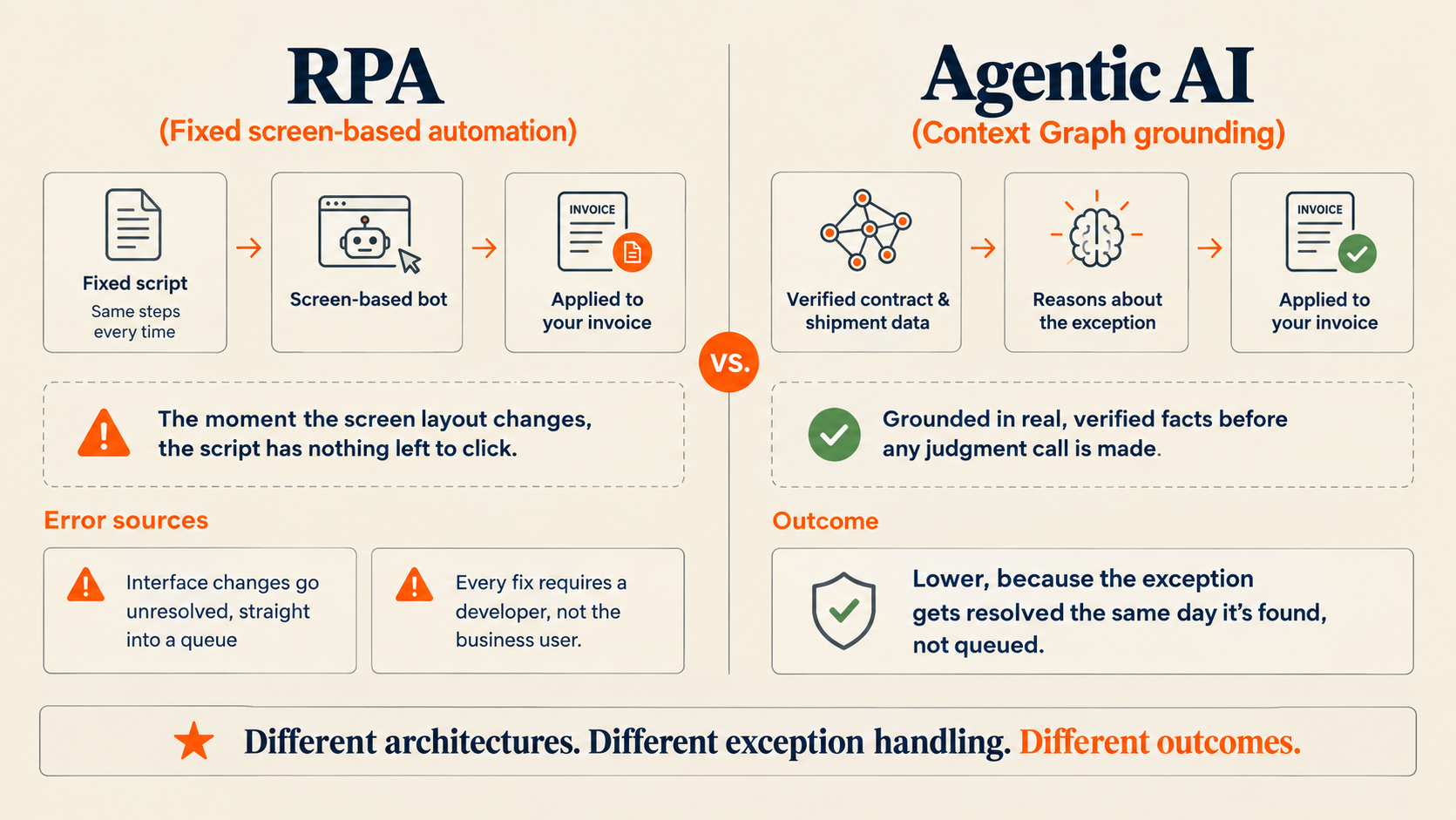
Same input, two different architectures. RPA's error sources compound in a growing queue; agentic AI resolves the exception the same day it's found.
How well did that design actually hold up?
Not well, according to the firms that track it.
Gartner and Forrester report that 30-50% of enterprise RPA projects get abandoned within two years, and separate research from Ernst & Young puts initial project failure in that same 30-50% range.
The pattern across every one of these numbers is the same. A bot built against a specific screen layout or document format breaks the moment that layout changes, and every fix goes back through a developer, not the business user who actually understands the exception.
Why did the exception queue become the permanent bottleneck?
Because RPA's exception queue never shrinks, since the world it's automating keeps changing and the bot can't adapt on its own.
New carrier invoice formats, renegotiated contract terms, a vendor's new billing system, every one of these creates a fresh batch of exceptions a rules engine has never seen before.
A person still has to open every one of those exceptions, understand it, and decide what to do. RPA can look like a fully automated process on a dashboard while the actual judgment-heavy work still runs entirely on human hours. That's the part of the premise that agentic AI changes.
{{blue-cta}}
What does agentic AI actually change about that premise?
Agentic AI reasons about context instead of matching a fixed pattern, so it can make the same judgment call a person would make instead of stopping and waiting for one.
Where an RPA bot fails to locate an expected field and drops the item into a queue, an agentic system reads the document, understands what's actually different about it, and decides what that difference means.
That's a premise change, not a speed upgrade.
RPA's entire model assumed a stable environment and a human backstop for everything else. Agentic AI's model assumes the environment will keep changing, and builds the judgment call into the system itself instead of routing it out to a person every time.
Does that mean agentic AI is a guaranteed win?
No, and treating it that way repeats RPA's original mistake of overselling the tool instead of scoping the premise honestly.
Gartner predicts over 40% will be canceled by the end of 2027, citing escalating costs, unclear business value, and weak risk controls, the same categories of failure that sank a big share of RPA projects.
Gartner has also estimated that only a small fraction of vendors marketing themselves as "agentic," roughly 130 out of more than 2,000, actually build genuinely autonomous systems rather than rebranding a chatbot or an RPA bot with new language. T
hat gap matters. The premise shift is real. Not every vendor selling it is.
What does this look like in freight AP specifically?
A rules-based audit tool flags a rate that doesn't match, and stops there.
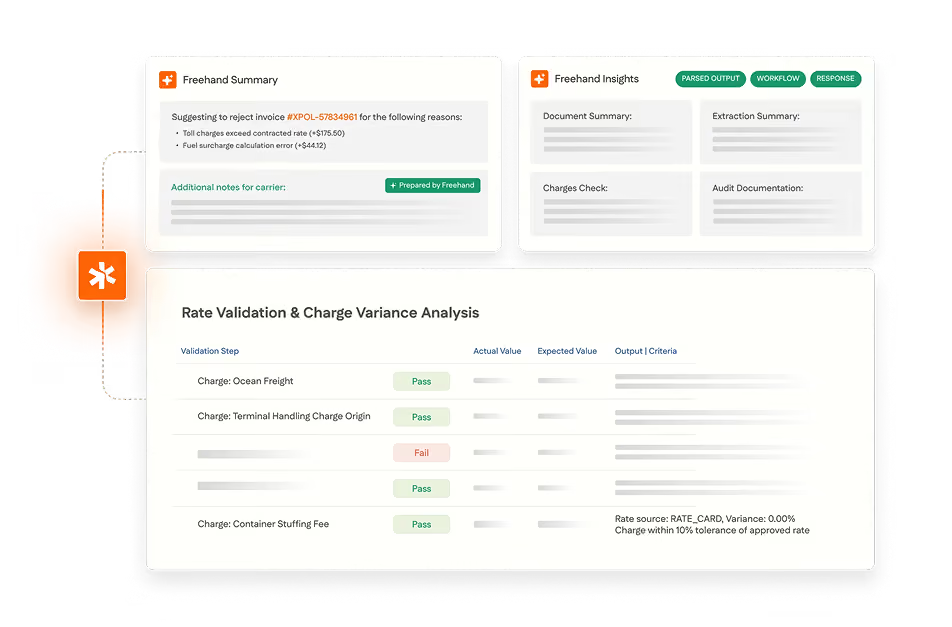
Freehand's Context Graph grounds that same check in verified contract and shipment data. The AI Team resolving it reasons against the same facts a person would check by hand, closing the exception instead of just flagging it.
That's the difference between a tool that automates the easy 80% of invoices and one built to run all of it.
Full audit coverage was never really about scanning more invoices faster. It was about not needing a permanent human queue to handle the ones a rules engine can't parse.
None of that works as a black box, either.
Freehand Studio is where your own team sets the tolerance thresholds and approval rules the AI Team runs on, in plain language. The judgment call the system is making stays visible and adjustable, not hidden inside a script only a developer can read.
Does this premise shift show up anywhere else in supply chain?
Yes, anywhere a process depends on judgment a rules engine can't make on its own.
Freight AP is one instance of a pattern that shows up across supply chain functions:
Procurement and sourcing:
A global industrial packaging manufacturer ran freight procurement through disconnected systems, pre-bid and post-bid analysis done manually in spreadsheets, with no automated way to reason across scattered RFQ data. Moving that analysis to an AI-native model cut the procurement cycle by 90% and found $10M-$18M in annual savings a rules-based tool had no way to surface, since the gap wasn't a missing rule, it was unstructured data no script was built to read.
Shipment visibility and discrepancy resolution:
A Fortune 15 pharmaceutical distributor ran freight costing on a legacy TMS, with constant manual workarounds and a visibility gap between its national logistics center and forward distribution centers. An agentic system catching $600K a month in discrepancies before they ever reached AP wasn't running a faster version of the old rules, it was reasoning across shipment and cost data a static system had no way to connect.
Same underlying pattern each time: the exception wasn't rare, it was the majority of the real work, and a rules engine was never going to be the thing that closed it.
How do you transition from RPA to agentic AI?
Start with the exception queue, not the whole system, and ground the replacement in real data before asking it to make a judgment call.
1. Find where the queue actually is: The RPA bots worth replacing first are the ones with the biggest human exception queue behind them, not necessarily the oldest or slowest ones. That queue is the visible cost.
2. Ground it before you automate the judgment: An agentic system reasoning against incomplete or unverified data just produces a faster wrong answer. The data layer has to be trustworthy first, which is the whole argument for something like a Context Graph: verified facts before autonomous decisions.
3. Keep the rules visible to the business, not just to engineering: One of RPA's real failures was that every fix went through a developer. Whatever replaces it should let the person who understands the exception set and adjust the rule directly, in plain language, the way Freehand Studio does.
4. Don't rip out working RPA on principle: Rules-based automation is still the right tool for genuinely stable, high-volume, low-ambiguity steps. The transition is about the exception-heavy work was never built for, not a wholesale replacement.
5. Scope the rollout the way the failure data suggests: With Gartner projecting over 40% of agentic AI projects canceled by 2027 over cost and unclear value, start on the process with the clearest, most measurable exception cost, not the most ambitious one.
{{brown-cta}}
Frequently Asked Questions
Did agentic AI replace RPA?
Not exactly. RPA still has a place for simple, stable, rules-based tasks. What agentic AI replaced is RPA's core assumption, that automation has to stop and hand off the moment a process gets ambiguous.
Why do so many RPA projects fail?
Gartner and Forrester research points to rigid, screen-specific automations that break whenever the underlying process changes, high ongoing maintenance cost, and an exception queue that never actually shrinks.
Is agentic AI overhyped?
Partly. Gartner predicts over 40% of agentic AI projects will be canceled by 2027, and estimates most vendors marketing "agentic AI" haven't actually built it. The premise shift is real; not every product claiming it delivers.
What's the actual difference in how RPA and agentic AI handle an exception?
RPA fails to match a pattern and routes the item to a human. Agentic AI reads the context around the exception and makes the judgment call itself, the same decision a person would have made.
Sources
- Gartner, "Gartner Predicts Over 40% of Agentic AI Projects Will Be Canceled by End of 2027"
- Gartner Peer Community, "Why do so many RPA projects fail?"
- UiPath, "Why Some RPA Deployments Fail. And What You Can Do About It."
- Flobotics, "RPA Reloaded: 50+ Robotic Process Automation Statistics"
- Zapier, "Agentic AI vs. RPA: Everything You Need to Know"
- SS&C Blue Prism, "Agentic AI vs RPA: Comparing AI Agents and RPA Bots"
- Freehand, "Freehand's Context Graph: How AI Agents Ground Freight Audits in Verified Facts"
See What Agentic AP Actually Looks Like.
Freehand's AI Teams resolve the exception instead of queuing it, grounded in your real contracts and shipment data, not a rules engine guessing at a pattern match.
Flagging an Exception Isn't Resolving It.
Rules-based tools stop at "this looks wrong" and hand the work back to your team. The queue keeps growing.
Every warehouse. Every provider. Every mile.
Gartner's 2026 outlook on logistics outsourcing, and how AI Teams hold every contract to the terms you agreed.
- Where outsourced logistics quietly loses margin
- Why billed charges drift from the contract
- How AI Teams close the gap