
Freight Audit Checklist: What to Check Before You Pay
A freight audit checklist for every invoice, before payment: documents, rate verification, accessorials, duplicates, and the exception steps that follow.
.webp)
September 3, 2026
•
8
mins
To run a freight audit checklist, confirm the documents are complete, verify the rate against the contract, and check the shipment details. Then audit every accessorial, scan for duplicate billing, and set a variance threshold before you release payment. Run it on every invoice. A sampled checklist only catches the errors that happen to fall in the sample.
Key Takeaways
- A freight audit checklist is the set of checks run against every carrier invoice, documents, rate, shipment details, and accessorials, before payment clears.
- Accessorial charges carry the highest error rate of any line item on a freight invoice. Detention and liftgate fees get disputed the most.
- Most teams run this checklist on a 15-30% sample. Full-coverage auditing recovers 1.5 to 2.5% of total freight spend, money a sampled checklist never touches.
- Rate misapplication, billing above the contracted rate, is usually the single biggest error a checklist catches.
- Freehand's AI Teams run this checklist against every invoice automatically and resolve the exception, instead of just flagging it for a person to work through by hand.
- The checklist in six phases: confirm documents, verify the rate, check shipment details, audit accessorials, scan for duplicates, set a threshold before payment.
What documents do you need before you start?
You need the invoice and five supporting documents, without them, you can't verify what shipped or what was agreed. Missing documents are their own red flag, not a reason to approve by default.
- [ ] Carrier invoice (EDI, PDF, or CSV)
- [ ] Bill of lading (BOL)
- [ ] Proof of delivery (POD)
- [ ] Original shipment quote
- [ ] Rate agreement or contract for that lane and mode
- [ ] Weight and dimension capture, if the shipment was reclassed or re-weighed
- [ ] Historical shipment data exported from your TMS, for cross-referencing beyond this one invoice
- [ ] Date range and vendor scope defined before you start, so the review has a clear boundary
What should you check to verify the rate?
Match the billed base rate to the contracted rate for that exact lane, mode, and carrier, including fuel and negotiated discounts. This is the check that catches the biggest single dollar error on most invoices.
- [ ] Base rate matches the contracted rate table for the lane and mode
- [ ] Fuel surcharge calculated off the correct, current index
- [ ] Negotiated discount tier applied correctly
- [ ] Rate matches the specific carrier and service level quoted, not a substitute
- [ ] Any expedited or special service billed was actually requested and actually delivered
{{blue-cta}}What should you check on shipment details?
Confirm the invoice describes the shipment that actually moved, not a different one with a similar reference number. A reclassed pallet or an inflated dimensional weight changes the base rate before any accessorial even applies.
- [ ] PRO or tracking number matches the correct BOL
- [ ] Origin, destination, and service level match the shipment record
- [ ] Weight and dimensions match what was captured at pickup
- [ ] Freight class matches, and any reclass has an inspection certificate behind it, not just a new number
What should you check on accessorial charges?
Verify every add-on fee against what you actually authorized and what the delivery record supports. Accessorials carry the highest error rate of any charge category on a freight invoice.
- [ ] Detention charge has dwell-time proof attached
- [ ] Liftgate fee matches a delivery that actually required one, not a dock-to-dock move
- [ ] Residential surcharge matches the actual delivery address type
- [ ] TONU (truck order not used) has documentation the load was actually cancelled
- [ ] Inside delivery fee matches what the delivery record shows was performed
- [ ] Detention or demurrage has a clear arrival and departure timestamp behind it, not an estimate
For the full breakdown of why these specific charges cause the most disputes, see our guide to why accessorial charges make freight billing complicated.
What should you check for duplicate or split billing?
Scan for the same shipment billed twice under different reference numbers, and for one move split across invoices to dodge an approval threshold. Both are easy to miss without cross-invoice matching, and duplicate LTL invoices show up more than most teams expect.
- [ ] Shipment ID, date, and lane cross-matched against other invoices in the batch
- [ ] No second invoice or PRO number covering the same move
- [ ] No single shipment split into multiple invoices under your auto-approve ceiling
Are you confident this checklist ran the same way on every invoice this month, not just the ones someone had time to open?
What should you check before you release payment?
Confirm every flagged variance has been resolved, not just noted, before the invoice moves to payment. A logged exception that never gets worked is the same as an exception nobody caught.
- [ ] Variance threshold applied consistently, not case by case
- [ ] Every flagged item routed to review, not auto-approved by default
- [ ] Claim or dispute filed within 18 months of delivery, the federal deadline for an overcharge claim, not an assumed shorter window
- [ ] Discrepancy logged: invoice and PRO number, carrier, charge type, dollar variance, claim status
- [ ] Recovery totals tracked over time, so the checklist shows savings, not just a cleared inbox
How does this checklist connect to the full audit process?
This checklist tells you what to check. Running it at scale, across every carrier, mode, and invoice format, without turning it into a full-time job, is the next question worth answering.
For the complete step-by-step method, including how to decide between manual, software, and AI-driven auditing, see our guide to how to audit freight invoices.
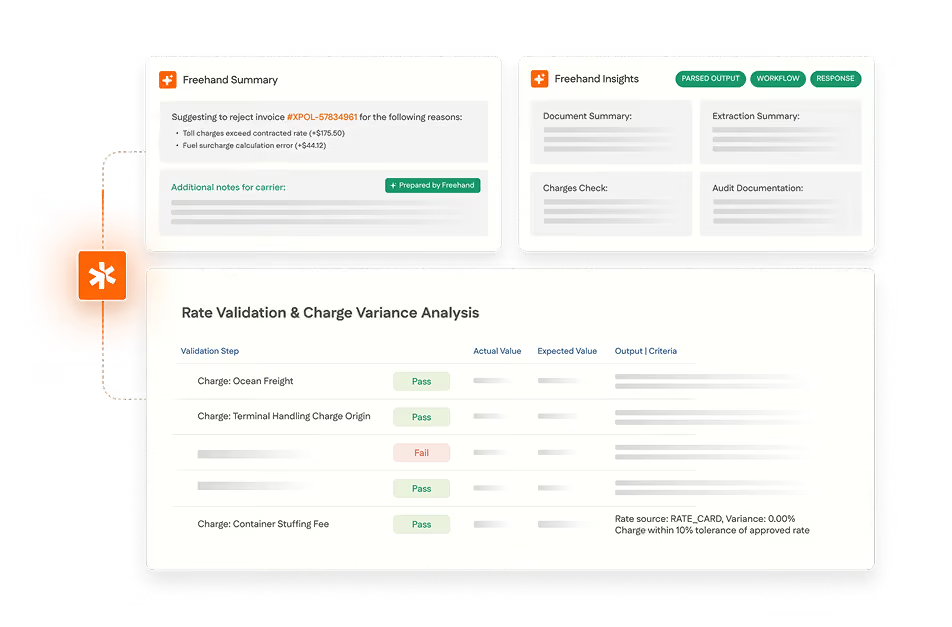
Freehand's AI Teams run every item on this checklist against every invoice automatically. They resolve the exception instead of just flagging it, and recover 1.5 to 2.5% of freight spend that a sampled checklist never reaches.
{{brown-cta}}
Frequently Asked Questions
What should be on a freight audit checklist?
Document completeness, rate verification against the contract, shipment detail matching, accessorial validation, duplicate billing checks, and a variance threshold before payment. Each layer catches a different error type.
How often should you run a freight audit checklist?
On every invoice, not a sample. A checklist run on 15-30% of invoices only catches errors that happen to fall in that sample. That's most of why recoverable overcharges go uncaught.
Is a checklist enough, or do you need software?
A checklist works at low invoice volume with a handful of carriers. Past that, running it consistently across every invoice, every carrier, and every format by hand doesn't scale. That's usually the point where sampling quietly replaces full coverage.
What's the most commonly missed item on a freight audit checklist?
Cross-invoice duplicate checks. Teams reliably check rate and accessorials. They miss the same shipment billed twice under a different reference number, since it requires comparing across invoices, not just checking one against its own supporting documents.
Can a freight broker or carrier run this checklist on its own invoices?
It happens, but it creates a conflict of interest. A carrier or broker checking its own billing has limited incentive to flag its own overcharges. This doesn't make the check fraudulent, but it does limit how much it will ever catch.
Every Item on This Checklist, Run Against Every Invoice.
Freehand executes this entire checklist automatically, on every invoice, and resolves the exception instead of just flagging it.
Take This Checklist Offline.
Download the printable PDF version, every check on one page, ready for your next audit.
Every warehouse. Every provider. Every mile.
Gartner's 2026 outlook on logistics outsourcing, and how AI Teams hold every contract to the terms you agreed.
- Where outsourced logistics quietly loses margin
- Why billed charges drift from the contract
- How AI Teams close the gap