
Accessorial Charges Are Where Freight Billing Gets Complicated

February 11, 2026
•
7
mins
Base freight and fuel are easy to audit. Everything else requires a system that was built for complexity.
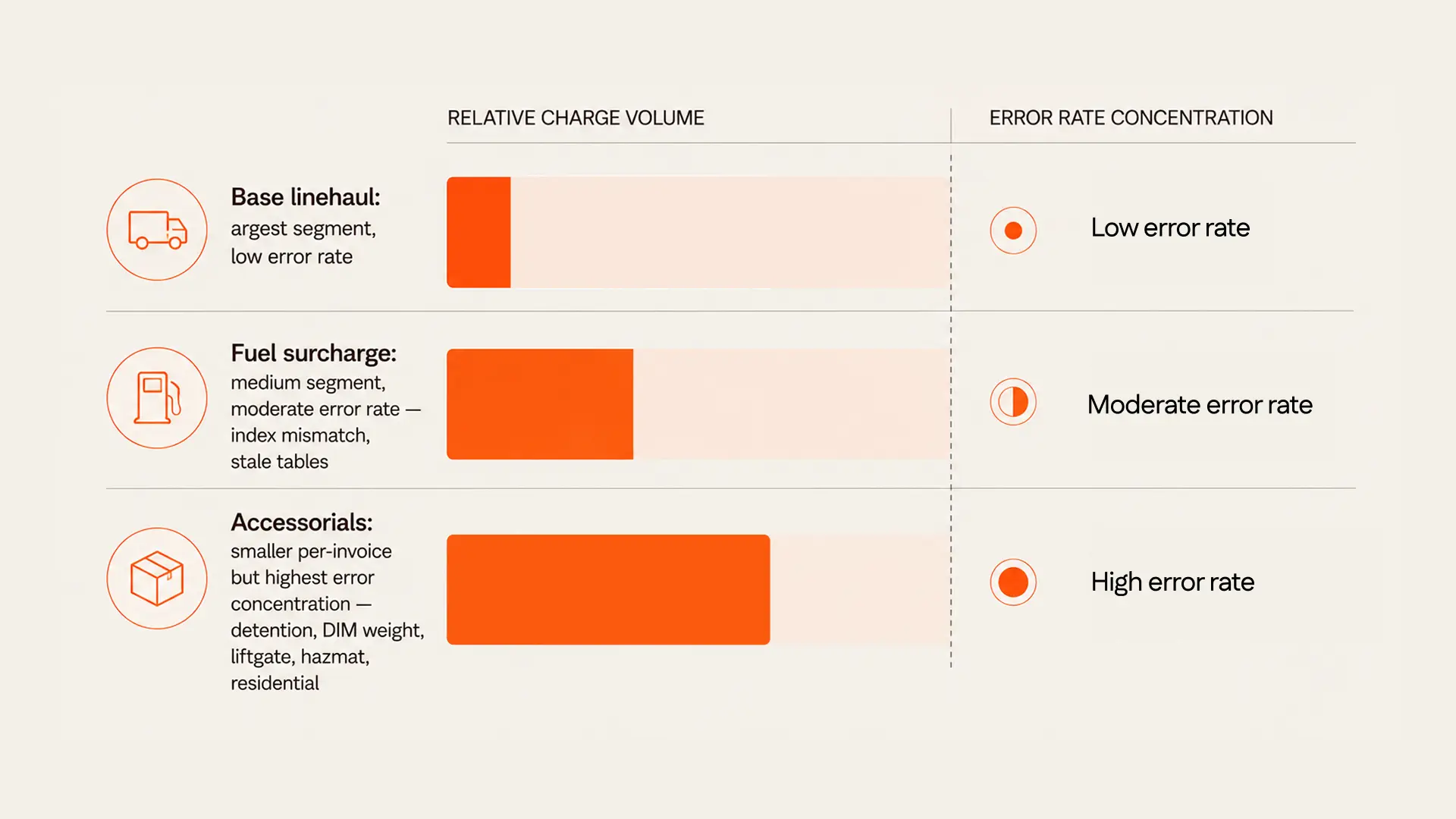
If you ask a logistics manager where billing errors show up most consistently, the answer is rarely the base linehaul rate. Carriers get those right most of the time. The errors, and they are systematic rather than random, concentrate in accessorials: the charges that sit on top of base freight and vary by lane, carrier, shipment characteristics, and contract clause.
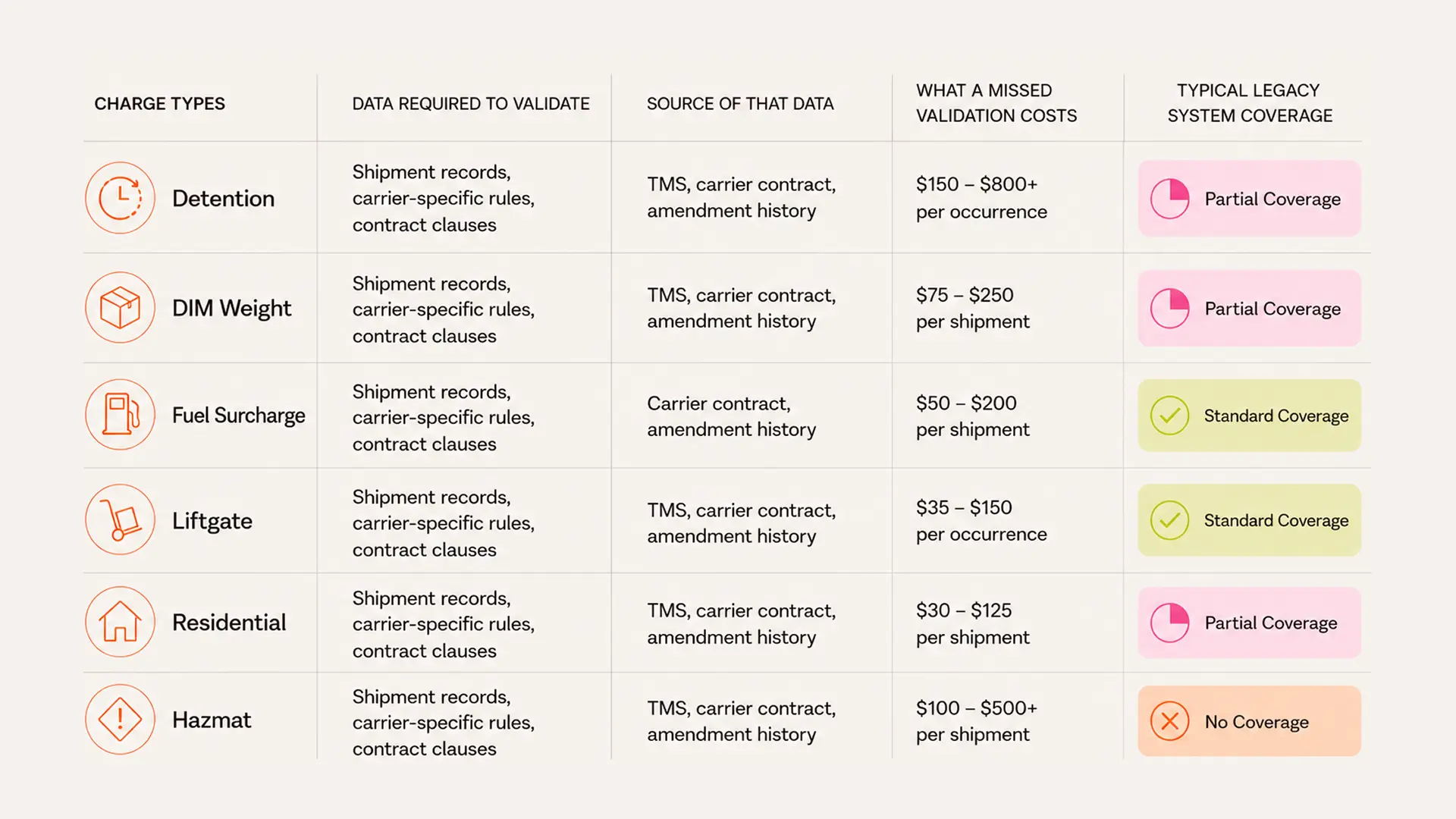
The category is large and genuinely complex. Detention charges apply when a driver waits beyond a contracted free-time window, but the contracted free-time varies by customer, by facility, by carrier, and sometimes by shipment type. Fuel surcharges are calculated against a weekly index, but the index used and the calculation method differ by carrier and contract vintage. Dimensional weight billing applies a formula to the relationship between package size and actual weight, but the divisor in that formula changes by service type. Liftgate charges, inside delivery fees, residential surcharges, and hazmat handling fees all carry carrier-specific rules that can differ from the master contract.
~60% of freight billing discrepancies involve accessorial charges, not base rate errors
Why static audit engines fail on accessorials
A static audit engine that matches invoice line items against a rate card has a structural problem with accessorials: the rate card does not fully specify the conditions under which the charge applies. The detention rule says $75 per hour after two hours of free time. But the invoice shows a detention charge on a shipment where the carrier's own shipment data records a 90-minute dwell. Whether that charge is valid depends on how dwell time is defined in the carrier agreement, whether the facility's loading dock time counts toward free time, and whether a specific clause in the amendment from 18 months ago modified the standard terms.
None of that is in the rate card. It is in the contract, the amendment, and the exception history that accumulated between the contract signing and today. An audit system that does not have access to all three cannot validate the charge correctly.
The dimensional weight problem at scale
Dimensional weight billing is worth its own discussion. The formula, cubic inches divided by a divisor that typically ranges from 139 to 166 depending on service type, produces a calculated weight that may exceed the actual weight. Carriers bill against whichever is higher. The divisor is carrier- and contract-specific.
At parcel volumes above one million shipments annually, a single misconfigured divisor in a carrier's billing system generates overcharges on every affected shipment. The individual overcharge is often small: $2, $3, $5. Multiplied across hundreds of thousands of shipments, the cumulative figure is material. Catching it requires reading the actual shipment dimensions from the carrier's tracking data, applying the correct divisor from the contract, and comparing the result to what was billed. That is a three-system join on every invoice, which is why it does not happen in manual audit and does not happen in 2-way matching.
“A 50-pound DIM weight charge on a 0.5-pound shipment looks like a billing glitch. Multiplied across 1.6 million annual parcel invoices, it looks like a $3 million annual problem.”
What carrier-ready audit logic means in practice
Auditing accessorials correctly requires pre-built knowledge of how each carrier structures each charge type: the NMFC freight classification rules for LTL, the fuel surcharge table and index source for each carrier contract, the dimensional weight divisors by service type, the detention rules by facility and shipment type. Building this knowledge from scratch for each carrier during implementation is the reason most audit platform deployments take months and still have coverage gaps at go-live.
A platform that arrives pre-trained on carrier billing structures, with rules that cover the major carriers on day one and adapt to contract-specific variations without custom configuration, removes that constraint. The audit is comprehensive from the first invoice processed rather than from the end of a multi-month onboarding project.