
Why "AI Agents" Undersell What's Actually Happening in Back-Office Finance
"AI agent" describes one component that still needs a person to act on its output. See why that word undersells what's replacing back-office finance labor.
.webp)
September 8, 2026
•
6
mins
"AI agent" describes a single capability that still hands its output to a person to act on. What's actually replacing manual freight audit and AP work is several of those capabilities working together to finish the job without a handoff, which is a different thing, and the word "agent" doesn't say so.
Key Takeaways
- An "AI agent" is a single automated capability, like flagging a mismatched invoice, that typically still requires a person to review its output and take the next action.
- Resolving one exception end to end usually takes several specialized capabilities working in sequence: reading the invoice, checking it against a contract, building a dispute packet, coding the entry, verifying settlement.
- Calling that chain "an agent" implies a tool you configure and monitor. Calling it "a team" implies a function that completes work and hands you the result.
- One retail case replaced a single black-box audit vendor with a 5-agent system, not because five is a magic number, but because five distinct jobs had to happen for one exception to close without a person opening it.
- The naming choice isn't cosmetic. It sets the buyer's expectation for what still needs a human, and "agent" sets that expectation lower than what's actually being delivered.
What does the word "AI agent" actually promise a buyer?
A single automated capability that performs one task and returns a result for a person to review.
That's an accurate description of what most enterprise AI tools do today: an agent that extracts invoice data, an agent that flags an anomaly, an agent that drafts a response. Each one does its job and stops at the handoff.
That's a reasonable thing to buy. It's also not what replacing a back-office function actually requires, because a single flagged anomaly isn't a closed exception, it's a task added to someone's queue.
What does closing one exception actually require?
Several specialized capabilities running in sequence, not one agent acting alone.
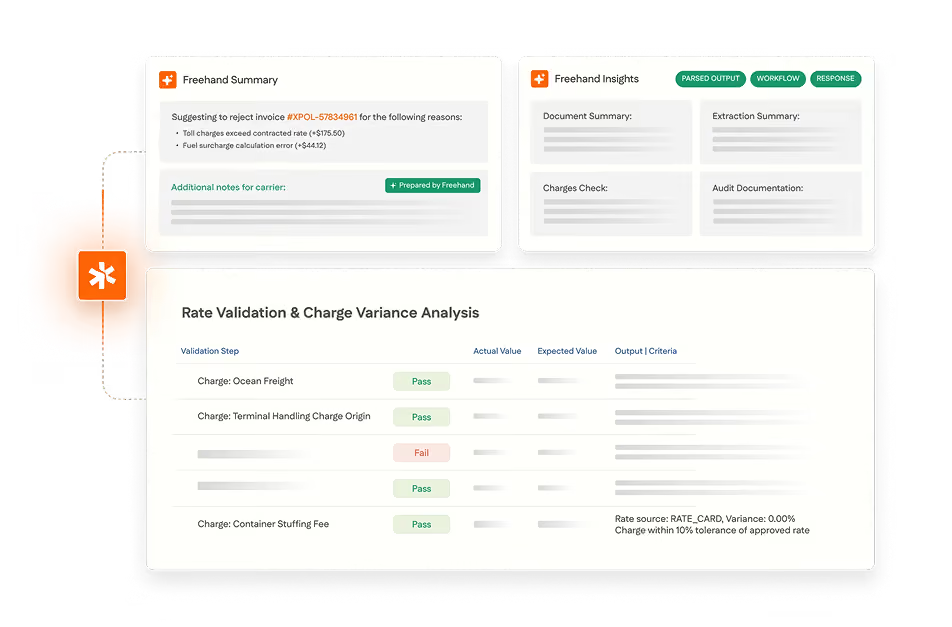
Take a single disputed accessorial charge: the invoice has to be read, checked against the contracted rate, built into a dispute packet, coded to the right GL account, and confirmed as settled. No single agent performs all five of those steps.
{{blue-cta}}
A vendor that sells you one agent has sold you the first step. The other four still need to happen, usually by a person, on your team, after the agent's output lands.
Why does Freehand call this "AI Teams" instead of "AI agents"?
Because the word has to describe what gets delivered, a completed outcome, not a single step toward one.
Freehand's positioning treats this as more than style: not a tool, since a tool implies a person still does the work, and not software rented as a service, since that puts the buyer back in the category the model replaces.
A tool is something you operate. A team is something you employ for an outcome. The distinction isn't marketing polish, it's the actual difference between a system that flags an exception and one that closes it.
What does this actually look like in practice?
One provider replacement showed the gap directly.
A leading American supercenter retailer ran freight audit through a black-box vendor, rate management sitting in spreadsheets, and a first-time match rate of roughly 70%. One analyst spent 25 hours a week working through that vendor's exception output alone.
A single AI agent would have automated one more step in that same manual chain. Instead, a 5-agent system took over the full workflow, intake, audit, dispute, coding, and verification. Match rate improved toward 95%, with $800K to $1.3M in annual recovery, work that used to require a person at every one of those five steps.
What should this change about how you evaluate an AI vendor?
Ask what happens after the agent's output lands, not just what the agent does.
If a person on your team still reviews it and takes the next step, you're buying one component of a chain, priced as if it were the whole chain. If the exception resolves without that handoff, you're buying what "AI Teams" actually describes.
That question matters more than the term itself. The word is just the label. What it should be labeling is whether the work actually gets finished, or whether it just moves one step closer to someone's desk.
{{brown-cta}}
Frequently Asked Questions
What's the difference between an "AI agent" and an "AI Team"?
An AI agent typically performs one task, like flagging an anomaly, then hands the output to a person. An AI Team is several specialized agents working in sequence to complete the full task without that handoff.
Why does Freehand avoid calling its product a "tool"?
Because "tool" implies a person still operates it to get the work done. Freehand's positioning is built around delivering completed work, not a tool a team uses to do that work themselves.
Does using more agents automatically mean better AI?
No. What matters is whether the combination of agents closes the exception end to end. A single well-built agent that fully resolves a narrow task can outperform five agents that each stop short of a finished outcome.
How do I tell if a vendor is selling a tool or a completed outcome?
Ask what happens immediately after the AI's output is generated. If a person on your team still has to act on it to finish the job, you're buying a tool. If the exception resolves without that step, you're buying completed work.
Sources
See What a Finished Exception Actually Looks Like.
Freehand's AI Teams read the invoice, build the dispute, code the entry, and confirm settlement, without routing any of it back to your team.
One Agent Flags It. A Team Closes It.
Reading an exception, disputing it, coding it, and confirming settlement are five different jobs. Calling that one "agent" undersells four of the five.
Every warehouse. Every provider. Every mile.
Gartner's 2026 outlook on logistics outsourcing, and how AI Teams hold every contract to the terms you agreed.
- Where outsourced logistics quietly loses margin
- Why billed charges drift from the contract
- How AI Teams close the gap