
The Hidden Cost of the BPO Model, Not in the RFP
A BPO's RFP quotes price per invoice. It doesn't quote who still owns the exceptions, who profits from recovery over prevention, or who owns the data.
.webp)
September 8, 2026
•
6
mins
A freight audit BPO's RFP response quotes a price per invoice or a percentage of recovered savings. It doesn't quote who still owns the exception queue, what the provider's incentive is once you're locked in, or what happens to your visibility once your data lives in their systems.
Key Takeaways
- An RFP for freight audit BPO services typically scores vendors on price per invoice, recovery percentage, and implementation timeline, the line items that are easiest to compare.
- Exception handling doesn't disappear when you outsource it. Someone still has to resolve disputes, chase missing documentation, and approve exceptions the BPO's system can't close on its own, and that headcount often stays inside your own team.
- Most BPO contracts pay on recovered savings, which means the provider profits more from catching an error after payment than from preventing it before payment goes out.
- Once your carrier contracts and shipment history live inside the provider's systems, you lose direct visibility into the dispute queue and the audit metrics, and get only what the provider reports back on its own schedule.
- A BPO's cost structure scales with headcount, not technology, which caps how much any single provider can invest in improving coverage over the life of your contract.
What does a freight audit BPO's RFP actually measure?
Price per invoice, recovery percentage, and implementation timeline, the numbers that are easiest to put in a comparison table.
Those numbers describe what the provider charges and what it claims to find. They say nothing about who does the work its system can't finish alone, what its incentive is once signed, or who controls the data once it moves.
A vendor scorecard built entirely from RFP line items misses the axes that actually determine what the relationship costs over its full term.
Where does the exception-handling labor actually go?
It stays inside your organization, even though the RFP presented outsourcing as removing that headcount.
A BPO's audit system closes invoices that match cleanly against a rate card. The ones that don't, a missing bill of lading, a disputed accessorial, get routed to a queue that still needs a person on your side to resolve.
That person's time doesn't show up in the BPO's per-invoice fee. It shows up in your own headcount plan, as a role your team assumed the outsourcing decision had eliminated.
Why does the contingency-fee model reward finding errors over preventing them?
Because the provider is paid a percentage of what it recovers, not a percentage of what it prevents.
Prevention closes a revenue opportunity before it exists. A BPO on contingency has no financial incentive to stop an overcharge from being billed, only to find it afterward and split the recovery with you.
{{blue-cta}}
An RFP that scores providers on recovery rate is scoring them on how well they perform inside a model built to reward catching money after it's already at risk, not on how much risk they remove.
What happens to your visibility once the audit moves to the provider's systems?
You lose direct access to your own dispute queue, audit metrics, and shipment history, and get only what the provider chooses to report back.
A Fortune 50 healthcare and consumer products company outsourced freight audit to CT Logistics for 20 years, across 400 sites, 80+ carriers, and 15 global ERPs, with no self-service visibility into any of it.
Every spend question required engaging the provider directly and manually reconciling whatever it sent back. After moving the audit in-house through an AI-native platform, the company recovered 6% of combined freight spend, spend that had been sitting inside a system it could see the outputs of but never the mechanics.
Why can't a BPO invest its way out of this over time?
Because the model's cost base scales with headcount, and headcount is expensive relative to what audit BPOs charge.
Labor costs scale linearly with invoice volume, so more shipment volume adds provider cost at nearly the rate it adds revenue, leaving thin margin for anything beyond running the existing operation.
That's not a temporary gap a good relationship manager can close. It's the structure of the model itself, and it doesn't change over the life of a multi-year contract.
What should an RFP actually ask instead?
Who owns exception resolution after go-live, how the provider is compensated, and who controls the underlying data, not just the price per invoice.
A comparison built around those three questions would show a CFO what the relationship actually costs over its term, not just what it costs to sign.
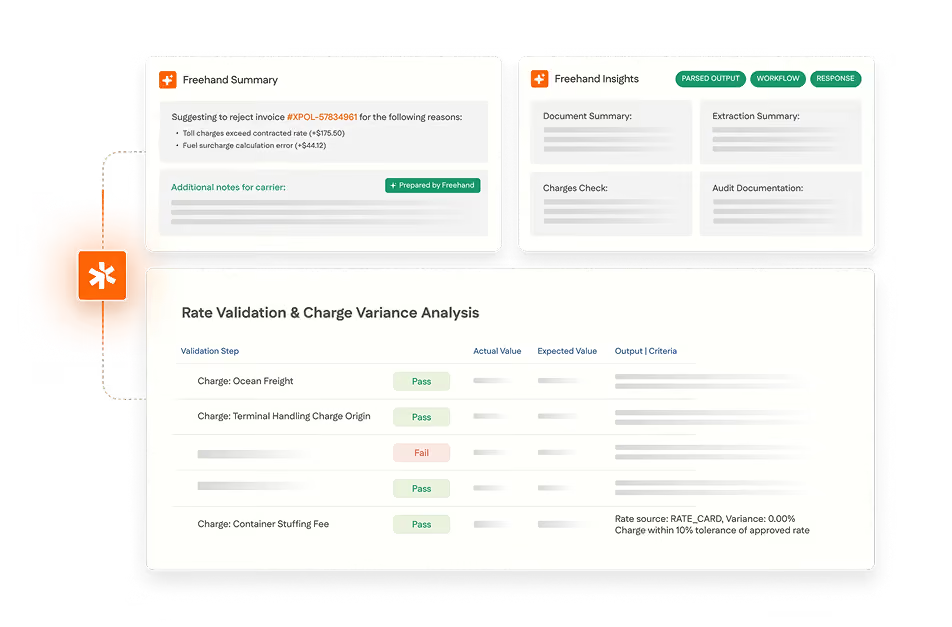
Full-coverage AI-native auditing changes the answer to all three. Every invoice gets checked before payment, the exception resolves inside the platform instead of your headcount, and the audit runs on your own data instead of a provider's black box.
{{brown-cta}}
Frequently Asked Questions
What costs does a freight audit BPO's RFP typically leave out?
The RFP usually quotes price per invoice, recovery percentage, and implementation timeline. It doesn't quote who still handles exceptions after go-live, how the provider's incentive changes once you're under contract, or who controls the underlying spend data.
Does outsourcing freight audit actually reduce headcount?
Not entirely. The BPO's system closes invoices that match cleanly, but exceptions, disputed accessorials, missing documentation, still route to a person, and that person is often still on your own team.
Why do contingency-fee BPOs focus on recovery instead of prevention?
Because their fee is tied to what they recover after an overcharge is billed, not to preventing the overcharge in the first place. Prevention closes the exact opportunity their revenue model depends on.
Can a BPO close these gaps if given more time?
Rarely. A labor-cost structure that scales with invoice volume leaves little margin to invest in the coverage or technology improvements that would fix the gap, no matter how the contract is renegotiated.
Sources
See What Your Next RFP Should Actually Be Asking.
Freehand audits every invoice before payment, resolves the exception without routing it to your team, and runs on data you control. No contingency fee. No black box.
Recovery Pays the Bill. Prevention Doesn't.
A contingency-fee BPO earns more from the overcharge it catches after payment than from the one it stops before payment goes out.
Every warehouse. Every provider. Every mile.
Gartner's 2026 outlook on logistics outsourcing, and how AI Teams hold every contract to the terms you agreed.
- Where outsourced logistics quietly loses margin
- Why billed charges drift from the contract
- How AI Teams close the gap