
Accounts Payable Outsourcing: Cost, Pros and Cons, and the AI Alternative
Accounts payable outsourcing cuts processing cost 60-75% versus in-house, but caps audit coverage at a sample. See the tradeoffs and the AI-native alternative.
.webp)
August 18, 2026
•
12
mins
Accounts payable outsourcing hands invoice processing to a third-party BPO provider, typically cutting per-invoice cost 60-75% versus an in-house team. The tradeoff is coverage: most BPO providers audit a sample of invoices, not every line on every invoice, which caps how much of your overcharge exposure actually gets checked.
Key Takeaways
- AP outsourcing typically costs $1.50-$3.00 per invoice, versus $12-$22 per invoice for manual in-house processing, a 60-75% reduction most providers point to.
- The savings come from labor arbitrage and process standardization, not from checking every invoice more thoroughly, most BPO providers still sample rather than audit 100% of volume.
- BPO cost scales with invoice volume: more invoices generally means more headcount on the provider's side and higher fees over time.
- An AI-native alternative removes the sampling cap and the headcount-linked cost curve at the same time, since coverage doesn't depend on adding people.
- Freehand replaces logistics AP BPO in 12-14 weeks with 100% invoice audit coverage, at a fixed cost that doesn't scale with volume the way a BPO fee does.
What is accounts payable outsourcing?
Accounts payable outsourcing is handing invoice receipt, processing, matching, payment execution, and reconciliation to a third-party provider (a BPO, business process outsourcer) instead of running it with an in-house team. The provider typically operates with its own staff, workflows, and technology, and bills the client per invoice, per FTE, or on a percentage-of-spend basis.
It's a labor decision as much as a technology one: the work still gets done by people, just people employed by the provider instead of the client.
AP is one stage inside the broader procure-to-pay cycle, requisition through payment. For the full cycle AP sits inside, see our guide to procure to pay.
How much does accounts payable outsourcing actually cost?
AP outsourcing typically runs $1.50 to $5.00 per invoice, or a flat monthly retainer of $200 to $800 for smaller operations, compared to $12 to $22 per invoice for manual in-house processing. That's a reduction of 60-75%, the primary reason enterprises consider it. For a company processing 500 invoices a month, that gap alone can represent $18,000 to $66,000 a year in processing cost.
| Model | Typical cost | What drives the cost |
|---|---|---|
| In-house manual | $12-$22 per invoice | Headcount, error correction, exception handling by hand |
| Outsourced (BPO), per-invoice | $1.50-$5.00 per invoice | Labor arbitrage, standardized workflows, provider scale |
| Outsourced (BPO), retainer | $200-$800 per month | Flat-fee model, typically for lower-volume operations |
These per-invoice figures cover processing cost only. For freight-specific AP, the fuller picture, implementation, exception-handling labor, and the cost of unaudited invoices, is broken down in our guide to total cost of ownership for freight audit software.
That cost gap is real, and it's why AP outsourcing has grown into roughly a $5 billion market. What it doesn't tell you is what happens to audit coverage once the work moves off your books.
For how this compares to keeping logistics AP in-house or moving to AI-native processing, see our guide to logistics BPO services.
{{blue-cta}}
What services does accounts payable outsourcing typically include?
Most AP outsourcing providers bundle four core services: invoice intake, matching and coding, approval routing, and payment execution. The exact mix varies by provider and contract tier, but these four cover what "full AP outsourcing" usually means in practice.
- Invoice intake and capture: collecting invoices by email, mail, or vendor portal, then extracting the line-item data, using OCR/AI extraction, manual entry, or a mix of both.
- Matching and coding: validating each invoice against its purchase order (two-way or three-way match) and applying the correct general ledger codes.
- Approval routing: running the digital workflow that gets sign-off from the right internal manager before an invoice releases for payment.
- Payment execution: issuing funds via ACH, check, or virtual card, and fielding the supplier inquiries that follow.
What are the benefits of outsourcing accounts payable, beyond cost?
Beyond the per-invoice savings, AP outsourcing typically lowers internal headcount overhead, reduces late fees, and scales more easily during volume spikes than an in-house team sized for average volume. For a company growing invoice volume faster than it wants to grow its AP headcount, that's often the actual trigger for looking at outsourcing in the first place, not the per-invoice rate itself.
- Lower headcount overhead: the processing work moves to the provider's staff instead of requiring new internal hires as volume grows.
- Fewer late fees: faster, more consistent processing turnaround reduces the invoices that miss a payment term and trigger a late fee or strained vendor relationship.
- Easier scaling during volume spikes: a provider can absorb a seasonal or one-time volume increase without the lead time of hiring and training internal staff.
- A more consistent process on paper: some providers structure a documented audit trail that's more consistent than an ad hoc in-house process, though as the next section covers, a documented process and a fully audited one aren't the same thing.
What are the drawbacks of outsourcing accounts payable?
The biggest drawback is coverage, not cost: most BPO providers audit a sample of invoices against contracted rates, not every line on every invoice, so overcharges in the unchecked remainder still get paid. BPO cost also scales with volume, more invoices generally means more headcount on the provider's side, so the fee grows even as the per-invoice rate stays flat.
- Sampling gaps: a BPO checking 15-30% of invoices leaves the majority of billing errors unexamined, paid without challenge every cycle.
- Volume-linked cost: BPO pricing is built around headcount, so cost scales with invoice volume in a way that doesn't fully decouple from growth.
- Less direct control: the work happens inside another company's systems and staff, which can slow down exception handling and reporting changes.
- Third-party data security exposure: vendor banking details, contract terms, and payment data all sit with an external provider, which adds a party to secure and audit for access.
- Hidden fees on exceptions: complex exception handling, rush payments, or non-standard invoice formats are common triggers for charges outside the base per-invoice or retainer rate.
- Data and process lag: provider-side systems don't always integrate cleanly with your own ERP or TMS, creating reconciliation work on your end anyway.
For example, a company processing 10,000 freight invoices a month with a 3% billing error rate has roughly 300 errors to catch. A BPO auditing a 20% sample catches at most 60 of them. The other 240 still get paid, every single month, regardless of how well the sampled 20% was checked.
When does outsourcing accounts payable actually make sense?
Outsourcing tends to make sense with high invoice volume relative to team size, manual or paper-heavy processes, expansion into a new market or region, or a seasonal volume spike an in-house team isn't sized for. It tends to make less sense when the business needs real-time spend visibility, already runs on automation tooling, or handles data sensitive enough that adding a third party raises the compliance bar.
| Outsourcing usually fits | Outsourcing usually doesn't fit |
|---|---|
| High volume, small internal team | Need for real-time spend visibility |
| Manual, paper-based process today | Already running on automation tooling |
| Entering a new market or region | Highly regulated or sensitive vendor data |
| Seasonal or one-time volume spike | Complex invoices that need institutional judgment |
That framework answers whether to hand the work to people outside the business. It doesn't answer the coverage question from the previous section, which is why enterprises increasingly evaluate a third option alongside outsourcing and in-house staffing.
What should you look for when evaluating an AP outsourcing provider?
The factors that matter most are technology and integration, security certifications, pricing transparency, and service-level guarantees, in that order for most enterprises. A provider that scores well on cost alone but weak on the rest usually shows up later as a hidden fee or an integration gap.
- Technology and integration: how cleanly the provider's systems connect to your existing ERP or TMS, since a manual re-entry step on your side defeats part of the point of outsourcing.
- Security certifications: SOC 2, ISO 27001, and similar credentials that confirm how vendor and payment data is actually handled, not just described.
- Pricing transparency: a clear breakdown of what's included in the base rate versus what triggers an additional charge, particularly around exception handling.
- Service-level guarantees: defined turnaround times and escalation paths for exceptions, not just a general commitment to "fast processing."
Is there an alternative to traditional BPO for accounts payable?
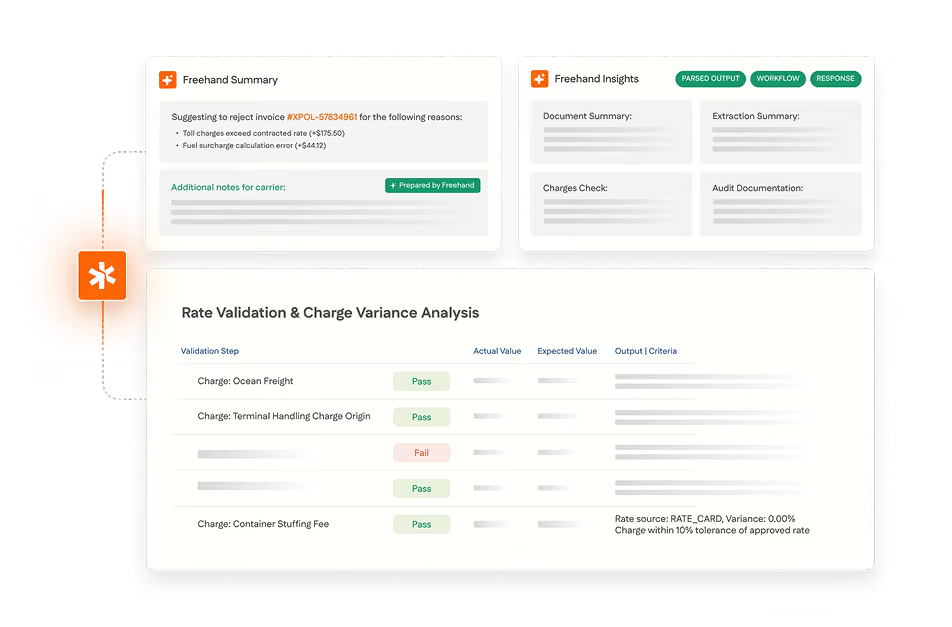
Yes: AI-native AP processing removes the sampling cap and the headcount-linked cost curve at the same time, since coverage no longer depends on adding people to check more invoices. Instead of a BPO's percentage-sample model, every invoice line gets checked against contracted rates, across every mode and carrier, with no cap and no threshold.
Freehand replaces logistics AP BPO with AI Teams instead of a bigger provider staff. Coverage is 100% of invoices, processing runs fully autonomously, and every check leaves a complete audit trail, at a fixed cost that doesn't scale with volume the way a BPO fee does.
The GL Coding Agent assigns cost centers and accounts at invoice time with zero manual entries. A traditional BPO still runs that step on human input, where errors compound across billing cycles instead of getting caught. On the security criteria above, Freehand holds SOC 2 Type II, ISO 27001:2022, ISO 27018:2019, GDPR, and CSA STAR certifications, with role-based access controls and complete audit trails built into every workflow.
Most enterprises are live and auditing within 12-14 weeks. Average annual recovery runs $4.1M once full coverage replaces sample-based checking. Across Freehand's customer base, that full-coverage audit consistently recovers 1.5-2.5% of total freight spend a year, money a sampled BPO process would have let clear as an approved overcharge.
{{brown-cta}}
Frequently Asked Questions
What is accounts payable outsourcing?
Accounts payable outsourcing is handing invoice receipt, processing, matching, and payment approval to a third-party BPO provider instead of running it with an in-house team.
How much does AP outsourcing cost per invoice?
AP outsourcing typically costs $1.50 to $5.00 per invoice, or a flat monthly retainer of $200 to $800 for smaller operations, compared to $12 to $22 per invoice for manual in-house processing.
What services are included in accounts payable outsourcing?
Most providers bundle invoice intake and capture, PO matching and GL coding, approval routing, and payment execution. The exact scope varies by provider and contract tier.
When does it make sense to outsource accounts payable?
It tends to fit high invoice volume relative to team size, manual or paper-heavy processes, new market expansion, or a seasonal spike. It fits less when real-time visibility, existing automation, or sensitive vendor data are priorities.
What should you look for in an AP outsourcing provider?
Technology and integration with your existing ERP or TMS, verifiable security certifications like SOC 2 and ISO 27001, transparent pricing that discloses exception-handling fees upfront, and defined service-level guarantees.
What are the downsides of outsourcing accounts payable?
The main downside is coverage: most BPO providers sample invoices rather than auditing every line, so overcharges in the unchecked remainder are paid without challenge. Cost also scales with volume as the provider adds headcount.
Is AI-native AP processing different from outsourcing to a BPO?
Yes. AI-native processing checks 100% of invoices at a fixed cost that doesn't scale with volume, instead of a BPO's percentage-sample model that scales cost with headcount.
How long does it take to replace a BPO with AI-native AP processing?
Freehand typically replaces logistics AP BPO within 12-14 weeks, moving from sample-based audit coverage to 100% of invoices checked against contracted rates.
Replace the BPO, Not Just the Sample Size.
Freehand checks 100% of invoices at a fixed cost that doesn't scale with headcount, live in 12 to 14 weeks.
A 20% Sample Catches 60 Errors. The Other 240 Still Clear.
BPO pricing buys labor arbitrage, not deeper checking. Most providers still sample, so the majority of billing errors ride through unexamined.
Every warehouse. Every provider. Every mile.
Gartner's 2026 outlook on logistics outsourcing, and how AI Teams hold every contract to the terms you agreed.
- Where outsourced logistics quietly loses margin
- Why billed charges drift from the contract
- How AI Teams close the gap