
Total Cost of Ownership for Freight Audit Software: The Real Math
License fees are the smallest line in freight audit software TCO. See what actually drives the total cost, and why coverage gaps cost more than the software.
.webp)
August 25, 2026
•
10
mins

The license fee is usually the smallest line in the total cost of freight audit software. The bigger costs are implementation, the labor needed to handle exceptions the software can't resolve on its own, and the overcharges that slip through because most systems only audit a sample of invoices. A true TCO comparison has to price all four, not just the subscription.
Key Takeaways
- Total cost of ownership for freight audit software is the license or subscription fee plus implementation, integration, ongoing exception-handling labor, and the cost of whatever audit coverage the system doesn't reach.
- Software price is usually the smallest of the four. Labor for manual exception handling is typically the largest, and it scales with invoice volume the same way BPO headcount does.
- Most freight audit systems, whether in-house tools or BPO-run platforms, sample invoices rather than checking all of them. The overcharges hiding in the unaudited portion are a real cost of ownership, even though they never appear on an invoice from the vendor.
- Freehand recovers 1.5% to 2.5% of total freight spend by auditing 100% of invoices rather than a sample, which changes both sides of the TCO equation: less recoverable spend lost to coverage gaps, and less labor spent routing exceptions manually.
- A real TCO comparison prices coverage percentage and exception-handling labor as line items, not just the contract cost, since those are what actually separate one vendor from another over a multi-year term.
What is total cost of ownership for freight audit software?
Total cost of ownership (TCO) for freight audit software is the full multi-year cost of running the system, not just its list price: subscription or license fees, implementation and integration, ongoing labor to handle what the software can't resolve on its own, and the dollar value of any invoices that go unaudited. It's the same concept used to evaluate any enterprise software purchase, applied to a category where the biggest hidden cost isn't a line item on any invoice, it's the overcharges a partial-coverage system never catches.
Two freight audit platforms priced identically per invoice can have wildly different TCO if one audits every line and the other samples 30%.
What are the components of TCO for freight audit software?
The first two are visible in a vendor's quote. The last two usually aren't, and they're where most of the real cost lives.
Why does the labor line dominate TCO, not the software price?
Exception-handling labor dominates TCO because it scales with invoice volume the same way headcount does in a BPO or in-house model, while the software subscription typically doesn't. The top 10 freight audit BPOs generate a combined $1.5 billion in revenue at sub-10% margins, a structural signal that the labor cost of manual review, not the software layer, is what actually drives the category's economics.
That's the same dynamic covered in our breakdown of accounts payable outsourcing: BPO providers price per invoice or per FTE, so cost rises in lockstep with volume regardless of how efficient any individual reviewer is. A freight audit platform that still routes a large share of invoices to manual exception queues inherits that same scaling problem even if its own license fee is flat.
What's the hidden cost of partial audit coverage in TCO?
Enterprises using BPO-based freight audit average 33% invoice coverage, meaning the remaining 67% clears accounts payable without line-item validation against contracted rates. Fortune 500 companies overpay an estimated 2-5% of total freight spend annually as a result. On a $2 billion freight book, that's $40 million to $100 million in exposure that a sampling-based system, no matter how cheap its license fee, never catches.
That exposure doesn't show up in a vendor's pricing sheet. It shows up on the P&L as freight cost that should have been recovered and wasn't. Any TCO comparison that only prices the contract and ignores coverage percentage is comparing an incomplete number.
{{blue-cta}}
What does a real TCO comparison look like?
A global electronic components manufacturer running $75 million in annual freight spend across 40+ facilities in 15+ countries ran freight audit through a customized SAP ERP module. It could only validate freight, fuel, and discount charges. Accessorial charges and DIM weight mismatches fell entirely outside its scope, 25% of the company's finance-booked freight spend had no audit trail at all, and 8-10 FTEs were tied up in manual audit work the system couldn't do on its own.
The SAP module's license and maintenance cost was likely the cheapest line in that company's freight audit stack. The 25% coverage gap and the 8-10 FTEs it took to cover the rest were where the real TCO lived.
How does agentic AI change the TCO calculation?
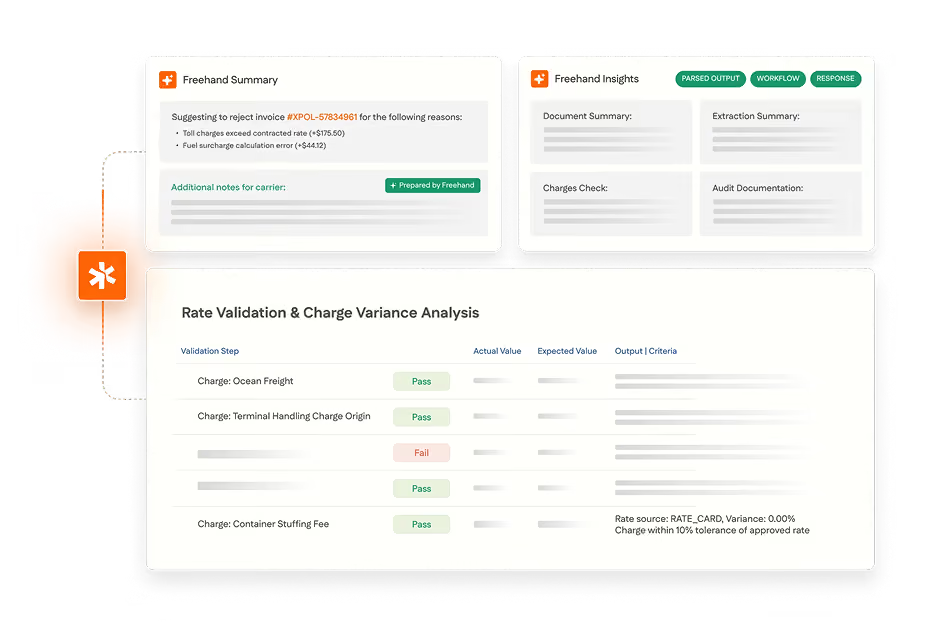
Agentic AI changes TCO by removing the link between invoice volume and labor cost. Instead of flagging exceptions for a human to resolve, an AI Team investigates the mismatch, checks it against contract terms and shipment data, and resolves what it can on its own, which is what lets coverage reach 100% without headcount rising in step with volume. Freehand's platform captures 1.5% to 2.5% of total freight spend this way, by auditing every invoice rather than a sample, and accelerates invoice processing cycle times by 80% to 90% in the process.
That reframes the TCO math: the coverage-gap line shrinks toward zero, and the exception-handling labor line shrinks with it, since most exceptions never reach a person.
What should you ask vendors to get an apples-to-apples TCO comparison?
- What percentage of invoices does the system audit at the line-item level, not just at the total-dollar level? A vendor auditing 30% of invoices and one auditing 100% aren't comparable on price alone.
- What happens to an exception once it's flagged? Ask whether a person resolves it manually every time, since that's the labor cost that scales with your invoice volume.
- What's included in implementation, and what recurs? Rate card updates and new carrier onboarding often carry ongoing setup costs that a one-time implementation quote won't show.
- How is pricing structured as volume grows? Per-invoice or per-FTE pricing means TCO rises with your freight volume; flat-fee, coverage-based pricing doesn't.
- What's the average time to first recovered dollar? A platform with a long implementation runway carries an opportunity cost that belongs in the TCO conversation, even though it never appears as a fee.
Pricing every one of these into a comparison, not just the subscription line, is what separates a real TCO number from a vendor's quote.
Total cost of ownership for freight audit software is never just the number on the contract. Add up implementation, the labor your team spends on exceptions the system can't resolve, and the spend that goes unaudited entirely, and the cheapest-looking quote is often the most expensive system once every line is counted.
{{brown-cta}}
Frequently Asked Questions
What is total cost of ownership for freight audit software?
TCO is the full multi-year cost of running the system: license or subscription fees, implementation and integration, ongoing exception-handling labor, and the dollar value of any invoices that go unaudited. It's not just the contract price.
Why is the software license usually the smallest cost?
Because it's the only cost a vendor prices upfront. Labor for manual exception handling and the overcharges lost to partial audit coverage are both larger over a multi-year term, and neither shows up on the vendor's invoice.
How much does partial audit coverage actually cost?
Enterprises using BPO-based freight audit average 33% invoice coverage. Fortune 500 companies overpay an estimated 2-5% of total freight spend annually as a result, exposure that scales directly with how much of your invoice volume goes unaudited.
Does a cheaper freight audit platform always mean lower TCO?
No. A platform with a low license fee but 30% coverage can cost more over time than a higher-priced platform auditing 100% of invoices, once you price in the labor and the missed overcharges the cheaper option leaves uncaught.
How does Freehand change the TCO equation?
Freehand audits 100% of invoices instead of a sample, recovering 1.5% to 2.5% of total freight spend, and its invoice audit agent hands confirmed overcharges directly to a Dispute Management Agent that generates and files the claim, rather than routing exceptions to a manual review queue, which reduces both the coverage-gap cost and the labor cost at the same time.
Buy the Finished Work, Not the Headcount.
Freehand delivers completed AP as software: invoices processed, charges audited, exceptions resolved. You scale volume without scaling a team.
You're Paying Per Seat. You Should Be Paying Per Result.
BPO and in-house AP teams cost the same whether they catch the overcharge or miss it. The math rarely favors headcount.
Every warehouse. Every provider. Every mile.
Gartner's 2026 outlook on logistics outsourcing, and how AI Teams hold every contract to the terms you agreed.
- Where outsourced logistics quietly loses margin
- Why billed charges drift from the contract
- How AI Teams close the gap