
7 Best LightSource Alternatives for 2026 (Compared)
The best LightSource alternatives for 2026, ranked and scored on sourcing autonomy, closed-loop execution, and pricing transparency.
.webp)
September 17, 2026
•
17
mins

The best LightSource alternatives for 2026: 1. Freehand, 2. Keelvar, 3. Fairmarkit, 4. Didero, 5. Kavida, 6. Coupa, 7. SAP Ariba.
LightSource runs an AI Workforce for direct-materials sourcing, automating item ingestion, RFQ setup, supplier activation, and bid analysis, with early customers cutting RFQ cycles from two weeks to 15 minutes and trusted brands like Amazon, Conair, Canada Goose, and Shure.
If you are here, you are likely weighing whether its sourcing-only scope and thin independent review base are still the right fit as your category coverage and downstream execution needs grow.
This page compares the alternatives that do the same core job.
LightSource Alternatives Comparison
Here is a detailed comparison of the best LightSource alternatives for 2026.
TL;DR
- Freehand: AI Teams that run freight sourcing, invoice audit, and payment as one autonomous loop, best for enterprises whose sourcing and AP leakage concentrate in freight and logistics spend.
- Keelvar: Autonomous optimization for complex, high-volume sourcing events across any category.
- Fairmarkit: All-category autonomous sourcing with strong tail-spend coverage.
- Didero: Agentic PO automation for direct materials layered on your existing ERP.
- Kavida: Supply chain risk visibility paired with procurement agents for manufacturers.
- Coupa: Company-wide spend visibility and adoption inside a full business spend management suite.
- SAP Ariba: The enterprise incumbent for SAP-centric estates, with the largest supplier network in the category.
Why teams look for LightSource alternatives
LightSource earns real credit. Its AI Workforce automates item ingestion, RFQ setup, and bid analysis, early customers report cutting RFQ cycles from two weeks to 15 minutes, and it holds a strong 4.9/5 on G2. Trusted brands like Amazon, Conair, Canada Goose, and Shure reflect real enterprise adoption. The reasons buyers evaluate alternatives are about scope and maturity, not sourcing quality.
- Sourcing-only scope: LightSource automates the sourcing event itself but does not extend into invoice audit or payment execution, so the awarded rate still needs to be enforced downstream by another system.
- Thin independent review base: With 11 reviews on G2, LightSource has a strong rating but a much smaller sample than the established enterprise suites, limiting broad peer validation.
- Minor technical issues cited: A small number of reviewers note minor bugs, described as quickly addressed but still a real, if negligible, consideration.
- Undisclosed pricing: Public pricing information is not available, so total cost requires a direct sales conversation.
If those points match your evaluation, the alternatives below sort cleanly by how they answer them.
{{blue-cta}}
How did we evaluate these LightSource alternatives?
We scored every provider on the same six criteria, weighted for a buyer replacing a direct-materials sourcing platform. Weights sum to 100%, and the Overall score in the table is the weighted result.
- Sourcing autonomy (25%): How much of the RFQ, bid analysis, and award decision the system runs on its own.
- Closed loop to payment (20%): Whether the awarded rate flows through to invoice audit and payment, or stops at the sourcing decision.
- Category coverage (15%): Breadth across direct materials, indirect spend, and freight or logistics.
- ERP integration (15%): Native connectors versus custom or file-based sync.
- Independent review depth (15%): Volume and recency of verifiable peer feedback.
- Pricing transparency (10%): Disclosed, predictable pricing versus custom, quote-only tiers.
This is an independent editorial comparison, not a Gartner Magic Quadrant or a paid ranking. A buyer whose priority is all-category sourcing across every indirect category should weigh category coverage highest, which moves Fairmarkit, Coupa, or SAP Ariba up; a team whose leakage concentrates in freight and logistics spend should weigh the closed loop to payment highest.
Freehand
Best for: Enterprises whose sourcing and AP leakage concentrate in freight and logistics spend, and who want the awarded rate enforced through audit and payment, not just sourced.

LightSource automates the RFQ and award decision and hands it back to your team; Freehand runs freight sourcing and then carries the same contracts into 100% invoice audit and payment, closing the loop that a sourcing-only tool leaves open. It is built as services delivered as software: you buy completed sourcing and audit work, not a platform that stops at the award.
Key features
- Automated carrier RFQ and bid collection for freight events
- Awarded contracts flow directly into invoice audit, so sourced rates are enforced
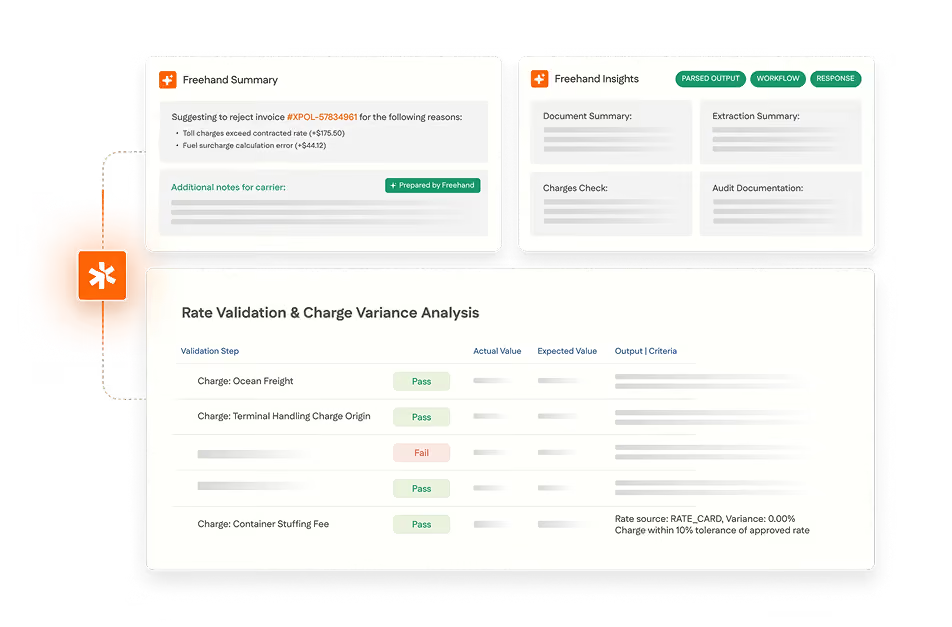
- AI Teams audit 100% of freight invoices, not a sample reviewed after the award
- Fully agentic exception resolution that opens, evidences, and resolves disputes without waiting for a person to approve each one
- Context Graph connects contracts, carrier history, and shipment data so decisions are explainable
- Real-time GL coding and cost-center allocation with automatic posting
- Native connectors for SAP ECC, S/4HANA, Oracle Cloud, Oracle JDE, and NetSuite
- Client-exclusive model in a dedicated environment; the enterprise owns and can export its own data
Pricing
Volume-based and disclosed at scoping, quoted by freight volume and modules. No undisclosed platform tier.
Pros
- Closes the loop from sourcing into audit and payment, which sourcing-only tools do not
- Enforces the awarded rate through 100% invoice audit rather than trusting it downstream
- Transparent volume pricing instead of a custom, quote-only tier
Cons
- Built for freight and logistics spend, so it is not an all-category direct-materials sourcing tool
- Enterprise-focused; a small shipper with low freight volume is not the target fit
What users say
Love: Sourced rate carried through to audit, not just awarded: Freehand runs the sourcing decision through to invoice audit and payment, closing the gap left by tools that stop at the award. (source)
Complain: Not an all-category sourcing platform: Freehand runs freight and logistics sourcing and AP, so direct-materials sourcing outside that scope still needs a dedicated tool alongside it. (source)
Keelvar
Best for: Enterprises running complex, high-volume sourcing events across any category that want strong optimization on the award decision.
Keelvar is a strong autonomous sourcing platform, built for complex, high-volume sourcing events and used by enterprises like Siemens, Coca-Cola, and Novartis, with a 4.7/5 rating across 23 G2 reviews.
Key features
- Autonomous optimization for complex, multi-round sourcing events
- Advanced bid analysis and scenario modeling
- Support for combinatorial and constraint-based awards
- Broad category coverage beyond direct materials
- Supplier collaboration tools
- ERP and system integrations
- Enterprise-grade event configuration
Pricing
Custom, quote-only pricing; built for large enterprise use.
Pros
- Strong optimization for complex, high-volume events
- Proven at enterprise scale across multiple industries
- Broader category reach than a direct-materials-only tool
Cons
- Advanced setup can need a dedicated analyst for complex configurations
- Contract lifecycle management is secondary to sourcing
- Sourcing focused, without downstream invoice audit and payment
What users say
Love: Ease of use and dependable support: A G2 reviewer notes some advanced settings are hard to configure without a Keelvar analyst assigned to the tender, but overall support and outcomes are dependable for complex events. (source)
Complain: Advanced setup needs a dedicated analyst: The same review category notes some advanced settings are hard to configure without a Keelvar analyst assigned to the tender. (source)
Fairmarkit
Best for: Procurement teams that want autonomous sourcing across all categories, including the tail spend that usually goes unmanaged.

Fairmarkit is an autonomous sourcing platform that uses AI agents to run the request-to-award workflow, with supplier recommendations and bidding automation, targeting the gap between fully strategic sourcing and unmanaged maverick buying.
Key features
- AI agents across the request-to-award sourcing workflow
- Supplier recommendations from historical and market data
- Automated bidding and bid analysis
- Tail-spend sourcing at scale
- Intake and guided request creation
- ERP integrations
- Direct and indirect category coverage
Pricing
Custom enterprise pricing, not published. Quotes depend on modules and event volume.
Pros
- Strong all-category and tail-spend coverage
- Fast to implement per user reviews
- Broader category reach than a direct-materials-only sourcing tool
Cons
- Sourcing focused, without downstream freight audit and payment
- Bundling multiple requests has been a noted limitation
- Custom pricing makes upfront cost modeling harder
What users say
Love: Bids in one place, easy to implement: A purchasing agent writes that Fairmarkit is a great way to receive bids all in one place, making it easier to reach vendors who normally would not be reached, and simple to use and implement. (source)
Complain: Vendor onboarding lag, sourcing-only: A Quality Manager notes vendors are not onboarded with the tool or updated and take time to share bids, and Fairmarkit stops at sourcing with no downstream freight audit or payment. (source)
Didero
Best for: Manufacturers and distributors that want agentic PO automation for direct materials layered onto their existing ERP.
Didero runs an agentic AI layer on top of SAP, Oracle, or Microsoft Dynamics for direct-materials procurement, reading supplier communications and issuing, acknowledging, and reconciling routine purchase orders, backed by a $30M Series A from Chemistry, Headline, and Microsoft's M12 fund.
Key features
- Agentic reading of supplier communications for contract terms and pricing
- Automated PO issuance, acknowledgment, and reconciliation
- Layers onto existing ERP without infrastructure replacement
- Exception Queue for tolerance-threshold breaches
- Direct-materials sourcing focus
- Real-time supply disruption flagging
- No infrastructure rip-and-replace required
Pricing
Custom, undisclosed pricing; negotiated by company size.
Pros
- Removes manual work on routine, in-tolerance purchase orders
- Layers onto existing ERP without a platform migration
- Strong investor backing reflects real market confidence
Cons
- Exceptions still route to a human Exception Queue rather than resolving automatically
- No visible independent review footprint yet as a newer platform
- Sourcing and PO focused, without invoice audit and payment execution
What users say
Love: Removes manual PO work on routine transactions: Didero's agents extract contract terms, pricing, and delivery variables from communications so routine purchase orders can be issued, acknowledged, and reconciled without manual intervention. (source)
Complain: Exceptions still need a person: Didero escalates tolerance-threshold breaches, such as invoice price discrepancies or lead-time extensions, to an Exception Queue for a procurement team to work rather than resolving them on its own. (source)
Kavida
Best for: Manufacturers in aerospace, automotive, garments, or electronics that want supply chain risk visibility alongside procurement agents.
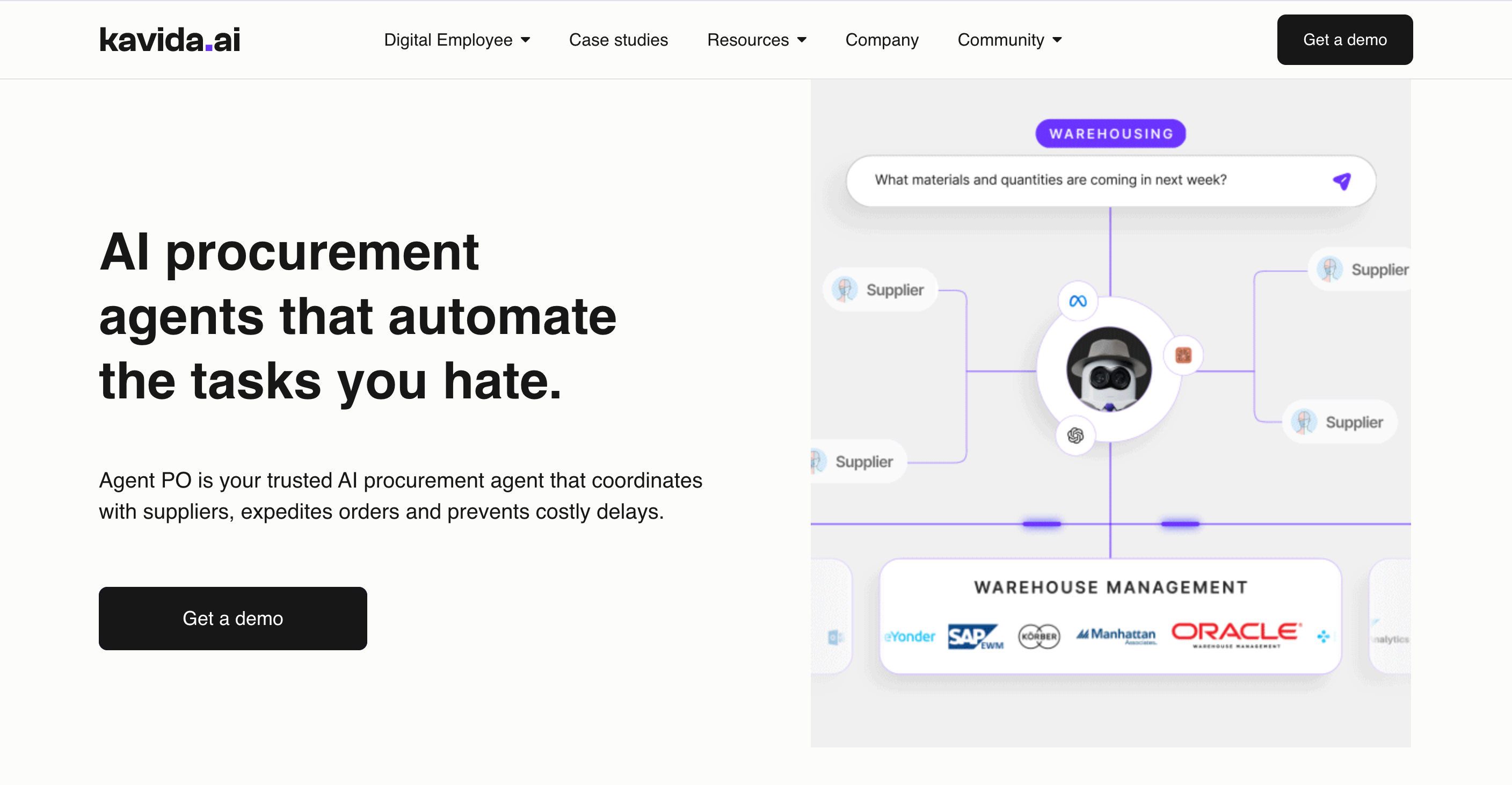
Kavida builds AI decision-intelligence tools and digital twins to prevent and mitigate real-time supply chain disruptions, with a Procurement Agent that manages supplier RFQs and quote validation.
Key features
- Digital twin visibility across the supply chain
- Procurement Agent for supplier RFQs and quote validation
- PO management and order confirmation automation
- Real-time disruption alerts in Microsoft Teams or Slack
- Copilot chatbot for procurement-supplier interactions
- Sales Agent for customer RFQs and order processing
- Industry focus in aerospace, automotive, garments, and electronics
Pricing
Custom, quote-only pricing; negotiated by company size and modules.
Pros
- Strong real-time disruption visibility across the supply chain
- Frees up meaningful procurement time on routine PO changes and confirmations
- Deep manufacturing-industry focus
Cons
- Integration with existing enterprise software described as a heavy data-import process
- Limited external data source options cited by users
- Sourcing and visibility focused, without downstream invoice audit and payment
What users say
Love: Connected view of supply chain risk: Users say the platform gives the most comprehensive view of how components are connected, helping teams spot issues early and respond to emerging challenges. (source)
Complain: Heavy integration and limited external sources: Integrating Kavida with existing enterprise software has been a challenge, with a data-import process users describe as heavy and fewer external data sources than they would like. (source)
Coupa
Best for: Enterprises that want company-wide spend visibility and fast user adoption across indirect procurement.
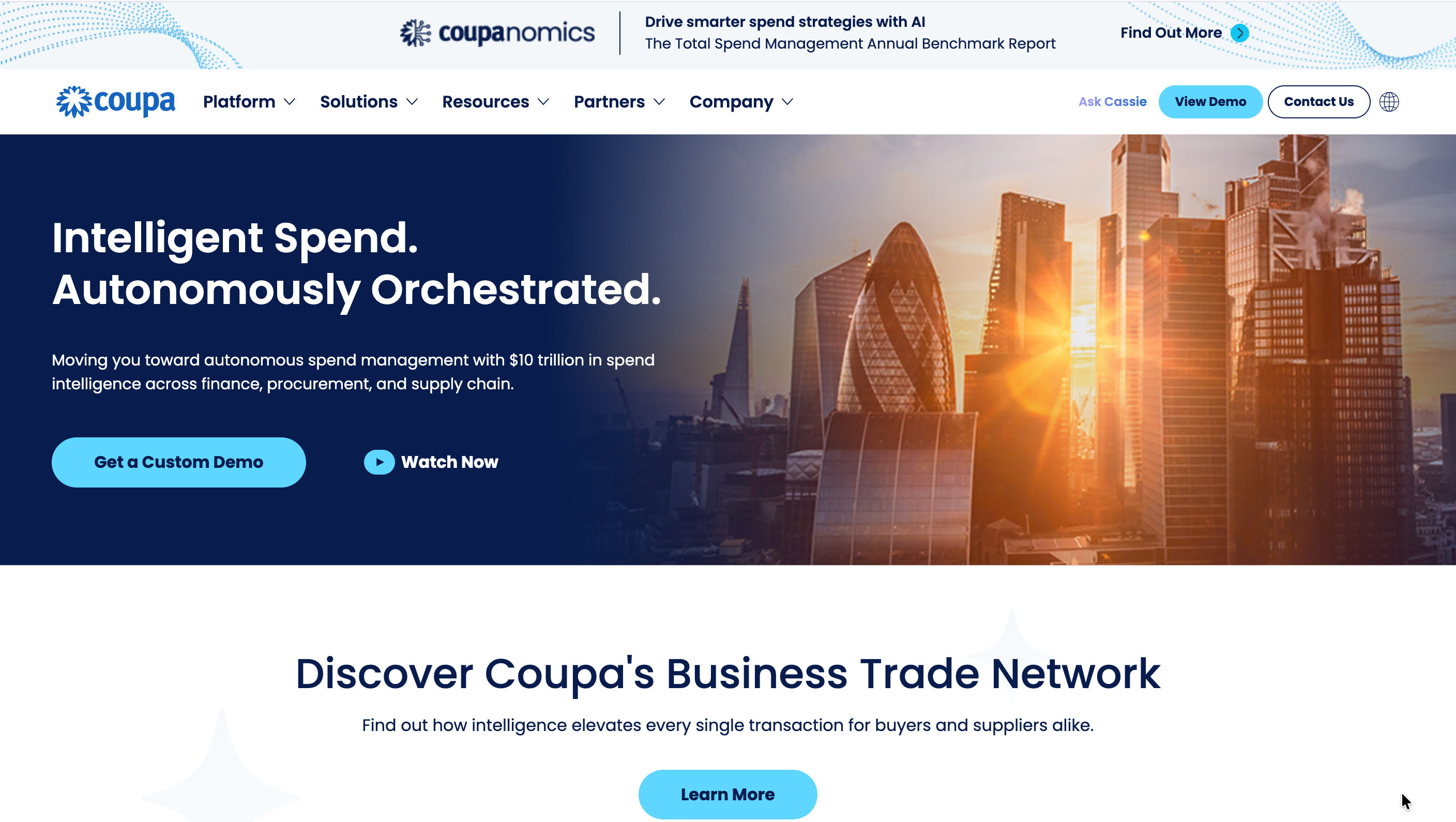
Coupa runs a cloud Business Spend Management platform that spans procurement, invoicing, expenses, and supplier and treasury functions. Its reputation is built on ease of use and quick time-to-value, with community-based benchmarking drawn from aggregate spend across its customer base.
Key features
- Business Spend Management across procurement, invoicing, and expenses
- Strong self-serve user experience and guided buying
- Spend analytics with community benchmarking
- Supplier management and risk tools
- Invoice and payment automation
- Prebuilt ERP integrations
- Broad indirect procurement coverage
Pricing
Custom enterprise pricing, not published. Quotes depend on modules, users, and spend volume.
Pros
- Best-in-class usability drives adoption
- Strong spend visibility and benchmarking
- Full source-to-pay coverage beyond sourcing
Cons
- Direct-materials sourcing depth trails specialized tools
- Cost climbs at full-suite scale
- Freight and logistics audit depth is generic, not specialized
What users say
Love: Centralized spend visibility and fast adoption: A G2 reviewer credits one place to track purchases, approvals, invoices, and expenses, with 3-way matching that "move[s] smoothly" (4.2/5 across 569 G2 reviews; a 2025 Gartner Magic Quadrant Leader). (source)
Complain: Clunky navigation at scale: A reviewer notes the system "can feel slow and clunky at times especially when navigating between modules." (source)
SAP Ariba
Best for: Large enterprises deeply invested in the SAP ecosystem that want process standardization and supplier reach.
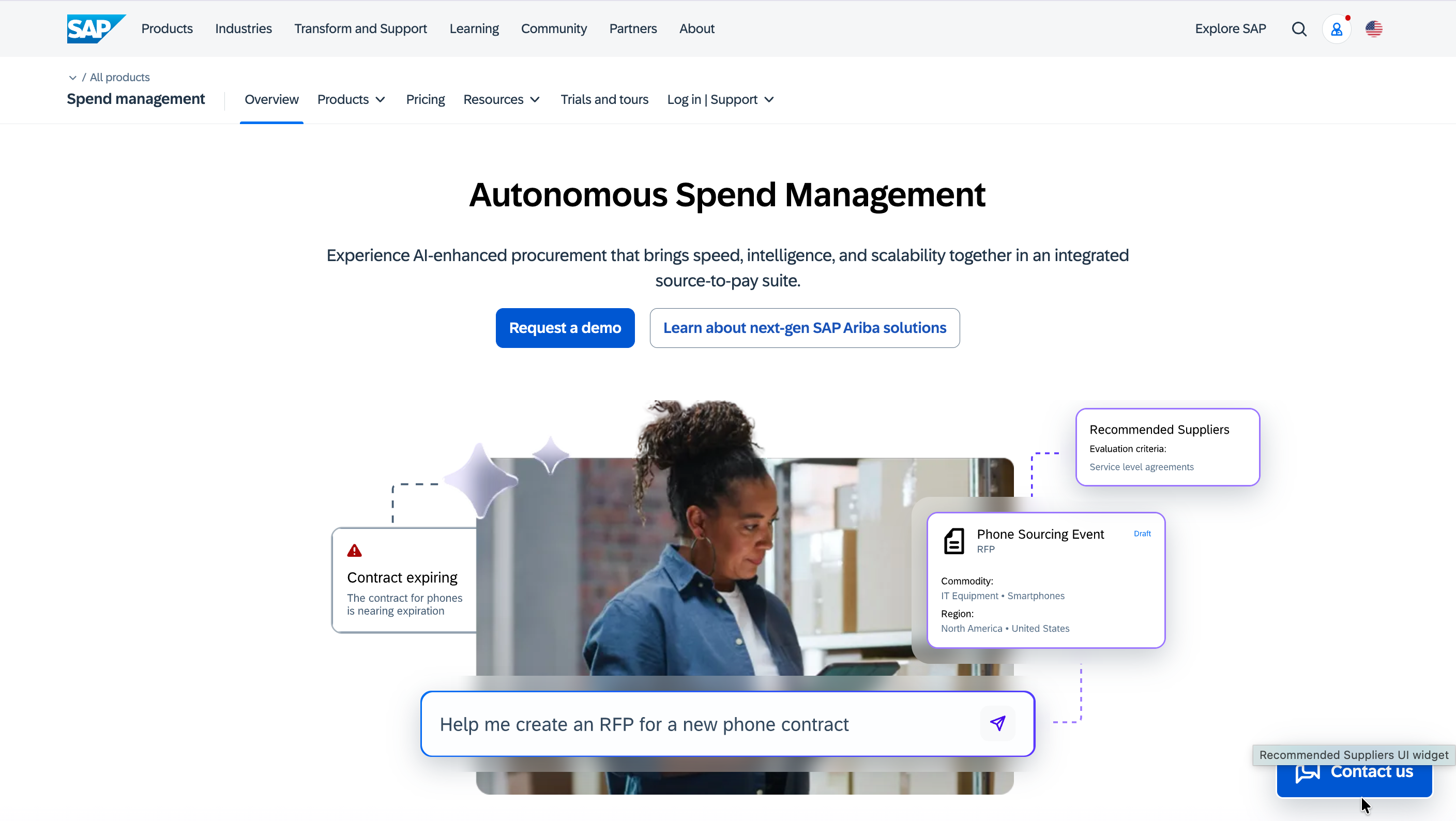
SAP Ariba delivers source-to-pay across sourcing, contracts, procurement, and invoicing, anchored by the Ariba Network, one of the largest business-to-business supplier networks. It is a strong fit where SAP ERP is the system of record and standardization across regions matters more than a specialized sourcing tool.
Key features
- End-to-end source-to-pay across sourcing, contracts, and procurement
- Ariba Network for supplier discovery and collaboration
- Tight SAP ERP integration
- Guided buying and catalog management
- Invoice and payment automation
- Global tax and compliance support
- Direct and indirect spend coverage
Pricing
Custom enterprise pricing, not published. Quotes scale with modules, users, and supplier network usage.
Pros
- Deep SAP integration and process standardization
- Largest supplier network in the category
- Full source-to-pay coverage beyond sourcing
Cons
- Supplier network fees and onboarding friction
- Interface and setup complexity draw consistent criticism
- Heavier deployment than a specialized sourcing tool
What users say
Love: Structured workflow and a clean audit trail: Enterprise reviewers value Ariba's centralized document tracking and the "consistent, unbroken audit trail for approvals and invoice reconciliation" (4.1/5 across 791 G2 reviews; a 2025 Gartner Magic Quadrant Leader). (source)
Complain: Long rollout and steep learning curve: G2 pricing data puts implementation at roughly 6 months and ROI at 16, and buyers cite supplier-network fees and onboarding friction. (source)
LightSource vs Freehand
They automate different slices of the same lifecycle, and the honest comparison is narrow. LightSource runs the sourcing event itself: item ingestion, RFQs, supplier activation, and award optimization. Freehand does not replace that sourcing layer for direct materials.
What it does is run the freight sourcing, invoice audit, and payment that a sourcing-only tool hands off once the award is made.
If your gap is direct-materials RFQ speed and bid analysis, LightSource's focus is the deciding factor. If your gap is enforcing the sourced rate through invoice audit and autonomous payment for freight and logistics spend, Freehand is the direct replacement for that slice of your operation.
How to choose a LightSource alternative
Match the replacement to the job you actually need done, not to the longest feature list. Run each option against these questions:
- Does the sourcing decision flow through to invoice audit and payment, or stop at the award?
- How much of the RFQ and bid analysis does the system run autonomously?
- Do you need all-category sourcing, or freight and logistics AP depth specifically?
- Is there enough independent review depth to validate quality at your scale?
- Is pricing disclosed upfront, or a custom, quote-only conversation?
Weight the closed loop to payment highest if the goal is to stop leakage after the award, not just source faster.
{{brown-cta}}
FAQ
Who are LightSource's main competitors?
Its main direct-materials sourcing competitors include Keelvar, Fairmarkit, Didero, and Kavida, plus source-to-pay suites like Coupa and SAP Ariba. Freehand competes on freight sourcing and AP.
What is the best LightSource alternative?
For enterprises whose sourcing and AP leakage concentrate in freight and logistics spend, Freehand ranks first because it enforces the sourced rate through invoice audit and payment.
Is there a cheaper alternative to LightSource?
Freehand's volume-based pricing is disclosed at scoping, which is easier to model than LightSource's custom, undisclosed quotes.
Why do companies switch from LightSource?
Common reasons are a sourcing-only scope that stops at the award, a thinner independent review base than established suites, and undisclosed pricing.
Does LightSource handle invoice audit and payment?
No. LightSource automates RFQ, bid analysis, and award decisions. Invoice audit and payment execution still run through separate systems once a rate is sourced.
What should I look for in a LightSource replacement?
Prioritize whether the sourcing decision flows through to payment, sourcing autonomy, category coverage, independent review depth, and disclosed pricing.
Is Freehand a full LightSource replacement?
Not for direct-materials sourcing. Freehand runs freight and logistics sourcing, audit, and payment autonomously, so it complements a direct-materials sourcing tool rather than replacing it.
How does Keelvar compare to LightSource?
Keelvar specializes in complex, high-volume sourcing event optimization across any category; LightSource focuses specifically on direct-materials sourcing with a faster RFQ-to-award cycle.
Buy the Finished Work, Not the Headcount.
Freehand delivers completed AP as software: invoices processed, charges audited, exceptions resolved. You scale volume without scaling a team.
You're Auditing a Sample. The Errors Live in the Rest.
Most teams spot-check 15 to 30% of freight invoices. Overcharges hide in the 70% no one opens.
Every warehouse. Every provider. Every mile.
Gartner's 2026 outlook on logistics outsourcing, and how AI Teams hold every contract to the terms you agreed.
- Where outsourced logistics quietly loses margin
- Why billed charges drift from the contract
- How AI Teams close the gap