



7 Best Didero Alternatives for 2026 (Compared)
The best Didero alternatives for 2026, ranked and scored on exception autonomy, category coverage, and pricing transparency.
.webp)
September 17, 2026
•
17
mins
The best Didero alternatives for 2026: 1. Freehand, 2. Kavida, 3. Gatekeeper, 4. Levelpath, 5. ZipHQ, 6. Coupa, 7. SAP Ariba.
Didero runs an agentic AI layer on top of your existing ERP for direct-materials procurement, reading supplier communications and issuing, acknowledging, and reconciling routine purchase orders without manual work, backed by a $30M Series A from Chemistry, Headline, and Microsoft's M12 fund.
If you are here, you are likely weighing whether its exception-queue model and manufacturing-specific scope are still the right fit as your category coverage and exception volume grow.
This page compares the alternatives that do the same core job.
Didero Alternatives Comparison
Here is a detailed comparison of the best Didero alternatives for 2026.
TL;DR
- Freehand: AI Teams that audit 100% of freight invoices before payment and resolve exceptions autonomously, best for enterprises whose logistics AP leakage sits alongside a direct-materials procurement need.
- Kavida: Supply chain risk visibility and procurement agents built for manufacturers in aerospace, automotive, and electronics.
- Gatekeeper: Unified vendor and contract lifecycle management with AI agents handling contract analytics and compliance monitoring.
- Levelpath: AI-native intake, sourcing, and supplier management with embedded generative AI assistants.
- ZipHQ: Guided intake with cross-team approval routing across finance, legal, security, and procurement.
- Coupa: Company-wide spend visibility and adoption inside a full business spend management suite.
- SAP Ariba: The enterprise incumbent for SAP-centric estates, with the largest supplier network in the category.
Why teams look for Didero alternatives
Didero earns real credit. It removes manual work on routine purchase orders by reading supplier communications directly, layers onto existing ERPs like SAP, Oracle, and Microsoft Dynamics without a rip-and-replace, and its $30M Series A from Chemistry, Headline, and Microsoft's M12 fund reflects real investor confidence in the model. (source) The reasons buyers evaluate alternatives are about exception depth and category scope, not the core automation.
- Exceptions still route to a human queue: Didero escalates activity that breaches tolerance thresholds, such as invoice price discrepancies, lead-time extensions, or supply disruptions, to an Exception Queue for a person to work, rather than resolving those cases on its own. (source)
- Scoped to direct-materials sourcing: Didero is built for manufacturers and distributors sourcing raw materials and inputs, so indirect spend, services, and freight and logistics AP sit outside its focus.
- No independent review footprint yet: As a newer platform still building its public track record, Didero has little to no visible G2 or Gartner review sample for buyers to validate against.
- Undisclosed pricing: Public pricing information is not available, so total cost requires a direct sales conversation.
If those points match your evaluation, the alternatives below sort cleanly by how they answer them.
{{blue-cta}}
How did we evaluate these Didero alternatives?
We scored every provider on the same six criteria, weighted for a manufacturer or distributor replacing an agentic procurement layer. Weights sum to 100%, and the Overall score in the table is the weighted result.
- Exception autonomy (25%): Whether the system resolves flagged discrepancies on its own or routes them to a human queue.
- Category coverage (20%): Breadth across direct materials, indirect spend, services, and freight or logistics AP.
- ERP integration (15%): Native connectors versus custom or file-based sync, and whether the tool layers onto your existing ERP.
- Supply chain and risk visibility (15%): Depth of supplier, contract, and disruption monitoring.
- Payment execution and reach (15%): Whether the platform executes payment itself or hands off to another system.
- Pricing transparency (10%): Disclosed, predictable pricing versus custom, quote-only tiers.
This is an independent editorial comparison, not a Gartner Magic Quadrant or a paid ranking. A buyer whose priority is broad indirect-category sourcing across the whole business should weigh category coverage highest, which moves Coupa or SAP Ariba up; a team whose leakage concentrates in freight and logistics AP should weigh exception autonomy and payment execution highest.
Freehand
Best for: Enterprises whose freight and logistics AP leakage sits alongside a direct-materials procurement need, and who want invoice exceptions resolved rather than queued.

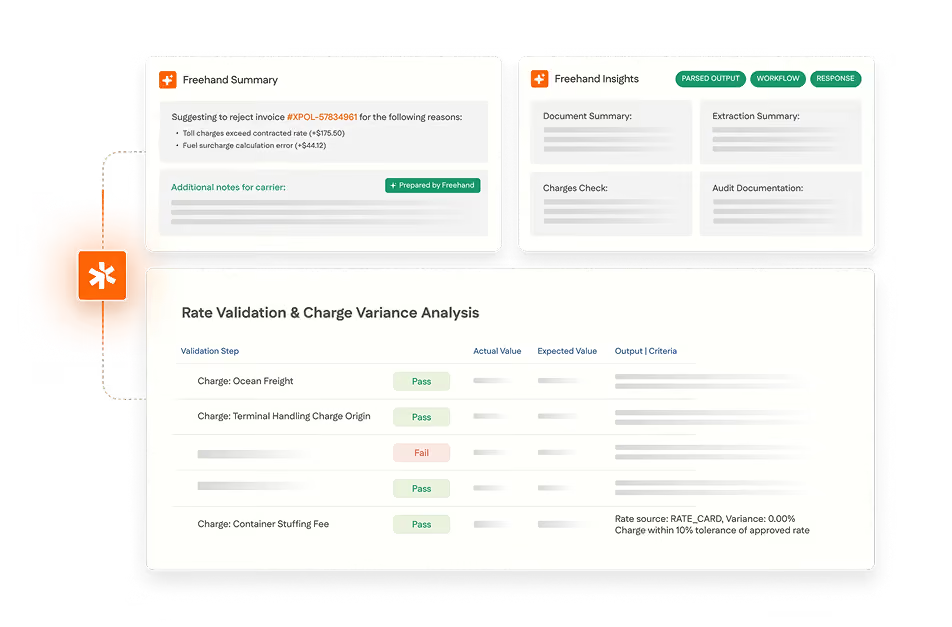
Didero automates routine purchase orders and escalates flagged exceptions to a queue for a person to work; Freehand runs the equivalent job for freight and logistics AP and resolves the exceptions itself. It is built as services delivered as software: you buy completed audit and payment work, not another agent layer that still needs a team behind the queue.
Key features
- Audits 100% of freight invoices before payment, not a sample reviewed after the fact
- Fully agentic exception resolution that opens, evidences, and resolves disputes without routing them to a human queue
- Multi-way matching across invoice, contracted rate, shipment, and PO for freight and logistics spend
- Context Graph that learns your carriers, vendors, contracts, and GL rules so decisions are explainable
- Real-time GL coding and cost-center allocation with automatic posting
- Native connectors for SAP ECC, S/4HANA, Oracle Cloud, Oracle JDE, and NetSuite
- Layers onto your existing ERP and TMS rather than requiring a rip-and-replace
- Client-exclusive model in a dedicated environment; the enterprise owns and can export its own data
Pricing
Volume-based and disclosed at scoping, quoted by invoice and freight volume. No undisclosed platform tier.
Pros
- Resolves exceptions itself instead of queuing them for a person to work
- Layers onto your existing ERP without infrastructure replacement, the same design principle Didero uses
- Transparent volume pricing instead of an undisclosed custom quote
Cons
- Built for freight and logistics AP, not direct-materials sourcing and supplier RFQs
- Enterprise-focused; a small manufacturer with low freight volume is not the target fit
What users say
Love: Exceptions resolved, not queued: Freehand audits every freight invoice and resolves the exception itself, closing the gap left by tools that still route flagged issues to a person. (source)
Complain: Not a direct-materials sourcing platform: Freehand runs freight and logistics AP, so raw-material sourcing and supplier RFQs still need a dedicated procurement platform alongside it. (source)
Kavida
Best for: Manufacturers in aerospace, automotive, garments, or electronics that want supply chain risk visibility alongside procurement agents.
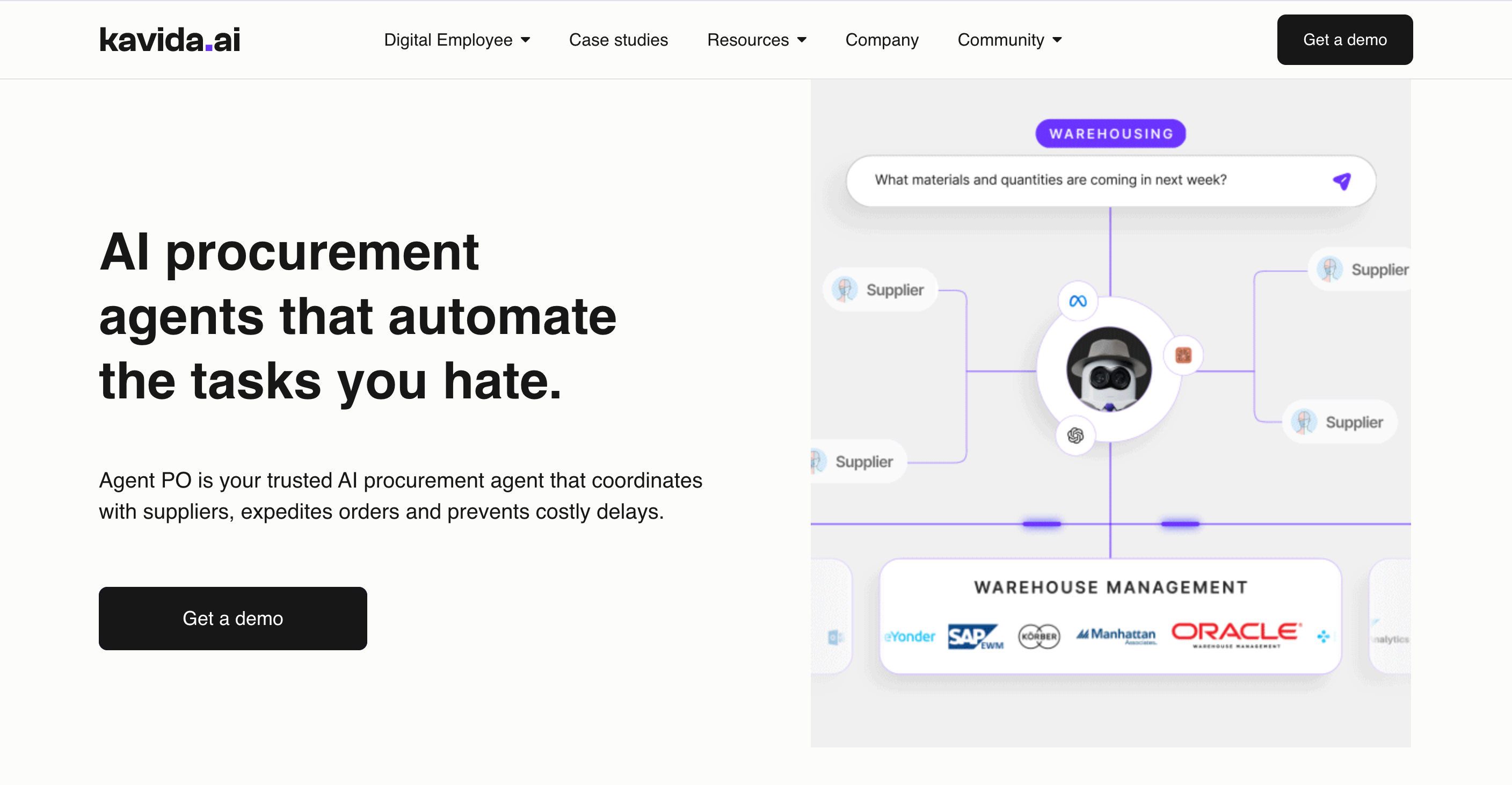
Kavida builds AI decision-intelligence tools and digital twins to prevent and mitigate real-time supply chain disruptions, with a Procurement Agent that manages supplier RFQs and quote validation and a Digital Employee Procurement Agent handling PO management and order confirmations.
Key features
- Digital twin visibility across the supply chain
- Procurement Agent for supplier RFQs and quote validation
- PO management and order confirmation automation
- Real-time disruption alerts in Microsoft Teams or Slack
- Copilot chatbot for procurement-supplier interactions
- Sales Agent for customer RFQs and order processing
- Industry focus in aerospace, automotive, garments, and electronics
Pricing
Custom, quote-only pricing; negotiated by company size and modules.
Pros
- Strong real-time disruption visibility across the supply chain
- Frees up meaningful procurement time on routine PO changes and confirmations
- Deep manufacturing-industry focus
Cons
- Integration with existing enterprise software described as a heavy data-import process
- Limited external data source options cited by users
- Sourcing and visibility focused, without downstream invoice audit and payment
What users say
Love: Connected view of supply chain risk: Users say the platform gives the most comprehensive view of how components are connected, helping teams spot issues early and respond to emerging challenges. (source)
Complain: Heavy integration and limited external sources: Integrating Kavida with existing enterprise software has been a challenge, with a data-import process users describe as heavy and fewer external data sources than they would like. (source)
Gatekeeper
Best for: Teams that want unified vendor and contract lifecycle management with AI agents handling contract analytics and compliance monitoring.
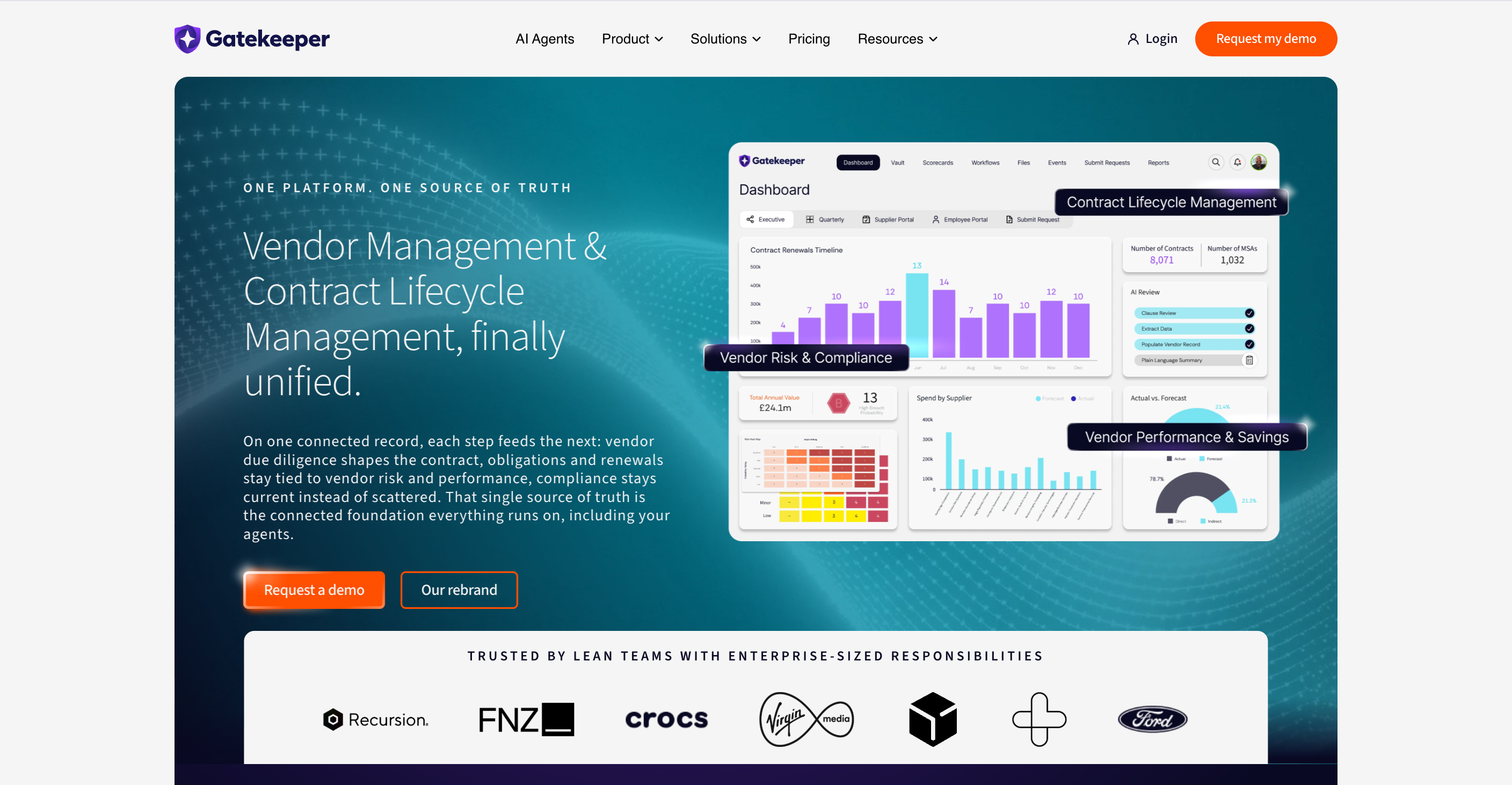
Gatekeeper unifies contract lifecycle management, third-party risk management, and spend management in one platform, with AI agents powered by Amazon Bedrock handling contract summaries, clause extraction, automated redlining, and 24/7 third-party risk surveillance.
Key features
- Unified contract lifecycle and vendor management
- AI-powered contract summaries and clause extraction
- Automated redlining and intelligent approval routing
- 24/7 third-party risk surveillance across financial and regulatory sources
- Integrated e-signature
- Vendor onboarding automation
- Spend optimization tools
Pricing
Custom, quote-only pricing; negotiated by company size and modules.
Pros
- Vendor cost reductions and cycle-time savings reported by the vendor
- Strong contract analytics and risk monitoring
- Intuitive, well-organized workflows praised by reviewers
Cons
- Initial setup described as complex and requiring additional support
- Contract and vendor-management focused, without freight or logistics invoice audit
- Custom pricing makes upfront cost modeling harder
What users say
Love: Intuitive workflows and automated notifications: Users consistently praise the product's ease of use and intuitive design, appreciating well-organized workflows and automated notifications that improve organization. (source)
Complain: Complex initial setup: Some users note that initial setup can be complex and requires additional support to get fully configured. (source)
Levelpath
Best for: Teams that want AI-native intake, sourcing, and supplier management guided by embedded generative AI assistants.
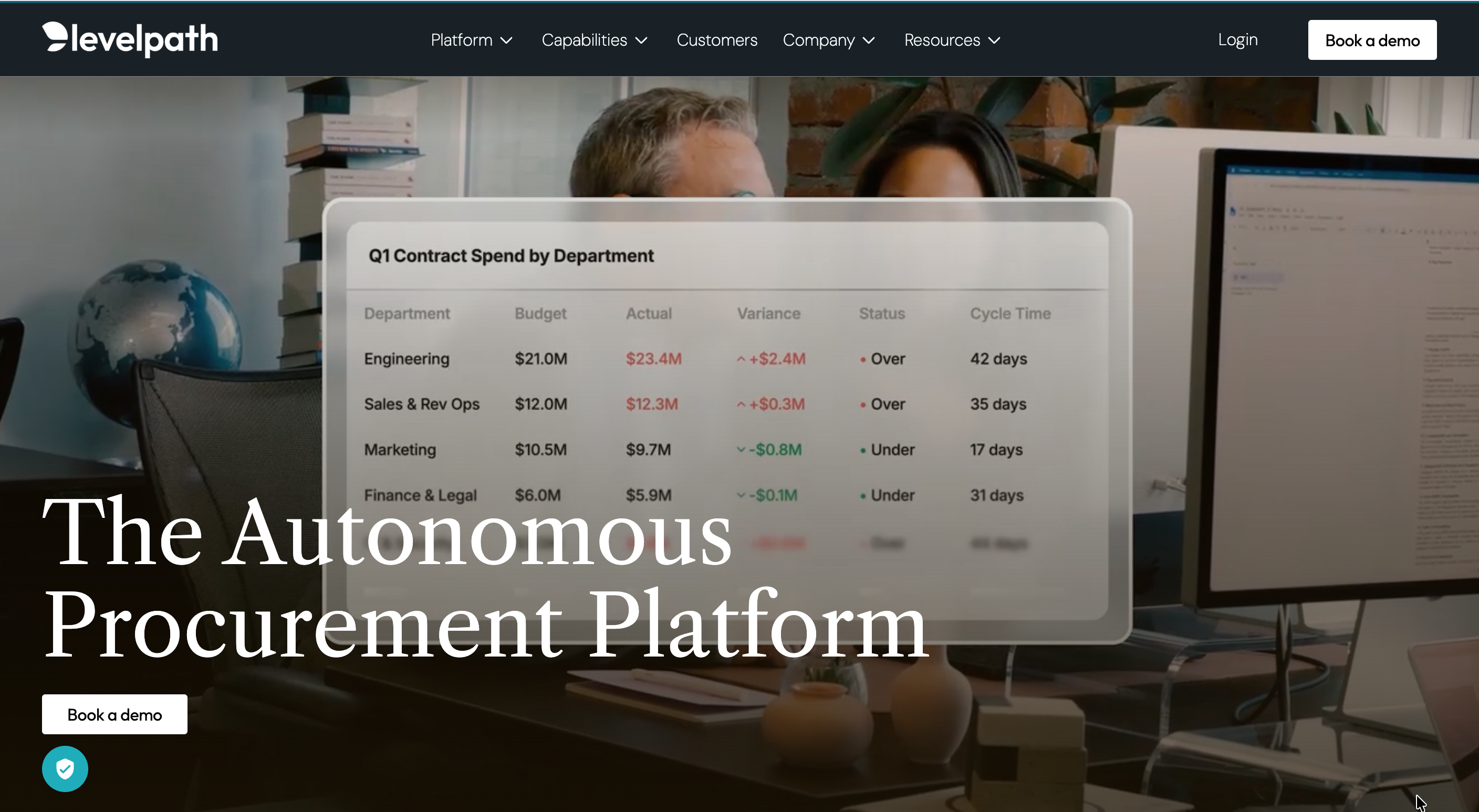
Levelpath is an AI-first procurement platform covering intake management, sourcing, supplier management, and contracts in one environment, with generative AI guiding users through requests and surfacing insights at each stage. It was included in the 2026 Gartner Hype Cycle for Procurement and Sourcing Solutions.
Key features
- AI-guided intelligent intake management
- Embedded generative AI assistants across the workflow
- Sourcing and supplier management
- Contract management
- Automated repetitive procurement tasks
- Compliance-guided intake experience
- Gartner Hype Cycle recognition for generative AI in procurement
Pricing
Custom, quote-only pricing; negotiated by company size and modules.
Pros
- Strong generative AI guidance through the procurement workflow
- High G2 rating with responsive implementation support
- Broader indirect procurement scope than a manufacturing-only tool
Cons
- Thin independent review base relative to established enterprise suites
- Not focused on direct-materials or freight and logistics spend
- Sourcing and intake focused, without downstream invoice audit and payment
What users say
Love: Outstanding customer support: A verified user highlighted outstanding customer support, noting they chose Levelpath based on past experience with similar platforms and confidence in implementation support. (source)
Complain: Thin independent review base: With 9 reviews on G2, buyers have less independent peer feedback to validate against than with the established enterprise suites.
ZipHQ
Best for: Teams that want guided intake with cross-team approval routing across finance, legal, security, and procurement.
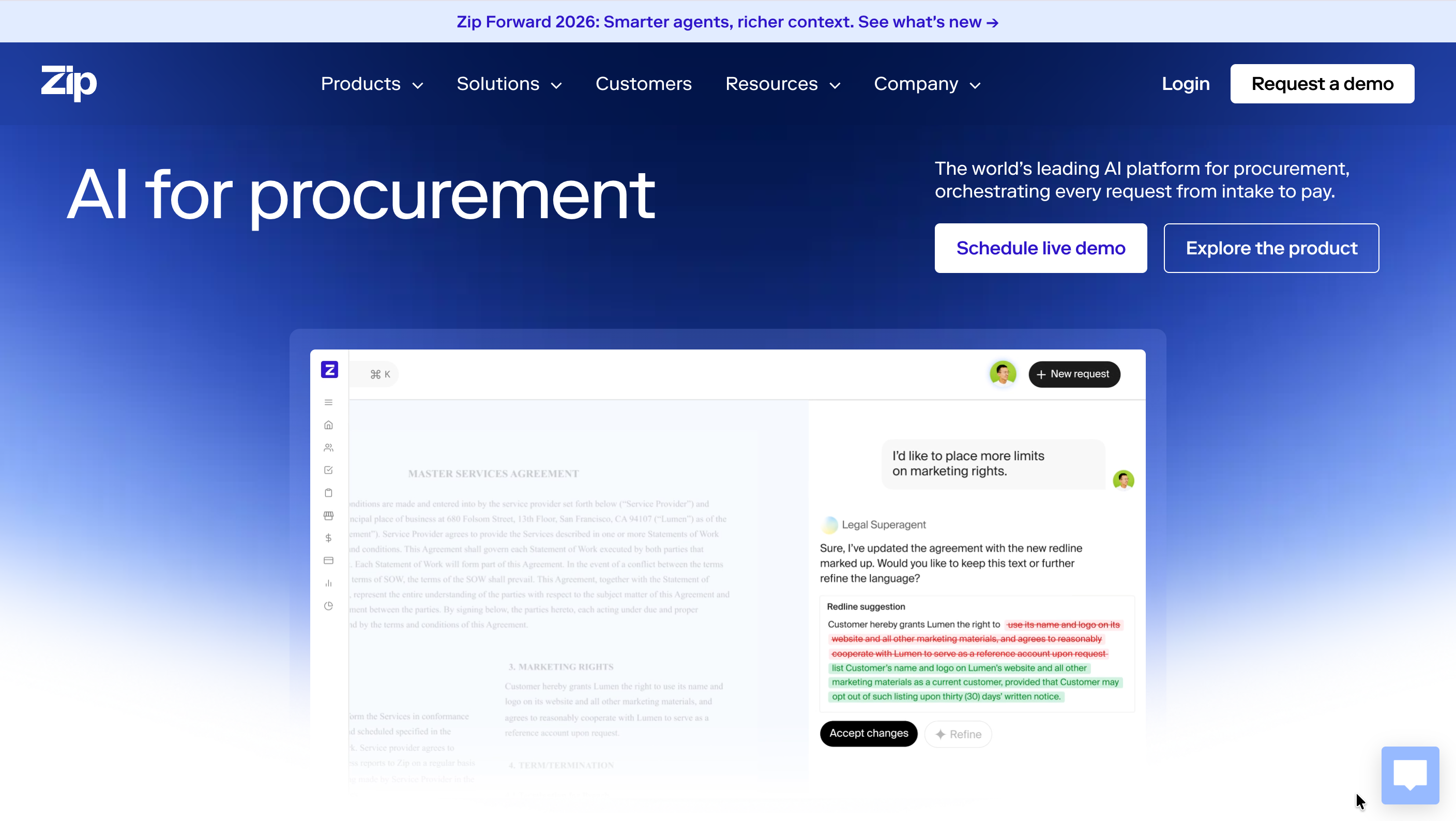
Zip runs procurement intake and orchestration, giving requesters a guided front door and routing approvals across departments in one workflow. Reviewers praise the visibility it gives into each step, keeping approvers aligned.
Key features
- Guided intake front door for requesters
- Cross-team approval routing across finance, legal, and security
- Workflow visibility at every step
- Purchase order and vendor management
- Spend visibility dashboards
- Integrations with common business systems
- Configurable approval hierarchies
Pricing
Custom, quote-only pricing; negotiated by company size and modules.
Pros
- Strong workflow visibility keeps approvers aligned
- Well-reviewed core intake experience
- Cross-functional approval routing built in
Cons
- Rigid workflows for exceptions, reviewers report extra steps needed
- Not scoped for direct-materials sourcing or freight and logistics AP
- Stops at approval, not full invoice audit and payment execution
What users say
Love: Clear visibility across workflow steps: Reviewers say the visibility into each step of the workflow is especially helpful, keeping everyone aligned and making approvals smoother. (source)
Complain: Rigid on exceptions, thin admin self-service: Reviewers report that small changes or exceptions sometimes require extra steps, and admin features often depend on the Zip team to enable settings. (source)
Coupa
Best for: Enterprises that want company-wide spend visibility and fast user adoption across indirect procurement.
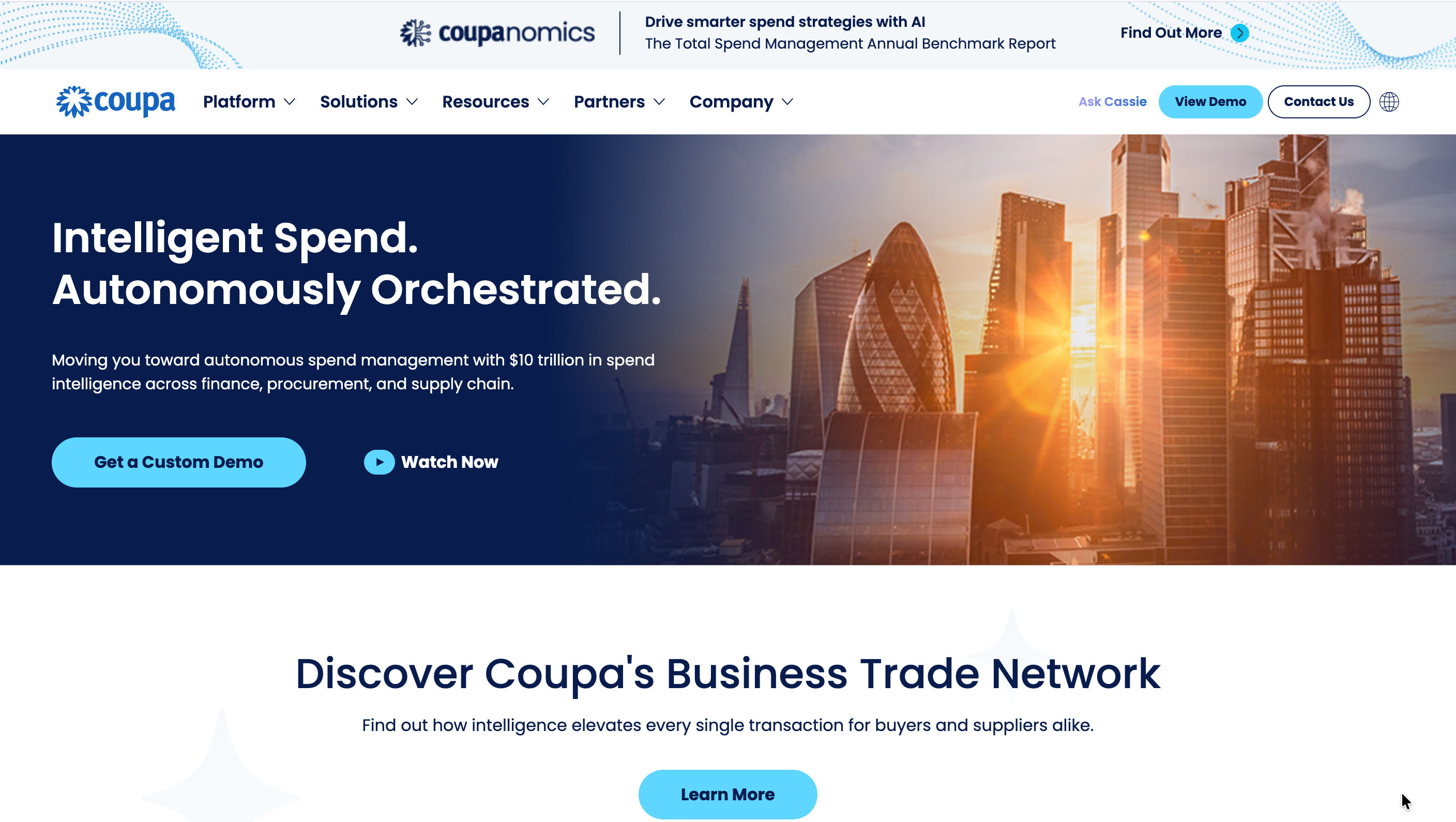
Coupa runs a cloud Business Spend Management platform that spans procurement, invoicing, expenses, and supplier and treasury functions. Its reputation is built on ease of use and quick time-to-value, with community-based benchmarking drawn from aggregate spend across its customer base.
Key features
- Business Spend Management across procurement, invoicing, and expenses
- Strong self-serve user experience and guided buying
- Spend analytics with community benchmarking
- Supplier management and risk tools
- Invoice and payment automation
- Prebuilt ERP integrations
- Broad indirect procurement coverage
Pricing
Custom enterprise pricing, not published. Quotes depend on modules, users, and spend volume.
Pros
- Best-in-class usability drives adoption
- Strong spend visibility and benchmarking
- Full source-to-pay coverage beyond intake
Cons
- Direct-materials and manufacturing-specific depth trails specialized tools
- Cost climbs at full-suite scale
- Freight and logistics audit depth is generic, not specialized
What users say
Love: Centralized spend visibility and fast adoption: A G2 reviewer credits one place to track purchases, approvals, invoices, and expenses, with 3-way matching that "move[s] smoothly" (4.2/5 across 569 G2 reviews; a 2025 Gartner Magic Quadrant Leader). (source)
Complain: Clunky navigation at scale: A reviewer notes the system "can feel slow and clunky at times especially when navigating between modules." (source)
SAP Ariba
Best for: Large enterprises deeply invested in the SAP ecosystem that want process standardization and supplier reach.
SAP Ariba delivers source-to-pay across sourcing, contracts, procurement, and invoicing, anchored by the Ariba Network, one of the largest business-to-business supplier networks. It is a strong fit where SAP ERP is the system of record and standardization across regions matters more than a specialized manufacturing tool.
Key features
- End-to-end source-to-pay across sourcing, contracts, and procurement
- Ariba Network for supplier discovery and collaboration
- Tight SAP ERP integration
- Guided buying and catalog management
- Invoice and payment automation
- Global tax and compliance support
- Direct and indirect spend coverage
Pricing
Custom enterprise pricing, not published. Quotes scale with modules, users, and supplier network usage.
Pros
- Deep SAP integration and process standardization
- Largest supplier network in the category
- Full source-to-pay coverage beyond intake
Cons
- Supplier network fees and onboarding friction
- Interface and setup complexity draw consistent criticism
- Heavier deployment than a specialized manufacturing procurement tool
What users say
Love: Structured workflow and a clean audit trail: Enterprise reviewers value Ariba's centralized document tracking and the "consistent, unbroken audit trail for approvals and invoice reconciliation" (4.1/5 across 791 G2 reviews; a 2025 Gartner Magic Quadrant Leader). (source)
Complain: Long rollout and steep learning curve: G2 pricing data puts implementation at roughly 6 months and ROI at 16, and buyers cite supplier-network fees and onboarding friction. (source)
Didero vs Freehand
They automate different slices of the same lifecycle, and the honest comparison is narrow. Didero reads supplier communications and executes routine direct-materials purchase orders, escalating tolerance breaches to a person. Freehand runs the equivalent job for freight and logistics AP and resolves the exceptions itself.
If your gap is direct-materials sourcing and PO automation, Didero's focus is the deciding factor. If your gap is freight and logistics invoice audit with exceptions resolved rather than queued, Freehand is the direct replacement for that slice of your operation.
How to choose a Didero alternative
Match the replacement to the job you actually need done, not to the longest feature list. Run each option against these questions:
- Does it resolve flagged exceptions on its own, or route them to a human queue?
- Is the tool scoped to direct materials, indirect spend, or freight and logistics AP?
- Does it layer onto your existing ERP, or require a platform migration?
- Is there an independent review base to validate quality against?
- Is pricing disclosed upfront, or a custom, quote-only conversation?
Weight exception autonomy highest if the goal is to stop routing discrepancies to a person; weight category coverage highest if your sourcing spans more than direct materials.
{{brown-cta}}
FAQ
Who are Didero's main competitors?
Its main direct-materials and manufacturing procurement competitors include Kavida, Gatekeeper, Levelpath, ZipHQ, Coupa, and SAP Ariba. Freehand competes on freight and logistics AP.
What is the best Didero alternative?
For enterprises whose leakage sits in freight and logistics AP, Freehand ranks first because it resolves invoice exceptions autonomously instead of routing them to a queue.
Is there a cheaper alternative to Didero?
Freehand's volume-based pricing is disclosed at scoping, which is easier to model than Didero's undisclosed, custom pricing.
Why do companies switch from Didero?
Common reasons are exceptions that still route to a human queue, a scope limited to direct-materials sourcing, no visible independent review footprint yet, and undisclosed pricing.
Does Didero resolve exceptions automatically?
No. Didero escalates tolerance-threshold breaches, such as invoice price discrepancies or lead-time extensions, to an Exception Queue for a procurement team to work.
What should I look for in a Didero replacement?
Prioritize exception autonomy, category coverage beyond direct materials if needed, ERP integration without a platform migration, and disclosed pricing.
Is Freehand a full Didero replacement?
Not for direct-materials sourcing. Freehand replaces the invoice audit and payment execution layer for freight and logistics AP, not Didero's supplier RFQ and PO automation.
How does Kavida compare to Didero?
Both are AI agent platforms for manufacturing supply chains. Kavida leans toward risk visibility and digital twins; Didero focuses on automating routine purchase order execution.
Buy the Finished Work, Not the Headcount.
Freehand delivers completed AP as software: invoices processed, charges audited, exceptions resolved. You scale volume without scaling a team.
You're Auditing a Sample. The Errors Live in the Rest.
Most teams spot-check 15 to 30% of freight invoices. Overcharges hide in the 70% no one opens.
Every warehouse. Every provider. Every mile.
Gartner's 2026 outlook on logistics outsourcing, and how AI Teams hold every contract to the terms you agreed.
- Where outsourced logistics quietly loses margin
- Why billed charges drift from the contract
- How AI Teams close the gap
.png)