
6 Best Medius Alternatives for Freight & Logistics AP (2026)
.webp)
July 21, 2026
•
15
mins

The best Medius alternatives for 2026: 1. Freehand, 2. Stampli, 3. Tipalti, 4. BILL, 5. AvidXchange, 6. Basware.
Medius is a capable AP automation platform, a 2026 Gartner Magic Quadrant Leader for Accounts Payable Applications, with strong invoice capture and high straight-through rates on general vendor bills. The catch shows up when your AP is dominated by freight and logistics invoices.
Carrier bills with accessorials, fuel surcharges, and contracted rates need freight-specific audit that general AP automation does not run, so the hardest and costliest invoices still land on your team.
This page compares the best Medius alternatives for freight and logistics AP, ranked for how well they cover that complexity and how much of the work they remove.
TL;DR
- Medius automates general AP well, but reviewers cite long, costly implementations and a per-seat model your team still runs, and no general AP suite was built to audit freight and logistics invoices. The six alternatives, ranked for logistics-heavy AP:
- Freehand (4.6/5)L Agentic AP that validates 100% of invoices and resolves exceptions autonomously, delivered as software rather than seats. Strongest on complex freight and logistics AP.
- Stampli (3.7/5): Collaborative invoice approvals with the deepest independent review base, best when the bottleneck is approval workflow.
- Tipalti (3.6/5): Strong global mass payments and tax compliance alongside AP automation.
- BILL (3.5/5): Easy AP/AR for SMB and mid-market finance teams with broad accounting integrations.
- AvidXchange (3.3/5): Mid-market AP that replaces paper checks with electronic payments.
- Basware (3.2/5): Enterprise invoice-to-pay with deep e-invoicing, for teams that can staff a complex rollout.
- Pick by how you want AP to run (execution for you favors Freehand; better workflow software favors Stampli or BILL), by payments needs (global mass pay favors Tipalti), and by segment (enterprise favors Basware; SMB favors BILL).
Medius Alternatives Comparison Table
Why teams look for Medius alternatives
Medius earns its standing. It is a Gartner Magic Quadrant Leader for Accounts Payable Applications, with accurate OCR capture, roughly 99% invoice auto-routing, solid Microsoft Dynamics 365 integration, and high straight-through processing. The reasons buyers evaluate a switch are about effort, model, and cost, not whether the automation works. Accounts payable is a labor problem before it is a software problem, and that shapes where these tools fall short.
- Implementation runs long and costs a lot: Reviewers repeatedly cite lengthy setup and high implementation costs before value shows up.
- Configuration and upkeep are complex: Buyers note it takes real effort to configure and maintain, and some lean on a managed services team to keep rules current.
- It is per-seat software your team still operates: Medius automates the workflow, but people still run approvals, exceptions, and coding, so effort scales with volume and users.
- It was not built for freight invoices: Medius captures vendor bills well, but carrier invoices with accessorials, fuel surcharges, and contracted rates need freight-specific rate audit that general AP tools do not perform, so freight overcharges pass through.
- Support and high-volume performance draw complaints: Reviews flag customer-service friction, and some report processing strain at large payment volumes.
If setup effort, the per-seat model, or missing freight-invoice audit is what is pushing you to look, the alternatives below either simplify the software or, in Freehand's case, run freight and vendor AP for you.
How did we evaluate these Medius alternatives?
We scored every provider on the same six criteria, weighted for a logistics-heavy finance team replacing AP automation software, where autonomy and freight-invoice handling drive the return. Weights sum to 100%, and the Overall score in the table is the weighted result. See how the underlying AI invoice processing differs across models.
- Processing autonomy (25%): Does it run AP for you and resolve exceptions, or automate a workflow your team still operates?
- Freight-invoice coverage and capture accuracy (20%): Straight-through rate and how well it validates complex freight and logistics invoices, including accessorials, fuel surcharges, and contracted rates, not just simple vendor bills.
- ERP integration (15%): Pre-built connectors to SAP, Oracle, NetSuite, and Dynamics versus custom setup.
- Implementation speed and effort (15%): Time and cost to go live and to maintain.
- Pricing model and transparency (15%): Outcome or volume-based versus per-seat, disclosed versus custom.
- Global payments and scale (10%): Payment execution, currencies, and behavior at high volume.
This is an independent editorial comparison, not a Gartner Magic Quadrant or a paid ranking. A team with simple, low-complexity vendor AP would weight workflow usability higher; a team with heavy freight and logistics invoices would weight autonomy and freight-invoice coverage highest.
{{blue-cta}}
Freehand
Best for: Enterprises with complex freight and logistics AP that want the work executed for them as software, with every invoice validated and exceptions resolved without adding staff.

Freehand is AI Teams that run your accounts payable end to end. Instead of licensing seats your team operates, you buy the completed work. The AI Teams capture invoices, validate every one against contracts and agreed rates, match, resolve discrepancies, code to the GL, and execute payment. Freehand runs the full spend-management lifecycle and is built for the hardest invoices, freight and logistics, where accessorials and multi-charge bills break generic OCR workflows.
Key features
- Validates and audits 100% of invoices before payment, with no sampling
- Agentic AP Teams that capture, match, resolve exceptions, code, and pay end to end
- Context Graph that learns your carriers, vendors, contracts, and GL rules
- Freehand Studio for full visibility into every decision and recovered dollar
- Autonomous exception and dispute resolution rather than routing to approvers
- Automated GL coding, cost-center allocation, and three-way matching
- Pre-built integrations with SAP, Oracle, NetSuite, and Dynamics 365
- Payment execution and reconciliation inside the same flow
- Deepest handling of complex freight and logistics invoices
- Enterprise data ownership, scaling without added headcount
Pricing
Volume-based and delivered as software, so cost tracks work done rather than the number of seats or a tiered per-user plan. Request a quote for your AP and freight volumes.
Pros
- Only option here that runs the AP work and resolves exceptions autonomously
- No per-seat scaling; you buy outcomes, not licenses
- Strongest coverage of complex freight and logistics invoices
Cons
- Freight and logistics-focused audit-to-pay strength, less suited to teams that only need simple, horizontal vendor AP
- Newer entrant than the established AP automation suites
What users say
Love: The work is done for you, not just routed: Freehand validates every invoice and resolves the exceptions, closing the gap left by per-seat software that still needs your team to run it. (source)
Complain: Built for complex AP, not simple horizontal invoicing: Teams that only process straightforward vendor bills may not need the full agentic, freight-grade depth. (source)
Freehand also replaces the logistics BPO services many finance teams layered on top of AP software.
Stampli
Best for: Finance teams whose main bottleneck is invoice approvals and want collaborative, easy-to-run software.
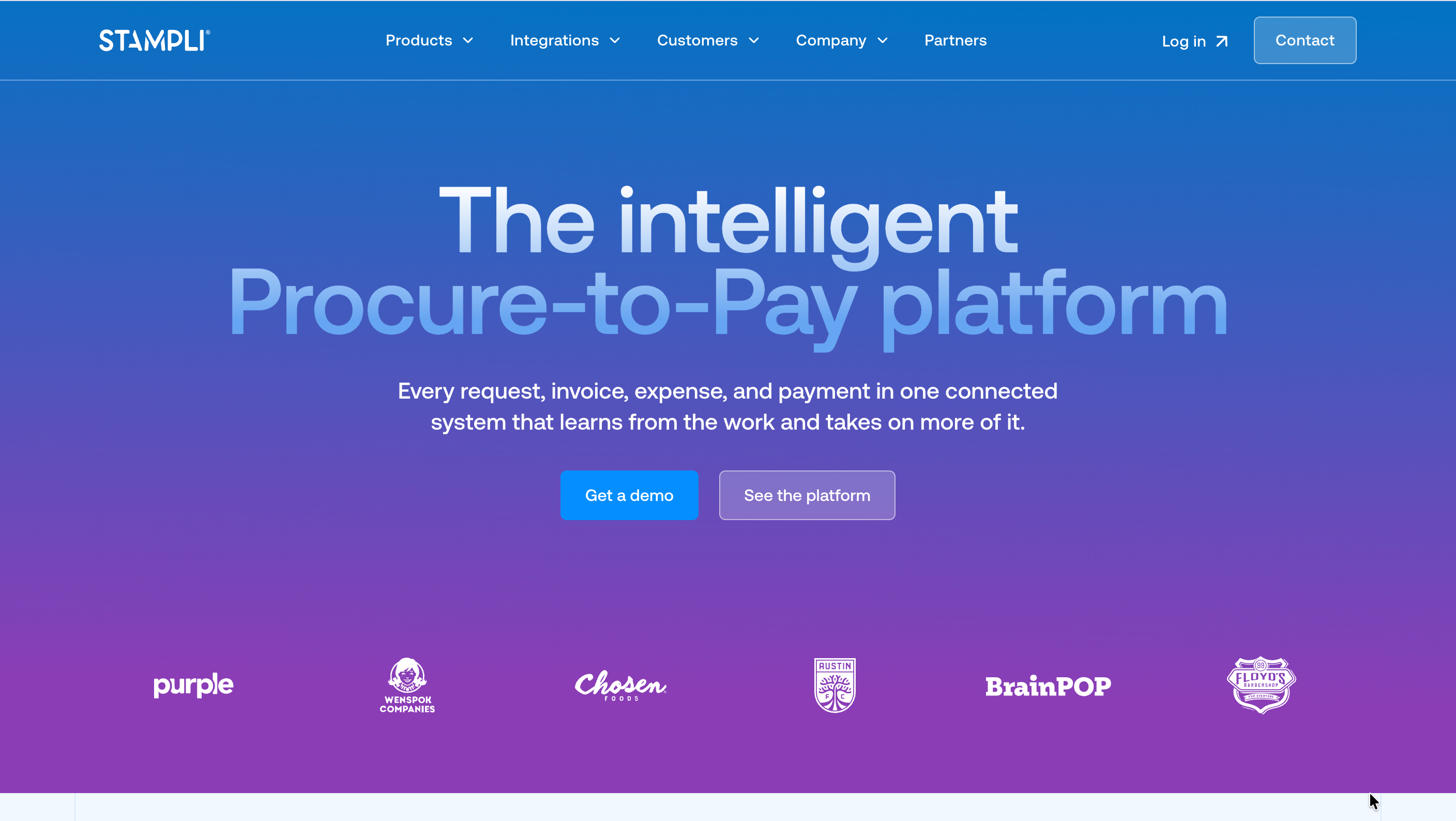
Stampli centers AP around the invoice, keeping communication, coding, and approvals on the document itself. It is easy to adopt and carries the deepest independent review base of this group, which makes it a safe workflow-software choice. It automates and organizes the workflow rather than running the work for you.
Key features
- Invoice-centric collaboration and approvals
- AP automation with capture and coding
- Configurable approval workflows
- Vendor management and communication
- Payments module (Stampli Direct Pay)
- Reporting on approval status and aging
- Fast implementation relative to enterprise suites
Pricing
Per-seat or custom, quoted by volume; not publicly listed.
Pros
- Deepest independent review base of this set
- Fast to adopt and easy to run
- Clear, invoice-attached approvals
Cons
- Automates workflow rather than running AP autonomously
- Reviewers want deeper analytics and spend drill-down
- Pricing is not publicly listed
- Built for general vendor AP; no freight-specific rate or accessorial audit
What users say
Love: Clear, invoice-attached approvals: A reviewer says "the process for approving invoices is very clear and easy to do," with the invoice attached so they "can review it for accuracy," which helps their fully remote team. (source)
Complain: Shallow analytics: A reviewer notes it is "missing some of the analytics that other programs offer," with just enough to get by rather than deep spend-category drill-down. (source)
For the broader field, see our guide to accounts payable automation.
Tipalti
Best for: Companies that pay many suppliers globally and want strong mass payments alongside AP automation.

Tipalti pairs AP automation with global mass payments, supplier onboarding, and tax compliance across entities and currencies. It suits finance teams whose complexity is in paying the world, not just capturing invoices. Like the others here, it automates a workflow your team runs.
Key features
- End-to-end AP workflow from capture to remittance
- Global mass payments across currencies and methods
- Supplier onboarding and tax form collection
- Fraud and compliance controls
- ERP integrations
- Self-billing and PO matching
- Multi-entity support
Pricing
Platform fee plus per-payment fees; quoted by volume and modules.
Pros
- Strong global payments and tax compliance
- Broad multi-entity, multi-currency support
- Large, positive independent review base
Cons
- Automates workflow rather than running AP autonomously
- Reviewers want better reporting and invoice-activity visibility
- Platform-plus-payment fees add up at scale
- General AP and payments; no freight rate or accessorial audit
What users say
Love: End-to-end AP into remittance: A reviewer praises how the workflow "covers everything from collecting invoices via email, to submitting an invoice and adjusting approvers, and finally providing remittance to the payee," even for non-finance users. (source)
Complain: Reporting and visibility gaps: A reviewer wants Tipalti to "continue to improve reporting and visibility into invoice activity, as well as team-level tracking," and notes some tax form updates need support. (source)
Compare where the effort goes in our accounts payable process guide.
BILL
Best for: SMB and mid-market finance teams that want easy AP/AR with broad accounting integrations.
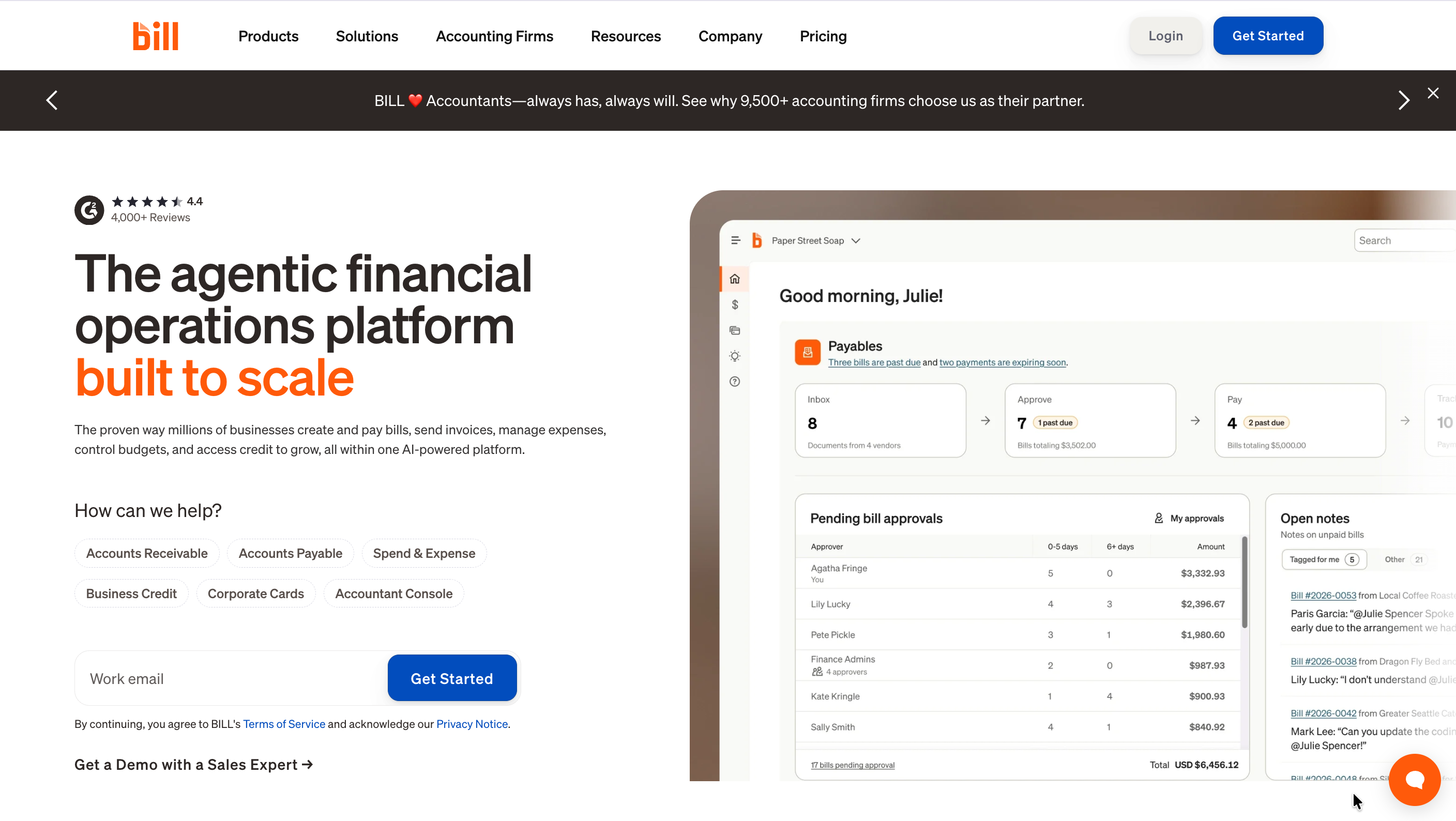
BILL (formerly Bill.com) automates AP and AR for smaller finance teams, with strong vendor management, ePayments, and deep ties to accounting tools like QuickBooks. It is quick to adopt and widely reviewed, though it is aimed below the large-enterprise tier.
Key features
- AP and AR automation
- Vendor management and ePayments
- Approval workflows and controls
- Deep accounting integrations (QuickBooks, Xero, NetSuite)
- Document capture and storage
- Mobile approvals
- Broad SMB ecosystem
Pricing
Subscription per user plus payment fees; published entry tiers.
Pros
- Easy to adopt for smaller teams
- Strong vendor management and integrations
- Very large independent review base
Cons
- Automates workflow rather than running AP autonomously
- Sync issues with accounting tools noted by reviewers
- Aimed below large-enterprise complexity
- No freight-specific invoice audit for carrier bills
What users say
Love: Easy navigation and strong vendor management: A reviewer highlights that "the navigation and features are easy to use," with strong vendor management, secure bill approvals, ePayment setup, and "extensive integration capabilities." (source)
Complain: Accounting-sync hiccups: A reviewer notes "the sync between BILL and QuickBooks Online sometimes has issues, which can be frustrating at times." (source)
For where matching fits in, see our guide to three-way matching in accounts payable.
AvidXchange
Best for: Mid-market teams that want to replace paper checks with electronic AP payments.
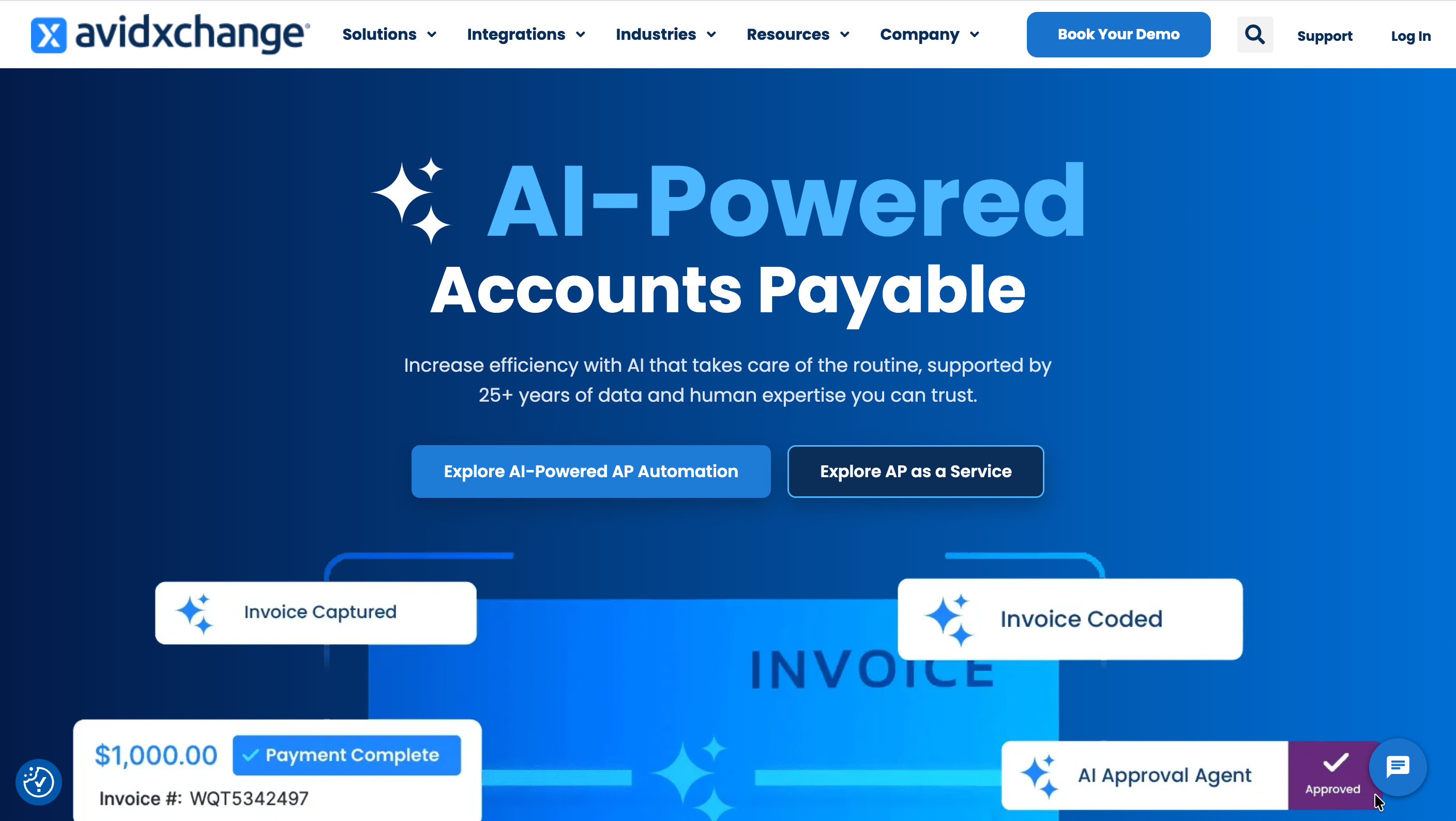
AvidXchange focuses on AP automation and payments for the middle market, with a large supplier payment network. Its strength is moving teams off manual check processing. It automates the payment workflow rather than running AP for you.
Key features
- AP invoice automation and approvals
- Electronic supplier payments and network
- Check replacement
- ERP and accounting integrations
- Purchase order matching
- Reporting and audit trails
- Mid-market focus
Pricing
Custom or per-transaction; not publicly listed.
Pros
- Strong at eliminating paper checks
- Large supplier payment network
- Solid mid-market fit
Cons
- Automates workflow rather than running AP autonomously
- Reviewers cite payment-timing issues
- Search and reporting depend on ERP ID conventions
- No freight rate or accessorial audit on carrier invoices
What users say
Love: Gets you off paper checks: A reviewer says it "almost eliminates the need for check processing, saving valuable time and materials, while adding a more secure payment process." (source)
Complain: Payment timing: A reviewer notes "check payments don't always go out in a timely manner, which can be frustrating." (source)
See how a modern accounts payable workflow removes manual steps.
Basware
Best for: Large enterprises that want deep invoice-to-pay and e-invoicing and can staff a complex rollout.

Basware is an enterprise invoice-to-pay platform with strong e-invoicing and compliance breadth across geographies. It suits large, complex finance organizations. Reviewers value the depth while flagging integration and setup complexity.
Key features
- Enterprise invoice-to-pay automation
- Global e-invoicing and compliance
- PO and non-PO invoice handling
- Bulk invoice management and export
- ERP integrations (SAP and others)
- Analytics and reporting
- Supplier network
Pricing
Custom, enterprise; not publicly listed.
Pros
- Deep enterprise e-invoicing and compliance
- Handles large invoice volumes and bulk edits
- Broad global coverage
Cons
- Integration and setup are complex and time-consuming
- Reviewers cite offshore support gaps
- Automates workflow rather than running AP autonomously
- General invoice-to-pay; no freight-specific rate audit
What users say
Love: Bulk handling and usability: A reviewer finds Basware "user-friendly," with convenient Excel exports and the ability to "modify large numbers of invoices" by updating selected rows. (source)
Complain: Complex ERP setup: A reviewer says "getting Basware fully integrated with ERP systems (like SAP or others) can be complex and time-consuming. It's not easy to setup." (source)
Weigh the enterprise path in our procure to pay software overview.
Medius vs Freehand
If you are replacing Medius specifically, this is the head-to-head that matters. Medius captures and auto-routes invoices well, but it is per-seat software your team configures and operates, and reviewers cite long, costly implementations.
Freehand keeps the capture-and-route strengths and closes the loop. AI Teams validate every invoice, resolve exceptions autonomously, code to the GL, and pay, delivered as software rather than seats, and built for the complex freight and logistics invoices that generic AP tools struggle with. The decision comes down to effort and model: keep a platform your team runs, or move to AI Teams that run the AP work for you. A finance team fighting exception volume and implementation drag feels that difference first.
{{brown-cta}}
How to choose a Medius alternative
Three questions narrow the shortlist fast:
- What ERP do you run? For NetSuite or Sage Intacct, BILL, Stampli, and AvidXchange integrate cleanly for mid-market teams. For SAP, Oracle, or Microsoft Dynamics at enterprise scale, Basware, Tipalti, and Freehand fit, with Freehand offering pre-built connectors to all four.
- What is your average monthly invoice volume? Lower volumes suit BILL or Stampli. Mid-market volumes suit Stampli, AvidXchange, or Tipalti. High enterprise volume, especially freight-heavy, favors Freehand, which scales without adding headcount, or Basware.
- Do you need global mass payments, or just invoice capture? Global, multi-currency mass payments point to Tipalti. Invoice capture and approvals point to Stampli or BILL. Full audit-to-pay execution across freight and vendor AP points to Freehand.
Whatever your answers, weight freight-invoice coverage and autonomy highest. Freight and logistics invoices are where general AP tools leave the exception work, and the headcount, with you.
FAQ
Who are Medius's main competitors?
In AP automation, the main alternatives are Freehand, Stampli, Tipalti, BILL, AvidXchange, and Basware.
What is the best Medius alternative?
For teams that want AP run for them, Freehand ranks first because it validates 100% of invoices and resolves exceptions autonomously, delivered as software rather than per-seat licenses.
Why do companies switch from Medius?
Common reasons include long and costly implementations, configuration complexity, a per-seat model the team still operates, and reported support and high-volume payment issues.
Is there a cheaper alternative to Medius?
Volume or outcome-based providers like Freehand can be more predictable than per-seat tiers, since cost tracks work done rather than the number of users.
Which Medius alternative is best for freight and logistics AP?
Freehand is built for freight and logistics AP, validating carrier invoices with accessorials and contracted rates that general AP tools like Medius and Basware do not audit.
Which Medius alternative is best for small business?
BILL and Stampli fit SMB and mid-market finance teams that want easy, quick-to-adopt AP automation.
Does any Medius alternative run AP autonomously?
Freehand runs AP as agentic AI Teams, validating invoices and resolving exceptions on their own. The other tools automate a workflow your team still operates.
How long does implementation take versus Medius?
Medius reviewers report lengthy rollouts. Lighter tools like Stampli and BILL go live faster, and Freehand deploys as a managed service rather than a per-seat configuration project.
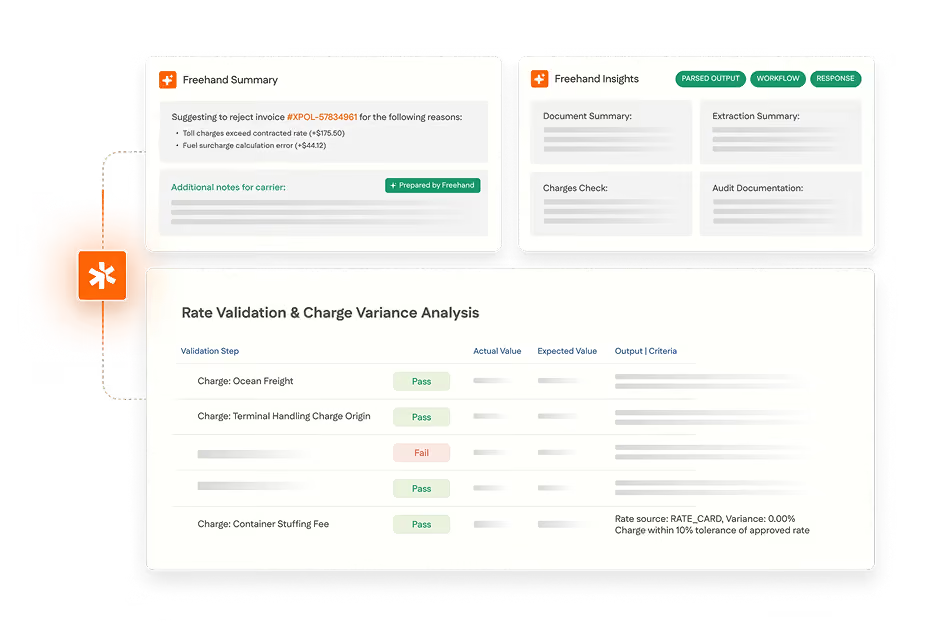
Freight Invoices Checked Against the Contract, Not Just Approved Faster.
Freehand's AI Teams are trained on freight rate structures and accessorial rules, auditing charges Medius has no visibility into.
Medius Automates the Invoice Workflow. It Doesn't Know What a Detention Charge Should Cost.
General AP automation approves invoices faster. It has no way to know if the freight-specific charges on them are correct.
Every warehouse. Every provider. Every mile.
Gartner's 2026 outlook on logistics outsourcing, and how AI Teams hold every contract to the terms you agreed.
- Where outsourced logistics quietly loses margin
- Why billed charges drift from the contract
- How AI Teams close the gap