
What Autonomous Exception Management Actually Means

May 23, 2026
•
5
mins
The difference between flagging an exception and owning it is the entire value proposition.
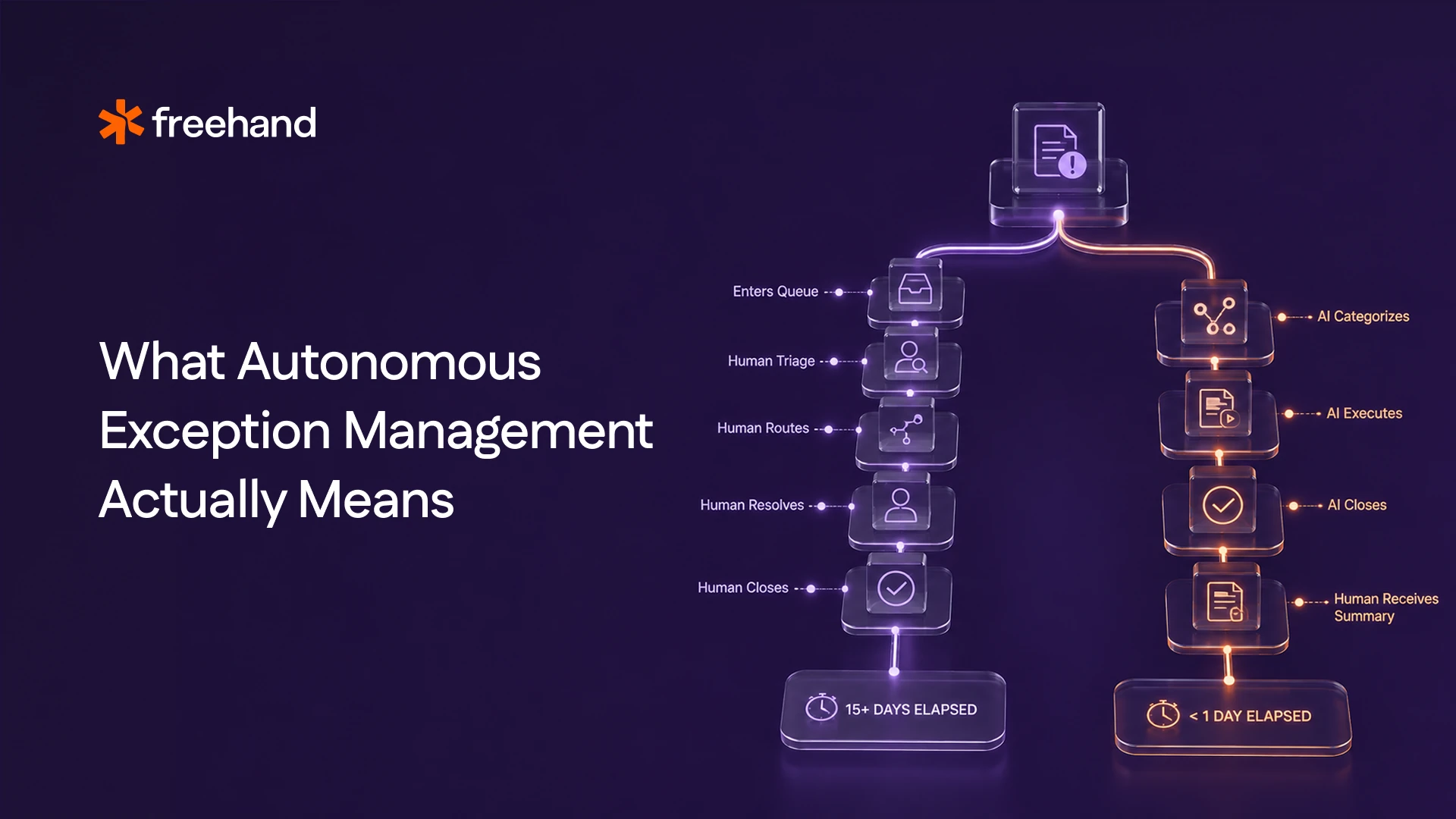
An exception flag tells you something is wrong. An exception owned by an AI agent is resolved. The distance between those two outcomes is where most freight audit automation stalls — systems that detect problems efficiently and then route them to human queues efficiently, leaving the resolution work exactly where it started.
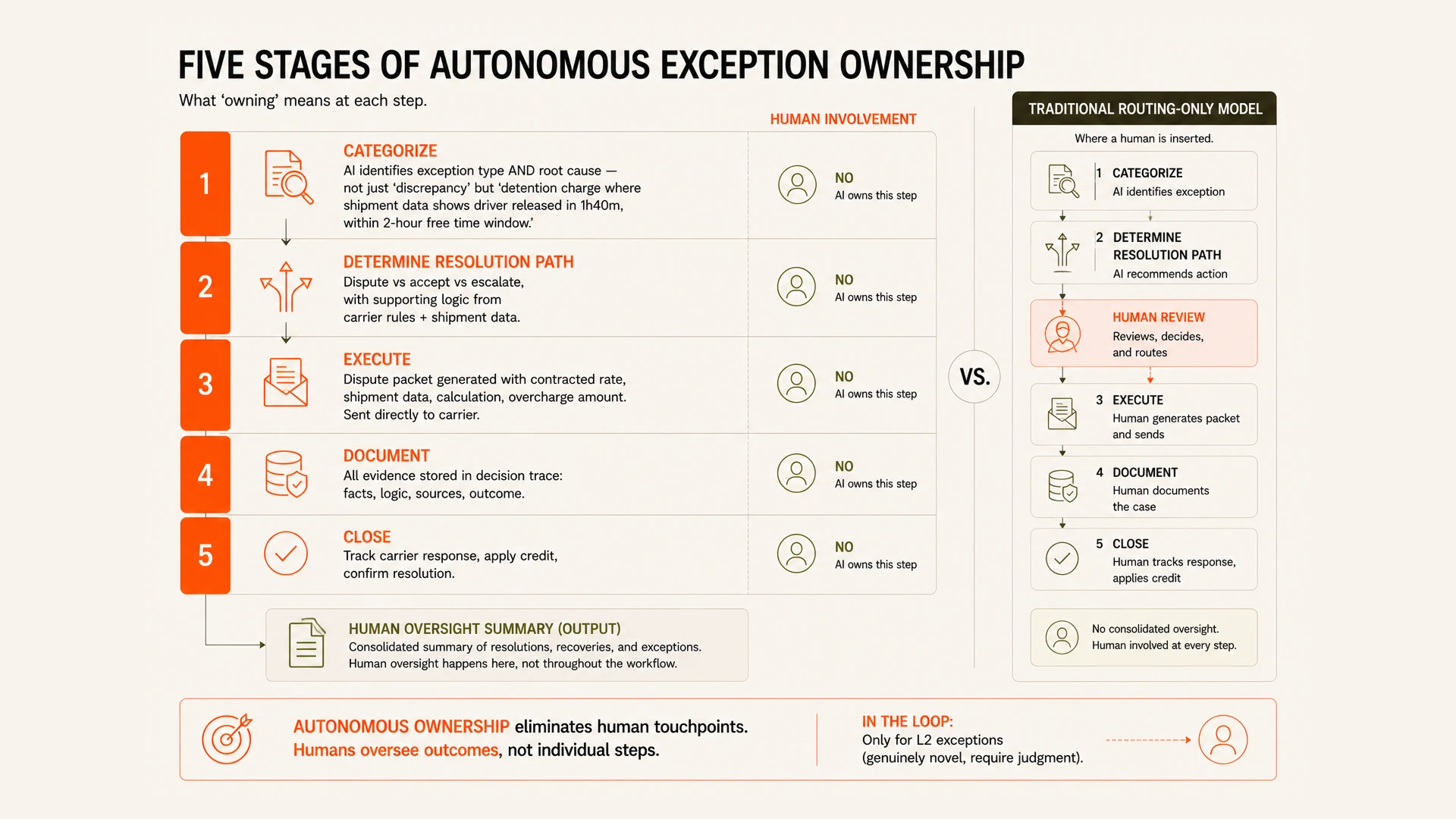
Autonomous exception management means the AI categorizes the exception, determines the appropriate resolution path, executes the resolution, documents it with supporting evidence, and closes it. The human sees a resolution summary, not a queue of work. This distinction sounds incremental. At scale, across a freight operation processing tens of thousands of invoices monthly, it is the difference between a technology investment that reduces costs and one that reduces headcount requirements.
The five stages of owning an exception
Categorization is the first stage and the hardest to get right. An exception is not just a billing discrepancy — it is a billing discrepancy with a specific root cause that determines the resolution path. A detention charge where the carrier's tracking shows the driver was released within the free-time window requires a different response than a fuel surcharge calculated using the wrong index. Both are exceptions. The resolution logic is completely different. Categorization that cannot distinguish between them routes both to human review, producing the kind of exception queue that autonomous management is supposed to eliminate.
After categorization comes resolution path determination. For an L1 exception — one where the resolution logic is established and the supporting data is available — the AI determines whether to dispute, accept, or seek additional information. For a fuel surcharge using the wrong index, the resolution is to generate a dispute referencing the contracted index and the correct calculation. For a residential delivery surcharge applied to a commercial address, the resolution is to dispute with the carrier's own delivery record showing the commercial address classification.
What the dispute packet contains
The execution stage of autonomous exception management produces a dispute packet that is complete on first submission. The contracted rate, retrieved from the rate repository. The invoiced rate, extracted from the invoice. The calculation showing the overcharge. The shipment data from the TMS or carrier tracking system that validates the charge condition — or contradicts it. All of this is assembled automatically from the decision trace that was generated when the exception was identified.
Carriers who receive a dispute packet that is complete on first submission typically resolve it faster than carriers who receive a dispute that requires follow-up documentation. The resolution time difference is not because the carrier is more cooperative — it is because there is nothing to request. The position is documented. The evidence is present. The calculation is shown. The carrier either accepts the dispute or provides a specific counter-argument. The back-and-forth that extends dispute resolution times in manual processes is eliminated because the evidence was assembled at the moment of detection, not assembled in response to the carrier's request.
“A dispute that requires three rounds of documentation requests takes 45 days. A dispute that arrives complete on first submission takes 7. The difference is not the carrier. It is whether the evidence was assembled at detection or assembled in response to the carrier's request.”
The recurring exception suppression effect
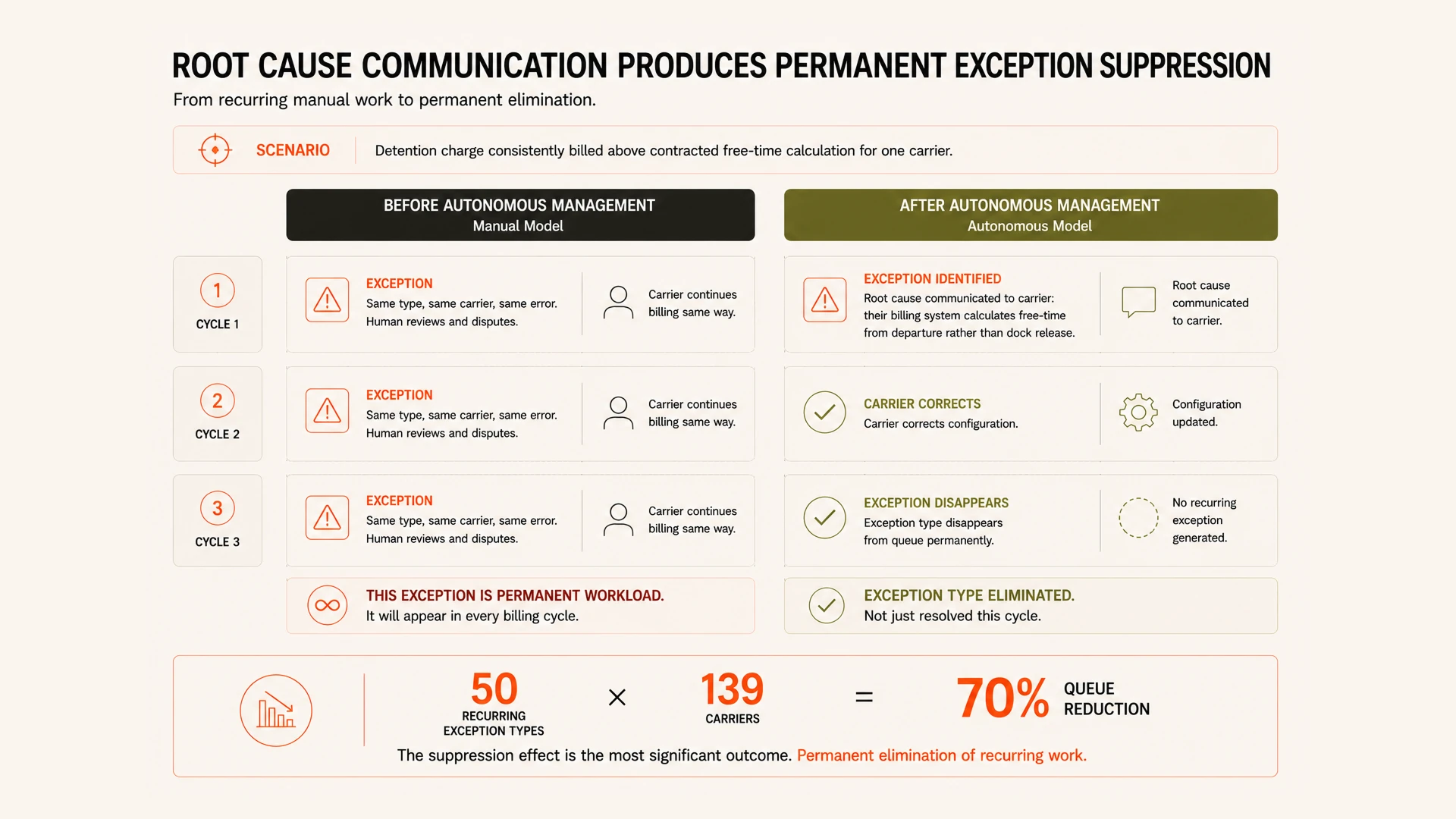
The most significant operational output of autonomous exception management is not the speed of individual exception resolution. It is the suppression of recurring exceptions. When the AI resolves an L1 exception and identifies the root cause — a carrier's DIM weight divisor is misconfigured, a fuel surcharge table references the wrong index — the system communicates the root cause to the carrier and tracks whether it is corrected. When the carrier corrects the underlying configuration, that exception type stops appearing in future billing cycles.
At a major global FMCG shipper with 139 carrier relationships, this suppression effect reduced the recurring exception rate by 70% within the first 90 days. The exception queue did not just process faster. It permanently shrank — because the cases that had been generating exceptions every cycle were resolved at the root cause rather than addressed individually each time they appeared.