
The Annual RFQ Was Built for a World That No Longer Exists

July 1, 2026
•
6
mins
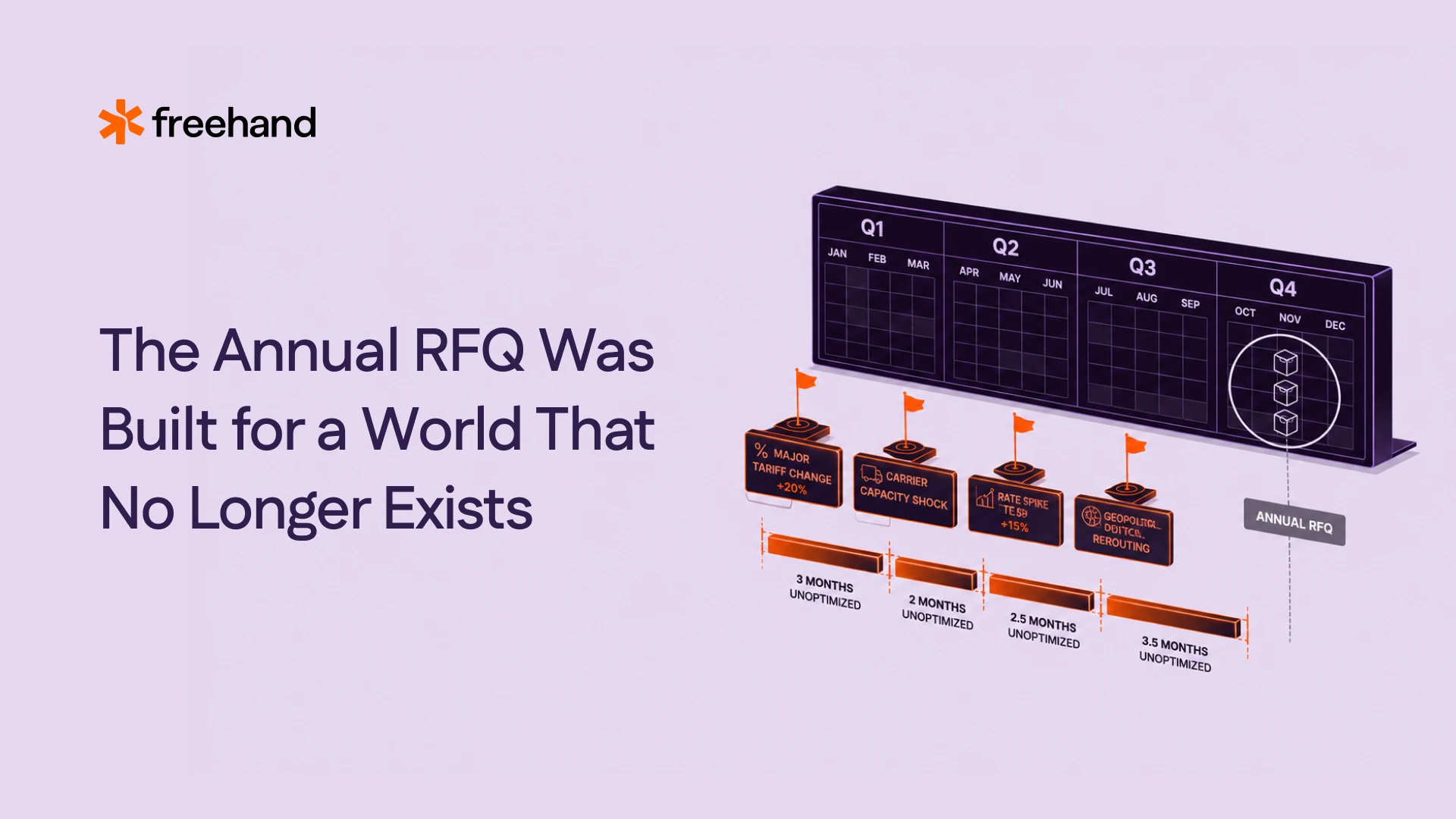
When tariff changes can move landed cost by 15% overnight, a sourcing cycle that runs annually is not a sourcing process. It is a recording mechanism.
The annual freight RFQ was designed for a world where rates were relatively stable, tariff changes were predictable and infrequent, and carrier capacity moved in gradual cycles that could be anticipated a year out. In that world, a sourcing event that consumed six to eight weeks of procurement effort, produced contracts valid for twelve months, and was refreshed annually was a reasonable balance between procurement rigor and operational continuity.
That world no longer exists. Freight rates moved 50% in either direction within single quarters during the 2020 to 2023 period. Tariff changes introduced by the U.S. administration in 2025 moved landed costs for specific product categories by 15 to 25% overnight. Carrier capacity availability has become subject to disruptions — geopolitical, weather, labor — that are neither predictable nor gradual. In this environment, a sourcing cycle that refreshes annually is not a sourcing process. It is a recording mechanism that documents the rate environment that existed when the cycle ran.
What the annual cycle costs when the market moves
The specific cost of an annual sourcing cycle in a volatile rate environment is the period between a market event and the sourcing cycle's response to it. A tariff change that increases the cost of importing a product category by 20% in January does not trigger a sourcing response until the Q4 RFQ, which runs in October and produces contracts effective January of the following year. The cost delta — the difference between the optimal carrier and route structure for the current tariff environment and the one the annual contract locked in — is absorbed for twelve months.
At a company with $100 million in annual freight spend, even a 5% improvement available from a sourcing event triggered by the January tariff change represents $5 million in annual savings opportunity. If that savings opportunity is not captured until the Q4 RFQ, the absorbed cost over the twelve-month lag is $5 million. The annual RFQ did not fail. It simply ran on a schedule that was incompatible with the pace of the market that changed.

What continuous sourcing requires
Continuous sourcing requires three capabilities the traditional procurement stack does not provide. A live rate repository that reflects current market rates at the lane level, so sourcing events are triggered by actual rate drift rather than the calendar. An accelerated RFQ process that produces a competitive market test in days — automated bid generation, carrier portal distribution, bid normalization, scenario analysis, and award recommendation without manual handoffs. And an audit connection that enforces new rates immediately upon award, not after the weeks-long configuration cycle traditional audit platforms require.
The Greif deployment produced a 90% reduction in procurement cycle time through AI-powered RFQ automation. A sourcing cycle that had previously taken six to eight weeks of procurement effort compresses to days. This compression does not come from rushing the process — it comes from automating the steps that previously required sequential human effort: carrier outreach, bid collection, normalization across carrier bid formats, scenario modeling, award optimization, contract generation. Each step that was a manual handoff in the traditional process becomes an automated workflow in the continuous sourcing model.
“The annual RFQ is not wrong. It is built for a cadence that the market no longer follows. The question is not whether to run sourcing events annually. It is whether to run them only annually.”
The audit connection that makes continuous sourcing defensible
Continuous sourcing without a connected audit function produces a procurement process that generates savings on paper and recovers them incompletely in practice. Every time a sourcing event produces a new contract, the rate changes have to propagate to the audit configuration. If that propagation takes four to six weeks — which is the reality in a traditional audit platform — the sourcing event's cost savings are theoretical for the duration of the lag. The carriers are billing under the new contract. The audit system is checking against the old one.
When sourcing and audit run on the same live rate repository — as they do when both are part of the same AI-native platform — the propagation lag disappears. A rate negotiated on a Tuesday afternoon is enforceable by the audit system on Wednesday morning. The continuous sourcing model produces savings that are immediately enforceable because the rate repository that drives sourcing decisions is the same repository that the audit system reads from.