
How Freehand Handles Carrier-Specific Rate Logic Without Custom Parsers

June 24, 2026
•
5
mins
Carrier onboarding that takes six weeks is not a technology constraint. It is an architecture choice.
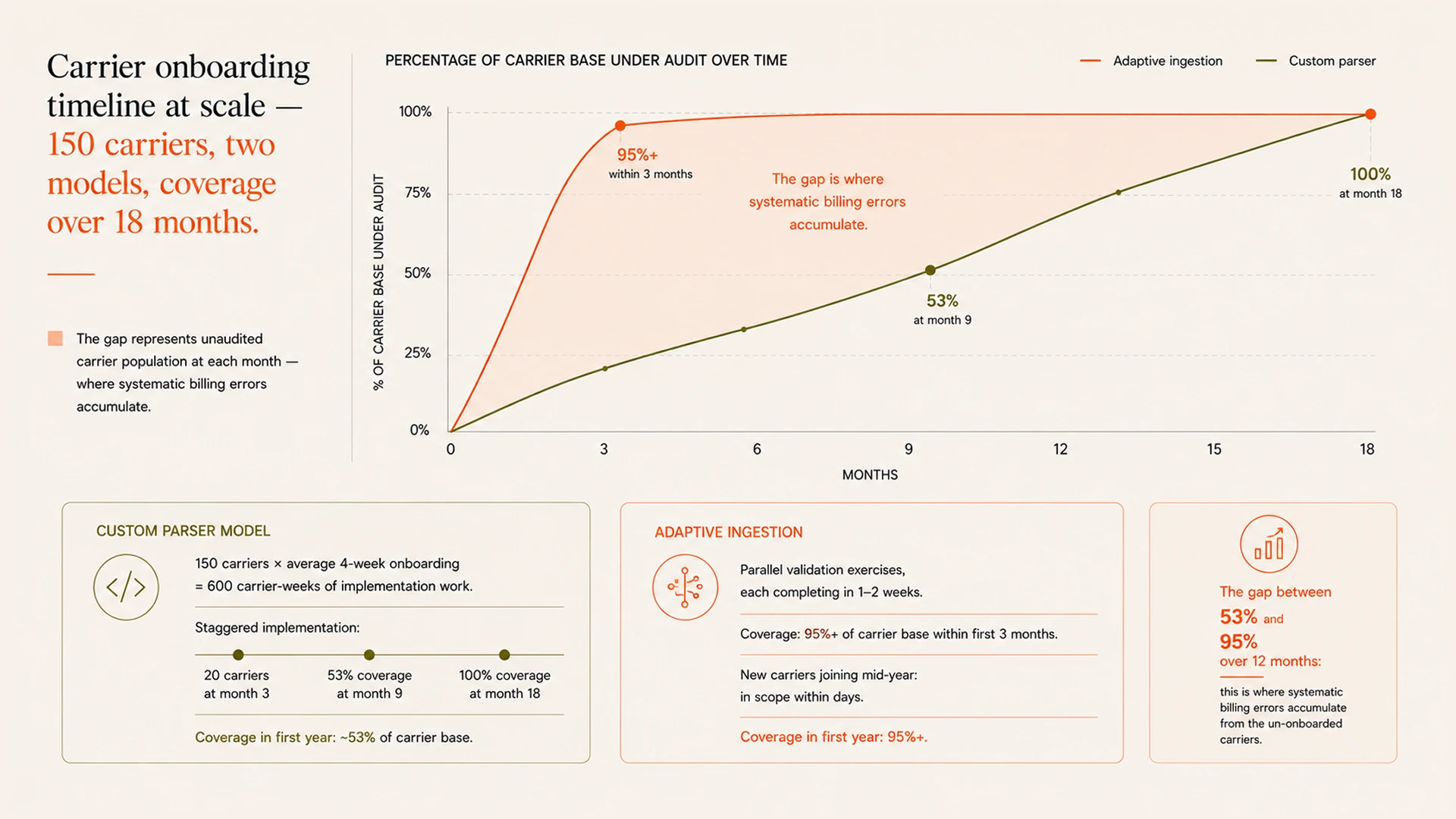
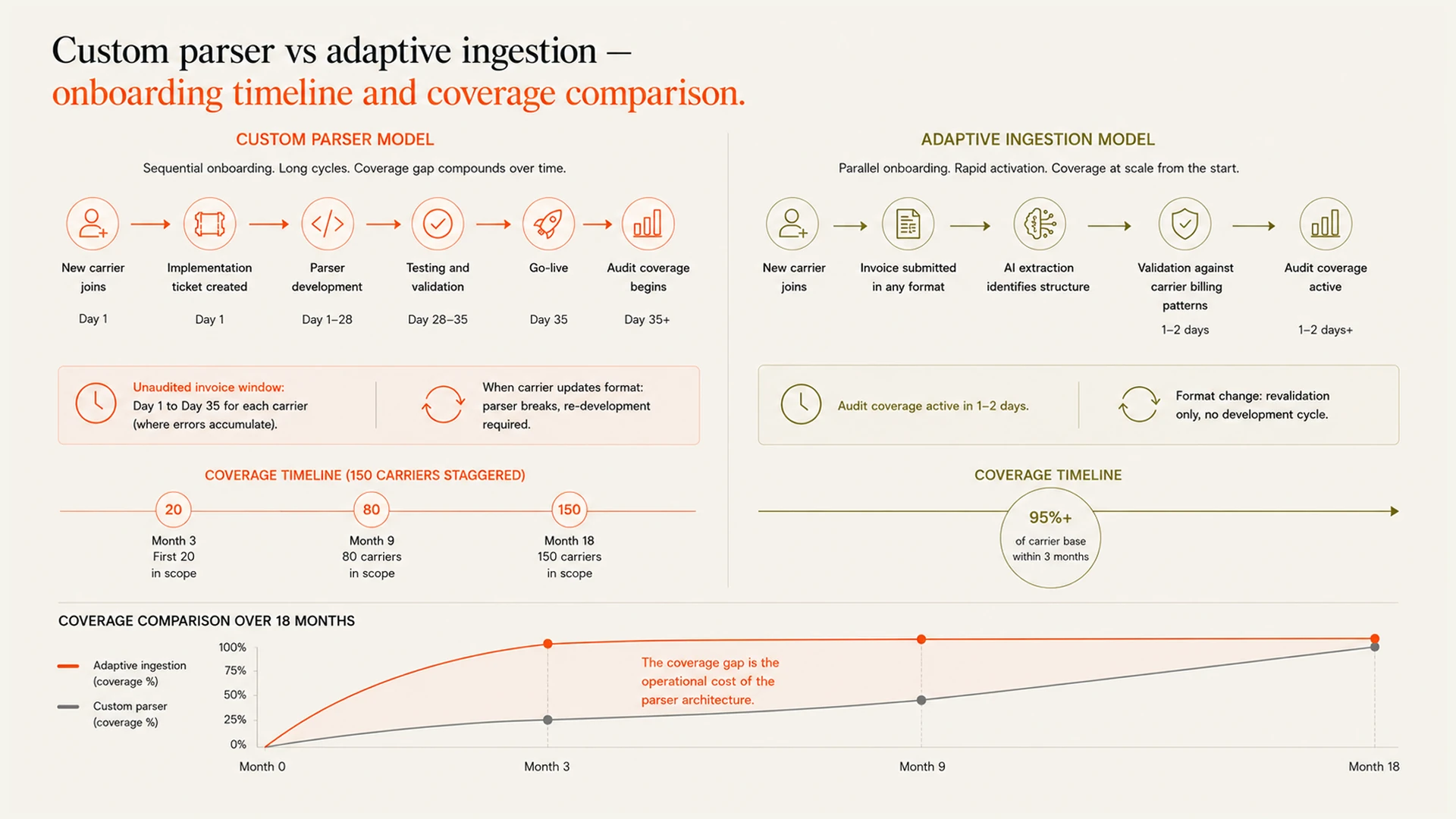
Every freight audit platform in the market claims to handle diverse invoice formats. What they mean is that they have built custom parsers for the formats they have specifically onboarded — typically the major national carriers in standard EDI formats. For the carriers outside that set, the implementation team builds a new parser. Each new parser takes three to six weeks. Until the parser is live, invoices from that carrier are processed outside the audit system or queued for manual review.
At a company with 150 carrier relationships, the list of carriers that the audit system can handle without a new parser project is substantially smaller than 150. The carriers in the backlog are typically the regional carriers, the international carriers, and the specialized carriers with non-standard billing formats — precisely the carriers most likely to have billing errors in their invoice structures, because their billing logic is more idiosyncratic and has been subject to less external scrutiny.
Why custom parsers are the wrong architecture
The custom parser model was designed for a world where carriers invoiced in EDI 210 format and the variation between them was marginal. The actual invoice landscape that enterprise freight operations navigate is far more diverse: EDI formats that differ by carrier version and configuration, multi-page PDF invoices that require layout-specific extraction, Excel files with carrier-specific column structures, email invoices from smaller regional carriers, flat files in formats proprietary to specific TMS or carrier portal systems.
Building a custom parser for each format produces a coverage architecture that is perpetually incomplete. The parser backlog never reaches zero because carriers periodically update their invoice formats, new carriers join the network, and format variations emerge within the same carrier across different billing systems for different services. Each update to an existing format requires testing to confirm the parser still functions correctly. Each new format requires a new development cycle. The technical debt accumulates continuously.
What adaptive ingestion actually means
Adaptive ingestion replaces the parser-per-carrier model with an AI extraction layer that understands invoice structures rather than following format-specific rules. The distinction is significant. A parser follows a set of rules that are specific to a particular invoice format: field X is in column 4, amount is in the pattern $X,XXX.XX, carrier reference is preceded by the string 'PRO:'. When the format changes, the rules break.
An AI extraction layer that understands invoice structures identifies what a carrier reference looks like, what an amount looks like, and where accessorial charges appear on invoices in general — and applies that understanding to formats it has not previously seen. A regional carrier that invoices in a non-standard PDF layout does not require a new parser. The extraction layer processes the invoice, identifies the fields by their structural characteristics rather than their position, and produces normalized output that feeds into the standard audit logic.
The validation step that follows confirms the extraction accuracy. For a new carrier, the first batch of invoices is validated manually to confirm that the extracted fields match the invoice content. Once the extraction accuracy is confirmed, subsequent invoices from that carrier run automatically. The onboarding time compresses from weeks to days because the development work that a custom parser requires has been replaced by a validation exercise.
“A custom parser is a set of rules for a specific format. Adaptive ingestion is an understanding of what an invoice is. The difference is whether a format change requires a development cycle or a revalidation.”
The continuous maintenance difference
The operational advantage of adaptive ingestion over custom parsers accumulates over time. A custom parser architecture requires maintenance work every time a carrier changes their format — which happens regularly. A new billing system rollout at a major carrier typically affects invoice format across the carrier's entire client base simultaneously. An audit platform with 200 custom parsers has 200 maintenance tasks when a major carrier updates its billing system. An adaptive ingestion platform has a revalidation exercise for that carrier's invoices, typically resolved within a billing cycle.
At Freehand, the carrier onboarding process is a validation exercise rather than a development project. When a new carrier joins a customer's network, the first invoices are processed through the extraction layer and validated against the carrier's known billing patterns. The validation typically completes within a week. The carrier is in scope for audit from that point. No implementation ticket, no parser development, no test cycle, no go-live ceremony.