
Automotive Freight Has 40 Plants and One Missing Audit Layer (Forward)

June 27, 2026
•
6
mins

The plant that approved the invoice without knowing the contracted rate did not make a bad decision. It made the only decision it could with the information it had.
The automotive freight audit problem is a visibility problem. Plant logistics coordinators approve invoices because they have to — the carrier needs to be paid, the shipment was delivered, and the invoice looks approximately correct to someone who knows the lane but not the specific contracted rate. The approval is not uninformed. It is informed by the wrong data.
At a global automotive manufacturer with 40 plants, the plant-level approval process is producing a systematic gap between what was contracted and what is being paid. Not because the plants are careless. Because they do not have access to the full rate structure — the master contract with its lane-specific rates, accessorial schedules, and amendment history — in a form they can use at the moment of invoice approval. They have a general sense of what freight should cost on their lanes. They do not have the specific contracted rate that would tell them whether the invoice in front of them is correct or 8% over.
Three tiers of audit in a multi-plant manufacturer
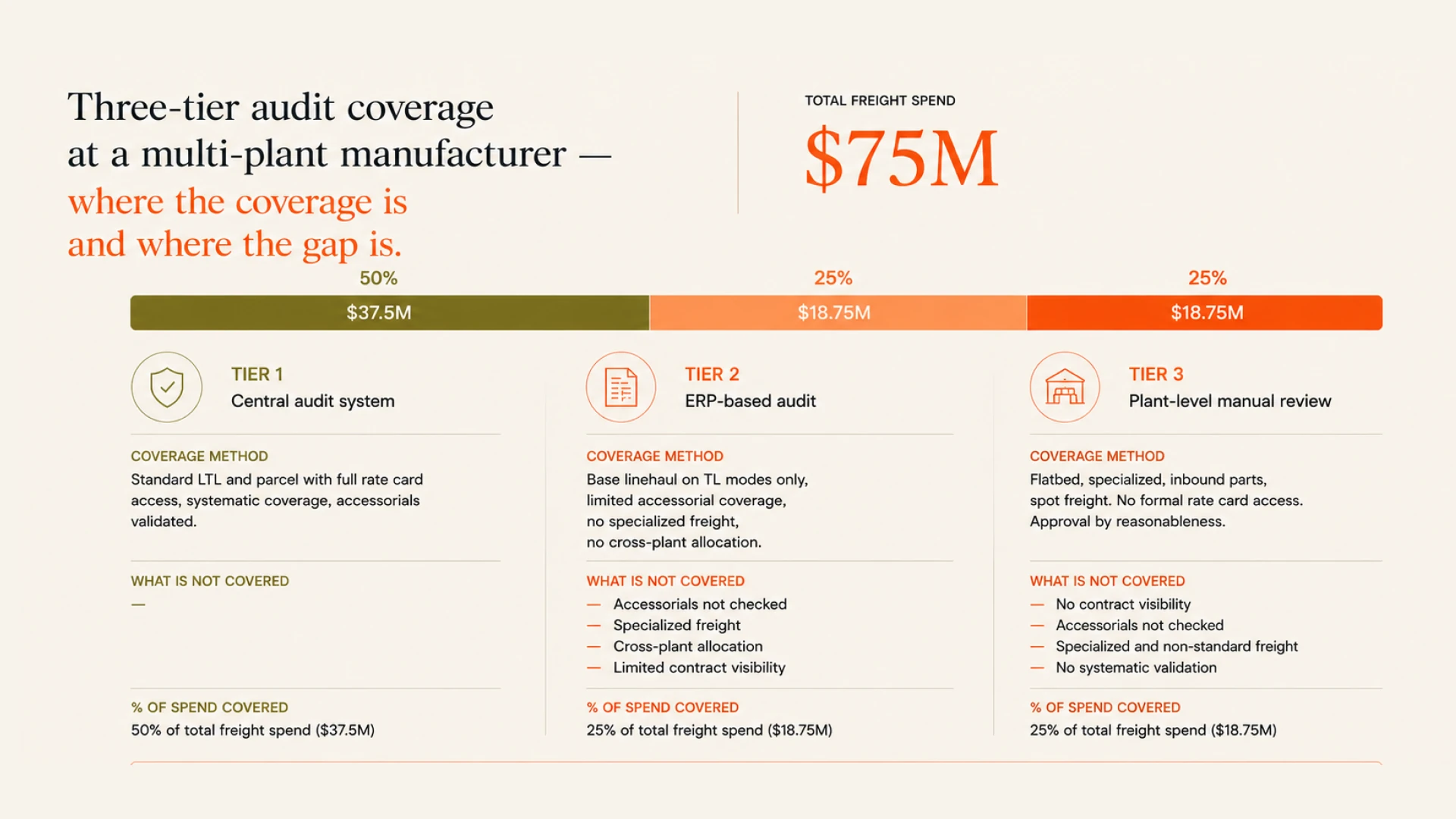
A multi-plant manufacturer typically operates with three tiers of freight audit that together cover less than the sum of their parts. The central audit system covers the high-volume standard modes — LTL and parcel — against the contracted rates loaded in the system. The ERP-based audit checks base linehaul rates on TL shipments against the contract module. Plant-level manual review covers everything else: the flatbed and specialized freight, the inbound parts from tier-1 suppliers, the cross-plant transfers, the spot freight. Each tier is doing what it was designed to do. Together they leave 20 to 30% of total freight spend in a zone where no formal audit takes place.
The 20 to 30% in the plant-level manual zone is not a random 20 to 30%. It is disproportionately the high-cost, high-complexity modes: flatbed freight with oversized permits and escort charges, inbound parts freight under complex Incoterms, specialized equipment charges that require contract knowledge to validate. These are the invoices most likely to contain billing errors that require contract context to detect, and they are being approved by the people in the organization with the least access to that contract context.
What the plant team actually needs
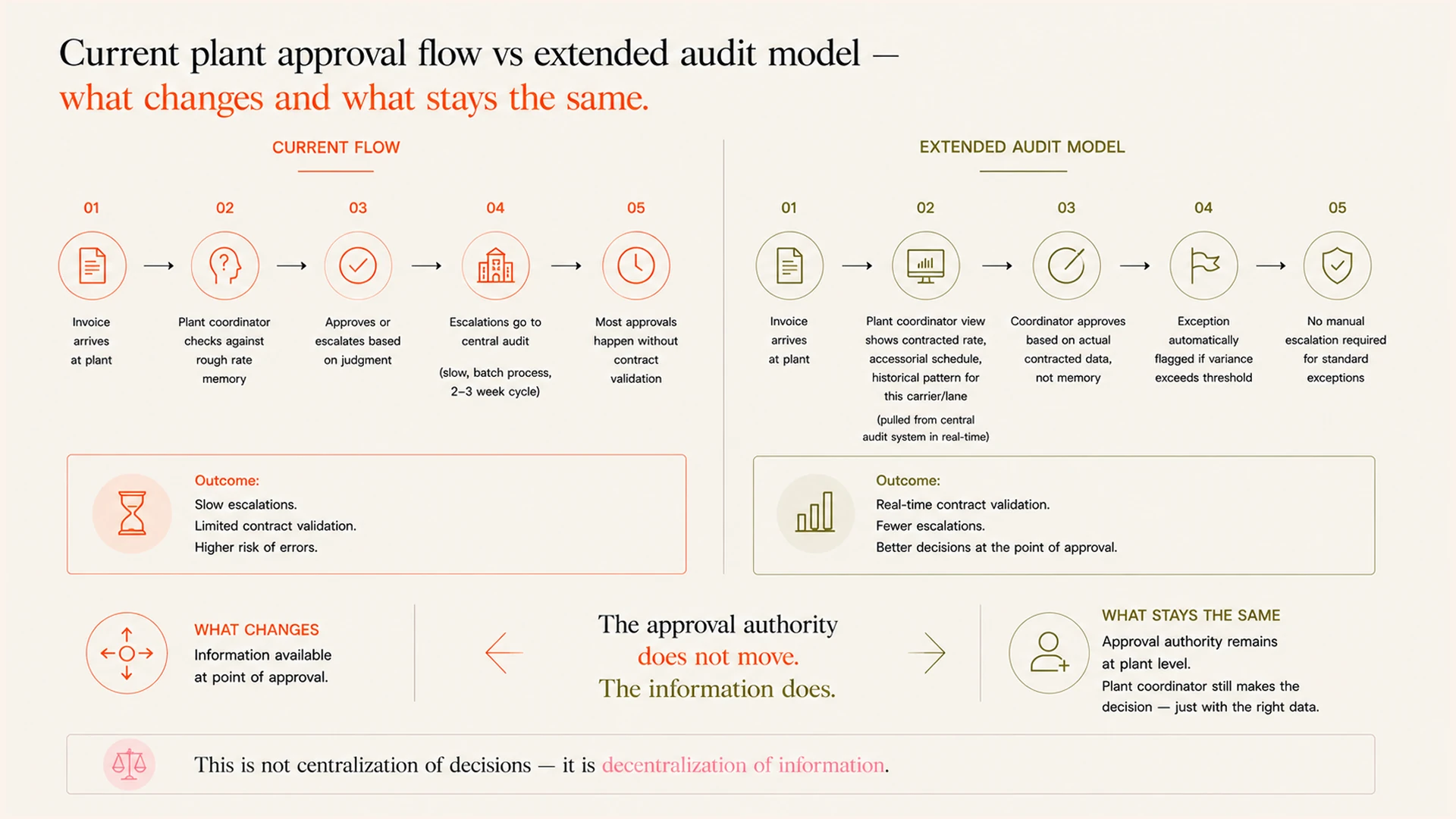
The plant logistics coordinator approving a flatbed freight invoice needs three things that they currently do not have. The first is the contracted rate for this carrier on this lane for this equipment type, including any amendments that have been made since the original contract was executed. The second is the accessorial schedule that applies to this movement — what the oversized permit fee should be, what the escort vehicle calculation is, what the tolls coverage arrangement specifies. The third is the historical pattern for this carrier on this lane — what the last 20 invoices from this carrier looked like, so that a systematic deviation from the established pattern is visible even if the individual charge appears within range.
None of these are exotic requirements. They are the information that a well-resourced central audit function would have. The problem is that the plant coordinator does not have access to the central audit function at the moment of approval. The approval has to happen within the payment cycle. The central audit system, operating on its own batch cycle, has not reviewed this invoice yet. The plant approves it with what they have.
“The plant coordinator is not making a bad decision. They are making the only decision they can with the information they have. The audit problem is that they have the wrong information.”
Extending the audit layer to the plant
Extending audit coverage to plant-level approvals requires bringing the contract context to where the approval decision is being made, not bringing the approval decision to where the contract context lives. This means connecting the plant's invoice approval workflow to the central audit system — not as a sequential step where invoices route from the plant to a central queue, but as an instantaneous lookup where the plant coordinator's invoice view includes the contracted rate, the accessorial schedule, and the historical pattern for that carrier on that lane.
The approval remains at the plant level, where it belongs — the plant coordinator knows their operations. The rate validation happens at the central level, where the contract context lives. The result is a plant coordinator who approves the invoice because it matches the contracted rate, not because it seems approximately correct. The approval is still local. The information that makes it correct is now centralized.