
Accounts Payable Is a Labor Problem. AI Is the Only Fix That Compounds.

May 29, 2026
•
8
mins
What I told a room full of CFOs at the Gartner Finance Symposium — and why the conversation has finally shifted from ROI debate to deployment sequencing.
I spoke at the Gartner Finance Symposium in National Harbor this week. The room was full of CFOs and controllers — the people who have been giving headcount reduction targets to the rest of the business and are now being asked by their boards to apply the same logic to their own functions.
The conversation has shifted. A year ago, the question in every room was: is AI real? Can it actually do this? Show me the ROI model. This year, the question is: where do I start? Which category goes first? How long does it take? The skepticism has been replaced by sequencing questions. That is a different kind of conversation, and it is the right one.
The problem that outsourcing never solved
Accounts payable is a labor problem disguised as a process problem. Most finance leaders know this. They have tried every version of the structural fix. You outsource to Genpact or Accenture. Cost drops 20% — then plateaus forever. You can no longer see what the BPO is catching or missing. You offshore shared services to Krakow or Bengaluru or Manila. Cheaper per seat. Same exception queue. More handoffs, less control.
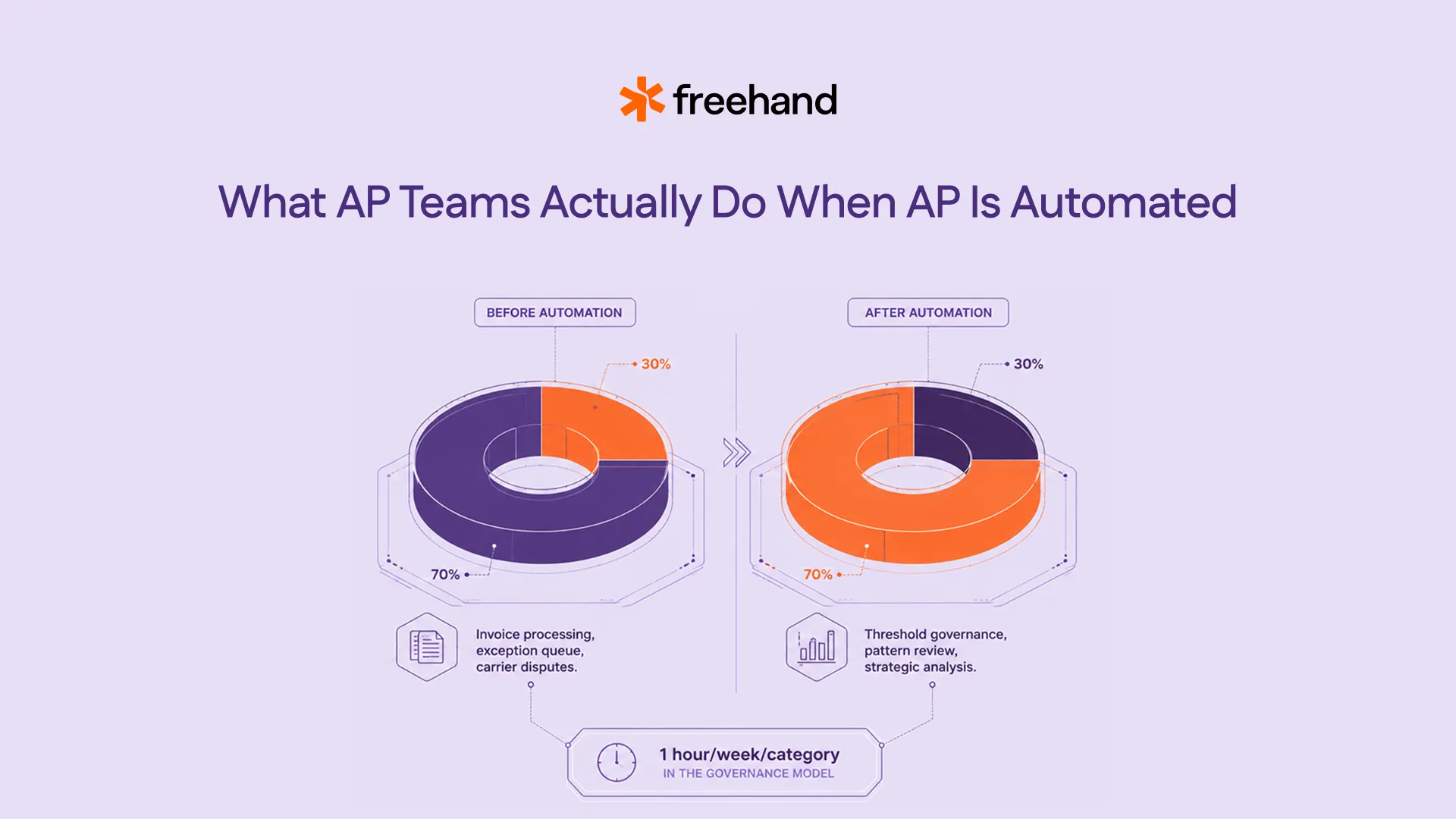
The reason these fixes plateau is that they move the labor without changing the work. Accounts payable at scale is fundamentally an exception management problem. Roughly 70% of complex invoices still require manual processing. The 30% that contains 90% of the leakage — the accessorial dispute, the SOW ambiguity, the PO mismatch on a complex category — is precisely the part that human teams, BPOs, and shared services have never solved. They managed it. They did not eliminate it.
“For every $1 you spend on P2P technology, you spend $10 to $12 on labor running that technology. Offshoring made the labor cheaper per seat. It did not make the work disappear.”
What F500 leaders have already done
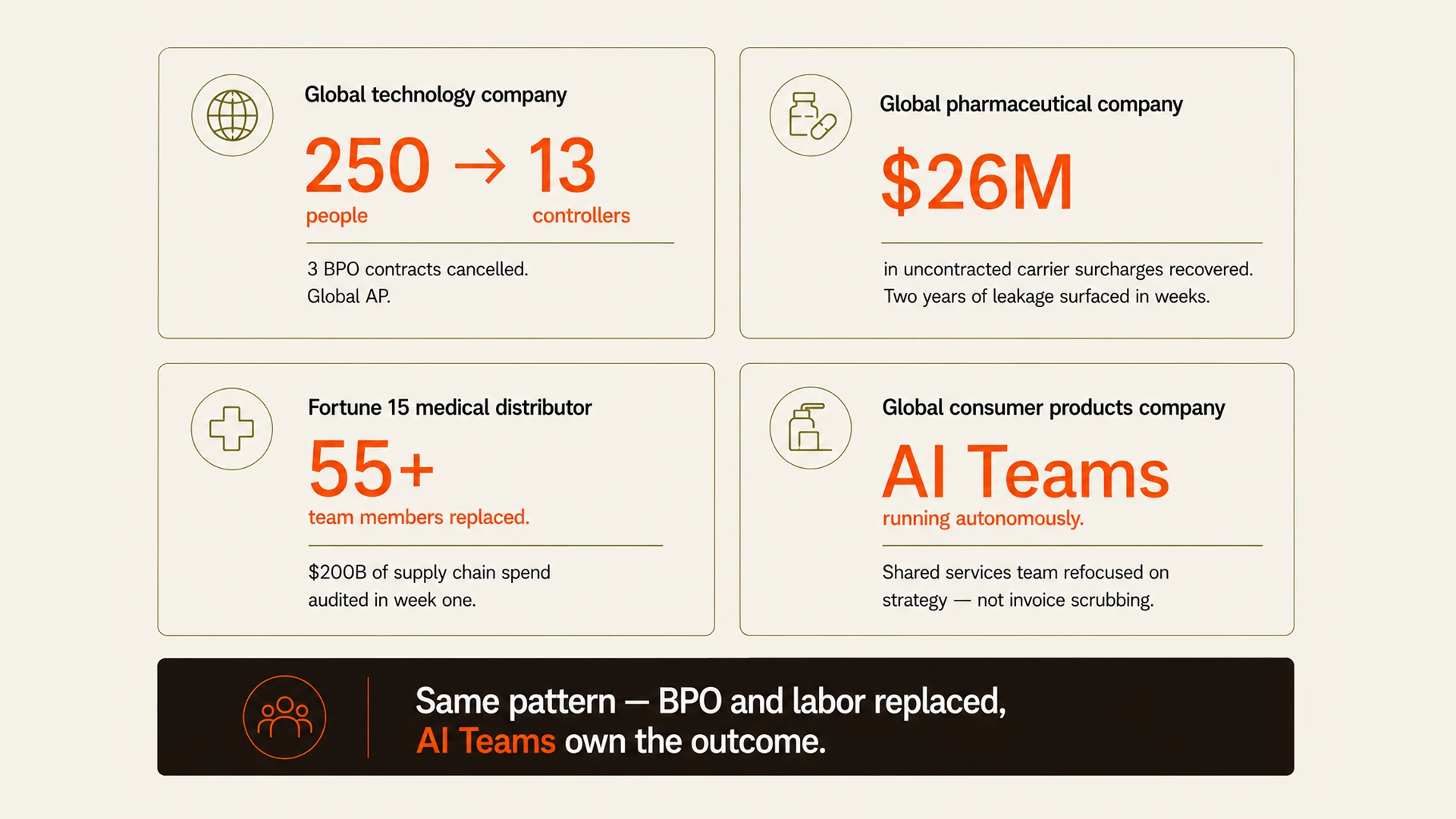
The slide that consistently stops the room is the one showing what companies like Meta have done. Meta had three outsourced BPOs and 250 people touching invoices across their global AP operation — not all in finance, but everyone who approved an exception, coded a GL, confirmed a delivery, or touched an invoice before payment. Today, 13 controllers oversee the entire global AP operation. Three BPO contracts are cancelled. The AI Teams own the outcome.
At Johnson and Johnson, the Freehand deployment recovered $26 million in uncontracted carrier surcharges that had been billed across global suppliers for two years. The team would never have seen it — not because they were not capable, but because the volume and the cross-category complexity made systematic detection impossible at human review rates. At Cardinal Health — a Fortune 15 medical distributor with $400 million-plus in annual freight spend — more than 55 team members were replaced, and $200 billion of supply chain spend was under audit in week one.
Three forces colliding
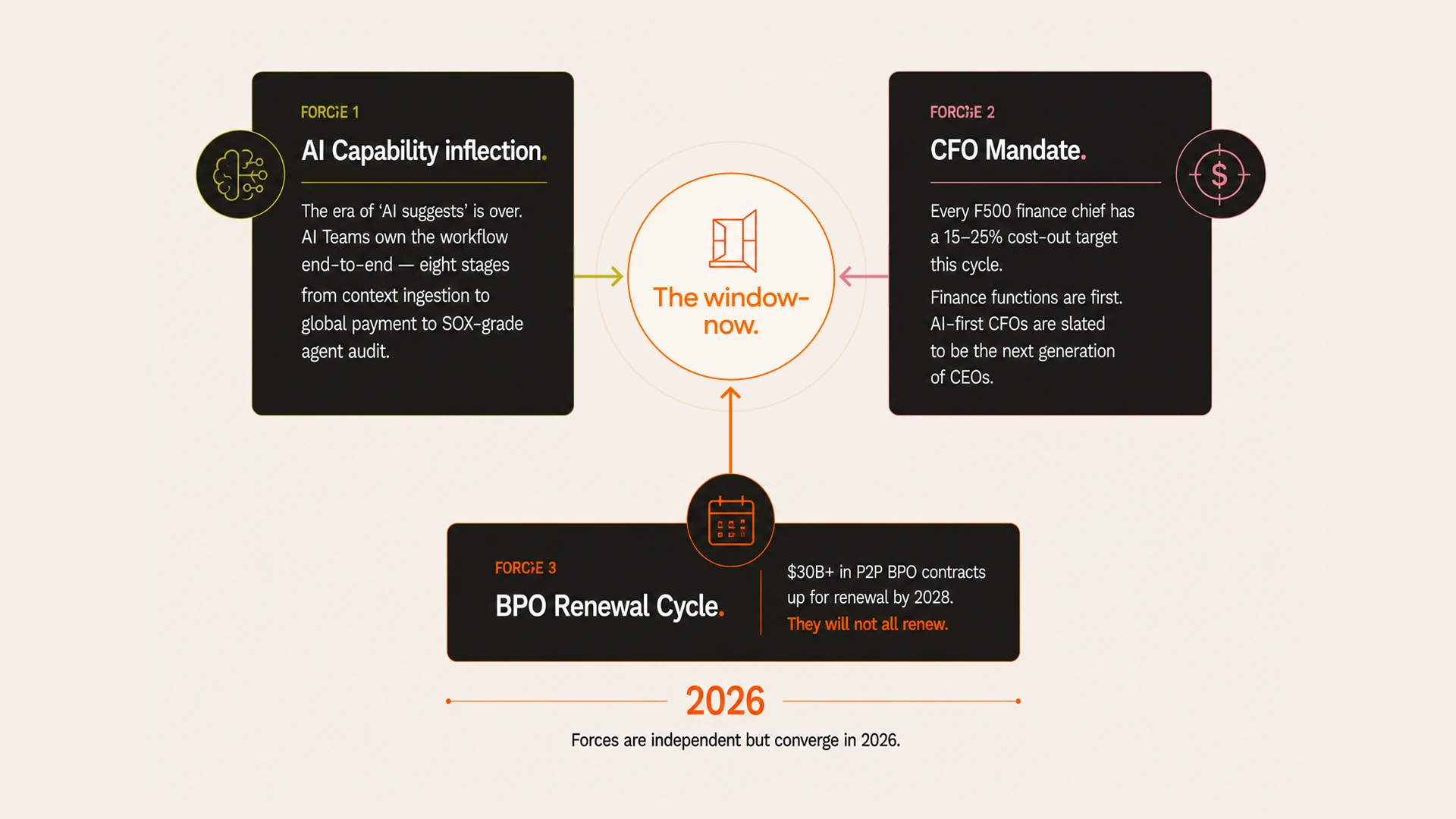
Three forces are colliding. The first is capability: AI can now reason over unstructured spend data. The era of AI that suggests what to do is over. AI Teams own the job — from real-time context ingestion to pre-invoice costing to deep audit matching against emails, contracts, BOLs, and call recordings through to global payment and SOX-grade agent audit. The eight-stage workflow that a BPO executes is now executable autonomously.
The second force is the CFO mandate. Every Fortune 500 finance chief has a 15 to 25% cost-out target this cycle. Their own functions are first. The finance leaders who are deploying AI in their own operations are the ones who will be credible when they ask the rest of the business to do the same. The CFO who can point to an AI-native AP function as evidence that the productivity model works will have more authority in the next budget cycle than the one who ran the pilot and is still evaluating.
The third force is the BPO renewal cycle. More than $30 billion in P2P BPO contracts are up for renewal by 2028. They will not all renew. The organizations that have run the math — AI at 50 to 70% of BPO cost, delivering 5x better outcomes on coverage, accuracy, and cycle time — are choosing not to. The conversations among those who do renew will accelerate as peers move ahead.
What the deployment question actually is
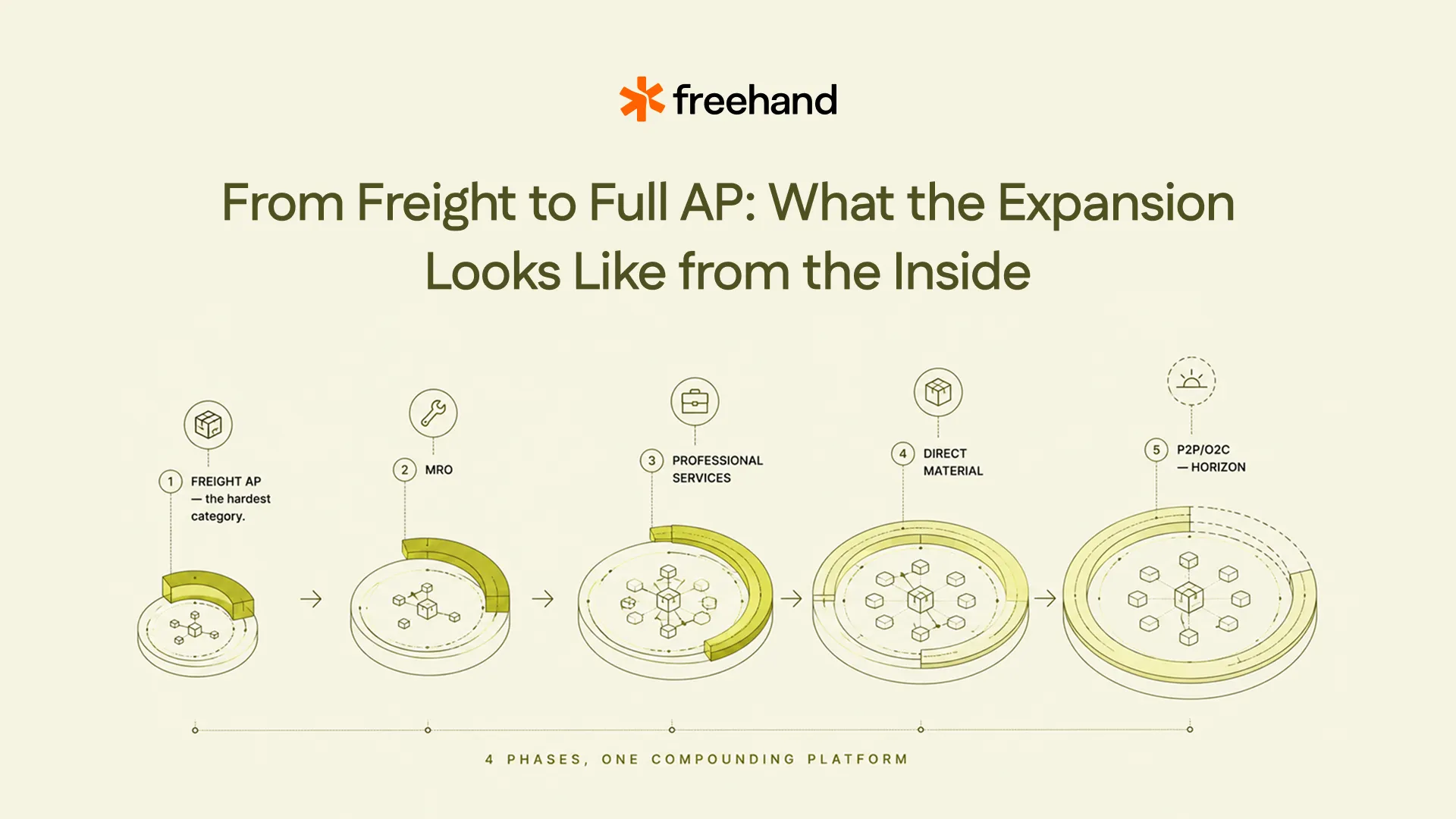
The conversation at the Gartner Finance Symposium was not about whether AI can do this. It was about where to start. The answer is one category — the hardest one you have. Not the easiest one, where success is easy to show and hard to scale from. The hardest one, where the exceptions are most complex, the contracts most ambiguous, and the BPO or shared services team most likely to be managing rather than solving.
Start with that category. In 90 days, the AI Team should be running it autonomously — invoices approved, exceptions resolved, GL coded, disputes handled, payments disbursed. Then scale across categories. The context graph built in the first category becomes the foundation that makes each subsequent category faster to onboard. By the time the third category goes live, the AI Team is building on accumulated institutional reasoning about how the organization handles exceptions — not starting from scratch.
The question I get most often: what does the controller who oversees this actually do? They manage outcomes, not workflow. They set thresholds, review aggregate performance, handle the rare genuine exception. They spend their time on financial planning, strategic analysis, and governance — the actual job of a finance function. Not pushing invoices. Nobody should be.