



AI Invoice Processing: What It Is, and Where It Breaks for Freight
AI invoice processing automates standard invoices end to end. See how the AI actually works, what limits it, and why freight invoices need a different layer.
.webp)
June 28, 2026
•
16
mins
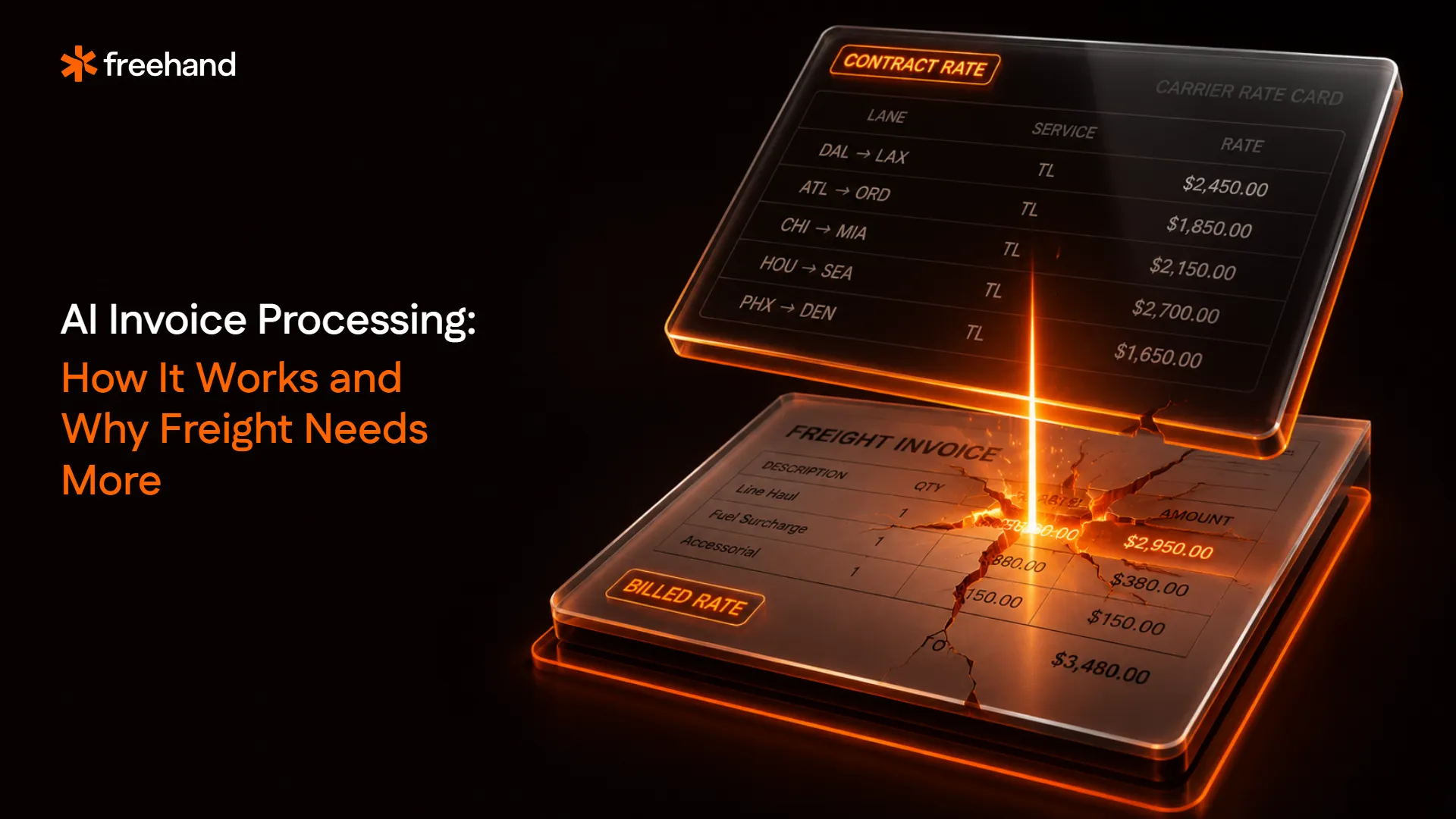
AI invoice processing is AI Teams, not a rules engine, reading, matching, and clearing an invoice with zero manual intervention when every check clears. "Touchless" is the metric that measures how well it's working on standard, PO-matched invoices. It breaks down for freight invoices, which carry no PO and need an AI Team built to validate different data before they can clear untouched.
Key Takeaways
- AI invoice processing is AI Teams reading, matching, and clearing an invoice end to end, from receipt through payment, with no human intervention when every check clears.
- The touchless rate, the share of invoices that clear with zero manual touch, is the metric AI invoice processing is judged on. Best-in-class programs run 70% or higher.
- Standard AI invoice processing depends on a clean match against a purchase order. Invoices without a PO reference, or with charges a PO can't describe, fall out of the automated path by design, not because the AI failed.
- Freight invoices are structurally excluded from most AI invoice processing programs: they carry no PO, and their charges (fuel surcharges, accessorials) require contract and shipment data standard AP automation doesn't hold.
- Freehand's AI Teams extend automated processing to freight specifically, validating each invoice against the carrier contract and TMS shipment data instead of a PO, so freight invoices can clear automatically too.
What is AI invoice processing?
AI invoice processing is AI reading, matching, and clearing an invoice from the moment it's received to the moment it's paid, with no manual intervention when every check on the invoice clears cleanly. The AI captures the invoice, matches it against a purchase order and receipt record, codes it, approves it, and schedules it for payment. It's the same sequence a person would run, at a volume and speed no person could sustain.
The mechanism is a chain of AI-driven checks: data extraction (OCR invoice processing reads line items off an invoice regardless of format), matching (comparing the invoice against the PO and, often, a goods receipt note within tolerance thresholds), and routing (posting to the ledger and scheduling payment once the match clears).
This is what automated invoice processing means in practice: running every step of that chain without a person, not just digitizing a document. If every check passes, no person ever opens the invoice.
The result is what the industry calls touchless processing, the outcome you get when AI invoice processing works as designed. It's the clearest efficiency metric AP automation has: what share of total invoice volume never requires a human to intervene. It's also, by definition, only as good as what the AI's matching logic can actually check.
What's the difference between basic AP automation and AI actually processing the invoice?
AP automation digitizes the process. AI invoice processing is the layer that reads, matches, and decides, clearing the subset of that automated volume with zero human review. A company can automate data capture, route every invoice through a digital workflow, and still have a low touchless rate if the system underneath is really just a rules engine that hands most invoices to a person for approval or exception handling.
The distinction matters because vendors often report an automation rate (the share of invoices that entered an automated system) as if it were a touchless rate (the share the AI actually cleared without anyone touching them). The two numbers can be far apart. A platform that's 100% digital but requires manual review on 60% of invoices has a 40% touchless rate, not a 100% one, however the marketing describes it.
How does touchless invoice processing actually work?
A touchless invoice moves through the same three-way matching most AP automation runs on, just without a person in the loop when it clears. The invoice is captured and its line items extracted. Those line items are compared against the purchase order (quantities, prices, terms) and, for physical goods, the goods receipt note. If everything falls within configured tolerance thresholds, the invoice posts and schedules for payment automatically.
The mechanics of that matching process, and where it breaks down for carrier invoices specifically, are covered in more depth in our guide to three-way matching in accounts payable.
What actually changes when you move to touchless AP?
The AP team's job shifts from processing invoices to managing the exceptions and relationships around them. Before touchless processing, every invoice, clean or not, passes through a person for data entry, matching, and approval routing. After, only the invoices that fail a check reach a person at all.
That shift changes what an AP role looks like day to day. Time that went into keying data and chasing approvals goes instead into exception investigation, supplier communication, and the process governance that keeps the exception rate from creeping back up. The invoice volume doesn't change. The nature of the work does.
What are the benefits of touchless invoice processing?
Touchless processing delivers four measurable benefits: faster cycle times, lower cost per invoice, fewer errors, and AP staff freed for higher-value work.
These benefits compound with volume. A team processing a few hundred invoices a month notices the speed. A team processing tens of thousands notices all four, since the exception-handling capacity freed up scales the same way the error reduction does.
What determines whether an invoice can go touchless?
Three conditions have to hold for an invoice to clear without human intervention, and any one failing routes it to manual review instead.
What are the common challenges in implementing touchless invoice processing?
Most implementation problems trace back to data that isn't clean or complete enough for the matching logic to trust, not to the automation technology itself.
- Incomplete vendor master data. A supplier record missing current bank details or tax information blocks automated matching even when the invoice itself is correct.
- Inconsistent PO discipline. If purchasing doesn't consistently require a PO before a transaction, a meaningful share of invoices arrive with no anchor for automated matching, regardless of how good the extraction technology is.
- Poor invoice format variety. Non-standard formats, especially scanned paper or unusual EDI structures, increase extraction errors that route invoices to manual review even when the underlying transaction is clean.
- Tolerance thresholds set too tight or too loose. Thresholds set too tight flag routine, immaterial variances as exceptions, undermining the touchless rate. Set too loose, they let real errors clear untouched.
Why is the touchless rate the headline AP automation metric?
The touchless rate, the share of invoices that clear with zero manual touch, is the single number that best captures how much of an AP team's work has actually been automated, as opposed to just digitized. A team can scan and extract every invoice electronically and still have a low touchless rate if most invoices still need a person to resolve an exception.
Best-in-class AP programs run touchless rates of 70% or higher. That figure varies heavily by invoice type: standard, PO-matched vendor invoices with a stable vendor relationship touch nothing close to that ceiling reliably. Invoices without a clean PO reference, which includes most freight invoices, sit well below it structurally, not due to a process gap but because the matching logic they run on was never built to check them.
Why does touchless processing matter more than invoice volume?
Volume tells you how much work is coming in. Touchless rate tells you how much of that work the team is actually doing by hand. A team processing 5,000 invoices a month at a 20% touchless rate does more manual work than a team processing 20,000 invoices a month at an 80% touchless rate, even though the second team's volume is four times higher.
That's why touchless rate, not invoice count, is the metric that determines whether AP can scale. A team that scales headcount linearly with invoice volume hasn't automated anything meaningful, it's just gotten bigger. A team that holds headcount flat while volume grows, because the touchless rate absorbs most of the increase, has actually changed the economics of the function.
Why does touchless processing break down for freight invoices?
Freight invoices are the clearest case of non-PO invoice processing failing by design: they carry no PO reference to match against, which is the first condition that makes touchless processing possible. A supplier invoice traces back to a requisition and a purchase order. A carrier invoice traces back to a shipment and a rate agreement, a structurally different authorization chain that standard AP matching logic doesn't hold data for.
Even when a freight invoice is routed through a touchless-capable AP platform, it typically falls out to manual review immediately, since there's no PO to check it against. The charges themselves compound the problem: fuel surcharges recalculate weekly against a published index, and accessorial charges (detention, residential delivery, DIM weight) require shipment-level data, like dock timestamps or address classification, that a PO-matching system was never built to hold.
Worked example
A standard vendor invoice for office supplies references PO #48291, matches cleanly against quantities and unit prices already on file, and clears touchless in seconds. A carrier invoice for the same shipment cycle references no PO at all, lists a base linehaul charge, a fuel surcharge tied to that week's diesel index, and a detention fee. None of those three charges has a PO line to check against. The invoice routes to manual review by default, not because anything is wrong with it, but because the touchless system has no matching logic built for freight in the first place.
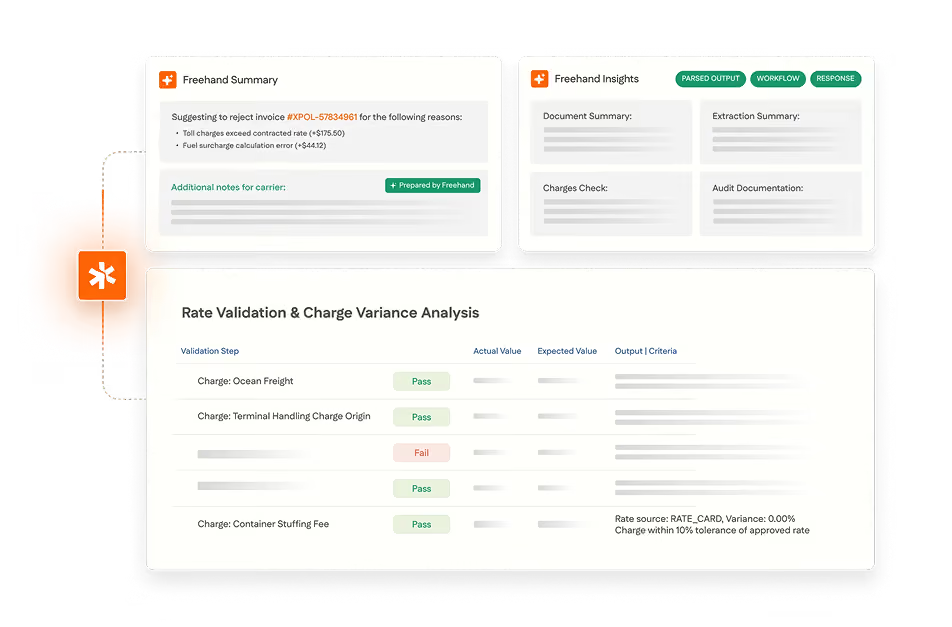
Freehand's invoice audit agent replaces the PO the touchless system is looking for with the carrier contract and TMS shipment data: the base rate for that lane, the fuel index for the ship date, and the shipment record confirming whether the detention fee's trigger actually occurred. That gives freight invoices the same kind of clean, checkable match a PO gives a standard invoice, so they can clear automatically too.
{{blue-cta}}
What KPIs measure touchless invoice processing success?
Touchless rate is the headline number, but nine metrics together give the full picture of whether a program is actually working.
- Touchless (straight-through) processing rate: share of invoices that clear with zero human touch, start to finish.
- Invoice cycle time: total time from receipt to payment, across all invoices.
- Cost per invoice: total processing cost divided by invoice volume, the clearest ROI measure.
- Invoice exception rate: share of invoices that fail a check and route to manual review.
- First-pass match rate: share of invoices that clear automatically on the first check, without rework.
- Percentage of invoices requiring manual intervention: the inverse of the touchless rate, tracked separately since it highlights where the remaining manual work concentrates.
- On-time payment percentage: share of invoices paid within agreed terms, a downstream signal of whether cycle time is actually fast enough.
- Early payment discount capture: share of available early-payment discounts actually captured, which depends on cycle time being fast enough to hit the discount window.
- Invoices processed per employee: a rough proxy for how much the touchless rate has actually changed team capacity.
Freehand delivers a 99.5% first-pass match rate on freight invoices, against an 85 to 90% industry average for BPO-based freight audit. That gap is the exception queue: traditional providers route 10 to 15% of invoices to manual review as standard practice; Freehand routes fewer than 1%.
Is touchless AP a realistic goal, or mostly marketing?
Touchless is realistic for the invoice categories it was built for, and it's routinely oversold for the categories it wasn't. For standard, PO-matched vendor invoices from stable suppliers, high touchless rates are achievable and well-documented across the AP automation industry. For invoice categories with no PO anchor, freight chief among them, a platform's headline touchless rate usually reflects the mix of invoice types it processes, not a capability that extends evenly across all of them.
The honest read: ask what share of your specific invoice mix a touchless claim actually applies to, not just what the vendor's blended rate is. A platform quoting an 80% touchless rate across all AP volume may still be processing freight invoices manually, if freight is even included in that number at all.
How do you extend touchless coverage to freight invoices?
Extending touchless processing to freight requires replacing the PO-matching logic with a validation layer that checks the actual authorization chain freight invoices run on: the carrier contract for the rate, the fuel index for the surcharge, and TMS shipment data for accessorial triggers.
Freehand's AI Teams run that validation automatically against every freight invoice, connecting contract, fuel index, and shipment data the way PO-matching connects a supplier invoice to its requisition. The result is the same outcome touchless processing targets for standard invoices, applied to the category most AP automation platforms exclude by default. For the broader workflow freight invoices sit inside, see our guide to the accounts payable workflow.
{{brown-cta}}
Touchless invoice processing works exactly as advertised for the invoice types it was designed around. Freight was never one of them, since a PO was never the document freight invoices run on. Freehand builds the missing validation layer freight needs to clear automatically too, checking every invoice against the contract and shipment data instead of a PO that was never going to exist.
Frequently Asked Questions
What's a good touchless invoice processing rate?
Best-in-class AP programs run 70% or higher across standard, PO-matched invoice volume. That figure applies unevenly across invoice categories; freight and other no-PO invoice types typically run far below it without a dedicated validation layer.
Can touchless invoice processing work without a purchase order?
Not with standard PO-matching logic. A touchless system needs some structured data to check the invoice against; for freight, that's the carrier contract and shipment data instead of a PO, which requires different matching logic than most AP platforms run by default.
Does touchless invoice processing eliminate the need for an AP team?
No. It shifts AP work from routine processing to exception handling and process governance. The invoices that don't clear touchless, and any category structurally excluded from touchless matching, still need people, or a different kind of automation.
Is a high touchless rate always a sign of a well-automated AP process?
Not on its own. A high blended touchless rate can still mean an entire invoice category, like freight, is processed manually and simply excluded from the reported number. Ask what invoice types the rate actually covers before treating it as a full picture.
Can AI be used to automate invoice processing?
Yes. AI handles the data extraction step (reading line items off invoices regardless of format) and increasingly the matching and coding steps too, applying the same rules a person would but at invoice volumes manual review can't keep pace with.
Is SAP VIM part of SAP?
No. Vendor Invoice Management (VIM) is a third-party module built by OpenText, sold as an add-on for SAP environments rather than a native SAP product. It's a common touchless-processing layer for SAP customers, but it comes from a separate vendor.
Every Invoice Checked. Every Charge Verified.
Freehand reads each carrier invoice against your contracted rates and flags the variance before you pay it. No sampling, no backlog.
You're Auditing a Sample. The Errors Live in the Rest.
Most teams spot-check 15 to 30% of freight invoices. Overcharges hide in the 70% no one opens.
Every warehouse. Every provider. Every mile.
Gartner's 2026 outlook on logistics outsourcing, and how AI Teams hold every contract to the terms you agreed.
- Where outsourced logistics quietly loses margin
- Why billed charges drift from the contract
- How AI Teams close the gap


.png)