



Three-Way Matching in Accounts Payable: How It Works and Why It Matters
.webp)
June 22, 2026
•
12
mins

Three-way matching in accounts payable is the process of verifying a vendor invoice against both the original purchase order and the goods receipt note before payment is approved. It confirms that what was ordered, received, and billed all align, preventing overpayments, duplicate charges, and fraudulent invoices from clearing AP undetected.
According to the 2025 AFP Payments Fraud and Control Survey, 79% of organizations experienced attempted or actual payment fraud in 2024, making three-way matching one of the most operationally important controls in finance.
Key Takeaways
- Three-way matching is an accounts payable control process that cross-checks the purchase order, goods receipt note, and vendor invoice before approving payment.
- The three documents are the purchase order (authorization), the goods receipt note (delivery confirmation), and the vendor invoice (billing claim). All three must align on quantity, price, and terms before payment is released.
- Manual three-way matching is labor-intensive, error-prone, and does not scale. Automation processes invoices in seconds, eliminates 90%+ of matching errors, and routes exceptions to the right resolver without human review at each step.
- In freight and logistics, standard three-way matching is not enough. Carrier invoices require a fourth validation layer against contracted rates, TMS shipment data, and accessorial triggering conditions.
What Is Three-Way Matching in Accounts Payable?
Three-way matching is an accounts payable verification process that compares three documents before releasing payment: the purchase order, the goods receipt note, and the vendor invoice. Payment is only approved when all three align on quantity, price, and terms.
It is one of the oldest internal financial controls in procurement, and still one of the most important.
The logic is simple: before money leaves the organization, confirm three things happened.
- The purchase was authorized (purchase order)
- The goods actually arrived (goods receipt note)
- The bill matches what was agreed (vendor invoice)
Two-way matching checks only the PO against the invoice. It confirms pricing was correct but cannot confirm delivery occurred.
Three-way matching adds the goods receipt as a third checkpoint, closing that gap before payment moves.
In operational terms, most invoices should clear automatically when all three documents match within acceptable tolerances. The value is not in reviewing every invoice manually. It is in having a system that catches the ones that don't match before anyone approves them.
What Are the Three Documents in Three-Way Matching?
The three documents are the purchase order, the goods receipt note, and the vendor invoice. Each closes a distinct verification gap, and all three must be present and consistent before payment can be authorized.
The purchase order
The purchase order is the authorization document. Created by procurement before any goods change hands, it records what was agreed: vendor name, item descriptions, quantities, unit prices, delivery terms, and the total authorized amount.
It is the baseline the entire matching process runs against. An invoice for goods that were never ordered has no corresponding PO, and without a PO match, the invoice fails at step one.
The goods receipt note
The goods receipt note (GRN), sometimes called a receiving report, is created by the warehouse or receiving team when goods arrive. It records what was actually delivered: quantities counted, condition noted, and any shortfalls or damages documented.
This is the document two-way matching skips entirely. A supplier could invoice for 500 units on a PO that authorized 500 units, and the invoice would pass two-way matching even if only 300 units arrived. The GRN closes that gap. If the invoice claims 500 units and the GRN confirms 300, the discrepancy surfaces before payment.
The vendor invoice
The vendor invoice is the supplier's billing document. It lists what the supplier claims was delivered, at what price, with what payment terms.
It is also the document most likely to contain errors, whether from manual data entry on the supplier's side, billing system misconfigurations, or deliberate manipulation. 41.4% of finance professionals encounter up to 10 duplicate invoices every month, and nearly 47% detect up to 10 fraudulent invoices per month. Three-way matching is the control that catches them before payment goes out.
How Does the Three-Way Matching Process Work?
Three-way matching runs sequentially. The purchase order is created first, the goods receipt is generated on delivery, and the invoice triggers the comparison when it arrives. Payment is released only when all three align.
Step 1: Purchase order creation Procurement creates and approves a PO before any goods are ordered. It records the authorized quantities, agreed prices, and delivery expectations. The PO number becomes the reference linking all three documents throughout the process.
Step 2: Goods receipt When goods arrive, the receiving team generates a GRN confirming what was delivered: quantities counted, condition noted, and any shortfalls documented. This record sits in the ERP waiting to be matched.
Step 3: Invoice receipt The supplier submits an invoice for payment. AP logs it and pulls the referenced PO and GRN to begin the comparison.
Step 4: Document comparison AP compares all three documents across key fields:
- Invoice quantities against the GRN and PO
- Unit prices against the PO
- Total amounts for internal consistency
- Payment terms against what was originally agreed
Any field that falls outside the configured tolerance threshold triggers a hold.
Step 5: Match or exception Clean matches are approved and queued for payment. Exceptions are flagged and routed for investigation before any payment moves. How exceptions are routed and owned determines whether the matching process adds value or adds delay.
Step 6: Exception resolution The root cause is identified: data entry error, partial delivery, pricing dispute, or potential fraud. The resolution either corrects the discrepancy and approves payment or escalates to procurement, the receiving team, or finance depending on which document contains the error.
Worked example
A manufacturer orders 200 industrial valves at $85 each. The PO records: 200 units, $85/unit, $17,000 total. The shipment arrives and the warehouse counts 180 units. The GRN records 180 units received. The supplier invoices for 200 units at $85: $17,000.
Three-way matching flags the discrepancy immediately. AP holds the invoice, contacts the supplier to confirm the shortfall, and approves payment for $15,300 covering only the 180 confirmed units. The remaining $1,700 is held until the balance arrives or a credit note is issued.
Without the GRN as a third document, that $1,700 overpayment would have cleared.
What Is the Difference Between 2-Way, 3-Way, and 4-Way Matching?
Two-way matching compares the PO and invoice only. Three-way matching adds the goods receipt, confirming delivery occurred. Four-way matching adds a fourth document, either an inspection report or contract rate validation depending on the industry. Each adds a verification layer the previous method misses.
When to use two-way matching:
Recurring, low-risk purchases where the supplier relationship is established and transaction amounts are predictable.
When to use three-way matching:
Any purchase where physical delivery needs to be confirmed before payment. Standard goods procurement, manufacturing components, and wholesale purchasing all fit this profile.
When to use four-way matching:
Categories where the first three documents are insufficient. In regulated manufacturing and pharma, this is typically a quality inspection report. In freight and logistics, it is contract rate validation: confirming that each charge on a carrier invoice reflects the contracted rate for that lane, charge type, and billing date.
When Should You Use Three-Way Matching?
Three-way matching should be applied to any purchase of physical goods where delivery confirmation is required before payment. The practical rule: if a goods receipt note can be generated, three-way matching should run.
It is particularly important for:
- High-value, infrequent purchases from new or infrequently used suppliers
- Purchases where partial deliveries are common and invoice amounts vary by shipment
- Categories with a history of supplier billing errors or disputed quantities
- Any transaction where the financial exposure of an overpayment justifies the matching overhead
It is less appropriate for:
- Software subscriptions and SaaS licensing, where there is no delivery event
- Professional services billed on time and materials, where the deliverable is intangible
- Utility invoices and recurring fixed-fee contracts, where amounts are predictable and stable
- Very low-value transactions where the cost of matching exceeds the risk of error
Most organizations apply three-way matching above a defined dollar threshold and use two-way matching below it. A tiered approach prevents the matching process from becoming a bottleneck on low-risk transactions while maintaining full control on high-value ones.
What Are the Benefits of Three-Way Matching?
Three-way matching delivers four core benefits: fraud prevention, overpayment elimination, audit readiness, and stronger supplier relationships.
Fraud prevention
An invoice for goods that were never ordered has no matching PO. An invoice for goods that were never received has no matching GRN. Three-way matching surfaces both before payment. 79% of organizations experienced payment fraud attempts in 2024, and three-way matching is one of the most operationally straightforward controls available.
It also separates duties across three teams. Procurement, receiving, and AP each own a different document. Collusion across all three is significantly harder to execute than manipulating a single approval.
Overpayment and duplicate payment prevention
Quantity mismatches, pricing errors, and duplicate invoice submissions all surface during document comparison. A supplier invoicing for 100 units on a GRN that shows 80 cannot clear AP without an exception. A duplicate invoice referencing the same PO and delivery gets flagged on comparison against an already-matched record.
Audit readiness
Three-way matching creates a document trail auditors can follow: authorization, delivery confirmation, and billing record, all linked to each payment. Under SOX Section 404, companies must establish and document internal controls for financial reporting. Three-way matching is a foundational AP control that satisfies that requirement without building additional audit infrastructure on top.
Supplier relationship management
Accurate invoice matching accelerates payment approvals. When invoices are clean and match reliably, they clear faster and payment goes out on time. Suppliers who invoice accurately get paid faster, and that predictability builds the kind of relationship that supports better pricing and credit terms over time.
{{blue-cta}}
What Are the Discrepancies and Challenges in Three-Way Matching?
The discrepancies that trigger exceptions and the challenges of the process share the same root cause: when matching fails, it either reveals a real error worth catching or creates delay the process itself generated. In manual environments, the second category is common.
Common discrepancies
Quantity mismatches are the most frequent exception type. The invoice claims a different quantity than the GRN confirms, either because of partial delivery, returns, or supplier billing error. These are legitimate catches the process was designed to surface.
Price variances occur when the supplier's invoice price differs from the PO rate. These happen after contract amendments that weren't updated in the PO, during rapid procurement cycles when pricing is confirmed verbally before the PO is formally updated, or through outright billing errors.
Missing GRNs hold up otherwise-clean invoices when the receiving team hasn't logged delivery yet. The invoice is accurate. The match simply cannot complete without the third document.
Duplicate invoices arrive when suppliers resubmit, when EDI feeds generate duplicate entries, or when invoices come through multiple channels simultaneously.
Challenges of manual three-way matching
Manual three-way matching is labor-intensive and does not scale. Reading each line of each document across three separate records, for hundreds or thousands of invoices per month, is unsustainable.
Human error compounds the problem. A transposition error in a quantity field triggers a mismatch that didn't exist in the underlying transaction, and AP teams spend time investigating discrepancies the matching process itself generated. The ceiling is scalability: manual matching grows headcount proportionally with invoice volume, with no path to higher throughput without higher cost.
What Are the Best Practices for Three-Way Matching?
Each best practice below closes a specific gap in the matching chain.
Enforce PO-mandatory purchasing
Three-way matching cannot run without a purchase order. Any purchase that bypasses the PO workflow creates an invoice with no matching baseline, which is both an exception management problem and a maverick spending risk. PO-mandatory policies enforced at the system level, not through policy documents alone, are the prerequisite for reliable match rates.
Standardize GRN creation at the point of delivery
GRNs created retrospectively or in weekly batches are an unreliable matching document. Real-time GRN creation with accurate line-item counts at the point of delivery is the single highest-impact upstream improvement for three-way match rates.
Set tolerance thresholds by transaction type
Not every variance warrants a hold. Setting acceptable tolerances, for example approving invoices within 2% of the PO value, allows routine minor discrepancies to clear automatically while holding genuinely problematic invoices for review. Apply full three-way matching above a defined dollar threshold and simplified checks for lower-value transactions.
Define exception ownership and resolution SLAs
Every exception needs an owner and a timeline:
- Price variance exceptions go back to procurement
- Quantity discrepancies go to the receiving team
- Suspected duplicates stay with AP for system-level investigation
An undifferentiated exception queue with no SLA is not a matching system problem. It is a workflow design problem.
Track match rates and exception patterns as standing KPIs
A declining three-way match rate is a leading indicator of upstream problems: procurement creating imprecise POs, receiving teams logging GRNs late, or specific suppliers with persistently inaccurate invoicing. High-performing AP teams track exception rates by supplier and category, using that data to target process improvements rather than managing exceptions reactively.
How Does Automation Transform Three-Way Matching?
Automation converts three-way matching from a manual, sequential document review into a real-time comparison that runs the moment an invoice arrives. Clean matches clear without human involvement. Everything else gets structured exception routing.
The operational difference:
- Speed — manual matching takes days; automated matching takes seconds
- Cost — cost per invoice drops 70 to 80%
- Accuracy — more than 90% of matching errors eliminated compared to manual review
When an invoice arrives, the system extracts the data, pulls the referenced PO and GRN from the ERP, and runs the comparison automatically. Invoices within configured tolerances are approved without human review. Those outside tolerance are routed to the appropriate resolver with the discrepancy already identified.
That routing changes the nature of AP work entirely.
Manual matching means reviewing every invoice to decide if it's correct. Automated matching means resolving only the exceptions the system has already flagged, with the discrepancy pre-labelled and the owner pre-assigned.
For high-volume operations, the math is straightforward. An AP team processing 20,000 invoices per month at a 90% clean match rate still faces 2,000 exceptions per month. Automation means those 2,000 arrive pre-triaged with root cause identified, not as an undifferentiated queue waiting for someone to open each one.
No lag, no invoice sitting on hold while someone manually enters a receipt.
The accounts payable automation infrastructure that handles standard supplier invoices is the same foundation that should be running three-way matching. Where it breaks down for freight is in the fourth validation layer that carrier invoices require.
How Does Three-Way Matching Work in ERP Systems?
Three-way matching is a native function in most enterprise ERP platforms. SAP, Oracle, and NetSuite all support automated PO, GRN, and invoice matching within their AP modules, though configuration requirements and tolerance settings vary by platform.
- SAP — matching runs through the Materials Management (MM) module. Invoice verification against the goods receipt and PO is handled in the MIRO transaction. Tolerance keys define how much variance is acceptable before an invoice is blocked for payment.
- Oracle Fusion / Oracle ERP Cloud — configured within the Payables module. Match approval workflows determine which invoices auto-approve and which route for manual review based on variance rules the finance team sets.
- NetSuite — handled through the Vendor Bills workflow, comparing the bill against the PO and item receipt. Match rules and approval thresholds are configurable per vendor or transaction type.
The common challenge across all three platforms is the same. ERP-native matching validates document consistency. It does not validate contractual accuracy.
An invoice that matches the PO on quantity and price clears matching in SAP, Oracle, or NetSuite even if the PO was created at the wrong contracted rate. The ERP confirms the documents agree with each other. It does not confirm they agree with the carrier contract, the fuel surcharge index for that week, or the shipment data sitting in the TMS. That gap is specifically where freight AP breaks down, regardless of which ERP is running the process.
Why Does Freight Require Four-Way Matching?
Standard three-way matching was designed for supplier invoices with a PO, a delivery confirmation, and a bill. Carrier invoices in freight do not follow that structure. They require a fourth validation layer: contract rate verification. Without it, the highest-value error categories in freight billing pass three-way matching entirely undetected.
Carrier invoices carry six or more distinct charge types per shipment: base linehaul rate, fuel surcharge, residential delivery fee, dimensional weight adjustment, detention, and accessorial charges. Each has its own rate basis tied to a carrier contract. The fuel surcharge resets weekly by index. Accessorial charges apply conditionally based on service events the AP team never witnesses.
A carrier invoice that references a valid shipment, with confirmed delivery, can still carry charges that have no contract basis. Three-way matching approves it. A fourth validation layer catches it.
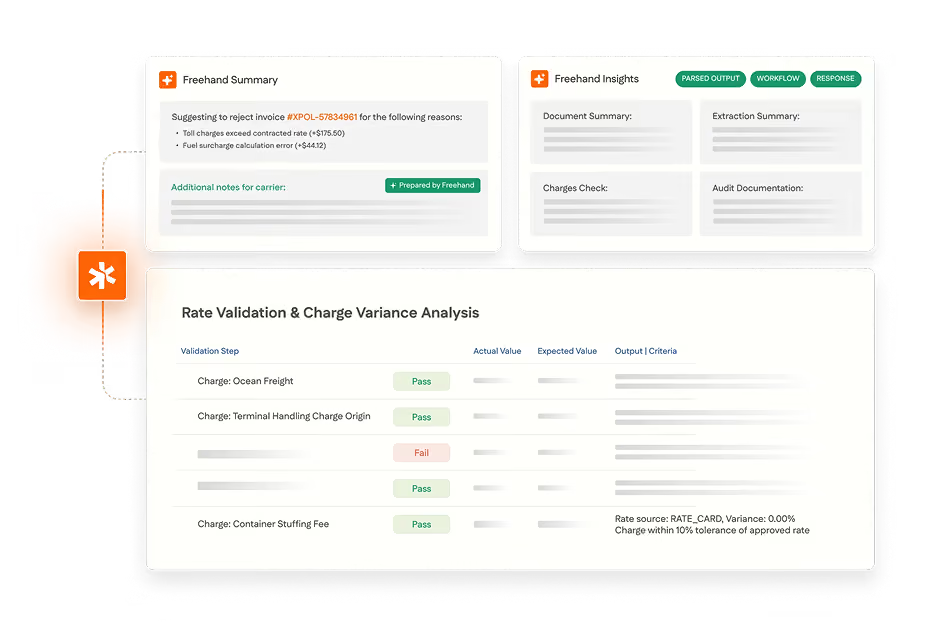
Freehand's Freight Audit and Payment platform runs 4-way matching across every carrier invoice before payment clears:
Each layer closes a gap the previous method misses. A fuel surcharge billed at the wrong tier passes contract rate validation if only the rate category is checked. It fails when compared against the actual index value for the specific departure week. A detention charge at the correct contracted rate passes all three standard matching checks. It fails when TMS timestamps show the driver was released within the free time window.
The freight invoice automation infrastructure that powers this runs at 100% invoice coverage across parcel, LTL, FTL, ocean (FCL/LCL), air, intermodal, rail, and last mile. Contract amendments propagate to the validation layer as part of the amendment workflow. Dispute packets are compiled and submitted to carriers autonomously when a charge fails validation.
For enterprises managing $15M or more in annual freight spend, the fourth layer recovers 1.5 to 2.5% of freight spend annually. Not through renegotiation. Through enforcing the contracts procurement already put in place.
Request a demo to see what 4-way matching looks like across your carrier portfolio.
For platforms that automate matching across the invoice lifecycle, see our ranking of the best AP automation software.
{{brown-cta}}
Frequently Asked Questions
What is three-way matching in accounts payable?
A verification process that compares the purchase order, goods receipt note, and vendor invoice before approving payment. Payment is released only when all three documents align on quantity, price, and terms.
What is the difference between 2-way and 3-way matching?
Two-way matching compares the PO and invoice only, confirming price but not delivery. Three-way matching adds the goods receipt note, confirming goods actually arrived before payment is released.
What are the most common three-way matching discrepancies?
Quantity mismatches between the GRN and invoice, price variances from the PO rate, missing GRNs that block otherwise-clean invoices, and duplicate invoice submissions from the same supplier.
When should you use three-way matching vs two-way matching?
Three-way matching applies to any physical goods purchase where delivery must be confirmed. Two-way matching is appropriate for services, subscriptions, and recurring fixed-fee contracts where no goods receipt is possible.
Why does freight require four-way matching instead of three?
Carrier invoices contain fuel surcharges and accessorial charges requiring contract rate validation and TMS shipment data to verify. Three-way matching confirms delivery but cannot validate whether each charge reflects the contracted rate or whether the triggering condition actually occurred.
A Fourth Layer for the Charges 3-Way Matching Misses.
Freehand validates freight invoices against contracted rates and fuel indexes on top of the standard match, so a clean match actually means a correct charge.
3-Way Matching Confirms the Shipment. Not the Price.
PO, receipt, and invoice can agree perfectly while the rate is still wrong. Standard matching has no way to catch that.
Every warehouse. Every provider. Every mile.
Gartner's 2026 outlook on logistics outsourcing, and how AI Teams hold every contract to the terms you agreed.
- Where outsourced logistics quietly loses margin
- Why billed charges drift from the contract
- How AI Teams close the gap

.png)