
The Accounts Payable Process: Steps, Workflow, and Best Practices
.webp)
July 2, 2026
•
11
mins
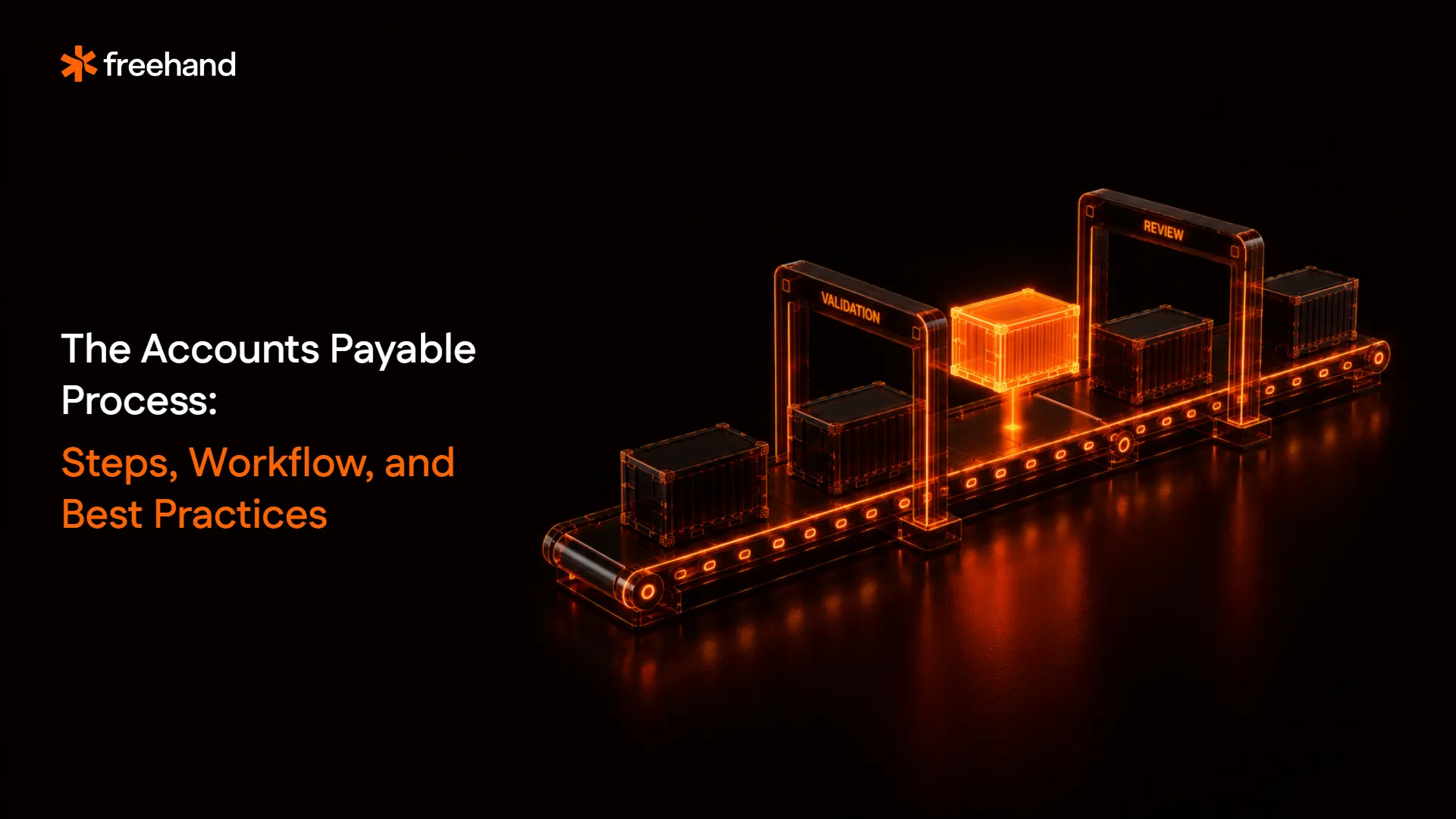
The accounts payable process is the sequence a business follows to receive, verify, approve, and pay supplier invoices.
Each step adds a control checkpoint, matching the invoice against the purchase order and goods receipt, so only accurate, authorized bills clear.
Done well it protects cash and catches errors before payment. Done manually it leaks money.
Key Takeaways
- The accounts payable process is the end-to-end workflow a company uses to record and pay what it owes suppliers, from invoice receipt through validation, approval, payment execution, and general ledger reconciliation.
- The cost gap is large. Best-in-class teams process an invoice for $2.18 while laggards spend $12.60, nearly 500% more.
- Manual processing is the culprit. Companies running manual AP spend four times more per invoice than fully automated teams.
- Errors concentrate in exceptions. Best-in-class AP departments hold an exception rate near 8%, roughly half the rate of everyone else.
- The biggest blind spot is not the routine invoice. It is the freight, accessorial, and contract-rate invoice that 3-way matching never scrutinizes, where 1.5 to 2.5% of spend quietly leaks.
What is the accounts payable process?
The accounts payable process is how a business turns a supplier invoice into an accurate, authorized payment. It governs who checks an invoice, what it is checked against, and when it gets paid, so the company pays the right amount to the right vendor at the right time.
Without a defined process, invoices get paid when someone remembers, approval authority is informal, and finance has no systematic way to catch errors before cash goes out the door.
That is where the money leaks. Duplicate invoices, price mismatches, and overbilling clear because no control caught them in time.
A well-run process is really a set of controls disguised as a workflow. Each step exists to stop a specific failure, from paying a fraudulent invoice to missing an early-payment discount.
What are the steps in the accounts payable process?
The accounts payable process has six core steps: capture the invoice, code it, match it, approve it, pay it, and record it. Each step is a checkpoint, and skipping one is where most errors and overpayments enter the ledger.
- Receive and capture the invoice. Route every invoice to a single intake point (an AP inbox or portal) and capture the data. Centralizing receipt is what prevents lost invoices and duplicate entries.
- Code the invoice. Assign the general ledger account, cost center, and tax treatment so the expense lands in the right place.
- Match against the PO and receipt. Compare the invoice to the purchase order and goods receipt to confirm you are paying for what you ordered and received.
- Route for approval. Send to the right approver based on amount and category, with clear segregation of duties.
- Schedule and execute payment. Pay via ACH, check, or card, timed to capture discounts and avoid late fees.
- Record and reconcile. Post the payment to the general ledger and reconcile, closing the loop.
What documents does the accounts payable process require?
The accounts payable process relies on three source documents: the purchase order, the goods receipt, and the vendor invoice. Together they answer three questions before payment: did we order this, did we receive it, and is the bill correct?
The purchase order records what was ordered and at what price. It is the contract the invoice is checked against.
The goods receipt (or goods received note) confirms what actually arrived. It is what separates a real delivery from a phantom one.
The vendor invoice is the request for payment. On its own it proves nothing, which is why matching it to the other two documents through your procure-to-pay process is the heart of the accounts payable cycle.
What is invoice matching in accounts payable?
Invoice matching is the control that compares an invoice against supporting documents before payment, and it comes in three depths. Two-way matching checks the invoice against the PO. Three-way adds the goods receipt. Four-way adds an inspection or contract-terms check. The deeper the match, the more error and fraud it catches.
Two-way vs three-way vs four-way matching
Three-way matching is the standard for most AP teams, and it is well covered in this guide to three-way matching. But it has a blind spot: it confirms the goods arrived, not that the rate matches the negotiated contract. That gap is where freight and service invoices overbill.
What are the common challenges in the accounts payable process?
The most common accounts payable challenges are manual data entry, lost invoices, approval bottlenecks, duplicate payments, and no visibility into where invoices sit. Each one slows the cycle and raises the cost per invoice.
Manual entry is the root cause of most of them. It is slow, error-prone, and does not scale with invoice volume.
Duplicate payments are the most expensive failure, because the money is already gone by the time anyone notices. Recovering it takes vendor cooperation that is not guaranteed.
The subtler challenge is scrutiny that does not scale. As volume grows, teams sample rather than check every line, and the complex invoices (freight, logistics, accessorials) are exactly the ones that get waved through.
What metrics measure accounts payable performance?
The core accounts payable metrics are cost per invoice, invoice cycle time, exception rate, straight-through processing rate, and days payable outstanding (DPO). Together they show whether the process is fast, accurate, and cheap, or none of the three.
Cost per invoice is the headline number. APQC benchmarks cost per invoice and cycle time as the two measures that most separate strong AP functions from weak ones.
A worked example: what cost per invoice really means
Take a company processing 120,000 invoices a year. At a manual cost of roughly $12.60 per invoice, that is about $1.51M spent just to run AP. Move to a best-in-class $2.18 per invoice and the same volume costs about $262,000, a saving near $1.25M per year. And that is before counting the duplicate payments and overbilling the tighter process now catches before cash leaves.
{{blue-cta}}
What good looks like: target metrics
What are accounts payable process best practices?
The best practices for the accounts payable process center on centralization, control, and automation. The goal is fewer manual touches per invoice and more errors caught before payment, not after.
- Centralize invoice receipt. Route every invoice to one intake point to kill lost invoices and duplicates.
- Enforce segregation of duties. Invoice approval, payment authorization, and vendor setup should sit with different people.
- Protect the vendor master file. Require formal verification for new vendors and any bank-detail change, the top target for payment fraud.
- Match every invoice, not a sample. Sampling is where overbilling hides. Coverage should be the default, especially on complex invoices.
- Track the metrics that matter. Watch cost per invoice, cycle time, and exception rate, and manage to them.
- Automate the repetitive steps. Capture, coding, and matching are rules-based work that software does faster and more accurately than people.
How does AP automation improve the accounts payable process?
AP automation improves the process by removing manual work from capture, coding, matching, and routing, which cuts both cost and error. Automated systems use AI and OCR to read invoices, match them to POs and receipts, route them for approval, and schedule payment, logging every action for audit.
The financial effect is direct. Automation can cut AP processing costs by nearly 80% while shortening cycle time and reducing exceptions.
Integration is what makes it stick. Automation connects to the ERP (NetSuite, SAP, Oracle, QuickBooks) so approved invoices post to the general ledger without rekeying, and the ERP stays the system of record. Modern AI invoice processing extends this to reading and validating even non-standard invoices.
The remaining gap is scrutiny on complex bills, which is where AP-specific tools stop and freight-aware validation begins.
Accounts payable vs accounts receivable: what is the difference?
Accounts payable is money your business owes suppliers; accounts receivable is money customers owe you. AP is a liability and its goal is to pay accurately and on time. AR is an asset and its goal is to collect quickly.
To automate these steps, compare platforms in our guide to the best AP automation software.
{{brown-cta}}
Frequently asked questions
Is accounts payable a debit or credit?
In the accounts payable process, accounts payable is a liability with a normal credit balance. It increases with a credit when you record an invoice and decreases with a debit when you pay it.
What is full-cycle accounts payable?
Full-cycle accounts payable is the complete accounts payable process, from receiving the purchase order and invoice through matching, approval, payment, and general ledger reconciliation, rather than a single step.
What is the difference between the accounts payable process and the accounts payable workflow?
They are closely related. The accounts payable process is the full cycle from invoice to payment; the accounts payable workflow is how those steps are sequenced, routed, and approved inside it.
What is a good cost per invoice for the accounts payable process?
Under $3 per invoice signals an efficient accounts payable process. Manual operations often exceed $12, so a low cost per invoice points to strong automation and tight controls.
How is the accounts payable process different from procure-to-pay?
Procure-to-pay spans sourcing and purchase orders through payment. The accounts payable process is the payment-side portion: receiving, validating, approving, and paying supplier invoices.
Who is responsible for the accounts payable process?
The AP team runs the accounts payable process day to day, under the controller and ultimately the VP Finance or CFO, with approval, payment authorization, and vendor setup split for control.
Where the accounts payable process quietly loses money
Most AP teams run a clean process on routine invoices. The breakdown happens on the invoices that are hardest to check: freight bills, accessorials, and service invoices where the rate is supposed to match a negotiated contract but no one verifies it line by line. Three-way matching confirms the goods arrived. It never confirms you were charged the rate you agreed.
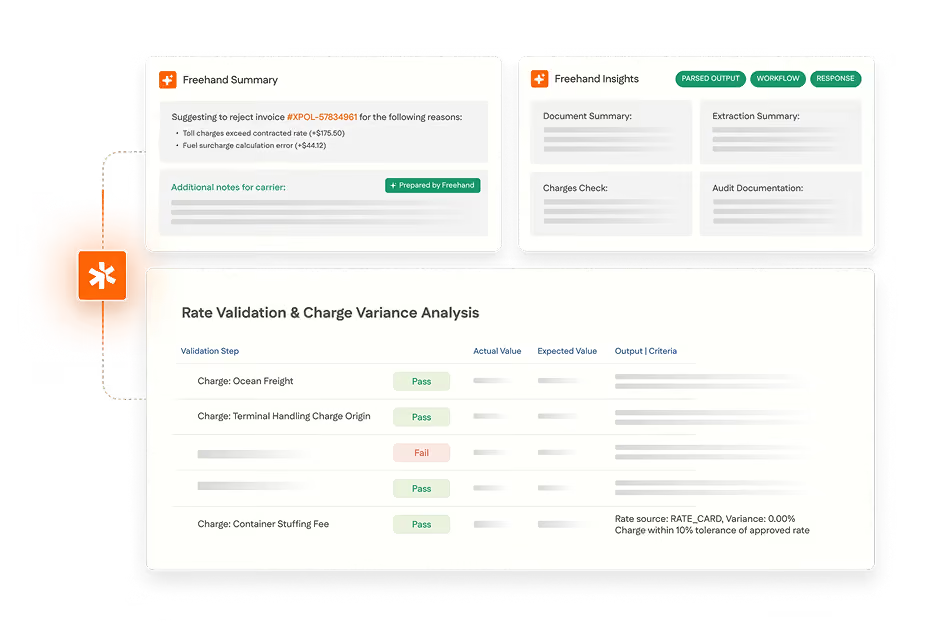
That is the freight invoice your AP team will never really see, and it is where overbilling clears unnoticed. Freehand's freight audit and payment platform uses AI Teams to check every complex invoice against the contracted rate, not just the PO, catching what standard AP automation leaves behind. It is built for the VP Finance who owns the number.
The outcome: a process whose controls hold on the invoices that leak the most, recovering the 1.5 to 2.5% of spend that sampling and 3-way matching consistently miss.
Every Invoice Validated Against the Contract, Not Just the PO.
Freehand's AI Teams check freight and accessorial charges against your actual contracted rates, catching what 3-way matching was never built to see.
Your 3-Way Match Doesn't Check the Rate.
Purchase order, receipt, invoice all align, and the contract rate still doesn't. That's where freight and accessorial overcharges clear untouched.
Every warehouse. Every provider. Every mile.
Gartner's 2026 outlook on logistics outsourcing, and how AI Teams hold every contract to the terms you agreed.
- Where outsourced logistics quietly loses margin
- Why billed charges drift from the contract
- How AI Teams close the gap