
The Freight Invoice Your AP Team Will Never See

February 4, 2026
•
5
mins

Batch reconciliation doesn't just delay the catch. It structurally prevents it.
There is a payment that cleared last Thursday that your AP team will never audit. Not because they are understaffed, though they likely are. Not because the invoice was illegible or the data was bad. But because the audit runs on a 10-to-21-day batch cycle, and by the time the next batch opens, that invoice has already been approved, queued, and disbursed.
This is not a workflow problem. It is a structural feature of how freight audit was designed before real-time processing was commercially viable. The batch model made sense when invoice volumes were manageable, carrier formats were standardized, and reconciliation required physical documents. None of those conditions hold for a Fortune 500 shipper in 2026.
10–21 days: average freight audit cycle time under batch reconciliation
The payment that cleared before the question was asked
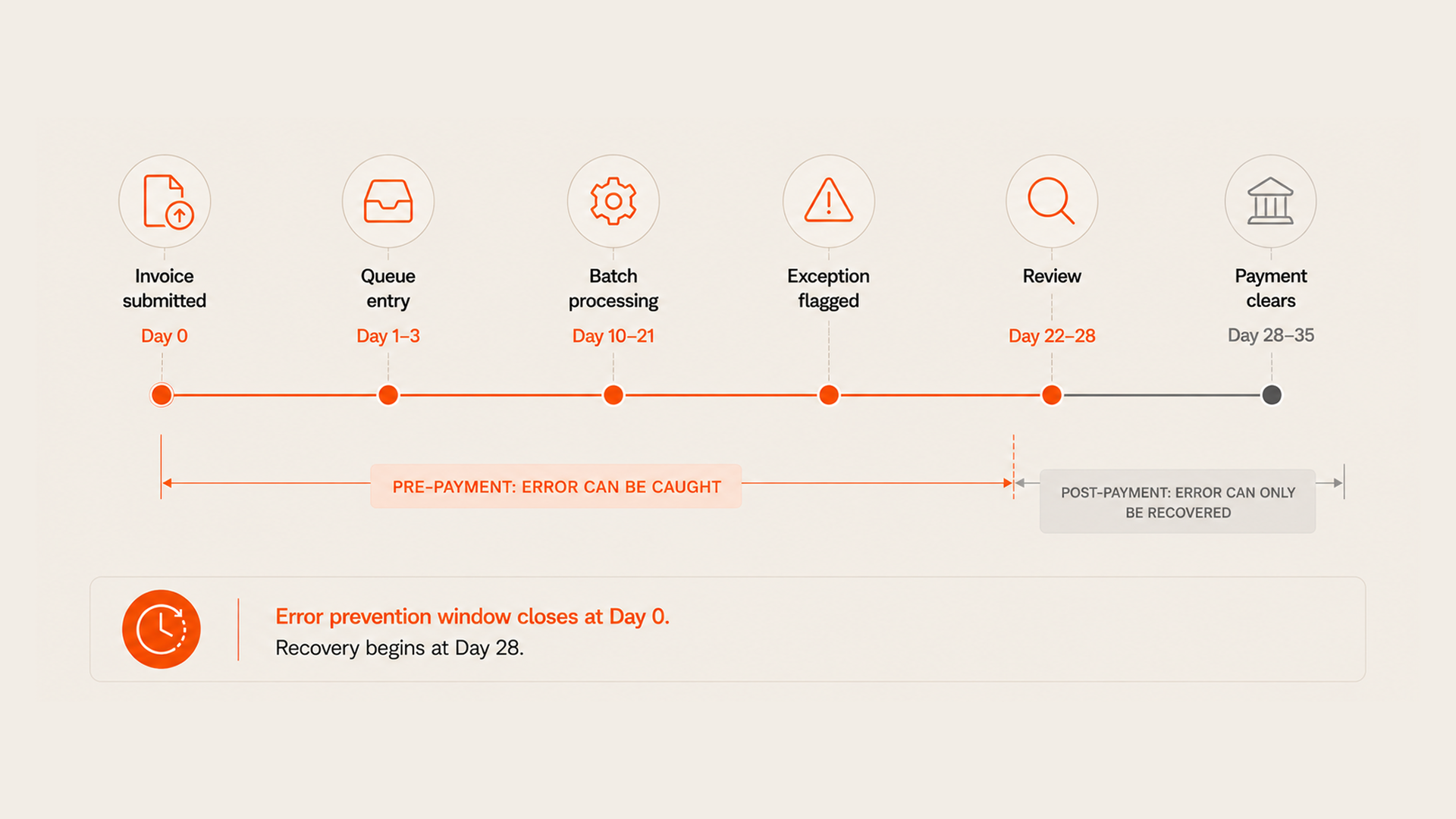
Here is what the timeline actually looks like. A carrier submits an invoice. It enters a queue. The queue processes in batch, typically weekly or bi-weekly. Exceptions get flagged and routed for review. Review takes days. Approvals happen. Payment clears. The dispute, if one was warranted, now has to travel backward against a payment that already moved.
Recovery is not the same as prevention. A carrier that has been paid $40,000 against a contract that allows $36,500 is not the same as a carrier whose invoice was corrected before payment. Recovery requires opening a dispute, generating documentation, tracking the carrier response, managing the credit memo, and reconciling it against a future payment cycle. The average dispute resolution time in freight audit runs between 30 and 90 days depending on the carrier. The average recovery rate on disputed charges is roughly 60 to 70 percent. The remaining 30 to 40 percent stays with the carrier.
The 1.5 to 2.5 percent that compounds quietly
Industry data is consistent on freight billing error rates: 1.5 to 2.5 percent of total freight spend contains some form of overcharge, billing discrepancy, or duplicate. On a $100 million freight spend, that is $1.5 to $2.5 million annually. On a $500 million spend, the math scales accordingly.
The more instructive number is not the percentage but the composition. Accessorial errors, specifically detention, liftgate, fuel surcharge misapplication, and dimensional weight miscalculations, account for a disproportionate share of that leakage. These are charges that require matching invoice line items against shipment-specific conditions, not just against a base rate card. A 2-way rate-versus-invoice match does not catch them. They require shipment data at the transaction level, which most batch audit systems do not pull.
“A carrier that has been paid doesn't owe you a correction. They owe you a consideration. That is a different negotiation.”
What real-time audit changes
The difference between a real-time audit and a batch audit is not just speed. It is the fundamental character of the control. Real-time audit runs against each invoice as it arrives, before the payment workflow begins. The discrepancy is caught when it can still be corrected rather than after it has been paid and must be recovered.
For finance, this means accruals that reflect actual freight costs as they happen, not estimates updated at month-end. For logistics, it means exception queues that surface only genuine disputes, not audit backlogs. For carriers, it means faster payment on clean invoices because the approval cycle compresses when audit happens at ingestion rather than in batch.
The freight invoice your AP team will never see is not an oversight. It is the predictable output of a system designed for a world that no longer exists. The question enterprises are now asking is not whether to modernize the audit model. It is how fast the transition happens relative to the leakage accumulating in the meantime.