
Accounts Payable Automation: How It Works, What It Returns, and Where It Falls Short
.webp)
June 17, 2026
•
9
mins
An AP team at a $2B manufacturer processes 22,000 invoices per month. 14,000 are supplier invoices: structured, PO-matched, arriving in consistent formats. 8,000 are carrier invoices: EDI 210 files, PDFs in a dozen carrier-specific layouts, accessorial charges that change by week, and rate tables that have not been verified against the contract since the last RFP.
The AP automation platform handles the first category well. The second moves through on manual review, exception queues, or approval by default, taking the billing errors with it.
Key Takeaways
- Accounts payable automation is the technology layer that manages the invoice-to-pay cycle without manual intervention, covering invoice capture, GL coding, matching, approval routing, payment execution, and reconciliation.
- Standard AP automation benchmarks assume a specific invoice structure. Knowing what they assume tells you whether the platform covers your hardest invoice category or just your easiest one.
- General AP automation handles supplier invoices well. Carrier invoices need more: format variability, accessorial charge complexity, and multi-system validation that 2-way and 3-way matching was not built for.
- Enterprises with significant freight spend need two parallel validation tracks: general AP automation for supplier invoices and a freight-specific audit layer for carrier invoices.
- AP automation ROI calculated on supplier invoices alone understates the total return. Adding freight-specific audit recovers 1.5 to 2.5% of freight spend in overcharges that general AP automation approves because it was not built to catch them.
What Is Accounts Payable Automation?
Accounts payable automation replaces manual steps in the invoice-to-pay cycle with automated workflows, AI-based data capture, and system integrations.
The goal is a high touchless processing rate: the share of invoices that move from receipt to payment without a human touching them.
Ardent Partners benchmarks the cost of manual AP at $12.88 per invoice with a 22% exception rate. Mature AP automation brings that down to $2.78 per invoice with exception rates under 9%.
AP automation handles two functions:
Processing (invoice receipt to payment approval)
- Capture invoice data across formats
- Code charges to correct GL accounts
- Match invoices against purchase orders and receipt records
- Route exceptions to the appropriate reviewer
Payment management (approved invoice to cleared payment)
- Execute disbursements on schedule
- Capture early payment discounts
- Sync payment records to the ERP
- Give suppliers real-time payment status
What Is the Difference Between AP Automation and AP Digitization?
AP Digitization means scanning paper invoices into a shared folder or uploading them to an ERP while AP automation builds smart, repeatable workflows around those invoices. The distinction matters because many enterprises believe they have AP automation when they have digitization: invoices are electronic, but someone still manually codes, matches, and routes each one.
How Does Accounts Payable Automation Work?
AP automation works in three sequential stages: invoice capture and data extraction, matching and approval routing, and payment execution with reconciliation. Each stage reduces a category of manual work and produces structured data the next stage depends on.
Invoice Capture and Data Extraction
The first stage handles invoice intake across every channel: email attachments, EDI feeds, supplier portals, PDF uploads, and scanned paper documents. OCR converts visual invoice content into structured data. AI-driven document understanding handles layout variability.
The output is a structured record: vendor, invoice number, date, line items, amounts, and reference data for the matching step. GL coding follows immediately. AI models trained on historical coding patterns assign GL accounts and cost centers to each line item. Mature systems code 85 to 95% of standard supplier invoice line items automatically.
Matching and Approval Routing
The matching layer validates each invoice against the data sources needed to confirm the charge is legitimate.
| Matching type | What it validates |
|---|---|
| 2-way | Invoice amount matches purchase order. |
| 3-way | Adds goods receipt confirmation. |
| 4-way | Adds contracted rate validation and shipment data. |
Invoices that pass matching move to payment approval automatically. Invoices that fail matching route to exception queues for human review. The matching type the platform uses determines how much of the invoice population it can validate without human intervention.
Payment Execution and Reconciliation
Once approved, the payment management layer handles disbursement timing and payment method selection, early payment discount capture, real-time ERP sync eliminating manual reconciliation, and supplier payment status visibility through portal access.
What Are the Measurable Benefits of AP Automation?
AP automation delivers three consistently documented outcomes on supplier invoice portfolios.
| Metric | Manual | Automated |
|---|---|---|
| Processing time | 8.2 days | 2.9 days |
| Cost per invoice | $10 to $15 | $2 to $4 |
| Touchless rate | Below 10% | 70 to 80% |
For an AP team processing 15,000 invoices per month, the cost difference runs to $90,000 to $165,000 per month in processing cost alone.
Ardent Partners found best-in-class organizations save up to $10 per invoice and 14 days of processing time through AP automation.
What these benchmarks assume: the invoices are supplier invoices. Structured, PO-matched, arriving in a consistent format. That holds for most of the AP workload. It stops holding when carrier invoices are a significant share of volume.
{{blue-cta}}
Where Does Standard AP Automation Fall Short for Logistics and Manufacturing Enterprises?
Standard AP automation underperforms on carrier invoices because its core assumptions, consistent format, stable rates, and PO-matchable charges, do not hold for freight billing.
The billing errors that accumulate in this gap do not appear in the exception report. They clear the exception queue because the AP team reviewing exceptions does not have the carrier contract and shipment data needed to catch them.
Three structural features place carrier invoices outside the scope of standard AP automation:
Format Variability at Scale
A manufacturer with 20 active carriers receives invoices in EDI 210 from some, PDFs in carrier-specific layouts from others, and CSV exports or portal downloads from the rest.
Template-based OCR breaks when a carrier changes its invoice layout. The freight invoices that arrive in non-standard formats are the ones least likely to be validated and most likely to carry billing errors.
Accessorial Charges Without a PO Reference
Fuel surcharges, residential delivery fees, address correction charges, DIM weight adjustments: these appear on carrier invoices without corresponding PO lines.
The only way to validate them is to compare each charge against the carrier contract's accessorial schedule for the specific lane, date, and service type. Standard AP matching has no mechanism for that comparison.
Multi-System Validation Requirement
Validating a carrier invoice line item requires data from three sources: the carrier contract (rate and surcharge schedule), the shipment record (actual weight, dimensions, delivery address, departure date), and the PO (authorized lane and volume).
General AP automation connects to the ERP for PO data. It does not connect to the TMS for shipment records or to contract management for carrier rate tables. Without all three, the match is incomplete.
What Does AP Automation Look Like When Carrier Invoices Are a Significant Share of Volume?
Enterprise AP environments with significant freight spend run two parallel validation tracks: general AP automation for supplier invoices and a freight-specific audit layer for carrier invoices. The architecture is not a replacement. It is an addition.
Track 1: General AP automation (supplier invoices)
OCR capture, GL coding, 3-way PO matching, approval routing, payment execution, ERP sync. This track works and the ROI case holds.
Track 2: Freight-specific audit layer (carrier invoices)
Carrier invoices route through the freight validation track instead of the standard matching workflow.
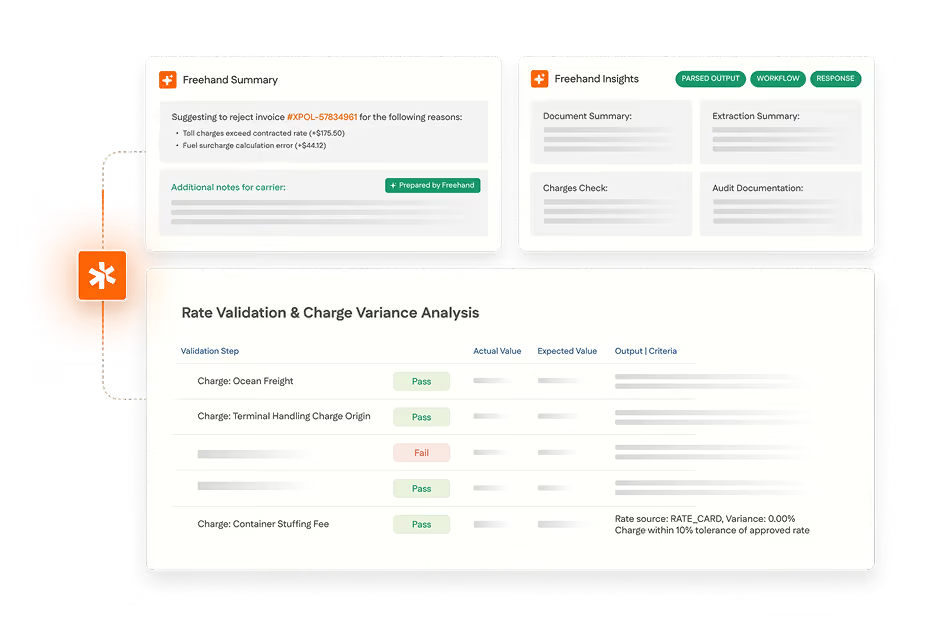
The freight track runs 4-way matching against: the contracted carrier rate for the lane and date, the applicable surcharge schedule, confirmed shipment data from the TMS or carrier EDI, and the authorizing purchase order.
When all four data points align, the invoice clears to payment automatically. When a charge fails validation, a billing pattern that signals a systemic carrier error rather than a one-time exception, the freight track compiles the dispute evidence and submits it to the carrier without routing to the AP exception queue.
The combined architecture results:
- Supplier invoice track runs at 75 to 80% touchless
- Freight track runs at 100% invoice coverage, with exceptions handled autonomously
- Month-end close improves because freight invoices clear faster with validated actual amounts
How Do Enterprise AP Teams Measure AP Automation ROI Across Their Full Invoice Portfolio?
Standard AP automation metrics blend supplier and carrier invoice performance in ways that obscure where the gaps are.
An enterprise running 75% touchless on supplier invoices and 15% touchless on carrier invoices reports a blended rate around 55%, without identifying that the below-average performance is concentrated in one category the general platform was not built to handle.
| KPI | What it reveals | Below threshold |
|---|---|---|
| Touchless rate by invoice category | Where automation coverage falls short and what the freight validation layer adds. | Below 70% on supplier invoices or below 90% on carrier invoices. |
| Invoice cycle time by invoice type | Carrier invoices with 4-way matching should clear in under 3 days, not sit in exception queues for 2 to 4 weeks. | Above 7 days for carrier invoices. |
| Overcharge recovery as % of freight spend | At 1.5% to 2.5% recovered, a $30M freight portfolio returns $450K to $750K annually. | Zero recovery means zero audit coverage. |
| Close accuracy: actuals vs. accruals | Invoices clearing in under 3 days let finance book actuals rather than estimates. | Month-end estimates signal the invoice cycle is too slow. |
How Does Freehand Add the Freight Audit Track to Your AP Environment?
A general AP automation platform covers most of your invoices. What it does not cover is the category where billing errors accumulate fastest: carrier invoices with accessorial charges, format variability, and rate complexity that 3-way matching was not designed to validate.
The 70 to 80% touchless rate your AP platform reports is real. It is also the rate on your easiest invoice category. The carrier invoices that make up 30 to 40% of AP volume at a logistics or manufacturing enterprise run at a fraction of that touchless rate, clear not because someone confirmed the charges were correct but because nobody flagged them, and carry 1.5 to 2.5% of freight spend in unvalidated fuel surcharges, accessorial overcharges, and rate mismatches.
Freehand's accounts payable automation software adds the freight validation track to your existing AP environment:
- Ingests carrier invoices across EDI, PDF, and email
- Runs 4-way matching against contracted rates and shipment data
- Submits dispute packets autonomously
- Feeds validated data into a spend analytics layer showing what every carrier relationship actually costs vs. what was contracted
Freehand serves industrial manufacturers, FMCG enterprises, retailers, and healthcare and life sciences companies managing carrier invoice volumes where general AP automation stops short.
Ready to compare vendors? See our roundup of the best AP automation software for logistics finance teams.
{{brown-cta}}
Frequently Asked Questions
What is accounts payable automation?
The technology layer that handles the invoice-to-pay cycle without manual intervention, covering invoice capture, GL coding, matching, approval routing, payment execution, and reconciliation. The goal is faster processing, fewer errors, and lower cost per invoice than a manual AP review process delivers.
What is a touchless processing rate in AP automation?
The share of invoices that move from receipt to payment approval without manual review. Mature AP automation reaches 70 to 80% touchless on standard supplier invoice portfolios. The rate drops significantly when carrier invoices, which require multi-system validation, are included in the same AP environment.
What is the difference between 2-way, 3-way, and 4-way matching?
2-way matching confirms invoice amount matches the purchase order. 3-way adds goods receipt confirmation. 4-way adds contracted rate validation and shipment data, required for carrier invoices where accessorial charges have no PO reference and cannot be validated through standard matching alone.
Why does standard AP automation underperform on carrier invoices?
Carrier invoices arrive in multiple formats with no standardization, carry accessorial charges that require contract reference to validate, and need TMS shipment data that general AP platforms do not integrate with. Standard AP automation is built for supplier invoices: consistent formats, stable rates, PO-matchable charges.
What does AP automation ROI look like when freight is a significant share of volume?
Full AP automation ROI includes supplier invoice processing savings plus freight overcharge recovery of 1.5 to 2.5% of freight spend. On a $30M freight portfolio, that adds $450,000 to $750,000 annually, an amount that does not appear in standard AP automation ROI models.
How fast does AP automation process invoices?
AP automation reduces average invoice processing time from 8.2 days manually to 2.9 days automated. Freight-specific automation brings carrier invoices to the same cycle time, allowing finance to book validated actuals rather than accrual estimates at month-end close.
What is the cost per invoice for manual vs. automated AP processing?
Ardent Partners reports the cost of manual accounts payable at $12.88 per invoice. Automated touchless processing costs $2 to $4. For an AP team processing 15,000 invoices per month, that is $90,000 to $165,000 per month in processing cost reduction.
Freehand Adds the Freight Audit Track Your AP Automation Is Missing.
Freehand's AI Teams validate carrier invoices against contracted rates on top of your existing AP automation, not in place of it.
Your AP Automation Handles Supplier Invoices Well. Carrier Invoices Are a Different Problem.
EDI files, a dozen carrier layouts, and accessorial charges that change weekly don't fit the workflow built for PO-matched invoices.
Every warehouse. Every provider. Every mile.
Gartner's 2026 outlook on logistics outsourcing, and how AI Teams hold every contract to the terms you agreed.
- Where outsourced logistics quietly loses margin
- Why billed charges drift from the contract
- How AI Teams close the gap