



Maverick Spending: What It Is, Why It Happens, and How to Stop It
.webp)
June 23, 2026
•
14
mins

Maverick spending is any purchase that bypasses an organization's approved procurement processes, contracted suppliers, or formal authorization workflows. It quietly erodes the savings procurement negotiated before they ever reach the bottom line.
Organizations lose between 5 and 16% of targeted savings to maverick buying annually, making it one of the most consistently underestimated cost leakage problems in enterprise procurement.
Key Takeaways
- Maverick spending is any purchase made outside an organization's approved procurement processes, contracted suppliers, or formal authorization workflows, whether intentional or not.
- The Hackett Group's research shows organizations lose between 5 and 16% of targeted savings to maverick buying annually. For a $500M spend organization, that's $15 to $55M left on the table each year.
- CIPS research shows maverick buying can account for up to 80% of all invoices, even at large organizations with dedicated procurement departments.
- In logistics and freight, maverick spending takes a specific form: spot freight booked outside the routing guide, carrier charges clearing AP without contract validation, and 3PL services billed outside the master service agreement.
What Is Maverick Spending?
Maverick spending is purchasing that bypasses approved supplier contracts, procurement workflows, or authorization controls, resulting in spend that falls outside the terms procurement negotiated.
It goes by several names: rogue spend, off-contract spending, unmanaged spend, maverick buying. The terminology varies. The problem is the same.
In strategic procurement terms, it is any transaction that happens without following established procurement policies, whether that means sourcing from non-approved suppliers, bypassing e-procurement systems, or ignoring contract terms. While often unintentional, this behavior sidesteps the controls designed to drive compliance, cost savings, and supplier performance.
One distinction matters before going further.
Maverick spending is specifically about bypassing established processes, whether the purchase value is large or small.
Tail spend refers to the high volume of low-value transactions that sit below procurement's attention threshold. Those purchases may be unmanaged, but they are not necessarily non-compliant.
Why Is Maverick Spending a Problem?
Maverick spending silently erodes the value procurement worked to create. Every off-contract purchase is a negotiated discount that went uncaptured, a supplier relationship that got bypassed, and a data point that corrupted the spend picture finance relies on.
The direct cost is straightforward. When a buyer purchases outside a contracted agreement:
- Higher unit prices apply
- Volume discounts negotiated by procurement are not captured
- Favorable payment terms are not extended
- Savings projected at contract award never materialize
The indirect costs are harder to see and compound over time. Fragmented spend weakens negotiating leverage at the next sourcing cycle. Volume that should consolidate behind a preferred supplier gets scattered, and future pricing reflects the lower commitment. Spend data that feeds category management and forecasting becomes unreliable.
There is also the compliance dimension. Unchecked maverick spend drives contract leakage, compliance breaches, ESG exposure, and higher fraud probability. According to ACFE's 2024 Report to the Nations, organizations lose nearly 5% of annual revenue to fraud, and maverick spend is a consistent contributing factor.
In logistics specifically, the problem takes a different structural form. Spot freight booked outside the routing guide bypasses contracted carrier rates. Carrier invoices that clear AP without contract-rate comparison include charges procurement already negotiated away. 3PL invoices billed outside the master service agreement carry rates nobody validated. The mechanism differs from an employee bypassing a PO workflow. The outcome is the same: money leaving the organization outside contracted terms.
{{blue-cta}}
What Are the Types of Maverick Spending?
Maverick spending concentrates in four distinct forms, each with its own detection challenge. Knowing which type is prevalent in your organization determines which controls will have the most impact.
Unapproved supplier spend
The most visible form: purchasing from a vendor procurement has not vetted, contracted, or approved. Unapproved suppliers are cited as the primary concern by 74% of procurement professionals when discussing maverick spend.
In logistics, this is spot freight booked directly with carriers outside the routing guide, or one-off 3PL services engaged without a master service agreement.
Non-PO spend
Purchases completed without a formal purchase order, processed through expense reports or procurement cards after the fact. These evade the matching process and arrive in AP as invoices with no corresponding authorization record.
In freight, a carrier invoice that arrives without a corresponding PO may still look legitimate if the carrier is on the approved list and the rate appears plausible. The authorization gap is invisible at the invoice level. See how freight invoice automation closes that gap before payment clears.
Off-contract buying from approved vendors
Purchasing from the right supplier but outside the negotiated terms. The vendor is approved. The price, volume band, or service tier is not what the contract specifies.
This is the form of maverick spend that contract compliance validation specifically addresses. Without invoice-level contract rate comparison, it is entirely invisible. The vendor appears on the approved list, the charge clears, and the deviation from contracted terms never gets flagged.
Shadow spend
Unofficial purchases made through personal payment methods and submitted as expenses, or through departmental cards without AP visibility. A 2024 Gartner report found that nearly 40% of SaaS spending goes unmonitored, meaning a large share of software purchases happen outside approved channels without finance or IT ever knowing.
How Do You Prevent Maverick Spending?
Preventing maverick spending requires making the compliant path faster and more visible than the non-compliant one. Enforcement alone does not work if the procurement process is slower or harder than the alternative employees reach for under pressure.
Simplify the procurement process
If the compliant workflow takes five days and the off-contract alternative takes five minutes, employees will choose speed under deadline pressure. Reducing the friction of the approved path is the highest-leverage intervention.
Guided buying tools that surface approved vendors and contracted pricing at the point of purchase eliminate one of the most common triggers: employees not knowing what the contracted option is. When the compliant choice is as easy to reach as the off-contract one, compliance rates improve without enforcement pressure.
Extend contract coverage in high-maverick categories
Spot buying concentrates where no contracted alternative exists. Building out contract coverage in categories with consistently high maverick rates removes the structural reason employees go off-contract.
In logistics, that means ensuring the routing guide covers the full carrier network and that contracted 3PL terms address the full scope of services being used.
Validate invoices against contracts before payment
For freight and logistics, reducing maverick spending requires validating invoices against contracted terms before payment, not auditing spend after the fact.
The procure-to-pay infrastructure in logistics is structurally different from direct procurement. There is no PO anchoring the carrier invoice. The rate authority is the carrier contract. Without a validation layer that compares every invoice line to that contract before payment clears, the compliance gap in logistics spend is permanent regardless of how well procurement manages other categories. See how freight rate management keeps contracted rates current at the validation layer.
Use spend analytics to surface patterns, not just incidents
Individual off-contract purchases are hard to act on. Patterns are actionable.
A department that has made 47 purchases from unapproved vendors over six months represents a category management problem and a process education problem, neither of which is addressed by disputing individual transactions. Spend analytics that aggregate maverick purchasing by department, category, and vendor convert an anecdotal problem into one with a clear remediation path.
Why Does Controlling Maverick Spending Matter?
Controlling maverick spending matters because the savings procurement negotiates only reach the bottom line if the contracts are actually enforced.
Every percentage point of spend that bypasses contracted terms is a percentage point of negotiated savings that never materialized. The sourcing work happened. The contract was signed. The savings just didn't follow.
Hackett Group's 2025 research found that top performers had 60% less savings lost to rogue buying compared to peers. That is not a marginal difference. It is the gap between a procurement function that delivers and one that only projects.
There is also the data dimension. Maverick spending fragments spend data at the source, and when AP is filled with off-contract charges, the cost analytics that procurement and finance rely on for category strategy, budgeting, and supplier negotiations are built on numbers nobody fully trusts.
Ardent Partners puts world-class contract-compliant spend at 74.9%, against an industry average of 59.5%. Measurable. Closable. But only if maverick spend rate is tracked as a standing metric rather than investigated after someone notices something is off.
In logistics, the stakes are higher because the volume is higher. A $30M freight spend portfolio running at 2% off-contract leakage represents $600,000 per year in charges that cleared AP outside contracted terms. Not a rounding error. Recoverable margin sitting in the gap between what was contracted and what was enforced.
What Are the Best Practices for Managing Maverick Spending?
The best practices combine policy clarity, process design, technology controls, and continuous measurement. No single lever works alone.
Set clear policy with visible boundaries
Policy that employees cannot find or do not understand is not enforced. Procurement policies should clearly define:
- Approved suppliers by category
- Purchase thresholds requiring PO authorization
- The escalation path for exceptions
Plain language, accessible to the people making purchases, not only to procurement professionals.
Cross-check POs against contracts systematically
Organizations with centralized procurement that cross-check POs against existing contracts consistently outperform peers on maverick spend control. Visibility is the most consistent differentiator between high and low maverick spend rate organizations.
For logistics categories, this means invoice-level contract rate validation before payment. Freight rate management requires the validation layer to hold current contracted rates and check each invoice line against them at billing time, not quarterly.
Implement tiered approval workflows
Not every purchase requires the same approval depth. A tiered structure matches the workflow to the risk:
- Low-value purchases from approved vendors clear quickly
- High-value or off-contract purchases require additional authorization
The goal is not to slow everything down. It is to focus scrutiny where the exposure is highest.
Track maverick spend rate as an ongoing KPI
World-class procurement teams achieve 74.9% contract-compliant spend versus the industry average of 59.5%. That gap is closable, but only if maverick spend rate is tracked as a standing metric, not investigated reactively after something surfaces.
Treat logistics invoice compliance as part of the maverick spend program
Most maverick spend programs focus on procurement decisions. In logistics, the equivalent control operates at the invoice level.
Carrier spend management that validates every invoice line against contracted terms before payment is functionally the same control applied to a category where the purchase decision and the billing event are structurally separated.
Maverick Spending and Freehand
Maverick spending in logistics does not look like a rogue purchase. It looks like a normal invoice.
A carrier billing a fuel surcharge at the wrong index tier. A 3PL applying a pick rate from the wrong SKU tier. A residential delivery fee billed at the contracted rate on a commercial address. Each passes a standard AP review. Each represents spend outside the contracted terms procurement negotiated.
The mechanism is different from an employee bypassing a PO workflow. The outcome is identical: money leaving the organization outside negotiated terms.
Most enterprises have strong maverick spend controls in direct and indirect categories and almost none in logistics. The contracts exist. The contracted rates are documented. The validation layer that enforces them at invoice level is either manual, incomplete, or not running at all.
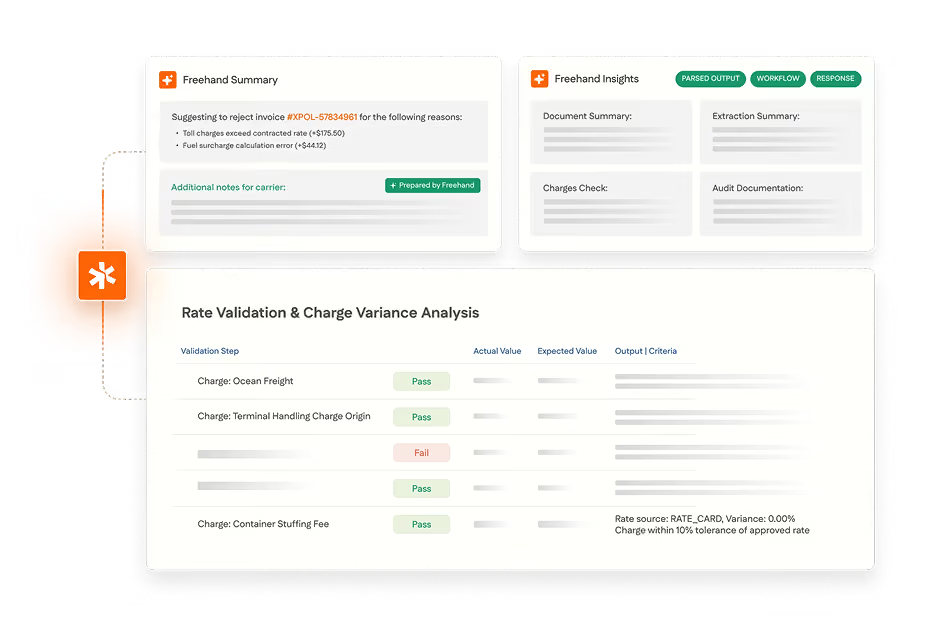
Freehand's freight audit platorm closes that gap. It connects carrier contracts, TMS shipment data, and AP systems to validate every invoice line against contracted terms before payment clears, across parcel, LTL, FTL, ocean, and 3PL.
For enterprises where freight represents $15M or more in annual spend, that enforcement recovers 1.5 to 2.5% of freight spend annually. Not through renegotiation. Through enforcing the contracts already in place.
Request a demo to see what contract compliance looks like against your current carrier portfolio.
{{brown-cta}}
Frequently Asked Questions
What is maverick spending?
Any purchase made outside an organization's approved procurement processes, contracted suppliers, or formal authorization workflows, whether intentional or not.
How much does maverick spending cost organizations?
Organizations lose 5 to 16% of targeted procurement savings to maverick buying annually. For a $500M spend organization, that's $15 to $55M per year in lost negotiated value.
What is the difference between maverick spend and tail spend? T
ail spend is low-value purchasing across many suppliers. Maverick spend is non-compliant purchasing that bypasses approved processes. Tail spend may be unmanaged. Maverick spend violates established policy.
Why does maverick spending happen?
Primarily because the compliant procurement process is slower than the alternatives. Cumbersome workflows, lack of approved supplier visibility, and decentralized buying structures are the most common root causes.
How does maverick spending appear in freight and logistics?
As spot freight outside the routing guide, carrier invoice charges billed without a contract basis, and 3PL billing outside the master service agreement. All represent money flowing outside negotiated terms, arriving via invoice rather than purchase decision.
Freehand Checks Every Freight Invoice Against the Contract That Was Actually Signed.
Freehand's AI Teams validate freight charges against your negotiated rates automatically, closing one of the largest sources of maverick cost leakage in logistics.
A Contracted Rate Doesn't Stop Maverick Spend on Its Own.
Negotiated savings erode the moment a purchase, or an invoice, slips outside the terms procurement signed off on.
Every warehouse. Every provider. Every mile.
Gartner's 2026 outlook on logistics outsourcing, and how AI Teams hold every contract to the terms you agreed.
- Where outsourced logistics quietly loses margin
- Why billed charges drift from the contract
- How AI Teams close the gap


.png)