
What Is Freight Audit and Payment? How the Combined Process Works
.webp)
June 13, 2026
•
12
mins
Most enterprise AP teams process freight invoices through one system and release payment through another. That separation looks like a workflow choice. In practice, it's a control gap: payment can release before validation is complete, and charges that should have been disputed have already cleared the AP account.
Freight audit and payment (FAP) is the integrated model that closes that gap by making validation the gate that payment can't bypass, within a single end-to-end workflow.
What follows covers what freight audit and payment is, what the combined process includes, why the integration between audit and payment determines recovery rate, and what full coverage looks like in practice.
Key Takeaways
- Freight audit and payment is one integrated process, not two.Audit validates every charge against contracted rates and verified service events. Payment releases only after that validation clears. Separating them creates a window where overcharges clear payment before any dispute is filed.
- Carrier billing errors run 1.5–2.5% of total freight spend.On $50M in annual freight spend, that's $750,000–$1.25M per year in overcharges. Most clear because payment releases before validation runs deep enough to catch them.
- Three structural gaps define most FAP programs.Threshold auto-approval, statistical sampling, and broker conflict of interest each create predictable blind spots in programs that are otherwise actively auditing and paying freight invoices.
- Four numbers show whether a FAP program is working.Invoice coverage rate, first-pass match rate, recovery rate against the 1.5–2.5% benchmark, and invoice cycle time each measure a different dimension of what the program is actually catching.
What Is Freight Audit and Payment?
Freight audit and payment (FAP) is the end-to-end workflow that validates every carrier invoice against contracted rates, approved charge types, and verified service events, then releases payment only after that validation is complete.
The two parts of the term represent two distinct functions: audit (the validation layer) and payment (the execution layer). The reason they're described together is that the order matters.
Standard AP processes freight invoices the same way it processes vendor invoices: confirm the invoice references a known supplier, check that the amount is within a plausible range, and release payment. For vendor invoices with fixed pricing, that workflow is appropriate.
Freight invoices don't have fixed pricing. A carrier invoice contains three components:
- Linehaul rate: set in the carrier contract, validated against the rate card at time of shipment
- Fuel surcharge: calculated weekly against the EIA diesel price index
- Accessorial charges: variable in number, each with a contracted fee and a triggering service condition that may or may not have been met
Releasing payment on that structure without validating every component means paying whatever the carrier billed, not what the carrier contracted to bill.
Freight audit and payment closes that gap by making validation the gate. Audit completes, exceptions are resolved, and payment releases from the same workflow. That sequence is what separates FAP from freight payment with a parallel or after-the-fact audit layer.
The integration between audit and payment isn't an operational convenience. It's the control mechanism that determines whether overcharges are disputed before payment or chased afterward.
What the Freight Audit and Payment Process Covers
The freight audit and payment process covers six stages: invoice ingestion and extraction, rate validation against contracted terms, accessorial verification, exception handling and dispute resolution, GL coding and ERP allocation, and payment release. Audit runs before payment at every stage.
Each stage has a distinct failure mode. Understanding where the process can break determines how much of the 1.5–2.5% overcharge rate a program actually captures.
Invoice ingestion and rate extraction
Carriers submit invoices via EDI 210, carrier portal, PDF, or email. Ingestion captures the invoice data and prepares it for validation. Non-EDI formats require data extraction before validation can begin. At enterprise invoice volumes, that extraction backlog adds cycle time: invoices sit in a queue while data is normalized, delaying the audit that follows.
Rate validation against the carrier contract
Every invoice charge is compared against the carrier agreement. Linehaul rates are checked against the rate card in force at time of shipment. Fuel surcharges are validated against the EIA diesel index for the departure week. Accessorial charges require the contracted rate check plus a confirmed service event trigger.
Rate card staleness is the most common source of systematic billing errors at this stage.
When the audit system validates against a rate card that's days or weeks out of date, because a contract amendment wasn't loaded or a fuel surcharge table wasn't refreshed, charges pass validation against the wrong rate. The invoice matches. The match is wrong.
Accessorial verification and exception handling
Accessorial charges each have a contracted rate and a service event trigger. Detention requires verified carrier arrival and departure timestamps. Liftgate requires a non-dock delivery record. Residential delivery requires a confirmed address classification. Validating the rate without verifying the trigger is the most common accessorial audit gap.
Invoices that fail validation enter an exception workflow: the discrepancy is documented, a dispute packet is assembled, and the claim goes to the carrier. At BPO-based providers, 10–15% of the invoice population enters this queue as standard operating condition, producing the cycle time drag that pushes manual FAP to 30+ days.
GL coding and payment release
Validated invoices are coded to the correct cost center, lane, business unit, and GL account before ERP entry is created. At enterprise scale, this runs across multiple ERPs with entity-specific allocation rules. Payment releases only after GL coding clears, so every invoice reaches the ERP with the right cost attribution, not an estimate that requires correction at month-end.
The coverage at each stage determines the recovery rate. An FAP program that validates rates but skips accessorial trigger verification covers part of the exposure. One that samples invoices recovers from part of the population. Full coverage means every stage applied to every invoice.
For the exception types each stage catches and how each one gets resolved, see our stage-by-stage guide to the freight audit process.
Why Freight Audit and Payment Run Together, Not Separately
Running freight audit and payment as a combined workflow is a control argument: payment that releases before audit completes creates a window where overcharges become recoverable disputes rather than prevented payments. Dispute recovery costs more time and carrier relationship capital than pre-payment validation.
Three structural gaps define most FAP programs, and each represents a design decision that lets charges through before full validation runs.
The threshold auto-approval problem
Most legacy FAP systems set a dollar threshold below which invoices auto-approve without line-item validation. Thresholds exist because manual audit is labor-intensive.
At 10,000 invoices per month, auditing every $47 accessorial charge by hand costs more in analyst time than the charge is worth. Sub-threshold auto-approval was a reasonable tradeoff when audit was a manual process.
A Fortune 500 home appliance manufacturer ran freight audit with a $3,000 invoice threshold. Invoices below that amount cleared AP automatically, every billing cycle. After Freehand deployed full-coverage audit across every invoice, the company recovered $6M annually. The majority came from charges that had been auto-approving for years, because carriers had learned where the threshold sat.
The broker conflict of interest
When a freight broker or 3PL performs the audit on its own invoices, the incentive to find and recover billing errors is structurally zero. This arrangement is common in mid-market logistics, where the broker bundles audit as a service. FTL and dedicated lane spend, often the highest-cost categories, typically receive no independent review in these setups.
Freight audit requires an adversarial relationship between the audit function and the billed party. Combined FAP with an independent platform eliminates the conflict by design: the audit engine has no financial relationship with the carriers being reviewed.
Post-payment vs. pre-payment recovery
Post-payment FAP releases funds and pursues recovery through carrier credits and dispute adjustments. Pre-payment FAP holds funds until audit clears. Recovery rates differ because post-payment disputes require carrier cooperation, dispute windows have time limits, and the payment already released shifts negotiating position toward the carrier.
Pre-payment FAP is the standard for enterprise operations with sufficient audit infrastructure. Post-payment is common where cycle time or audit capacity can't keep pace with invoice volume, which is itself a symptom of the structural problem.
Eliminating these three gaps requires 100% invoice coverage, validation against current rate data, and an audit function with no financial relationship with the carriers being audited.
{{blue-cta}}
What Full Freight Audit and Payment Coverage Looks Like
Full FAP coverage means every invoice, in every mode, validated against the current contracted rate and service event record, before payment releases, with a first-pass match rate approaching 99.5% rather than the 85–90% BPO average.
The gap between partial and full coverage shows up in three places: recovery rate, cycle time, and the accuracy of freight cost data reaching the ERP.
A leading American supercenter retailer ran freight audit through a third-party provider with no AI capability. Rate management was maintained manually in spreadsheets, with one analyst spending 25 hours per week on exception output alone. The first-pass match rate was approximately 70%, meaning 30% of invoices required manual exception handling as a baseline operating condition.
After Freehand took over the freight audit and payment program, annual recovery reached $800K–$1.3M on $54M in freight spend. The first-pass match rate moved toward 95%. The analyst workload that had consumed 25 hours per week shifted to exceptions that genuinely required human judgment, which turned out to be a fraction of the prior volume.
The difference wasn't effort. It was coverage depth: more invoice types in scope, rate cards current at time of validation, and accessorial triggers checked rather than assumed.
| Partial Coverage (BPO / Managed Service) | Full Coverage (AI-Powered FA & P) | |
|---|---|---|
| Invoice population covered | Partial sample | 100% |
| First-pass match rate | 85–90% | 99.5% |
| Exception rate to manual queue | 10–15% | Under 1% |
| Rate card currency | Days to weeks lag | Real-time |
| Accessorial trigger verification | Spot-check or skipped | Every invoice, every charge |
| Invoice-to-payment cycle | 30+ days | Under 3 days |
| GL coding | Manual or rules-based | Automated, multi-ERP |
Coverage depth is the variable that determines recovery rate. Every other metric follows from how many invoices actually clear full validation before payment releases.
Why Traditional FAP and AI-Powered FAP Produce Different Recovery Rates
Traditional freight audit and payment providers use managed service models where human reviewers validate invoices and route exceptions to analyst queues. AI-powered FAP automates the full validation, exception, and payment workflow, which changes the invoice coverage rate that's operationally achievable.
The traditional FAP model scales headcount with invoice volume. At enterprise freight volumes, the BPO's labor cost grows with the shipper's freight spend, and the 10–15% exception rate stays constant because human reviewers can only audit the sample they have capacity for.
AI-powered FAP scales intelligence with volume. Every additional invoice processed improves the model rather than adding to a queue. The 99.5% first-pass match rate, compared to the 85–90% BPO average, is the direct consequence of that structural difference.
That structural difference explains why the 10–15% exception rate is a fixed cost in the BPO model: the exception queue is the audit mechanism, not a symptom of insufficient effort.
The economic case for AI-powered FAP isn't about replacing reviewers. It's that the 10–15% exception rate a BPO manages is the expected output of sampling-based audit.
Full coverage drops the genuine exception rate to under 1%. The AP team handles exceptions that require judgment, not exceptions that exist because the review queue outgrew the team's capacity to clear it.
The top 10 freight audit BPOs generate $1.5B in combined revenue at sub-10% EBITDA margins. The labor cost model is structural: every new invoice is another unit of work. That constraint doesn't exist in an AI-native platform.
How to Know If Your Freight Audit and Payment Program Has Gaps
Four metrics show whether a freight audit and payment program is working: invoice coverage rate, first-pass match rate, recovery rate against total freight spend, and invoice cycle time.
Invoice coverage rate
Full Freight Audit and Payment covers every invoice in every mode: parcel, LTL, FTL, ocean, intermodal, air, and dedicated fleet. Any mode that processes outside the audit workflow is exempt from the recovery benchmark, even though billing errors in that mode accumulate at the same 1.5–2.5% rate.
Most enterprise programs have at least one coverage gap: parcel on a separate system, EMEA managed regionally, or dedicated fleet audited by the 3PL managing it.
First-pass match rate
The share of invoices that clear validation without entering a manual exception queue. BPO average is 85–90%. AI-powered platforms with current rate cards and service event data achieve 99.5%.
A first-pass match rate below 90% means 10% or more of invoices go to manual review every cycle. That queue is where cycle time accumulates and where coverage gaps compound.
Recovery rate against total freight spend
Carrier billing errors run 1.5–2.5% of total freight spend. If a program recovers significantly below that benchmark, especially when measuring recovery against the audited portion rather than total spend, the gap represents overcharges clearing without detection.
Programs that sample 30–40% of invoices will show a lower recovery rate, not because their audit is more accurate, but because they're not reviewing the full population.
Invoice cycle time
Manual and BPO-based FAP processes run 30+ days from invoice receipt to carrier payment. AI-powered FAP compresses that to under 3 days.
For AP teams managing month-end close, that difference determines whether freight costs appear as actuals or estimated accruals. A 30-day cycle means invoices received after the close cutoff accrue at estimated rates, creating a gap that compounds across every close.
Your Freight Audit and Payment Program. Is the Gate Pre-Payment?
At 1.5–2.5% of freight spend in carrier billing errors, an enterprise with $50M in annual freight spend carries $750,000–$1.25M per year in charges that cleared AP because payment released before audit ran deep enough, because a mode was outside scope, or because the invoice population was too large for the exception queue to process before month-end.
The pre-payment gate is what separates freight audit and payment from freight payment with an audit layer attached. When audit is the gate, overcharges don't clear. When audit runs after payment, overcharges do clear, and recovery becomes a dispute-and-wait process instead of a validation-and-block process.
Full freight audit and payment closes the pre-payment gap across four dimensions.
- Validating every invoice in every mode against current contracted rates, before payment
- Verifying every accessorial charge against a confirmed service event record
- Applying GL coding across all ERPs before payment releases
- Compressing the invoice-to-payment cycle to under 3 days
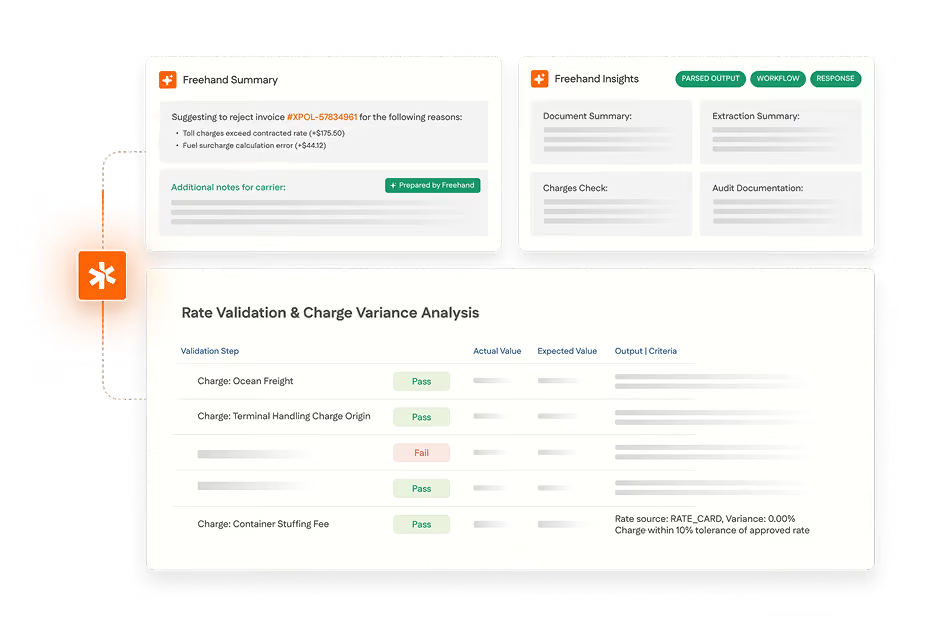
Freehand's Freight Audit & Payment platform runs AI Teams across every invoice. Each charge is matched against the Context Graph: the connected layer of carrier contracts, shipment records, BOL data, service event logs, and GL rules.
It delivers a 99.5% first-pass match rate, 95–98% touchless processing, and 30-to-3-day cycle time compression from the first month of operation.
The right question for any enterprise FAP program: is the 1.5–2.5% recovery benchmark being measured against every invoice in every mode, or against the audited portion of a sampled population? That distinction determines what the program is actually capturing and what it isn't.
For a side-by-side look at providers, our guide to the best freight audit and payment software breaks down how the leading options compare. If you're evaluating audit-only tools rather than combined FAP platforms, our roundup of the best freight audit software covers that narrower category.
{{brown-cta}}
Frequently Asked Questions
What is freight audit and payment?
Freight audit and payment (FA&P) is the integrated process of validating carrier invoices against contracted rates and service events, then releasing payment only after validation clears. It combines charge-by-charge audit with payment execution in one pre-payment workflow, so overcharges are disputed before funds leave the AP account rather than recovered after the fact.
What is the difference between freight audit and freight audit and payment?
Freight audit validates invoices against contracted rates. Freight audit and payment adds the payment execution step, so funds release from the same workflow that ran validation. When audit runs separately, payment and audit can operate on different timelines, creating a window where overcharges clear before any dispute is filed. Combined FA & P eliminates that window.
What does a freight audit and payment company do?
A Freight audit and payment company validates carrier invoices against contracted rates and service events, routes billing exceptions to dispute workflows, applies GL coding, and releases payment. Traditional providers used manual reviewers on 30+ day cycles. AI-native platforms automate validation and dispute resolution end-to-end, compressing invoice-to-payment to under 3 days on every billing cycle.
What is pre-payment freight audit?
Pre-payment freight audit validates every carrier invoice against contracted rates and service event records before payment is released. No charge reaches the AP account until it has cleared validation, exceptions are resolved, and GL coding is confirmed. Pre-payment captures the full recovery value by preventing overcharges rather than pursuing carrier credits after payment has cleared.
What is the difference between pre-payment and post-payment freight audit?
Pre-payment audit validates invoices before payment releases: overcharges are disputed before funds leave the AP account. Post-payment audit releases payment and pursues recovery through carrier credits and adjustments. Pre-payment captures higher recovery value. Post-payment recovers a portion, and resolution requires carrier cooperation across dispute windows that may span multiple billing cycles.
Why do freight audit and payment programs miss billing errors?
Most Freight audit and payment programs let billing errors through three structural gaps: invoice thresholds that clear charges without validation, sampling that skips a large share of invoices each cycle, and audit run by the biller with no incentive to find errors. Each gap creates a window where overcharges accumulate undetected.
How much does freight audit and payment recover?
Full Freight audit and payment recovers 1.5–2.5% of total freight spend annually. On $30M, that's $450,000–$750,000 per year. On $100M, it's $1.5M–$2.5M. Both figures apply to the full invoice population. Programs auditing a partial sample or applying invoice thresholds recover a fraction of those amounts and leave the balance clearing AP undetected.
What is the first-pass match rate in freight audit and payment?
First-pass match rate is the share of invoices that clear validation without entering a manual exception queue. BPO-based providers average 85–90%, meaning 10–15% of invoices go to manual review every cycle. AI-powered Freight audit and payment platforms achieve 99.5%, dropping the genuine exception queue to under 1% of invoice volume.
What freight modes should a Freight audit and payment program cover?
A complete Freight audit and payment program covers LTL, FTL, parcel, intermodal, ocean, air, and dedicated fleet across all carrier relationships. Most enterprise programs cover domestic LTL and truckload systematically. Parcel, ocean, EMEA, LATAM, and dedicated fleet frequently fall outside scope and generate no recovery, even though billing errors in those modes accumulate at the same 1.5–2.5% rate.
How long does freight audit and payment implementation take?
Enterprise FAP platforms typically go live in 12–14 weeks, requiring 11–20 hours of the client team's time. No ERP customization is needed at go-live. The platform operates on existing infrastructure while API integration is configured in parallel. Within 90 days, touchless processing reaches 95–98% and recurring exception suppression passes 70%.
What ERP systems does freight audit and payment integrate with?
Enterprise Freight audit and payment platforms integrate with SAP, Oracle, JD Edwards, NetSuite, Infor, Dynamics, and other major ERP systems for GL coding, cost allocation, and invoice entry. At enterprise scale, programs normalize data across multiple ERP instances. A global manufacturer running 15 ERP systems requires the platform to apply the correct GL allocation rules for each legal entity, the exact problem this Fortune 50 healthcare and consumer products company solved after replacing a 20-year outsourced BPO.
What is a freight audit and payment BPO?
A freight audit and payment BPO is a managed service provider that handles invoice validation and payment through human reviewers. BPO providers audit a sample of invoices, route exceptions to analyst queues, and run 30+ day payment cycles. Coverage and accuracy are constrained by headcount, which scales linearly with invoice volume and creates a permanent capacity ceiling.
One Workflow. No Gap for a Charge to Slip Through.
Freehand runs audit and payment as a single process, so a charge is validated before it's ever eligible to pay.
Two Systems, One Blind Spot Between Them.
Freight audit runs in one system, payment in another. That gap between them is where overcharges clear before anyone disputes them.
Every warehouse. Every provider. Every mile.
Gartner's 2026 outlook on logistics outsourcing, and how AI Teams hold every contract to the terms you agreed.
- Where outsourced logistics quietly loses margin
- Why billed charges drift from the contract
- How AI Teams close the gap