

What Is Freight Payment? How the Process Works at Enterprise Scale
.webp)
June 24, 2026
•
10
mins
An AP team processes freight invoices alongside vendor invoices every day. The difference: a vendor invoice is fixed. A freight invoice contains a linehaul rate, a fuel surcharge calculated against an external price index, and a variable number of accessorial charges, each with a contracted rate and a triggering condition that may or may not have been met.
At an enterprise processing 10,000 freight invoices a month, the gap between processing those invoices and validating them against contracted rates costs 1.5–2.5% of total freight spend per year. At $50M in annual freight spend, that's $750,000–$1.25M in charges that cleared AP without the validation that would have caught them.
What follows covers what freight payment is, how the process works from invoice receipt through carrier remittance, where it breaks down at enterprise scale, and what a fully validated freight payment workflow looks like.
Key Takeaways
- Freight payment is not standard AP. Carrier invoices have three charge types: linehaul, fuel surcharge, and accessorials, each requiring a different validation check before payment releases.
- The process has six steps. Invoice ingestion, rate validation, accessorial verification, exception routing, GL coding, and payment release. Each step is a potential breakpoint.
- Cycle time is a working capital issue. Manual freight payment processes run 30+ days from invoice receipt to release. At enterprise freight volumes, that cycle ties up funds and produces freight cost estimates at month-end rather than actuals.
- Recovery runs 1.5–2.5% of freight spend. That is the benchmark for what systematic, fully validated freight payment recovers annually from carrier billing overcharges.
What Is Freight Payment?
Freight payment is the end-to-end process of receiving carrier invoices, validating every charge against contracted rates and verified service events, resolving discrepancies, coding invoices to the correct cost centers, and releasing funds to the carrier.
The word "payment" implies the end of the process. In practice, the validation work that happens between invoice receipt and payment release is where most of the cost and risk sits.
Standard AP processes carrier invoices using the same workflow applied to vendor invoices: match the invoice to a purchase order, confirm the goods or services were received, and release payment.
Freight invoices don't fit that model. There is no PO for an accessorial charge that billed because the carrier claimed a residential delivery on a commercial address. There is no receipt to match against a detention charge that may or may not reflect a real carrier wait time.
Freight payment at enterprise scale requires a workflow built specifically for carrier invoice structure, not a standard AP workflow applied to freight.
The six steps of that workflow are where the validation either happens before payment or gets skipped entirely.
How the Freight Payment Process Works
The freight payment process runs through six steps: invoice ingestion, rate validation, accessorial verification, exception handling, GL coding, and payment release. Each step is a potential gap in coverage.
Understanding where the process can fail at each step explains why enterprise freight payment costs more than it should and why cycle times run as long as they do.
Invoice receipt and ingestion
Carriers submit invoices via EDI 210, carrier portals, email, or PDF. At enterprise freight volumes, this step is usually automated: invoices arrive and data gets extracted. Most AP automation solves the capture problem. The problem is what happens after capture.
Invoices that arrive via PDF or non-standard carrier portals require data extraction before validation can begin. At enterprise invoice volumes, that extraction backlog is a source of cycle time drag: invoices sit in the queue while the AP team processes incoming formats.
Rate validation against the carrier contract
Every charge on a carrier invoice needs to be compared against the rate the carrier was contracted to bill. Linehaul rates are set in the carrier contract. Fuel surcharge tiers are indexed to the EIA diesel price for the week of pickup. Minimum charges, weight-based adjustments, and mode-specific pricing all have contracted values.
The rate validation step fails when the audit system checks against a rate card that is out of date. Carrier contract amendments, fuel surcharge updates (weekly for most contracts), and seasonal rate changes create windows where the validation system checks against the wrong rate.
Rate card staleness is the single most common root cause of systematic freight billing errors, because charges pass the match check while being compared to a prior contract version.
Accessorial verification
Accessorial charges have two data requirements: a contracted rate and a verified trigger event. The contracted rate is in the carrier agreement. The trigger event is in the shipment record.
Detention requires verified carrier arrival and departure timestamps. Liftgate requires a delivery confirmation on a non-dock shipment. Residential delivery requires an address classification.
Without service event data in the audit flow, an accessorial charge cannot be verified. Most freight payment processes don't connect service event data to the validation step: the charge passes on the contracted rate alone, without confirming the service event occurred.
Exception handling and dispute routing
Invoices that fail validation enter a dispute workflow. The exception is documented with the specific charge, the contracted rate, and the supporting evidence. The dispute goes to the carrier with a deduction or a payment hold.
Resolution timelines vary by error type. Overcharges on documented charges resolve in days. Post-delivery reclassification disputes, where the carrier reinvoices at a higher freight class weeks after delivery, require comparing the reclassification claim against the NMFC schedule, the original BOL, and any carrier inspection documentation.
At BPO-based freight audit providers, 10–15% of every invoice population enters the exception queue as standard operating condition. That queue is where most of the cycle time in a manual freight payment process accumulates.
GL coding and ERP allocation
Once validated, every invoice line is coded to the correct cost center, lane, business unit, and GL account. At enterprise scale, that coding logic is complex: multiple ERPs (SAP, Oracle, NetSuite), multiple cost allocation rules by mode and lane, and business unit requirements that vary by region.
GL coding errors on freight invoices don't generate exceptions during payment processing. They surface in financial reporting: when freight cost per lane is wrong, when a business unit P&L shows an unusual cost spike, or when month-end close produces freight accruals that don't match the actual invoice population.
Payment release and carrier remittance
After validation, exception resolution, and GL coding, payment is released. The timing depends on whether the process runs pre-payment or post-payment audit.
Pre-payment freight audit validates invoices before payment releases. The AP account isn't debited until the invoice clears full validation.
Post-payment audit releases payment first and recovers overcharges through dispute resolution afterward. Pre-payment is the standard for enterprise operations with sufficient audit infrastructure. Post-payment is common where cycle time or audit capacity can't keep pace with invoice volume.
The gap between a 30-day manual payment cycle and a 3-day AI-automated cycle has a direct working capital number: invoices validated but unpaid sit on the books for weeks longer than necessary.
Where the Freight Payment Process Breaks Down
The freight payment process fails in four predictable ways: rate card staleness, accessorial charges without trigger verification, GL coding errors at scale, and invoice cycle drag that creates working capital and accrual problems.
Each failure mode has a direct financial cost. Together, they explain why enterprises with active freight payment programs still carry recoverable overcharge exposure.
Rate cards that don't reflect the current contract
When the audit system validates invoices against a rate card that is days or weeks out of date, charges pass validation against the wrong rate. The carrier's invoice may be correct or incorrect against the current contract. The audit system cannot determine which because it is checking the wrong version.
Rate card staleness is most acute for fuel surcharges, updated weekly against the EIA index, and for carriers with active contract amendment cycles.
At enterprise scale with 50–150+ carrier relationships, keeping rate cards current in a manual or BPO-based system is a permanent catch-up problem. Every week of lag is a window where charges pass that should have been flagged.
Accessorial charges that clear without service verification
A standard freight payment process checks the accessorial rate, confirming the amount matches the contracted fee for that charge type. It typically doesn't check whether the triggering service event occurred.
When Freehand audited a Fortune 15 pharmaceutical distributor's freight program, $600K per month in billing discrepancies were being caught and resolved before reaching AP. The previous payment process had been checking rates. It had not been checking service events.
The discrepancies were accumulating in the gap between rate validation and trigger verification, clearing AP every billing cycle.
GL coding errors that don't surface until month-end
GL coding errors on freight invoices are invisible during payment processing. No exception is raised. The invoice processes, payment releases, and the coding error sits in the ERP until financial reporting surfaces it.
A Fortune 100 Healthcare & Consumer Goods company running freight payment across 80+ carriers and 15 global ERPs had no self-service visibility into freight spend by cost center, carrier, or mode. Every spend question required engaging their freight audit BPO and manually reconciling outputs.
When Freehand took over the freight payment process, the 15-ERP data landscape was normalized into a unified spend intelligence layer, and the logistics finance team shifted from manual discrepancy reconciliation to active carrier management.
Invoice cycle drag and its working capital cost
Manual freight payment runs 30+ days from invoice receipt to payment release. That cycle time is driven by the sequential nature of manual validation: invoices wait for rate card retrieval, then exception review, then GL coding approval, before payment queues are built.
For AP teams managing month-end close, a 30-day cycle means freight cost is an estimate at close, not an actuals-based figure.
Invoices received after the close date are accrued at estimated rates. The gap between estimated and actual freight cost accumulates across every close cycle, compounding in the financial data that business units use for P&L decisions.
Cycle time compression from 30+ days to under 3 days is the working capital lever most enterprise freight payment programs have not applied.
Freight Payment vs. Standard Accounts Payable
Freight payment requires a different workflow than standard AP because carrier invoices have variable charge structures, external-index-linked pricing, and service-event conditions that standard vendor invoices don't have.
The differences in invoice structure and exception rate explain why standard AP automation doesn't solve the freight payment problem at enterprise scale.
{{blue-cta}}
The exception rate difference is the most significant operational consequence. At a 10–15% exception rate, a freight AP team processing 10,000 invoices a month routes 1,000–1,500 invoices to manual exception handling every month as standard operating condition. That volume requires either a large AP team, a BPO provider, or an automated freight audit layer.
Standard AP automation was designed for 1–3% exception rates. At freight's 10–15%, the exception load breaks the automation.
What Full Freight Audit and Payment Looks Like
Full freight audit and payment combines rate validation, accessorial verification, GL coding automation, and dispute routing into a single workflow that runs before payment releases on every invoice.
The contrast between processing freight invoices and auditing them before payment is measurable in recovery rate, cycle time, and the accuracy of the financial data that reaches the ERP.
A high-growth consumer products company with $33M in annual freight spend had a structural problem in its freight payment process: its LTL carrier was also performing the LTL freight audit. The auditor reviewed its own invoices. FTL spend ($15M of $33M total) had no audit coverage at all. Invoice aging ran 30+ days.
After Freehand took over both the audit and payment process, invoice cycle time compressed from 30+ days to under 3 days. Annual recovery ran $495K–$825K, or 1.5–2.5% of $33M in freight spend. The FTE workload reduction on manual reconciliation ran $120K–$140K per year in reclaimed AP capacity.
Full freight audit and payment delivers three outcomes a standard freight payment process doesn't:
- Every invoice is validated before payment, not sampled or threshold-approved\
- Accessorial charges are verified against service events, not just rated against the contract
- GL coding runs automatically against current allocation rules across all ERPs
The gap between standard freight payment and full freight audit and payment shows up directly in the recovery rate and in the accrual accuracy that finance teams can use.
How to Know If Your Freight Payment Process Has Gaps
Four numbers show whether a freight payment process is working: invoice cycle time, first-pass match rate, recovery rate against total freight spend, and exception recurrence rate.
Invoice cycle time
A manual or BPO-based freight payment process runs 30+ days from invoice receipt to carrier remittance. An AI-automated process runs under 3 days.
If your current cycle time sits in the 20–30 day range, month-end accruals are estimates. If it exceeds 30 days consistently, the backlog is compounding: invoices from one period are clearing in the next.
First-pass match rate
The share of invoices that clear validation without manual exception handling. BPO-based providers average 85–90%, meaning 10–15% of invoices go to manual review as standard operating condition. A rate below 90% indicates that rate cards are out of date, accessorial validation logic is shallow, or both. The exception queue that results is where cycle time accumulates.
Recovery rate against total freight spend
Carrier billing errors run 1.5–2.5% of total freight spend. If your freight payment program's recovery rate is significantly below that benchmark, and especially if you're measuring recovery against the audited portion of invoices rather than total spend, the gap represents overcharges clearing without detection. The benchmark applies to the full invoice population, not a sample.
Exception recurrence rate
If the same carrier generates the same exception type every billing cycle, the freight payment process is routing individual occurrences rather than resolving the root cause. A well-built payment workflow identifies recurring billing error patterns and suppresses them at the contract or billing-logic level, not by re-queuing the same exceptions monthly.
Your Freight Payment. Is It Fully Validated Before Release?
At 1.5–2.5% of freight spend in carrier billing errors, an enterprise with $50M in annual freight spend carries $750,000–$1.25M per year in charges that cleared AP because the rate card wasn't current, the accessorial trigger wasn't verified, or the invoice arrived after the validation window closed.
That figure is a function of the validation depth the freight payment process runs: which invoice population it covers, which charge types it checks, and whether validation happens before or after payment releases.
Full freight audit and payment closes those gaps by:
- Validating every invoice against the current contracted rate before payment
- Verifying every accessorial charge against a confirmed service event record
- Automating GL coding across all ERPs before ERP entry is created
- Compressing the invoice-to-payment cycle to under 3 days
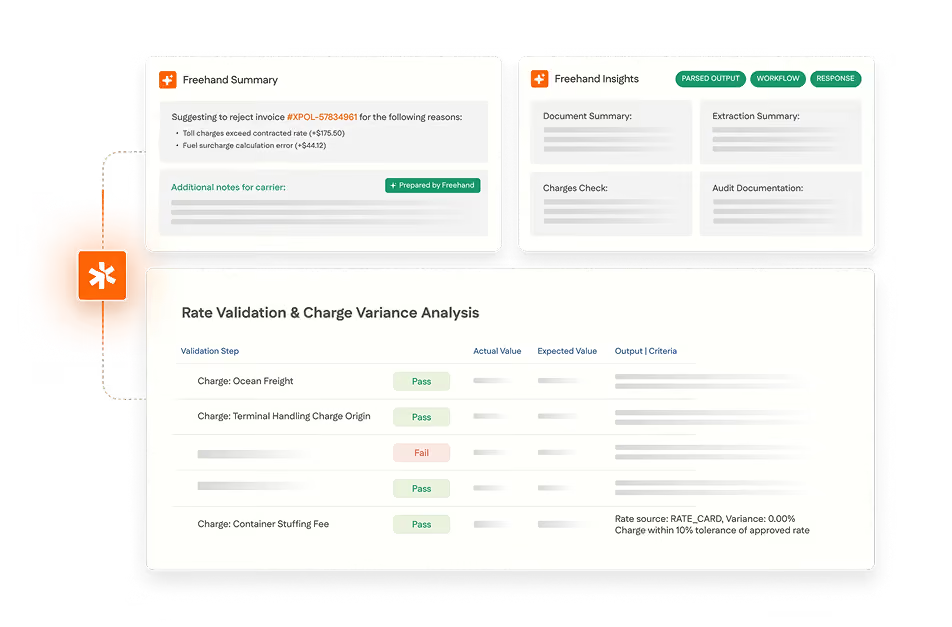
Freehand's [Freight Audit & Payment](https://freehand.ai/freight-audit-payment) platform runs AI Teams across every invoice, matching each charge against the Context Graph, the connected layer of carrier contracts, shipment records, BOL data, and GL rules.
It delivers a 99.5% first-pass match rate, 95–98% touchless processing, and 30-to-3-day cycle time compression from the first month of operation.
For enterprise AP and transportation finance teams: the recovery benchmark is 1.5–2.5% of total freight spend. The cycle time benchmark is under 3 days. Those are the numbers a fully validated freight payment process produces.
{{brown-cta}}
Frequently Asked Questions
What is the freight payment process?
The freight payment process is the end-to-end workflow for validating carrier invoices against contracted rates, resolving discrepancies, coding invoices to the correct GL accounts, and releasing payment to the carrier. It covers every charge type: linehaul, fuel surcharge, and accessorials, before funds are released.
How is freight payment different from standard accounts payable?
Standard AP matches invoices to purchase orders at fixed prices. Freight payment validates variable charges: linehaul rates against carrier contracts, fuel surcharges against EIA index tiers, and accessorial charges against verified service events. The exception rate is 10–15% in freight AP vs. 1–3% in standard AP.
What are the steps in the freight payment process?
The six steps are: invoice ingestion, rate validation against the carrier contract, accessorial charge verification, exception handling and dispute routing, GL coding and ERP allocation, and payment release. Validation runs before payment in a pre-payment audit process and after payment in a post-payment process.
What is a freight audit and payment company?
A freight audit and payment company manages the full invoice-to-payment workflow: validating invoices against contracted rates, resolving disputes, and releasing payment. Traditional FAP providers used manual reviewers. AI-native platforms automate the process end-to-end, reducing cycle time from 30+ days to under 3.
What causes delays in the freight payment process?
The most common causes of freight payment delays are invoice backlogs from non-EDI carriers, manual exception queues from rate mismatches, GL coding approvals waiting on cost center sign-off, and dispute resolution timelines on post-delivery reclassification claims. BPO-based processes run 30+ days as a result.
What is pre-payment freight audit?
Pre-payment freight audit validates carrier invoices against contracted rates before payment is released. Every charge is checked, every exception is resolved, and every invoice is GL-coded before funds leave the AP account. It recovers overcharges before they occur rather than pursuing refunds after payment clears.
What is freight invoice GL coding?
GL coding assigns each freight invoice line to the correct cost center, lane, business unit, and general ledger account before the ERP entry is created. Errors produce inaccurate freight cost reporting by lane, carrier, and business unit, and compound in financial reporting until they surface at month-end close.
How long does the freight payment process take?
Manual and BPO-based freight payment typically runs a 30+ day invoice-to-payment cycle from receipt to carrier remittance. AI-powered freight audit and payment compresses that to under 3 days. For AP teams managing month-end close, that difference determines whether freight costs are booked as actuals or estimates.
What is the difference between freight payment and freight audit?
Freight payment is the process of releasing funds to a carrier. Freight audit is the validation layer that confirms every charge matches the contracted rate and every accessorial has a verified trigger event. Combined as freight audit and payment, they form an integrated workflow before funds leave the AP account.
What freight charges require validation before payment?
Carrier invoices contain three charge types that each require different validation: linehaul rates validated against the carrier contract, fuel surcharges validated against the EIA diesel index for the shipment week, and accessorial charges verified against both the contracted rate and a confirmed service event.
Why do freight invoices have so many billing errors?
Carrier billing errors occur when rate cards lag contract amendments, fuel surcharge tables aren't updated to match the current EIA index, or accessorial billing triggers without confirming the service event. These are system errors, not intent. They recur on the same carriers until audit catches the pattern.
What is EDI 210 in freight payment?
EDI 210 is the electronic standard carriers use to transmit freight invoices to a shipper's AP or freight audit system. It is how the invoice arrives, not a validation mechanism. Invoice data extracted via EDI 210 still requires rate validation, accessorial verification, and GL coding before payment is appropriate.
Payment Only Releases After the Charge Clears Validation.
Freehand checks every freight invoice against your contract before it's eligible to pay, closing the gap standard AP payment leaves open.
Processed Isn't the Same as Validated.
A freight invoice can clear payment without ever being checked against the contracted rate that should have applied.
Every warehouse. Every provider. Every mile.
Gartner's 2026 outlook on logistics outsourcing, and how AI Teams hold every contract to the terms you agreed.
- Where outsourced logistics quietly loses margin
- Why billed charges drift from the contract
- How AI Teams close the gap