
Procurement Contract Management: Lifecycle, Types, and Best Practices
.webp)
June 19, 2026
•
13
mins
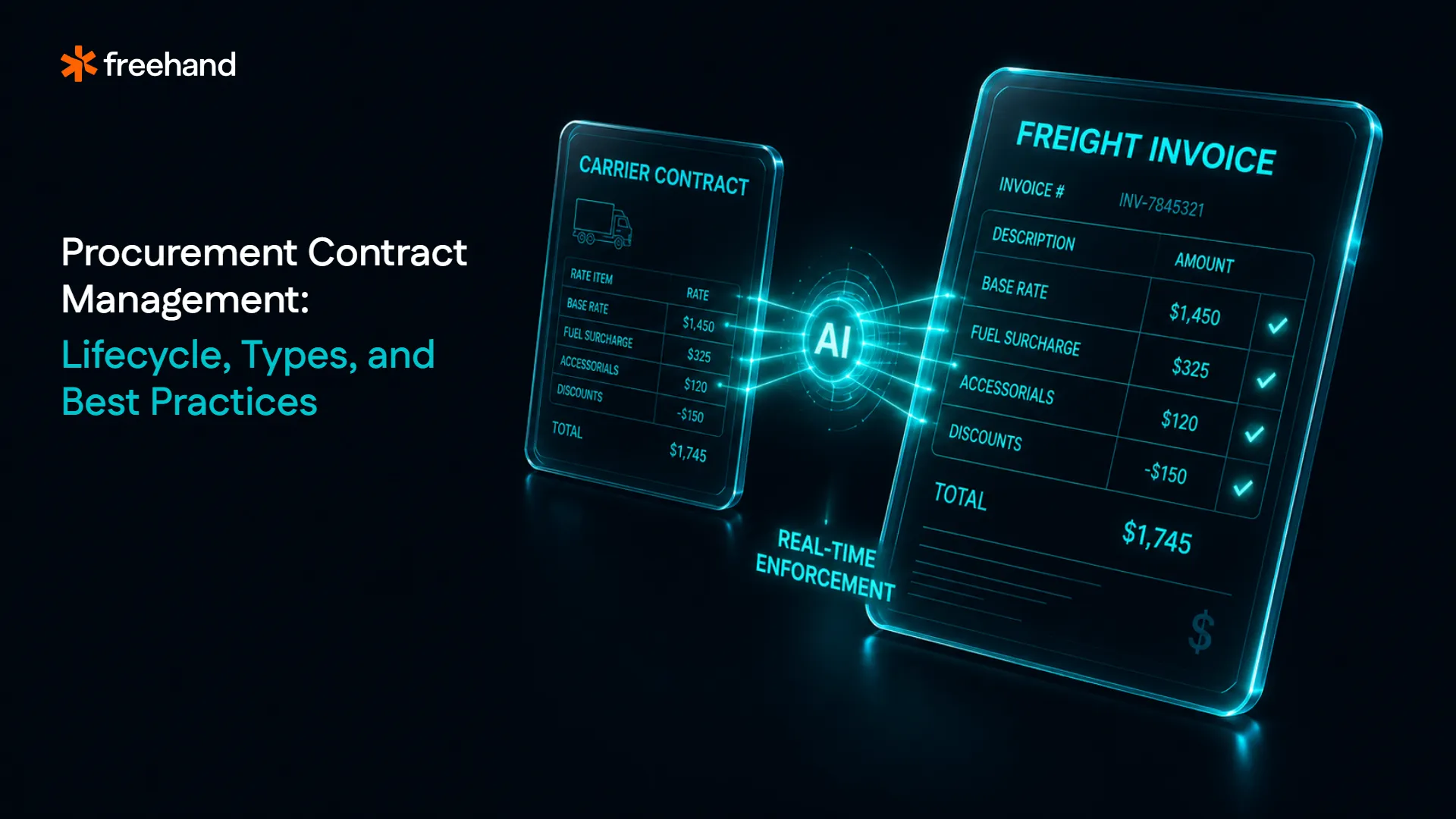
Procurement contract management is the process of creating, executing, and overseeing supplier contracts from initial negotiation through performance monitoring, compliance enforcement, and renewal. It ensures that the terms procurement negotiated are actually honored throughout the life of the agreement, not just at signing. Organizations lose an average of 8.6% of total spending annually to cost leakage in contracts, making contract management one of the highest-value disciplines in enterprise procurement.
Key Takeaways
- Procurement contract management is the systematic process of creating, executing, monitoring, and renewing supplier contracts to ensure that agreed terms are honored, costs stay within contracted limits, and supplier obligations are met throughout the contract lifecycle.
- The contract lifecycle runs across six stages: initiation, drafting, negotiation, execution, performance monitoring, and renewal or termination. Most value leakage occurs after execution, in the monitoring stage, where obligations go untracked.
- The average business loses 9.2% of annual revenue to contract mismanagement. Top performers limit leakage to 3%. The difference is systematic monitoring and enforcement, not better contracts at signing.
- In logistics and freight, contract management is the upstream discipline that determines what gets enforced at the invoice level. A carrier contract with no invoice-level enforcement layer is a document, not a control.
What Is Procurement Contract Management?
Procurement contract management is the process of overseeing supplier contracts across their entire lifecycle, from initial drafting and negotiation through execution, performance tracking, and renewal, to ensure that contracted terms are honored and procurement value reaches the bottom line.
The distinction from general contract management matters. Legal contract management focuses on structure, risk, and language. Procurement contract management focuses on whether the terms procurement negotiated are actually being applied in daily transactions.
A carrier contract that commits a supplier to specific lane rates, fuel surcharge formulas, and accessorial schedules has legal integrity the day it is signed. Whether those rates are being applied correctly on every invoice in every billing cycle is a procurement contract management question, not a legal one.
Operationally, procurement contract management means the terms that procurement spent months negotiating do not disappear into a shared drive after signing. They remain active reference points: compared against invoices, tracked against delivery commitments, and updated when amendments are agreed. Without that continuous enforcement layer, the value gap between contracted terms and actual spend compounds silently through every billing cycle.
What Is the Difference Between Procurement and Contract Management?
Procurement is the process of acquiring goods and services: identifying suppliers, negotiating terms, and placing orders while Contract management is the process of ensuring those terms are honored after the agreement is signed. They are sequential disciplines that most organizations manage separately, creating the enforcement gap where contract value leaks.
Procurement succeeds at the point of signature. A competitive sourcing event produces a carrier contract with favorable lane rates, capped accessorial charges, and a defined fuel surcharge formula. That is a procurement outcome.
Contract management begins at that same point. It tracks whether those lane rates are being applied, whether accessorial charges are staying within the cap, and whether the fuel surcharge formula reflects the weekly index. That is a contract management outcome.
When the two disciplines are disconnected, the most common failure mode follows: procurement negotiates savings that are never fully realized because the enforcement infrastructure to monitor them does not exist. The contract is technically valid. The terms are technically in effect. Nobody is confirming they are being honored transaction by transaction.
95% of organizations lack full visibility into their contractual obligations. That gap is not a negotiating problem. It is a contract management problem.
What Are the Stages of the Procurement Contract Lifecycle?
The procurement contract lifecycle runs across six sequential stages: initiation, drafting, negotiation, execution, performance monitoring, and renewal or termination. Value leakage occurs at every stage, but it concentrates in the post-execution phase where most organizations have the least structured oversight.
Stage 1: Contract initiation
The need for a contract is identified: a new supplier relationship, a renewal approaching, or a category requiring formal terms where informal arrangements currently exist. Procurement defines the scope, establishes internal stakeholder alignment, and documents the requirements the contract must address.
This is also where contract strategy decisions are made. The type of contract, pricing structure, performance metrics, and review cadence should be determined before drafting begins, not during negotiation.
Stage 2: Drafting
The contract document is created: scope of work, pricing schedules, payment terms, delivery commitments, service level agreements, termination clauses, and dispute resolution mechanisms. Standard templates reduce drafting time and ensure clause consistency across the supplier portfolio.
Human contract review takes an average of 92 minutes per document. AI-assisted review takes 26 seconds with 94% accuracy. At enterprise contract volumes, that difference compounds into thousands of hours of legal and procurement team time annually.
Stage 3: Negotiation
Terms are refined between the buyer and supplier. Pricing, payment schedules, volume commitments, and service level standards are the primary negotiation points. The output of this stage is the contracted terms that will govern the relationship until renewal.
This is where sourcing quality pays forward into contract management: the more precisely negotiated the terms, the less ambiguity there is to resolve during performance monitoring. A contract that specifies a fuel surcharge formula to the index and tier level leaves no room for carrier interpretation at billing time.
Stage 4: Execution
The contract is signed and takes legal effect. Both parties accept their obligations. For procurement, this is the point where the enforcement infrastructure needs to be in place: the contracted rates loaded into the AP validation layer, the performance metrics activated in the monitoring system, and the renewal date logged with an advance alert.
Most contract value leakage that surfaces later traces back to this stage. The contract was executed but the terms were never operationalized into the systems that govern day-to-day transactions.
Stage 5: Performance monitoring and compliance
Active contracts are monitored against their terms. Delivery timelines, service levels, pricing compliance, and volume commitments are tracked continuously. Deviations are flagged, investigated, and resolved before they accumulate.
This is where most organizations underinvest. Periodic audits and quarterly reviews catch some deviations. They miss the systematic ones that accumulate across every billing cycle between reviews.
Stage 6: Renewal or termination
As contracts approach expiration, procurement evaluates performance, benchmarks terms against the market, and decides whether to renew, renegotiate, or terminate. Auto-renewal clauses that are missed lock organizations into unfavorable terms. Termination clauses that are not actioned in time create unexpected continuation costs.
71% of businesses cannot locate at least 10% of their contracts. At enterprise contract volumes, that means renewal dates are missed, auto-renewals trigger at unfavorable terms, and the leverage procurement built through performance data goes unused because nobody tracked it.
What Are the Types of Procurement Contracts?
Procurement contracts fall into three primary categories: fixed-price, cost-reimbursable, and time and materials. Each allocates pricing risk differently between buyer and supplier, and each is appropriate for different procurement contexts.
Fixed-price contracts
Fixed-price contracts set a defined price for goods or services regardless of actual costs incurred by the supplier. They give buyers cost certainty and shift cost risk to the supplier. For freight and logistics, lane rate agreements function as fixed-price contracts: a negotiated rate per lane and weight band that the carrier commits to for the contract term.
The enforcement challenge with fixed-price contracts is ensuring the fixed price is actually applied. A carrier that invoices at its published general rate rather than the contracted lane rate is billing off-contract. Three-way matching does not catch it. Contract-rate validation against every invoice does.
Cost-reimbursable contracts
Cost-reimbursable contracts reimburse the supplier for actual costs incurred and add an agreed fee or margin. They are appropriate where the scope cannot be precisely defined in advance: complex infrastructure projects, variable logistics operations, or professional services engagements.
The buyer absorbs cost risk in exchange for scope flexibility. Procurement contract management in cost-reimbursable environments requires rigorous cost documentation and approval workflows to prevent cost escalation from going unreviewed.
Time and materials contracts
Time and materials contracts bill at a defined hourly or daily rate plus the cost of materials. They are common in maintenance, managed logistics services, and professional services engagements where scope varies by period.
For logistics, T&M structures appear in 3PL fulfillment contracts: a per-pick rate, a per-pallet storage rate, and a defined outbound shipping fee. Monitoring compliance means confirming that each billing element matches the actual operational activity recorded in the WMS, and that the rates reflect the contracted tier for the volume handled in the billing period.
What Are the Key Challenges in Procurement Contract Management?
The core challenges in procurement contract management are not negotiation failures. They are execution and monitoring failures: terms that are agreed but not operationalized, obligations that are tracked manually at too low a frequency, and contract data that sits in disconnected systems nobody queries until something goes wrong.
Contract visibility and repository fragmentation
71% of businesses cannot locate at least 10% of their contracts. Contracts stored across shared drives, email threads, legal systems, and procurement platforms create a visibility problem that makes consistent enforcement structurally impossible.
When procurement cannot quickly retrieve the contracted rate for a specific carrier on a specific lane, they cannot confirm whether the invoice is correct. The validation defaults to what the invoice says rather than what the contract requires.
{{blue-cta}}
Post-execution enforcement gaps
Most procurement organizations invest heavily in the pre-signature stages: sourcing, negotiation, drafting, and review. The monitoring infrastructure to enforce terms after execution receives less investment and less attention.
The result is predictable. The 2025 Contracting Benchmarks Report found organizations lose an average of 8.6% of total spending annually to cost leakage in contracts. Most of that leakage does not occur because contracts are poorly negotiated. It occurs because the terms are not continuously enforced once signed.
Amendment management
Contracts are amended regularly: rate renegotiations, scope changes, service level adjustments, and volume tier updates. Each amendment creates a new version of the contracted terms that needs to propagate to every system that uses those terms for validation.
In freight, a rate amendment that is not updated in the AP validation layer before the next billing cycle means invoices validate against expired terms. The overcharges that result are structurally identical to what the renegotiation was meant to eliminate, just on the wrong side of the contract effective date.
Renewal management
Auto-renewal clauses are the most consistently underestimated risk in contract management. A contract that renews automatically on unfavorable terms because no one set an advance alert represents procurement effort invested in negotiation that was subsequently lost to administrative oversight.
Contract automation cuts negotiation cycles by 50% and reduces payment errors by 75 to 90%. Renewal management is one of the highest-return applications: automated alerts 90 and 30 days before expiration give procurement the lead time to renegotiate rather than accept renewal by default.
Worked example: amendment enforcement failure
A logistics enterprise renegotiates its LTL carrier contract in February, securing a 6% reduction on 85 lanes. The amended rate schedule is distributed to the carrier and acknowledged. The AP validation layer is not updated until mid-March.
In the intervening six weeks, 1,200 invoices are processed against 85 affected lanes. Every one validates against the pre-amendment rate. The 6% savings do not apply to any of them. The total overcharge for the six-week period is $47,000 on a $780,000 freight spend segment.
The amendment was negotiated correctly. The contract terms were correct. The enforcement infrastructure was not synchronized, and the savings evaporated before anyone noticed.
What Are the Benefits of Effective Procurement Contract Management?
Effective procurement contract management delivers measurable returns across four dimensions: cost recovery through enforcement, risk reduction through visibility, supplier performance improvement, and compliance readiness. The organizations with the strongest contract management programs are not necessarily better negotiators. They are better enforcers.
Cost recovery through enforcement
World-class procurement achieves 8 to 12% cost reductions in purchasing spend, plus 2 to 3% annually thereafter, according to Bain and Company benchmarks. The ongoing annual reduction comes from continuous enforcement, not from renegotiating every year.
In freight, the equivalent comes from applying contracted rates to every invoice rather than accepting what the carrier billed. Freight cost management at the contract enforcement level recovers 1.5 to 2.5% of freight spend annually in systematic billing deviations that clear AP undetected without an active validation layer.
Supplier performance accountability
Contracts define what suppliers committed to deliver. Contract management makes those commitments enforceable by creating a documented baseline that supplier performance is measured against. Organizations that actively track supplier performance against SLAs have a factual basis for renegotiation that organizations relying on impressions do not.
Compliance and audit readiness
Every contract creates a documentation trail: what was agreed, what was changed, and what was paid. When that trail is complete and accessible, audits and compliance reviews are straightforward. When it is fragmented, audits generate significant remediation work.
Under SOX Section 404, companies must establish and document internal controls for financial reporting. Procurement contract management is a foundational control in that framework, particularly for categories where payment terms, rates, and delivery commitments are contract-governed.
Reduced maverick spending
Clear, accessible contract terms reduce the primary driver of maverick spending: employees not knowing what contracted alternatives exist. When approved suppliers and contracted terms are visible at the point of purchase, off-contract buying concentrates in categories where no contract coverage exists, rather than in categories where contracts exist but nobody referenced them.
What Are the Best Practices for Procurement Contract Management?
The best practices for procurement contract management address the same failure modes: fragmented storage, manual tracking of obligations, amendment lag, and renewal oversight gaps. Each practice closes a specific gap in the enforcement chain.
Centralize contracts in a single repository
A contract that cannot be retrieved cannot be enforced. A central, searchable contract repository with version control and permission-based access is the prerequisite for everything else. Without it, the post-execution enforcement layer defaults to manual processes across scattered systems.
The IACCM's best practice guidance on contract management identifies a central repository as the foundational capability that enables all other contract management improvements. Organizations that skip this step cannot deliver consistent enforcement regardless of how sophisticated their other processes are.
Operationalize contracted terms into transaction systems
Contracted rates, volume tiers, and service level terms need to exist not just in the contract document but in every system that uses them: the AP validation layer, the sourcing benchmark database, the supplier performance dashboard.
For freight, this means carrier contract rates need to be in the freight invoice validation system, updated within days of each amendment taking effect. A carrier contract that is not queryable at invoice validation time is not enforced at invoice validation time.
Automate renewal and obligation alerts
Renewal dates, obligation milestones, and review triggers should generate automated alerts at 90, 60, and 30 days in advance. The alternative is manual calendar management across hundreds of contracts, which fails at enterprise scale regardless of team effort.
Automated alerts convert renewal management from a firefighting activity into a planned procurement event. Procurement teams that receive a 90-day alert for a carrier contract renewal have time to run a benchmark comparison, identify renegotiation targets, and approach the renewal with leverage rather than time pressure.
Track performance metrics against contract terms, not impressions
Supplier performance should be measured against the specific metrics in the contract: on-time delivery rate, invoice accuracy rate, response time to disputes, and compliance with rate schedules. Metrics that are not in the contract create disputes. Metrics that are in the contract create accountability.
For carrier spend management, this means tracking invoice accuracy by carrier against the contracted rate schedule, not just total freight cost by carrier. A carrier whose invoices fail contract-rate validation at 4% is presenting a different risk profile than one at 0.5%, and that difference should drive the renewal negotiation.
Apply systematic amendment governance
Every contract amendment should follow the same workflow: documentation of the agreed change, counterparty signature or written confirmation, propagation to all systems that use the amended terms, and a defined effective date that all systems enforce from the same date.
The lag between amendment agreement and system update is where the amendment enforcement failure in the worked example above occurred. Amendment governance eliminates that lag by making system update a required step in the amendment workflow, not a follow-on task that gets deprioritized.
How Does AI Transform Procurement Contract Management?
AI in procurement contract management reduces contract review time from hours to seconds, surfaces obligation and compliance risks before they become payment disputes, and converts contract terms from static documents into continuously enforced control mechanisms.
The operational impact across three specific applications:
Contract review and extraction
NLP models read contracts at document level, extracting pricing commitments, obligation clauses, SLA terms, renewal dates, and termination provisions. AI reviews a standard NDA in 26 seconds versus 92 minutes for a human lawyer, with 94% accuracy. At enterprise contract volumes, that compression across a portfolio of hundreds of active supplier contracts represents a material change in how much procurement can actively monitor.
Continuous compliance monitoring
AI contract management connects extracted contract terms to the transaction systems that need to enforce them. Invoice amounts are compared against contracted rates. Delivery records are compared against committed timelines. Obligation milestones are tracked against documented evidence.
The shift from periodic sampling to continuous monitoring is what changes the economics of contract management. A quarterly review catches some deviations. Continuous monitoring catches every one, including the systematic billing deviations in freight that accumulate across every invoice cycle between periodic audits.
Obligation and renewal management
AI identifies upcoming renewal dates, flags auto-renewal risks, and monitors contract health metrics that inform renegotiation strategy. Procurement teams operating with AI-assisted contract management approach renewal events with documented performance data, current market benchmarks, and specific renegotiation targets rather than general impressions of how the supplier has performed.
Contract automation cuts negotiation cycles by 50% and reduces payment errors by 75 to 90%. Procurement teams that recover those hours direct them toward sourcing strategy, supplier development, and category management, where judgment matters more than process execution.
How Does Freehand Apply Contract Management to Freight and Logistics?
Procurement contract management in freight has a specific failure mode that general CLM platforms were not built to address.
A carrier contract is signed. The lane rates, fuel surcharge formula, and accessorial schedule are documented and agreed. The contract is filed. The carrier begins invoicing.
What happens next in most enterprises is that the invoices are validated against format and internal consistency rather than against the contracted terms. The AP team confirms the invoice is from a known carrier and the amounts look plausible. Three-way matching confirms delivery. Payment clears.
The fuel surcharge applied at the wrong index tier clears. The accessorial charge above the contracted cap clears. The lane rate from before the amendment clears. All of them look like legitimate invoices. None of them reflect the contracted terms.
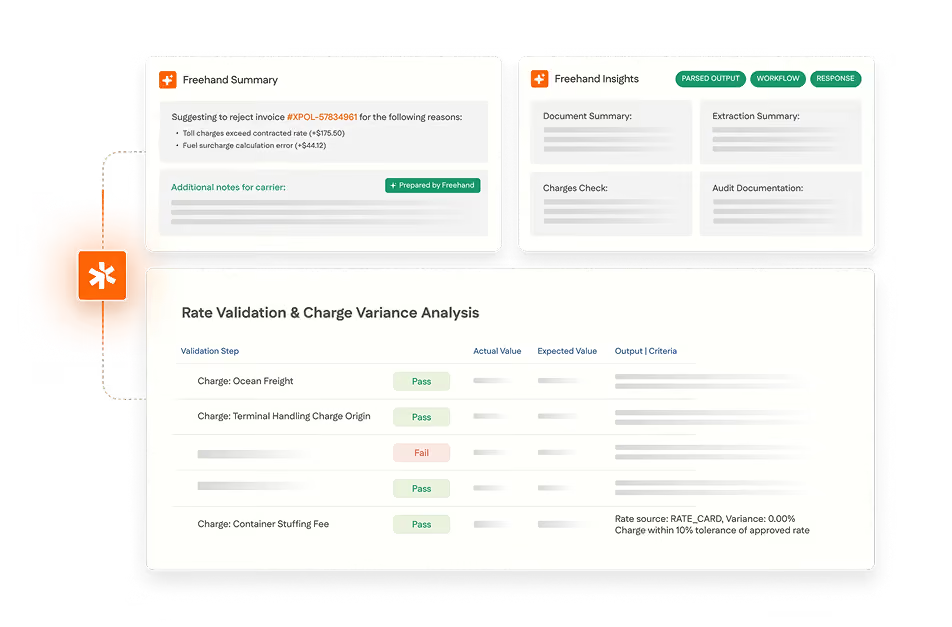
Freehand's freight audit platform is the contract enforcement layer that freight procurement contracts need after execution. It loads carrier contract rates into the validation engine, propagates amendments on the amendment effective date, and validates every invoice line against the contracted rate for the specific lane, charge type, and billing week before payment clears.
The result is that the savings procurement negotiated in the carrier contract are enforced on every invoice, not recovered retrospectively in quarterly audit cycles where the dispute window has partially closed.
For enterprises managing $15M or more in annual freight spend, systematic contract-rate enforcement at invoice level recovers 1.5 to 2.5% of freight spend annually. That return compounds every year the enforcement is running.
Request a demo to see how contract enforcement works across your carrier portfolio, and get an estimate of what current billing deviations are costing against your contracted terms.
{{brown-cta}}
Frequently Asked Questions
What is procurement contract management?
The process of creating, executing, monitoring, and renewing supplier contracts to ensure that agreed terms are honored, costs stay within contracted limits, and supplier obligations are met across the full contract lifecycle.
What are the main types of procurement contracts?
Fixed-price (set price regardless of actual costs), cost-reimbursable (actual costs plus agreed fee), and time and materials (hourly rate plus materials). Each allocates pricing risk differently and suits different procurement contexts.
Where does most contract value leakage occur?
In the post-execution monitoring phase. Organizations lose an average of 8.6% of total spending to contract cost leakage, most of which comes not from poor negotiation but from terms that are not continuously enforced after the contract takes effect.
What is the difference between contract lifecycle management and procurement contract management?
Contract lifecycle management covers contracts across all business functions from creation to termination. Procurement contract management focuses specifically on supplier contracts that govern purchasing, ensuring contracted pricing and terms are enforced in daily transactions.
How does AI improve procurement contract management?
AI extracts obligations and pricing terms from contracts in seconds rather than hours, monitors compliance continuously rather than periodically, flags auto-renewal risks before they trigger, and connects contracted terms to the invoice validation layer for real-time enforcement.
Freehand Enforces Contract Terms at Every Invoice, Not Just at Signing.
Freehand validates freight and logistics invoices against your negotiated contract terms automatically, so cost leakage doesn't wait for the next audit.
The Terms You Negotiated Don't Enforce Themselves.
A contract clause only matters if something checks every invoice against it. Most AP workflows never do.
Every warehouse. Every provider. Every mile.
Gartner's 2026 outlook on logistics outsourcing, and how AI Teams hold every contract to the terms you agreed.
- Where outsourced logistics quietly loses margin
- Why billed charges drift from the contract
- How AI Teams close the gap