
Why Freight Data Fragmentation Makes ‘Catching Issues Early’ Almost Impossible

February 20, 2026
•
5
mins
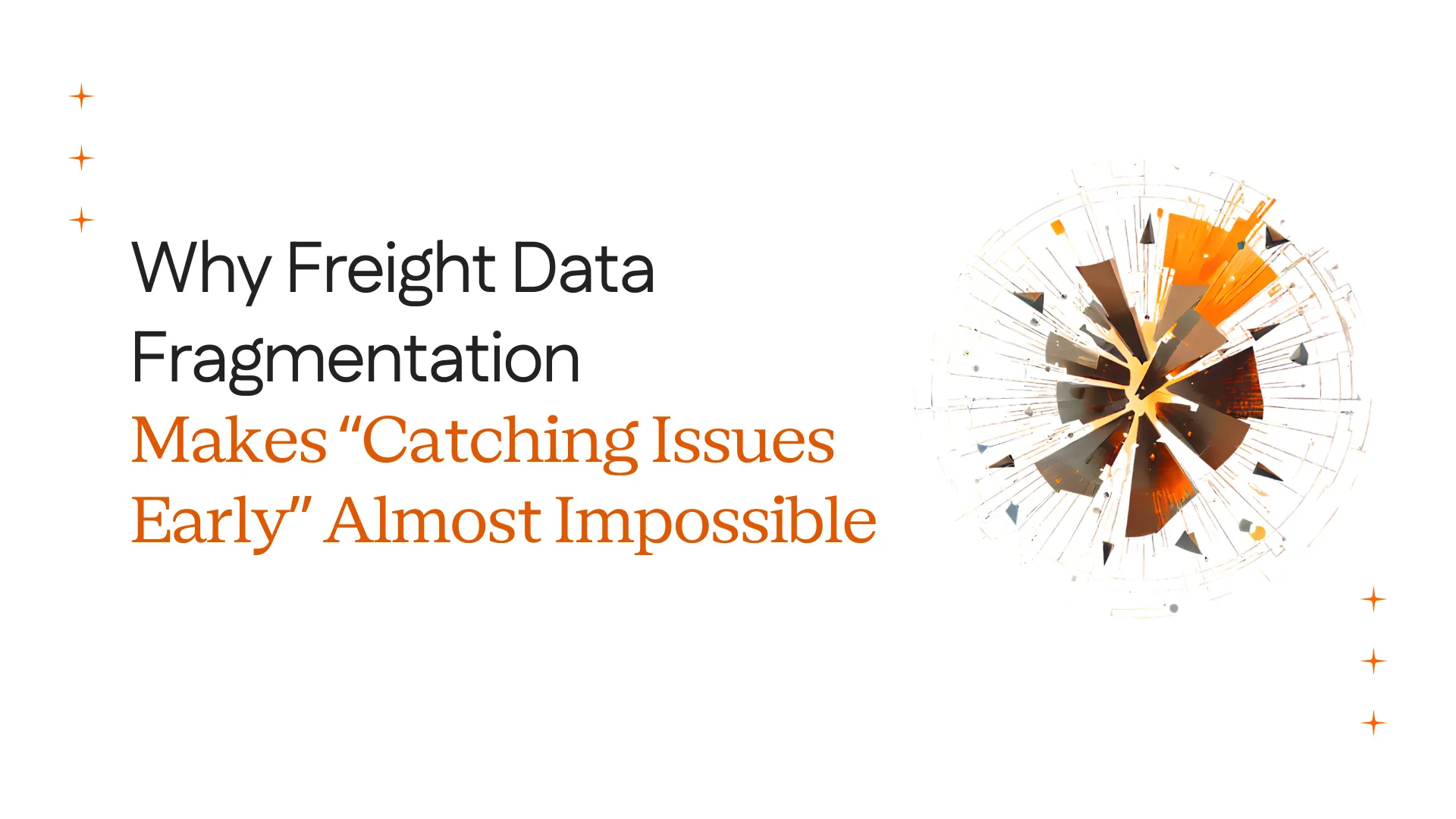
The problem isn’t that freight data doesn’t exist. It’s that the data lives in silos that mirror organizational boundaries, and the insights you need require synthesizing across those boundaries in ways the systems were never designed to support.
An audit analyst in a global autocorp is trying to validate a TONU charge. Here’s what it requires: log into the TMS for shipment record and appointment time, switch to the WMS for dock schedule and staging timestamps, open the mail for carrier email confirmation, navigate to the shared drive for contract and TONU terms, check the carrier portal for delivery attempt documentation.
Five systems. Multiple logins. Significant time. For one charge. Now compound it to 1000s of such line items on a weekly basis. Now imagine the effort required to audit and validate each of those charges.
If all this data exists, why is it so hard to use? The answer is structural. These systems were built to serve different functions, and each does its job well. The problem emerges when you need to answer questions that span all five.
TONUs, T-codes, and hot shipments aren’t separate problems. They’re symptoms of the same underlying issue: the insights you need to control freight costs require cross-system synthesis that no single system, and no single person, can do at scale.
Why Freight Data Lives in Silos (And Why It Made Sense)
The fragmentation of freight data isn’t a design flaw. It’s the natural result of how organizations divide work and optimize for functional excellence. Each system was purpose-built to serve a specific team’s needs.

Function-Specific Systems
Systems were built for specific functions, and each excels at its purpose:
TMS: Built for operational execution — tender loads, track shipments, manage appointments. Purpose: Keep freight moving.
WMS: Built for warehouse operations — manage inventory, stage freight, schedule docks. Purpose: Optimize warehouse flow.
AP/Finance: Built for payment processing — match invoices, validate charges, process payments. Purpose: Control financial transactions.
Contract Management: Built for procurement — store agreements, track terms, manage renewals. Purpose: Manage commercial relationships.
Carrier Portals: Built for carrier interaction — submit proof, report delays, upload documentation. Purpose: Enable carrier communication.
Systems Mirror Organizational Structure
The reason these systems are separate isn’t accidental. It’s organizational. Each system is owned by the function it serves:
TMS is owned by Transportation. They need operational control — tender, track, deliver. They don’t need warehouse dock schedules cluttering their interface or contract terms. They need shipment execution.
WMS is owned by Warehousing. They need dock optimization — unload, inbound, stage outbound, load, manage flow. They don’t need carrier contract details or AP invoice data. They need warehouse efficiency.
AP is owned by Finance. They need payment accuracy — match, validate, pay. They don’t need operational minutiae about why a shipment was late. They need invoice reconciliation.
Contracts are owned by Procurement. They need commercial terms — rates, penalties, obligations. They don’t need real-time shipment tracking. They need carrier performance summaries & agreement management.
Each team has the system it needs. The fragmentation, the functional focus gives each tool optimized for their workflow without irrelevant data from other functions.
But cost control problems don’t respect organizational boundaries. They emerge from interactions between operations, finance, and procurement. No single team owns the full problem. No single system sees the complete picture.
Insights Require Cross-System Reasoning That Doesn’t Scale Manually
Most organizations have integrated their systems transactionally. The TMS sends shipment data to AP for invoice matching. The WMS updates the TMS when freight is picked up. Carrier portals feed status updates. This works for transactions — when a shipment delivers, the TMS updates; when an invoice arrives, AP matches it.
But transactional integration doesn’t enable reasoning integration. Consider the TONU dispute: the TMS has an appointment time, the WMS has dock readiness, email has carrier confirmation, contracts have TONU terms, and the carrier portal has the driver arrival claim. These systems are technically integrated. But no system asks: “Given all this context, is this TONU charge valid and disputable?” That requires inference across contexts, not just data transfer.
The Dashboard Illusion
Many organizations respond with dashboards that pull data from multiple systems into one view. Dashboards centralize display. They don’t centralize reasoning.
· For TONUs, the data needed exists across five systems. By the time the audit manually assembles evidence, the invoice is weeks old, and the dispute window is closing. Systems don’t synthesize evidence automatically. Humans do it manually, at best in categorized buckets, but more likely one charge at a time.
Get Ken Kodger’s stories in your inbox
Join Medium for free to get updates from this writer.
Subscribe
Remember me for faster sign in
· For T-codes, the data exists: rejection event in TMS, secondary carrier cost in AP, contract penalty terms in procurement. But these live in three different systems owned by three different teams. No one connects them. No system asks, “This rejection plus this cost equals a contractual debit.”
· For hot shipments, the data exists: carrier delay reports, tracking carrier capacity utilized, weather alerts, dock constraints, and customer criticality. Each signal exists separately. No one continuously monitors all signals for all shipments. Systems report facts within their domain. Risk assessment requires synthesis across domains.
For example, the dashboard shows shipment assignment, dock schedule, and TONU charge. What it can’t do is tell you whether the TONU is disputable based on contract terms, appointment timeline, and dock availability. That still requires manual context assembly.
Manual Synthesis Doesn’t Scale
Large freight operations handle hundreds of thousands of shipments annually. Each shipment touches multiple systems generating multiple data points. Each potential issue requires synthesis across numerous data points from multiple systems.
The manual approach: analyst investigates one issue at a time, pulls data from each system, attempts to combine in Excel, assesses based on domain knowledge, produces recommendation. The time investment per investigation is substantial.
Result: only high-value exceptions get investigated. Everything else gets ignored — not because it’s not recoverable, but because investigation doesn’t scale.
What an AI Freight Analyst Changes
An AI Freight Analyst doesn’t eliminate fragmentation. It operates intelligently across it by continuously pulling data from TMS, WMS, AP, email, contracts, carrier portals, and weather services, synthesizing in real-time. It understands freight domain knowledge — what makes TONUs disputable, when carrier rejections trigger contractual debits, what signals indicate hot shipment risk.
Instead of answering questions when asked, the AI Analyst continuously asks questions: “Which TONUs are disputable based on contract terms and operational evidence?” “Which carrier rejections should trigger debits?” “Which shipments are trending toward premium freight?”
The AI Analyst does this reasoning for every shipment, every TONU, every rejection, every at-risk delivery — simultaneously and continuously — the AI Analyst doesn’t need to sleep or take breaks.
What This Looks Like in Practice
For TONU disputes, the AI Analyst monitors every charge as reported. It pulls appointment data (TMS), dock readiness (WMS), carrier communication (email), and contract terms (Procurement). It reasons: “Carrier claims TONU outside appointment window. WMS shows freight was staged on time. YMS shows the carrier arrived late. Contract says TONU only applies if the carrier arrives in the window and the freight isn’t ready. Conclusion: Disputable. Generating evidence package.”
For T-code debits, the AI Analyst monitors carrier rejections. When one occurs with secondary carrier assignment, it checks backup cost (AP) and contract terms (Procurement). It reasons: “Primary carrier rejected tender. Secondary carrier cost exceeds contracted rate. The contract allows recovery. Generating debit memo with rejection timestamp, cost delta, and contract citation.”
For hot shipment prevention, the AI Analyst continuously monitors shipments approaching delivery, synthesizing carrier status, tracking carrier capacity utilized, weather, dock constraints, and customer criticality. It reasons: “This shipment is trending late. Customer requires on-time delivery for critical production. Options: switch to an alternate carrier (minimal incremental cost), expedite (moderate cost), or wait (high risk of premium freight). Alerting planner with decision support.”
Why This Is Different from Integration or Dashboards
Integration connects systems for transactions, enabling data flow without reasoning. Dashboards consolidate display, centralizing viewing, but with manual human consumption. An AI Analyst reasons across fragmentation, synthesizing data from multiple sources, applying domain-specific knowledge, and generating actionable insights. It scales human reasoning, doesn’t just assist it.
The breakthrough: you don’t have to fix fragmentation. You operate intelligently across it.
Fragmentation Isn’t Going Away (So Work With It)
Systems will remain fragmented. Each function needs tools optimized for its workflow. Consolidating everything would create more problems than it solves. Different teams need different views optimized for their specific decisions. ERP & TMS systems have attempted this for years, adding generic capabilities, producing mediocre results, and not meeting the specific functional requirements…then one exports the data and attempts to utilize Excel.
The opportunity is deploying intelligence that operates across fragmentation — intelligence that continuously pulls data from wherever it lives, reasons across contexts, and produces insights that no single system and no single person can generate at scale.
TONUs, T-codes, and hot shipments are symptoms of the same challenge: freight cost control requires synthesizing information across organizational and system boundaries. When synthesis happens manually, it doesn’t scale. When it happens automatically through AI reasoning, cost control becomes systematic.
Map the systems your organization uses for freight management. For each cost control problem, disputed charges, missed recoveries, and preventable premium freight — identify which systems contain needed data. If the answer is multiple systems across multiple functions, you have a fragmentation problem. And manual synthesis won’t scale.
The question isn’t whether to integrate your systems. It’s whether to deploy reasoning that works intelligently across the systems you already have. Data fragmentation is structural. It mirrors how organizations divide work. The solution isn’t reorganizing or re-platforming. It’s deploying intelligence that operates at the organizational level — synthesizing across the systems and team boundaries.