
What Are Freight Shipping Costs? Rates, Factors, and How Enterprises Control Them

June 1, 2026
•
11
mins
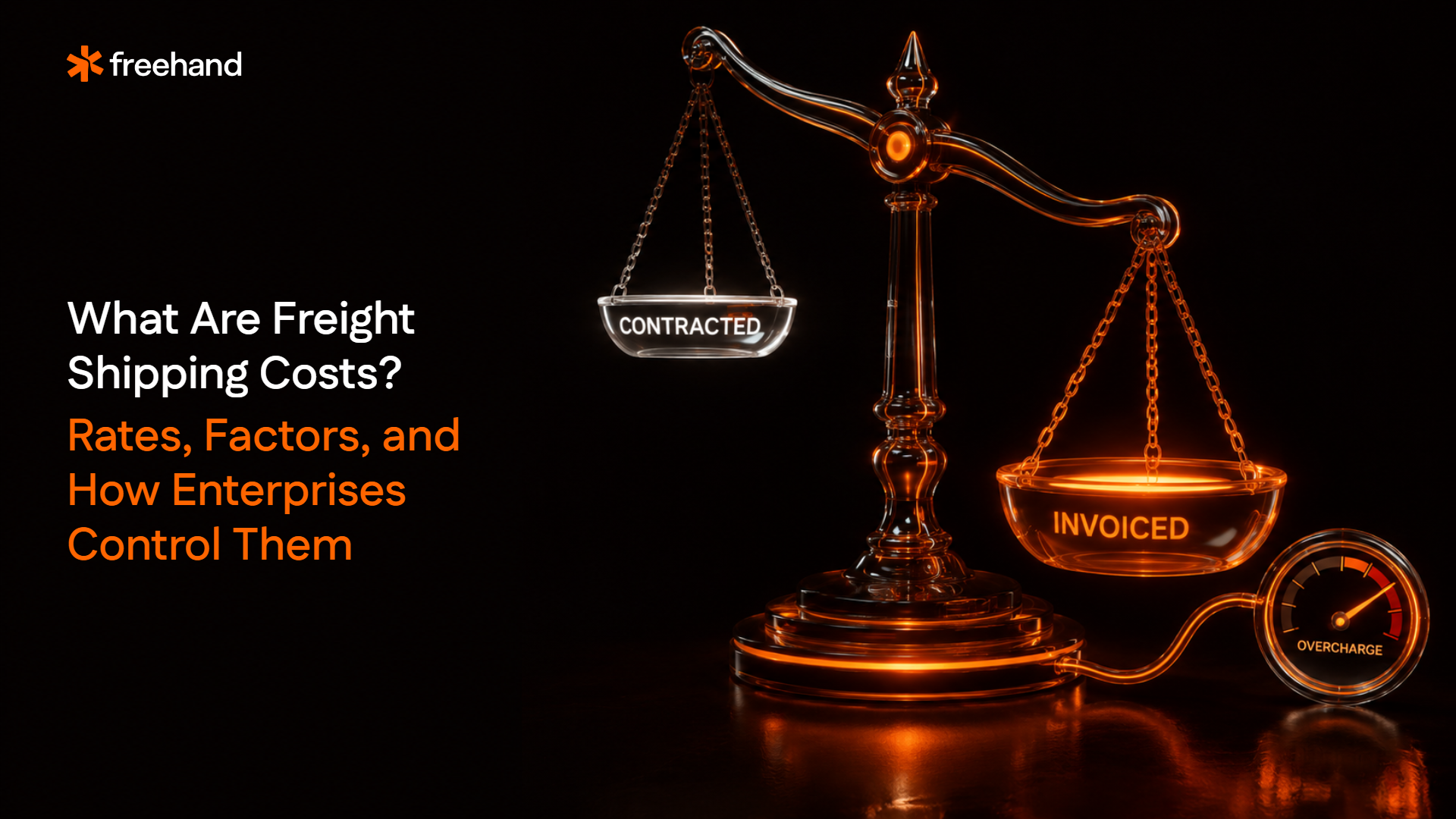
The rate your carrier charges is one number. What you actually pay is another.
Most enterprises manage the first through carrier procurement and assume the second follows from it. It doesn't. Between contracted rates and invoiced amounts, fuel surcharges tier up, accessorial charges appear without a contract basis, and invoice volumes outpace what any AP team can manually validate.
That gap is where freight costs stop being manageable.
Key Takeaways
- Understanding what's driving your freight shipping costs beyond the base rate gives you the specific levers to recover 1.5 to 2.5% of total freight spend currently lost to billing errors, accessorial overcharges, and fuel surcharge mismatches.
- Freight shipping costs are determined at two stages: carrier procurement, where contracted rates are set, and invoice settlement, where those rates either hold or get overbilled. Most enterprises manage the first stage and have limited control over the second.
- The biggest sources of unmanaged freight cost aren't rate negotiation gaps. They're post-contract billing errors accumulating across hundreds of thousands of invoices in amounts that fall below any manual review threshold.
- Controlling freight shipping costs at enterprise scale requires full invoice audit coverage, carrier spend benchmarking, and an RFP process built from actual shipment data rather than prior-year estimates.
What are freight shipping costs?
Freight shipping costs are the total charges an enterprise pays to move goods across carriers, modes, and lanes, including base linehaul rates, fuel surcharges, accessorial charges, dimensional weight adjustments, and carrier-specific handling fees.
Most cost analyses stop at the linehaul rate. That's the number carriers quote, the number that appears in contract negotiations, and the number tracked in budget reviews. It's also not what enterprises actually pay.
The full picture includes:
- Fuel surcharges: applied on top of the base rate, indexed to carrier-specific tables that update weekly or monthly
- Accessorial charges: liftgate service, residential delivery, detention, inside delivery, hazmat handling, re-consignment, and dozens of carrier-specific add-ons
- Dimensional weight adjustments: apply when a shipment's volume-to-weight ratio exceeds the carrier's threshold. For parcel shipments, this can multiply the billed weight several times over.
- Freight payment processing fees: embedded in third-party audit and payment agreements, often sitting entirely outside the freight cost view
The contracted rate is the floor. What actually gets invoiced depends on how accurately each component is applied and validated.
What factors determine freight shipping costs?
Freight shipping costs are determined by mode of transport, shipment weight and dimensions, freight class, distance, fuel surcharge indices, and accessorial requirements.
Mode of transport and lane characteristics
Each mode carries a structurally different cost structure:
- LTL: priced on freight class and distance between carrier terminals
- FTL: priced by mileage and lane availability
- Ocean: indexed to container type, trade lane, and vessel slot availability
- Air: weight-and-volume-based with premium pricing for speed and schedule certainty
The lane matters as much as the mode. A Chicago-Dallas FTL lane with high carrier density prices differently than a Chicago-rural Montana lane where carrier options are limited. Seasonal imbalances, holiday peak, and port congestion shift rates even on stable lanes.
Weight, dimensions, and freight class
Freight class (NMFC classifications 50 to 500) is calculated from density, stowability, handling requirements, and liability. A higher class produces a higher base rate.
Errors in freight class assignment, whether from the shipper's initial classification or a carrier's post-delivery reclassification, change the billable amount retroactively and often arrive weeks after delivery.
Dimensional weight applies primarily to parcel and LTL shipments. A 10-pound parcel in an oversized box can be billed at 40 DIM pounds. At high parcel volumes, a systematic DIM weight error across a single carrier network produces significant overbilling that most AP teams never flag because the billed weight looks reasonable on the surface.
Fuel surcharges and carrier pricing conditions
Fuel surcharges are indexed to carrier-specific tables that update weekly or monthly. The structure differs by mode:
- Parcel carriers apply a percentage of the base charge
- LTL carriers apply a per-hundredweight rate
- FTL carriers apply a per-mile rate
Your contract specifies which table applies and at what formula. The carrier's billing system applies the current week's rate. If the table in your audit engine isn't synchronized, the mismatch clears AP as a clean invoice.
What is the gap between contracted freight costs and what enterprises actually pay?
The gap between contracted and actual freight shipping costs comes from carrier billing errors, accessorial charges applied without a contract basis, and invoice timing delays that force finance teams to book estimated rather than actual freight costs at month-end close.
Carrier billing errors
When a contract renews, new rates need to be loaded into both the carrier's billing engine and your audit system. A three-week lag means the carrier bills at the new rate while your audit engine validates against the old one, or the reverse.
The result: 1.5 to 2.5% of total freight spend paid above the contracted rate, distributed across hundreds of thousands of invoices in amounts too small to trigger manual review.
Accessorial overcharges without a contract basis
Three examples of how this plays out:
- The carrier invoices detention at $75 per hour. Your contract caps it at $50.
- A residential delivery surcharge applies to a commercial address because the carrier's system misclassified it.
- A fuel surcharge matrix that expired 14 months ago is still running because the rate table in the audit engine was never updated.
None of these are individually large. Across a high-volume shipper, they compound to recoverable margin.
Invoice timing and accrual accuracy
Freight invoices don't always arrive at delivery. Carrier billing cycles and consolidation delays mean invoices for August shipments arrive in September or October. Finance teams closing August books need freight cost accruals before the invoices have cleared AP.
The standard response: book estimated freight costs at month-end based on prior-period averages. When actual invoices arrive carrying overcharges, the variance goes into a reconciliation queue that takes FTE time and rarely fully resolves.
Cost-to-serve models, P&L allocations, and procurement benchmarks all build on that estimate.
What are the most common hidden costs in freight shipping?
The most common hidden freight shipping costs are dimensional weight errors, duplicate invoice submissions, fuel surcharge tier mismatches, accessorial charges above the contracted rate, and GL miscoding.
.png)
How do enterprises reduce freight shipping costs at scale?
Enterprises reduce freight shipping costs through carrier procurement built from actual shipment data, full invoice audit coverage, and spend intelligence that shows variance between contracted and actual costs across every lane and carrier in real time.
Three levers drive reduction at enterprise scale, and they work in sequence:
1. Carrier procurement from actual shipment data, not estimates
RFP cycles built on prior-year actuals produce contracts that reflect what happened, not what's currently happening on your network. When RFQ generation uses live shipment data, including current lane volumes, actual accessorial frequency by carrier and lane, and real carrier performance history, the negotiating position reflects current reality.
2. Full invoice coverage with 4-way matching
Rate negotiation reduces contracted costs. Invoice audit determines whether those contracted costs are what actually gets paid. A carrier contract without invoice-level enforcement is a budget target, not a cost control mechanism.
4-way matching against contracted rates, confirmed shipment data, purchase orders, and carrier performance history catches what 2-way matching and threshold approval workflows miss.
3. Spend intelligence across carriers, modes, and lanes
Once contracted rates are negotiated and invoices validated, the remaining question is whether total freight spend is benchmarked against market conditions. Which carriers are consistently over-invoicing on specific accessorials? Which lanes are running 15% above the market rate four months after the last contract renewal?
How do you know if your freight shipping costs are actually under control?
Freight shipping costs are under control when your invoice accuracy rate exceeds 98%, overcharge recovery is measurable as a percentage of freight spend, audit covers 100% of invoice volume, and month-end freight accruals reflect actual invoiced amounts rather than estimates.
Most logistics finance teams track freight spend as a budget-versus-actual variance. That tells you whether you're over or under plan. It doesn't tell you whether you're overpaying carriers.
Four metrics indicate actual control:
.png)
Your freight shipping costs are contracted. Are they being enforced?
Contracting a rate and enforcing it at invoice level are two different operations. Most enterprises run carrier procurement rigorously and invoice validation inconsistently.
The gap between what was negotiated and what gets paid isn't a carrier relations problem. It's a coverage problem.
- At $30M in annual freight spend, recoverable margin from full invoice audit runs $450,000 to $750,000 annually
- At $50M, it's $750,000 to $1.25M
Those numbers don't require a rate renegotiation or a carrier change. They require closing the gap between contracted and invoiced.
Freehand's freight audit platform runs 4-way matching across every invoice, every mode, and every carrier, with automated GL coding and spend intelligence that shows where actual costs diverge from contracted rates in real time.
Frequently Asked Questions
What are freight shipping costs?
The total charges paid to move goods from origin to destination: base linehaul rates, fuel surcharges, accessorial charges, and dimensional weight adjustments. At enterprise scale, the invoiced amount typically differs from the contracted rate due to billing errors, surcharge mismatches, and accessorials applied without a contract basis.
What is included in freight shipping costs?
Base linehaul rate, fuel surcharges (BAF, EBS, FSC), accessorial charges such as liftgate and detention, dimensional weight adjustments, and freight payment processing fees. Fuel surcharges and accessorials carry the highest overcharge exposure at enterprise volume.
What is the difference between LTL and FTL freight costs?
LTL charges by weight and freight class for shipments sharing trailer space, working for loads under 15,000 pounds. FTL charges per mile for dedicated trailer use and becomes more cost-effective above that threshold. LTL billing complexity is higher because freight class, accessorials, and DIM weight all apply independently.
What causes freight shipping costs to increase unexpectedly?
Fuel surcharge tier changes, carrier general rate increases applied mid-contract, new accessorial charges added without notice, freight class reclassifications post-delivery, and peak season capacity surcharges. Most appear in invoices rather than in rate negotiations, which is why full invoice audit coverage matters.
How can I reduce freight shipping costs?
Carrier procurement built from actual shipment data, 100% invoice audit coverage to recover overcharges, automated GL coding to eliminate manual processing costs, and spend benchmarking to identify where contracted rates diverge from market rates across lanes and carriers.
What percentage of freight invoices contain billing errors?
Industry data puts billing error rates at 1.5 to 2.5% of total freight spend. Most enterprises recover a fraction of that because audit processes run on samples and threshold approvals rather than 100% line-item validation against contracted rates and confirmed shipment data.