

Carrier Spend Management: What It Is, Why It Breaks Down, and How to Fix It
.webp)
June 18, 2026
•
13
mins
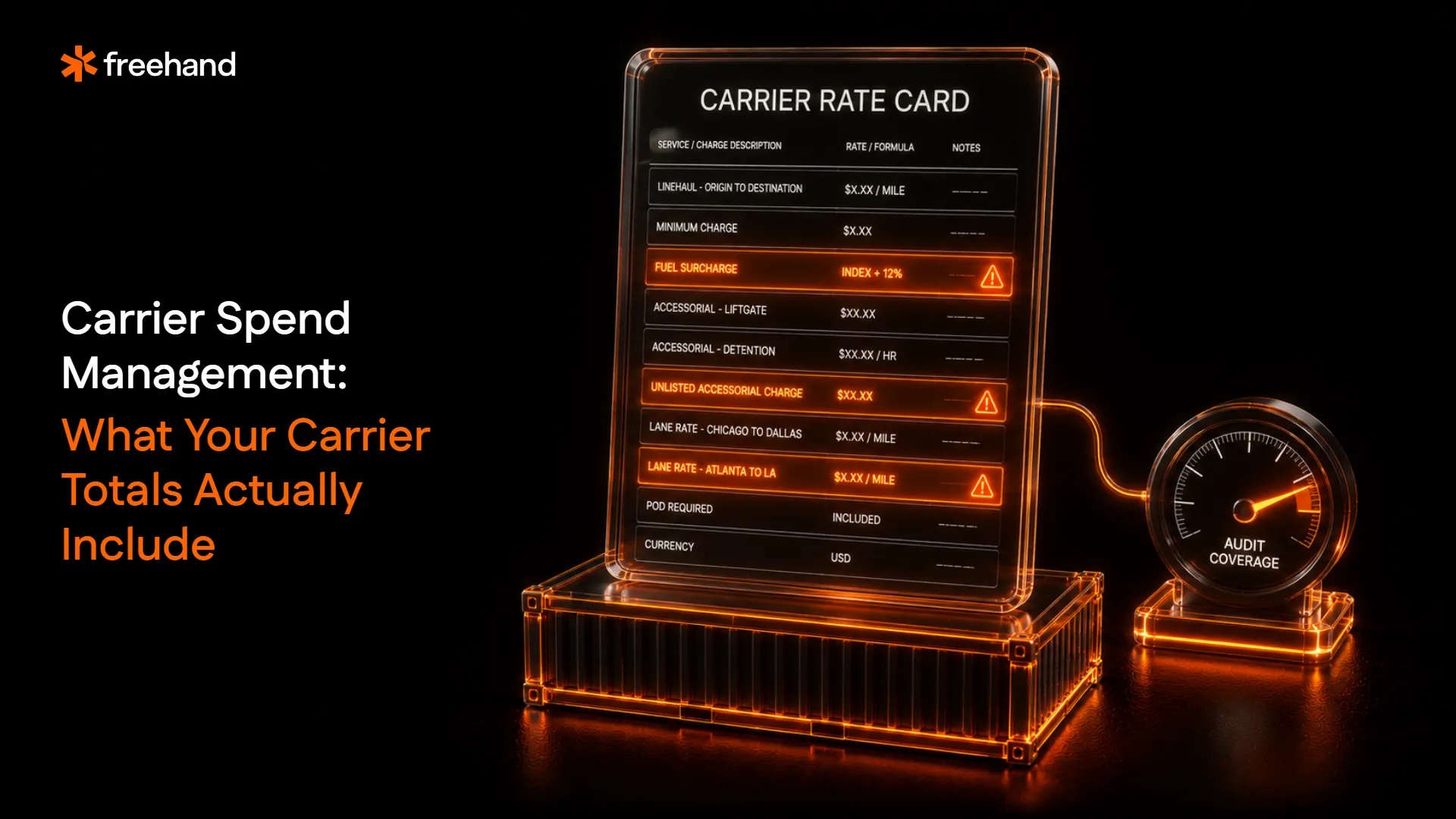
Your ERP shows $4.2M paid to a carrier last quarter. That number is accurate. What it does not tell you is whether $80,000 of that was billing errors that cleared unchallenged, whether the fuel surcharge formula drifted from the contracted tier, or whether a renegotiated lane rate from four months ago still has not been updated in your AP system.
That is the carrier spend management problem. It is not dramatic. It is distributed, persistent, and invisible in totals.
Key Takeaways
- Carrier spend management is how enterprises control what they actually pay carriers versus what their contracts say they should pay, across every charge type and every carrier relationship.
- Most enterprises audit only 33% to 60% of invoice volume. The rest clears at the carrier's full billing error rate, bundled invisibly into the ERP total.
- The lowest-rate carrier in your RFP is rarely the lowest-cost carrier in practice. Exception processing overhead and unrecovered billing errors change the ranking.
- Enterprises with structured carrier spend management recover 1.5% to 2.5% of total freight spend annually.
- Invoice cycles that run 30+ days manually compress to under 3 days with full audit coverage, and carriers price that payment friction into future contract rates.
What Is Carrier Spend Management?
Carrier spend management is the operational discipline of enforcing carrier contract terms through every billing cycle, tracking per-carrier cost against the negotiated baseline, and identifying where actual spend is deviating from contracted cost before payment clears.
It sits between carrier procurement and finance reporting.
Procurement negotiates the contract. Finance reports what cleared AP. Carrier spend management is the layer in between that determines whether those two numbers reflect the same reality or whether billing errors, rate drift, and amendment lag have created a gap neither function can see from where they sit.
That gap is where most enterprises are operating without knowing it.
The RFP produces a contract with negotiated rates. Carrier spend management enforces those rates through every billing cycle and flags deviations before payment clears.
Most enterprises have the contract. Fewer have the enforcement layer that makes it mean something.
Knowing what cleared AP is not the same as knowing whether what cleared matched the contract.
Is Parcel Spend Management Different from Carrier Spend Management?
Carrier spend management covers all freight modes.
Parcel spend management is a subset focused specifically on UPS, FedEx, and regional carrier invoices, which have different billing mechanics, error patterns, and compliance requirements than TL or LTL freight.
While carrier spend management enforces negotiated lane-level rate cards across a multi-mode portfolio, parcel spend management must also contend with annual general rate increases that reprice base rates, DIM weight factors, and accessorial schedules simultaneously, service guarantee credits that expire within strict 15 to 30 day filing windows, and DIM divisor discrepancies that generate systematic overcharges at volume.
| Dimension | Carrier Spend Management | Parcel Spend Management |
|---|---|---|
| Scope | All freight modes: TL, LTL, ocean, air, parcel. | UPS, FedEx, and regional parcel carriers. |
| Primary billing risk | Lane-level rate enforcement, LTL classification disputes, fuel surcharge formula drift. | DIM weight mismatches, accessorial stack concentration, GRI-cycle repricing. |
| Repricing trigger | Contract amendment or renewal. | Annual GRI affecting base rates, DIM factors, and accessorials simultaneously. |
| Credit/claims window | Dispute-driven, varies by carrier contract. | 15 to 30 days from service failure; high forfeit rate at manual process scale. |
| Volume profile | Hundreds to thousands of invoices monthly. | Up to millions of parcel invoices annually. |
| Key compliance check | Contracted rate vs. invoiced rate by lane and charge type. | Applied DIM divisor vs. contracted divisor; service failure claim eligibility. |
The monitoring cadence, data sources, and validation logic differ enough between modes that a single generic compliance process misses the errors specific to each. A spend management approach built only for freight will not catch the DIM weight mismatches and GRI drift that make parcel billing complex at volume.
What Are the Real Challenges of Carrier Spend Management?
Challenge 1: Your ERP total includes billing errors you cannot separate
A carrier with a 3% billing error rate makes its spend total appear 3% higher than contracted cost.
The ERP records what cleared AP, not whether it should have cleared.
Without an invoice validation layer running before payment, there is no way to separate correctly billed charges from overcharges after the fact.
One global electronics manufacturer operating across 150+ carriers found that legacy audit processes covered only 33% of freight invoices, leaving two-thirds of billing discrepancies undetected across $2 billion in annual spend.
Challenge 2: Amendment lag makes compliance checks pointless
When a carrier contract is amended mid-cycle, the rate reference in the AP system should update immediately. It often does not.
Invoices on renegotiated lanes continue validating against the old rate. The per-carrier spend total includes charges at outdated terms, and the AP team does not know until a carrier dispute surfaces the discrepancy, by which point multiple billing cycles have cleared at the wrong rate.
One mid-size manufacturer found that three-week contract update cycles were creating constant cost discrepancies between outdated system rates and actual market prices, requiring overtime work during peak seasons to manually reconcile.
Accessorial charges are conditional additions to the carrier invoice: residential delivery, liftgate, detention, address correction, DIM weight adjustments. When accessorial spend trends above 20 to 25% of total freight cost per carrier, it warrants investigation.
The compliance issue is not always the rate. It is often whether the triggering condition for the charge actually occurred.
Challenge 4: Billing exception cost does not appear in the AP total
A carrier generating 15% of its invoice volume as billing exceptions requires significantly more AP team labor per dollar of spend than a carrier generating 2% exceptions. That overhead does not appear in the per-carrier spend line. It only becomes visible when you calculate total cost of carrier relationship, not just what cleared AP.
Challenge 5: Parcel billing errors compound at volume
A 50-pound dimensional weight charge on a 0.5-pound shipment is a billing error. Across 1.6 million annual parcel invoices, that kind of systematic mismatch becomes a multi-million dollar problem.
FedEx frequently invoiced 50-pound charges for 0.5-pound phone case shipments at one global accessories manufacturer, and no manual audit or external provider could detect those errors proactively at that volume.
Manual processes cannot scale to this. Only automated, 100% invoice coverage catches them consistently.
Why Should Companies Control Their Carrier Spend?
Carrier spend is not a back-office cost center. For most enterprises, it is a direct P&L variable that responds to how well contracts are enforced, how quickly billing errors are caught, and how accurately spend data reflects reality.
Cost recovery.
Enterprises running structured freight audit programs recover 1.5% to 2.5% of total freight spend annually through overcharge detection, duplicate blocking, and rate mismatch resolution. (Source: Freehand platform data) On a $50 million freight spend, that is $750,000 to $1.25 million recovered per year.
Accurate procurement baselines.
If a carrier's spend total includes $100,000 in systematic billing errors, the procurement team negotiates the next RFP from a baseline that is $100,000 too high. Every savings projection from that baseline is miscalibrated.
A Fortune 500 CPG enterprise used validated spend data to identify and prioritize $7.4M in addressable freight savings across carrier mix optimizations, accessorial containment, and lane consolidation.
Working capital release.
Manual invoice processing cycles run 30+ days at many enterprises. Carriers price that payment friction into future contract rates. Structured freight audit and payment compresses the cycle to under 3 days, removing the premium carriers charge for late payment risk.
Accruals built on unvalidated spend data distort P&L reporting. Real-time validated freight accruals, including accessorials, give finance accurate liability at any point in the month, not a month-end reconciliation surprise.
What Does a Carrier Spend Management Audit Cycle Look Like?
Most enterprises treat freight audit as a batch process: invoices arrive, exceptions get flagged, disputes get filed, payments release. That is not a spend management audit cycle. It is invoice processing. The distinction matters because batch processing after the fact cannot catch errors before payment clears, and errors that clear become significantly harder to recover.
A structured carrier spend management audit cycle runs in six stages, all before payment is released.
Stage 1: Invoice ingestion and normalization
Invoices arrive from carriers in multiple formats: EDI 210, PDF, Excel, carrier portal exports.
The first stage normalizes all of them into a consistent data structure so they can be validated against a common rate reference. Invoices that cannot be normalized, missing PRO numbers, unrecognized carrier codes, incomplete shipment references, are flagged before they enter the validation queue.
Stage 2: Pre-validation against rate card
Each invoice line item is checked against the current contracted rate for that carrier, lane, and charge type before any matching against shipment data occurs. This catches the most common and highest-volume error class: invoices billed at the carrier's published general rate rather than the contracted rate.
Fuel surcharge formula mismatches, expired rate cards, and accessorial rates not in the contracted schedule are identified at this stage.
Stage 3: Three-way matching against shipment records
Validated invoice line items are matched against TMS shipment records and, where applicable, purchase order data. This is where DIM weight errors surface: a carrier invoicing a dimensional weight that does not match actual package dimensions recorded at shipment.
It is also where accessorial trigger verification occurs, confirming that the condition that justifies a charge, a delivery attempt, a detention event, a liftgate use, actually appears in the operational record.
Stage 4: Exception categorization and routing
Invoices that fail pre-validation or three-way matching are categorized by exception type: rate mismatch, duplicate submission, missing shipment record, unauthorized accessorial, DIM weight discrepancy. Each category routes differently.
Rate mismatches may auto-resolve if the carrier has a correction mechanism. Duplicates are held. Unauthorized accessorials require dispute generation with supporting documentation.
Stage 5: Dispute generation and carrier communication
For confirmed overbillings, the audit cycle generates a dispute packet: the original invoice, the contracted rate clause, the shipment record showing the correct data, and the calculated overcharge amount. This package is submitted to the carrier through the appropriate channel, carrier portal, EDI, or direct communication, with tracking so the dispute does not age past the recovery window.
Stage 6: Payment release and spend data recording
Only invoices that have passed pre-validation and three-way matching, or have had disputed line items resolved, are released for payment.
The validated invoice data, including the outcome of any disputes, is recorded against the carrier's spend profile.
This is the data that feeds the per-carrier compliance rate, the contracted-versus-invoiced variance, and the total cost of carrier relationship calculation.
The difference between a batch invoice processing operation and this cycle is where errors are caught. Batch processing catches errors after payment; this cycle catches them before. Recovered overcharges after payment require carrier credit or refund processes. Caught before payment, they never leave the account.
{{blue-cta}}
How Do You Build a Carrier Scorecard?
A carrier scorecard ranks your carrier relationships by true cost and compliance performance, not just contracted rate. The goal is to make the total cost of each carrier relationship visible in a single view so portfolio decisions, renewals, escalations, and RFP prioritization, are based on verified performance data rather than rate card comparisons alone.
A carrier scorecard combines five metrics. Each is tracked per carrier and updated each billing cycle.
Metric 1: Billing compliance rate
The percentage of invoices matching contracted rates without requiring correction. A billing compliance rate below 95% indicates a systematic deviation, not random error. Below 90% warrants a formal carrier review. This is the foundational scorecard metric because all other cost calculations are only reliable if this number is being tracked.
Metric 2: Contracted-versus-invoiced variance
The dollar and percentage gap between what the carrier should have billed based on contracted rates applied to actual volume, and what the carrier actually invoiced. Tracked by charge type, this metric identifies whether the deviation is concentrated in fuel surcharges, accessorials, or base rates, which determines the corrective action required.
Metric 3: Accessorial spend ratio
Accessorial charges as a percentage of total carrier spend. Industry benchmarks suggest that an accessorial ratio above 20 to 25% of total freight cost for a given carrier warrants investigation. Tracking this ratio per carrier over time identifies whether accessorial growth is driven by volume changes or by new charge categories appearing in invoices that do not have a contract basis.
Metric 4: Exception processing overhead
The AP team labor cost attributable to reviewing, categorizing, and disputing invoices from a specific carrier. This metric is the one most commonly missing from carrier scorecards, and it is the one that most often explains why the lowest-rate carrier in the RFP is not the lowest-cost carrier in practice.
A carrier generating 15% exception volume at $50 per exception to process costs significantly more in AP overhead than a carrier generating 2% exceptions at a slightly higher base rate.
Metric 5: Carrier spend-to-contract ratio
Actual spend divided by contracted rate multiplied by actual volume. A ratio consistently above 1.0 means the carrier is billing above the contracted rate as a pattern, not an isolated error. This is the quickest single-number indicator of whether a carrier relationship requires a compliance escalation or a contract renegotiation.
Scorecard summary table
| Metric | Green | Amber | Red |
|---|---|---|---|
| Billing compliance rate | Above 97% | 93 to 97% | Below 93% |
| Contracted vs. invoiced variance | Under 0.5% | 0.5 to 2% | Above 2% |
| Accessorial spend ratio | Under 20% | 20 to 25% | Above 25% |
| Exception processing overhead | Low, stable | Rising trend | Above peer average for mode |
| Spend-to-contract ratio | At or below 1.0 | 1.0 to 1.03 | Consistently above 1.03 |
A carrier with two or more red metrics is a candidate for a formal compliance review before the next contract renewal. A carrier with green across all five is a relationship worth prioritizing in the next RFP for volume commitment discussions.
How Important Is a Carrier Spend Management Solution?
What happens without one
Enterprises without structured carrier spend management operate reactively.
- Billing errors surface through carrier disputes rather than proactive detection.
- Amendment lag goes undetected until an exception reveals the rate discrepancy.
- Accessorial creep goes unmonitored until finance flags a budget variance.
- The spend data that feeds procurement decisions includes costs that were never correctly billed.
What the compliance gap actually costs
According to Gartner, enterprises that lack unified freight spend visibility consistently make carrier selection and procurement decisions on incomplete data.
The structural consequence: carrier relationships that appear cost-competitive in RFP analysis can be the most expensive in practice, once exception processing overhead and unrecovered billing errors are factored in.
The metric that makes this visible is total cost of carrier relationship: contracted freight cost, plus exception processing overhead, plus write-offs from disputes not resolved within the filing window.
A carrier with the second-lowest base rate and a high exception rate can have a higher total relationship cost than a carrier billing cleanly at a slightly higher rate.
Scale determines the urgency
Small and mid-size enterprises (under $5M annual freight spend) typically operate with 2 to 4 carrier relationships and no dedicated freight audit function.
The gap is simple: no systematic comparison of invoiced rates to contracted rates. Charges clear on plausibility.
Large enterprises ($20M+ annual freight spend) have 15 to 25 carrier relationships, thousands of monthly invoices, and amendment frequency that makes manual compliance impossible. The gap shifts from no audit to incomplete audit: invoices clearing unvalidated at the carrier's full billing error rate.
What Goes Into a Good Carrier Spend Management Solution?
A capable carrier spend management solution requires three functional layers working together.
1. Full-coverage invoice validation before payment
The audit coverage rate determines the quality of per-carrier spend data. A carrier audited at 40% of invoice volume produces a spend total that is 60% unvalidated.
The billing errors in that unvalidated portion are indistinguishable from correctly billed charges in the AP total.
100% coverage is what converts per-carrier AP tracking into carrier spend management. Every invoice line item validated against the contracted rate and operational records, before payment clears.
2. Three-layer per-carrier spend visibility
| Layer | What it shows | How it is used |
|---|---|---|
| Contracted cost | What invoices should total based on contracted rates applied to actual volume. | Benchmark for billing compliance measurement. |
| Invoiced cost | What actually cleared AP validation per carrier. | Deviation from contracted cost identifies compliance problems by carrier and charge type. |
| Market cost | What contracted volume would cost at current market rates for the same lanes. | Identifies renegotiation opportunities and ranks carrier relationships by savings potential. |
Maintaining all three layers requires a data infrastructure that connects carrier contracts, TMS shipment records, and market benchmarking data in a unified, queryable layer, not three separate systems pulled manually when a carrier review is overdue.
3. Amendment tracking that closes the rate lag
When a contract is amended, the rate reference in the AP validation layer should update immediately. A spend management solution that requires manual rate card updates creates the amendment lag that allows overcharges to compound across billing cycles undetected.
4. Mode-specific compliance logic
Parcel and freight billing mechanics differ enough that a single generic compliance check misses mode-specific error patterns. Parcel requires DIM weight validation at the SKU level, GRI-cycle re-benchmarking, and service guarantee claim tracking within the filing window.
Freight requires lane-level rate enforcement and LTL classification validation. Both require accessorial trigger verification, not just rate checking.
Why Work with an Expert Carrier Spend Management Partner?
Internal AP teams can process carrier invoices. What they cannot do at scale is validate every invoice line item against every contracted rate for every carrier, track DIM weight compliance across millions of parcel invoices, monitor accessorial trigger conditions, and manage dispute documentation for every carrier relationship, simultaneously.
Coverage rate.
Most enterprise audit programs run at 33% to 50% of invoice volume. A specialist platform running automated audit at 100% coverage catches the billing errors that threshold-based systems are designed to miss: errors below the challenge threshold, errors distributed across many small invoices, and DIM weight mismatches that require SKU-level data to detect.
One global industrial manufacturer increased invoice audit coverage from 33% to 100% across 345,000+ annual shipments by moving to Freehand. (Source: Freehand customer story, Global Industrial Technology Manufacturer)
Structural exception suppression.
A specialist with access to carrier billing patterns can identify recurring exception types and suppress them at the source, updating rate rules and validation logic so the same error does not generate a dispute the following month. Freehand customers suppress 70%+ of recurring billing exceptions within 90 days. (Source: Freehand platform data)
Conflict-free audit.
When a 3PL broker performs the freight audit, FTL and dedicated lanes, often the highest-spend modes, frequently receive no independent review. The conflict is structural. An independent specialist audits every mode, every carrier, every invoice without a financial interest in the outcome.
Procurement intelligence as a byproduct.
When audit data is clean and validated, it becomes the foundation for better procurement decisions. Sourcing cycles that start from validated spend baselines produce RFP savings projections that are accurate rather than inflated by billing errors embedded in the historical baseline.
What Does the Future of Carrier Spend Management Look Like?
The trajectory is toward autonomous, agentic spend management: AI systems that do not just flag billing errors for human review but resolve them through the full dispute lifecycle, update rate cards when contracts change, and continuously monitor spend for anomalies before they become budget variances.
AI-native freight audit platforms today deploy specialized agents that each own a distinct part of the invoice lifecycle: validation before invoice entry, audit against contracted rates, rate card refresh when carrier contracts change, dispute generation and carrier communication, and spend intelligence that triggers sourcing action when carrier costs exceed market benchmarks.
The practical outcomes of this architecture, documented across enterprise deployments, include:
- Invoice processing cycles compressed from 30+ days to under 3 days (Source: Freehand customer data)
- 80% to 90% reduction in manual audit workload (Source: Freehand platform data)
- Real-time freight accruals including accessorials, replacing month-end reconciliation
- Carrier mix and lane optimization decisions grounded in validated actuals rather than disputed spend data
According to McKinsey's research on supply chain automation, companies that fully automate freight billing and audit processes can reduce processing costs by up to 80% while significantly improving accuracy. The supply chains that build this infrastructure now gain a compounding advantage: each validated invoice cycle feeds cleaner data into the next sourcing decision, and each suppressed exception type reduces the dispute overhead of the carrier relationship it affects going forward.
What Should You Do Next?
Your per-carrier spend totals show what cleared AP. Whether they show what should have cleared depends on whether the invoice validation layer compared every line item to the current contracted rate before payment, and whether the rate card in that layer reflects today's contract, not last quarter's.
For most enterprises managing 10 or more carrier relationships, the answer is: not completely. Coverage rates fall below 100%. Amendment lag affects at least a few carrier relationships. Accessorial spend is tracked at the total level, not by trigger condition.
The spend data feeding procurement decisions includes billing errors that cannot be separated from correctly billed charges without the compliance layer running beneath it.
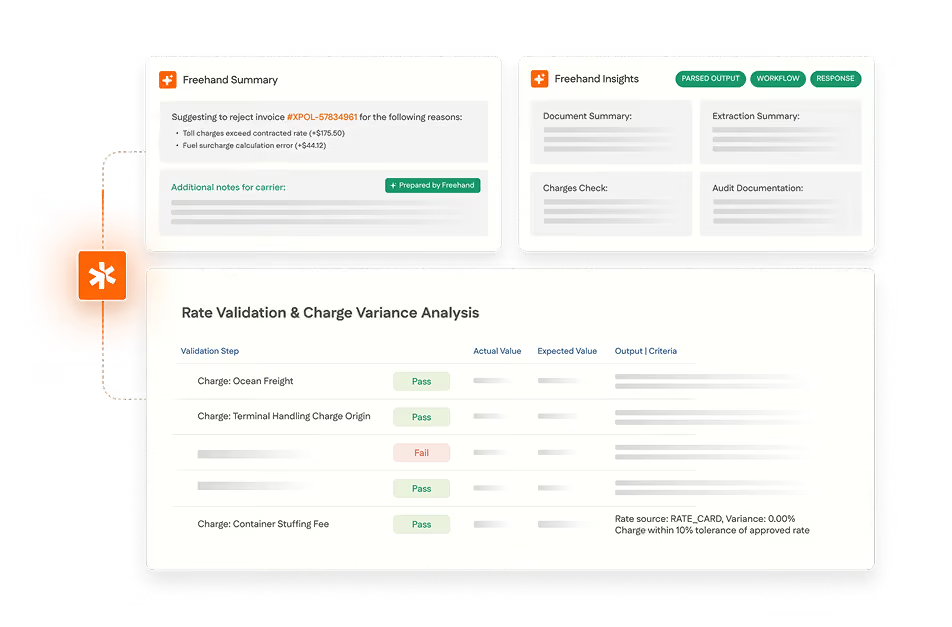
Freehand's freight audit platform runs at 100% of invoice volume across the carrier portfolio, validates every invoice line item against contracted rates and operational records, suppresses recurring exceptions at the source, and produces the validated spend data that turns carrier AP tracking into carrier spend management.
{{brown-cta}}
Frequently Asked Questions
What is carrier spend management?
The practice of systematically comparing what carriers invoice against what contracts permit, resolving the gap before payment, and using that validated data to make better procurement, finance, and compliance decisions.
How is parcel spend management different from carrier spend management?
Carrier spend management covers all freight modes. Parcel spend management addresses UPS, FedEx, and regional carrier invoices specifically, requiring DIM weight validation, GRI-cycle re-benchmarking, and service failure claim tracking within strict 15 to 30 day filing windows that freight programs do not need to manage.
Why is the ERP spend total not a reliable cost management metric?
The ERP records payments processed, not whether payments matched contracted rates. A carrier with a 3% billing error rate makes its spend total appear 3% above contracted cost, and the ERP has no mechanism to separate the two without invoice validation running before payment.
What is total cost of carrier relationship?
Contracted freight cost plus exception processing overhead plus write-offs from unrecovered billing disputes. A carrier with a low base rate and a high exception rate can have a higher total relationship cost than a carrier billing cleanly at a slightly higher contracted rate.
How much freight spend can carrier spend management recover?
Enterprises running structured freight audit programs typically recover 1.5% to 2.5% of total freight spend annually through overcharge detection, duplicate blocking, and rate mismatch resolution, based on Freehand customer data across enterprise deployments.
Every Carrier Invoice Checked Against the Contract, Not a Sample of Them.
Freehand audits 100% of carrier invoices against your contracted rates, so your spend total reflects what you actually owe, not what cleared.
Your ERP Total Is Accurate. It's Also Incomplete.
$80,000 in billing errors can clear unchallenged and still show up as a clean number in your carrier spend report.
Every warehouse. Every provider. Every mile.
Gartner's 2026 outlook on logistics outsourcing, and how AI Teams hold every contract to the terms you agreed.
- Where outsourced logistics quietly loses margin
- Why billed charges drift from the contract
- How AI Teams close the gap