
Best Procure-to-Pay Software for Logistics Teams in 2026: 8 Platforms Compared
.webp)
June 29, 2026
•
13
mins
Comparing the best procure-to-pay software for logistics teams in 2026: 1. Freehand, 2. Coupa, 3. SAP Ariba, 4. Ivalua, 5. GEP SMART, 6. Corcentric, 7. Basware, and 8. Tipalti.
Logistics teams run procurement across hundreds of carrier contracts and thousands of freight invoices, yet most procure-to-pay software was built for office supplies and indirect spend, not freight.
The gap shows up as missed sourcing savings, slow approvals, and freight invoices that never get matched to the rate that was negotiated.
This is a buyer's guide for logistics procurement and finance teams. If carrier sourcing, contracts, and freight payables are your reality, the comparison below helps you shortlist and book the right demos.
Below, we are going to see a detailed comparison of the best procure-to-pay software for logistics teams in 2026, one line per platform, before the full breakdown.
TL;DR: The best procure-to-pay software at a glance
- Freehand: logistics-native procure-to-pay that sources, audits, and pays freight with autonomous AI.
- Coupa: AI-native total spend management with supply chain depth and a large community dataset.
- SAP Ariba: the enterprise default for teams standardized on SAP, with a vast supplier network.
- Ivalua: highly configurable source-to-pay across direct, indirect, and services spend.
- GEP SMART: unified procurement and supply chain on one platform, with advisory services.
- Corcentric: source-to-pay with strong payments and AP depth, plus managed services.
- Basware: procure-to-pay with deep AP automation and e-invoicing for finance teams.
- Tipalti: mid-market procure-to-pay with global payments and tax compliance built in.
Comparison table: top procure-to-pay software for logistics teams in 2026
What is procure-to-pay software?
Procure-to-pay software manages the buying cycle from requesting goods or services through paying the supplier.
It covers requisitions, purchase orders, invoice matching, approvals, and payment in one connected flow, so spend is controlled instead of scattered across emails and spreadsheets.
Technically, it captures intake, issues POs, runs two- and three-way matching against POs and receipts, routes approvals, and pays suppliers, syncing every step to your ERP.
Source-to-pay platforms add the earlier stages: sourcing, supplier onboarding, and contract management. For freight, that means carrier sourcing and rate contracts feeding the same system that pays the invoice.
For a logistics procurement or finance team, the value is freight sourcing tied to the payment, carrier contracts enforced at invoice time, and spend visible by lane and mode. You can see how this fits freight on Freehand's procure-to-pay software page.
How we evaluated these platforms
We judged every platform on three things: independently verifiable evidence (named customers, third-party reviews, analyst recognition), AI and automation maturity, and fit to procure-to-pay for logistics teams.
Evidence came from vendor sites, G2, Gartner Peer Insights, the 2025 Gartner Magic Quadrant for Source-to-Pay Suites, and Capterra.
Figures we could not independently confirm are labeled vendor-claimed. Freehand publishes this guide and is included in it.
We ranked Freehand first on logistics fit while stating openly that the general suites have broader indirect-spend depth, and we invite you to score each vendor independently.
Best procure-to-pay software for logistics teams, ranked for 2026
Freehand leads on logistics fit because the page is about freight procurement. The general source-to-pay suites follow, ranked on analyst recognition and verifiable evidence, since they are what most enterprise procurement teams shortlist for all-category spend.
{{blue-cta}}
1. Freehand
Best for:
Logistics procurement and finance teams that want freight sourcing, audit, and payment in one autonomous platform, rather than a general procurement suite that treats carrier spend like office supplies. A fit for CPO, VP procurement, CFO, and supply chain finance leaders.

Freehand is an AI-native platform whose Autonomous AI Teams run freight sourcing, audit, and payment end to end. It connects carrier sourcing and rate contracts to the invoice that gets paid, so the negotiated rate is enforced at audit time, not lost between systems.
It ranks first here on logistics fit. The general suites below cover broader indirect and category spend more deeply, a tradeoff we state openly.
Key features:
- Freight sourcing agents automate RFQs, bid normalization, and scenario optimization
- Carrier contract execution feeds the same system that audits and pays
- 100% freight invoice audit against the negotiated rate, shipment, and PO
- Autonomous exception resolution, agents act rather than route to a queue
- Real-time spend analytics software by lane, mode, and carrier
- Connects to freight audit and payment software in one platform
- Native SAP (ECC and S/4HANA), Oracle (Cloud ERP and JDE), NetSuite, and Dynamics connectors
- Real-time GL coding and accruals for finance
- Client-exclusive model trained on your data
- 12 to 14 week go-live using 11 to 20 hours of your team's time
Pricing:
Custom, volume-based. No percentage-of-savings fee and no data connection fees, so you get a quote after a scoping call.
Pros:
- Freight sourcing, audit, and payment unified, not stitched across tools
- Autonomous resolution and carrier rate enforcement at invoice time
Cons:
- Built for freight and logistics spend, not general indirect procurement
- A newer name than the established source-to-pay suites
Freehand connects freight sourcing to audit and payment in one autonomous platform. Independent procure-to-pay reviews are still emerging.
2. Coupa
Best for: Large enterprises that want AI-native total spend management across all categories, with supply chain depth and fast adoption.
Coupa is a cloud source-to-pay platform covering sourcing, contracting, purchasing, and payment, with a large community dataset and supply chain design capabilities. Its Navi multi-agent AI, launched in 2025, pushes toward autonomous spend management across indirect categories.
Key features:
- Full source-to-pay across indirect and category spend
- Navi multi-agent AI for spend orchestration
- Community spend data informing benchmarks
- Supply chain design and planning modules
- Large global supplier network
- Strong user experience and rapid deployment
- ERP integrations
- Spend analytics and compliance controls
Pricing:
Custom enterprise pricing, not published. Quotes scale with modules and spend volume.
Pros:
- Broad spend coverage and strong adoption
- AI orchestration and supply chain depth
Cons:
- Built for indirect spend, not freight-specific carrier audit
- Enterprise pricing and scope can be heavy for narrow needs
Coupa is recognized as a leader in the 2025 Gartner Magic Quadrant for Source-to-Pay Suites. See the Coupa reviews on Gartner Peer Insights.
3. SAP Ariba
Best for:
Enterprises already standardized on SAP that want procurement tightly integrated with finance and supply chain systems.
SAP Ariba leverages the SAP ecosystem and the Ariba Network to deliver procurement that connects to ERP, finance, and supply chain. It offers structured PO management, supplier collaboration, compliance reporting, and deep spend visibility.
Key features:
- Source-to-pay tied to SAP ERP and SAP TM
- Ariba Network supplier access
- Structured PO and requisition management
- Supplier collaboration and onboarding
- Compliance reporting and controls
- Spend visibility and analytics
- Guided buying workflows
- Global scale and multi-entity support
Pricing:
Custom enterprise pricing, not published. Typically scales with users, modules, and network fees.
Pros:
- Deep integration for SAP-standardized enterprises
- Vast supplier network and compliance depth
Cons:
- Complex and costly to implement outside SAP environments
- General procurement, not freight-native audit
SAP Ariba is recognized as a leader in the 2025 Gartner Magic Quadrant for Source-to-Pay Suites. See the SAP Ariba reviews on Gartner Peer Insights.
4. Ivalua
Best for:
Enterprises that need a highly configurable platform spanning direct, indirect, and services spend on one source-to-pay system.
Ivalua is a cloud source-to-pay platform built for configurability across every spend category. It suits organizations with complex direct and indirect requirements that want one system to flex to their processes rather than force a template.
Key features:
- Source-to-pay across direct, indirect, and services
- High configurability without heavy custom code
- Supplier management and risk
- Contract lifecycle management
- Sourcing and spend analytics
- Invoice and payment workflows
- ERP integrations
- Category management depth
Pricing:
Custom enterprise pricing, not published.
Pros:
- Strong configurability for complex spend
- Recognized analyst leader
Cons:
- Configuration depth lengthens implementation
- General procurement, not freight-specific
Ivalua is recognized as a leader in the 2025 Gartner Magic Quadrant for Source-to-Pay Suites. See the Ivalua reviews on Gartner Peer Insights.
5. GEP SMART
Best for:
Enterprises that want procurement and supply chain unified on one platform, with consulting and advisory support alongside the software.

GEP SMART brings sourcing, procurement, and supply chain together in a single unified platform, paired with GEP's consulting services. It appeals to teams that want bundled technology and advisory support on large procurement initiatives.
Key features:
- Unified source-to-pay and supply chain
- AI-assisted sourcing and spend analytics
- Supplier and contract management
- Procure-to-pay execution
- Inventory and supply chain modules
- Consulting and managed services
- ERP integrations
- Mobile-first interface
Pricing:
Custom enterprise pricing, not published.
Pros:
- Procurement and supply chain on one platform
- Advisory support for complex programs
Cons:
- Broad scope can be more than narrow needs require
- General procurement, not freight-native audit
GEP is recognized in the 2025 Gartner Magic Quadrant for Source-to-Pay Suites. See the GEP reviews on Gartner Peer Insights.
6. Corcentric
Best for:
Teams that want source-to-pay with strong payments and AP depth, plus managed services, from a provider with finance and transportation heritage.

Corcentric provides source-to-pay software alongside payments and managed services. It centralizes sourcing, contract lifecycle, supplier collaboration, procurement, and AP, with automation for supplier onboarding, e-invoicing, PO management, and spend analysis.
Key features:
- Source-to-pay with integrated payments
- Supplier onboarding and e-invoicing
- PO management and spend analysis
- Contract lifecycle management
- AP automation
- Compliance tracking
- Advisory and managed services
- Two decades of procurement and finance experience
Pricing:
Custom, combining software, payments, and managed services. Not published.
Pros:
- Payments and AP depth alongside procurement
- Configurable with strong implementation support
Cons:
- Some users cite implementation and pricing concerns
- General procurement rather than freight-specific audit
"Working with the Corcentric team has been a great experience, able to configure the procure to pay application the way we needed it." Reviewer on Gartner Peer Insights.
7. Basware
Best for:
Finance-led teams that want procure-to-pay with deep AP automation and e-invoicing at the center.
Basware streamlines procure-to-pay with strong invoice capture, validation, matching, and approval workflows. Its strength is the AP and e-invoicing side, with compliance controls and broad ERP integration for finance teams processing high invoice volume.
Key features:
- Procure-to-pay with deep AP automation
- Invoice capture, validation, and matching
- E-invoicing and compliance controls
- Approval workflows
- Spend visibility and reporting
- Broad ERP integration
- Global e-invoicing compliance
- Supplier network
Pricing:
Custom enterprise pricing, not published.
Pros:
- Strong AP automation and e-invoicing compliance
- Broad ERP integration for finance teams
Cons:
- Procurement breadth is lighter than the full suites
- General AP, not freight-native carrier audit
Basware is reviewed on G2 and Gartner Peer Insights for AP and e-invoicing depth. See the Basware reviews on G2.
8. Tipalti
Best for: Mid-market logistics teams that want procure-to-pay with global payments and tax compliance, at published entry pricing.
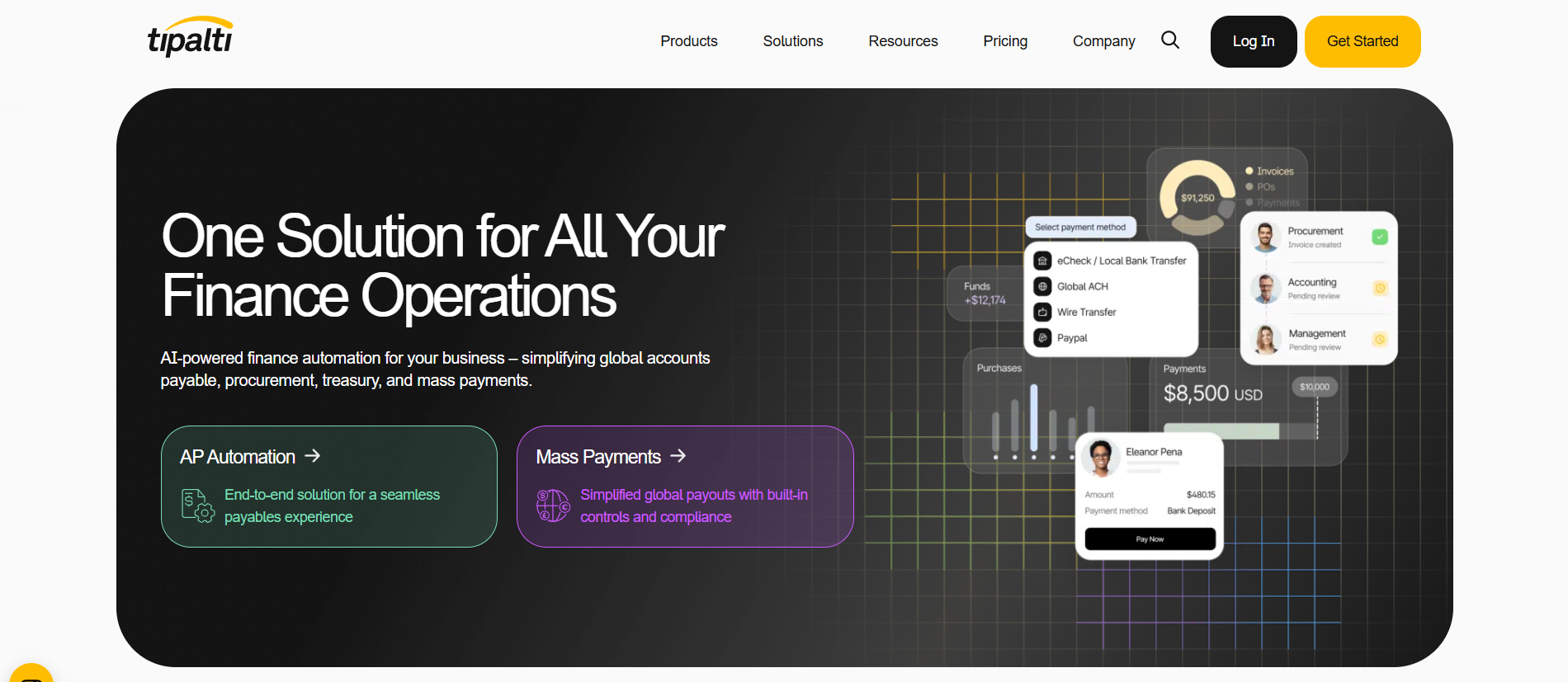
Tipalti pairs procurement and AP with global payments across 200+ countries and 120 currencies, plus a tax compliance engine handling W-9 and W-8 collection and 1099 reporting. It suits mid-market teams that want fast setup and strong payment automation.
Key features:
- Procure-to-pay with global payments
- Payments across 200+ countries and 120 currencies
- Built-in tax compliance and 1099 reporting
- Invoice capture and approval workflows
- Supplier onboarding portal
- ERP integrations
- Payment reconciliation
- Published entry pricing
Pricing:
Platform fee from about $99 per month, plus charges based on transaction volume.
Pros:
- Strong global payments and tax compliance
- Published entry pricing and fast setup
Cons:
- Lighter on strategic sourcing than the enterprise suites
- General payments, not freight-native carrier audit
"Tipalti's intuitive interface simplifies the payment process," with reviewers citing responsive support. See the Tipalti reviews on G2.
Best Coupa and SAP Ariba alternatives for logistics procure-to-pay
If you are evaluating the big general suites but your spend is freight-heavy, the logistics-native alternatives are worth a direct look.
Freehand
Choose Freehand if carrier sourcing and freight payables are the core of your procurement, not office supplies. It connects freight sourcing to audit and payment, enforces negotiated rates at invoice time, and resolves exceptions autonomously, which a general suite built for indirect spend will not do out of the box.
Corcentric
Choose Corcentric if you want a source-to-pay suite with payments and AP depth and a managed-service option, from a provider with finance and transportation heritage. It sits between the pure enterprise suites and the freight-native tools.
{{brown-cta}}
How to choose the right procure-to-pay software
The decision starts with what kind of spend dominates and how much of it is freight:
- If your spend is mostly indirect and all-category, a general source-to-pay suite fits.
Coupa and SAP Ariba lead for large enterprises, Ivalua for configurability, and GEP SMART when you want procurement and supply chain unified with advisory support.
- If freight and carrier spend is the core problem, a general suite treats it as a line item.
Freehand sources, audits, and pays freight in one system and enforces the negotiated rate at invoice time. Corcentric adds payments and AP depth with managed services.
- If you are mid-market or payment-led, Tipalti gives published pricing and global payments, and Basware leads when AP automation and e-invoicing compliance are the priority.
One question settles a lot of it: do you need a procurement suite for everything, or freight procure-to-pay that actually understands carrier billing? Match the tool to the spend, then book the right demos.
Frequently asked questions
What is procure-to-pay software?
Software that manages buying from requisition through payment: POs, invoice matching, approvals, and supplier payment in one connected flow, synced to your ERP.
Procure-to-pay vs source-to-pay, what is the difference?
Procure-to-pay covers execution from PO to payment. Source-to-pay starts earlier, adding strategic sourcing, supplier onboarding, and contract management before the buying cycle.
What is the best procure-to-pay software for logistics teams?
It depends on spend mix. Freehand fits freight-heavy procurement, while Coupa, SAP Ariba, and Ivalua lead for broad indirect spend across all categories.
How much does procure-to-pay software cost?
Most enterprise suites use custom pricing tied to modules and spend volume. Mid-market tools like Tipalti publish an entry platform fee from about $99 per month.
Does procure-to-pay software integrate with my ERP?
Yes. Leading platforms offer native or API connectors to SAP, Oracle, NetSuite, and Dynamics, so POs, invoices, and payments sync without manual rekeying.
Can procure-to-pay software handle freight and carrier spend?
General suites treat freight as a line item. Freight-native platforms like Freehand source carriers, enforce rate contracts, and audit freight invoices inside the same system.
The bottom line for 2026
If freight and carrier spend drive your procurement, start with Freehand, and look at Corcentric for payments depth.
If you need a general suite for all-category spend, Coupa, SAP Ariba, and Ivalua lead, with GEP SMART for unified supply chain and Tipalti for mid-market payments.
Match the platform to your spend mix and your ERP, then book the right demos.
Want to see freight sourcing, audit, and payment in one autonomous platform? Book a Freehand demo.
Conflict of interest disclosure:
This guide is published by Freehand, a platform included in this comparison. We applied the same criteria to every platform, ranked Freehand first on fit to logistics procurement while stating openly that the general suites have broader indirect-spend depth and deeper procure-to-pay reviews, labeled vendor-claimed figures, and invite you to score each vendor independently.
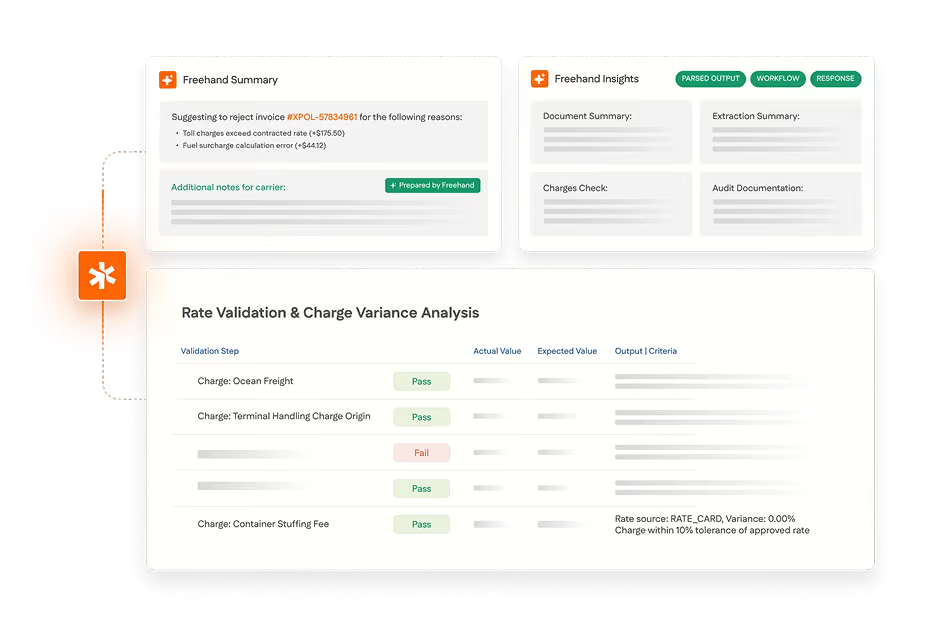
Every Freight Charge Checked Against the Contract, Not Just the PO.
Freehand audits freight invoices against carrier agreements and accessorial rules, catching what PO matching alone misses.
Procure-to-Pay Closes the Loop on Process. Not on the Invoice Amount.
A P2P platform matches the PO to the invoice. It doesn't know if the freight accessorial on that invoice was ever supposed to be billed.
Every warehouse. Every provider. Every mile.
Gartner's 2026 outlook on logistics outsourcing, and how AI Teams hold every contract to the terms you agreed.
- Where outsourced logistics quietly loses margin
- Why billed charges drift from the contract
- How AI Teams close the gap